STEM & Learning

Best Walkie Talkies for Kids of 2026

The best part of a kids' walkie talkie is the moment the other one answers — the crackle, then a small voice from three houses down. The worst part is everything before it: battery doors that need a screwdriver, buttons a seven-year-old can't press with cold hands, and a long-range claim that dies at the fence line. I've handed these to kids from four to ten, and the pattern holds: the set that gets played with is the one a kid can pick up cold and use without asking an adult for help. What you're really buying is a few hours of independent play instead of a tantrum over a dead battery.

My team and I spent four months with 16 sets, and the ones that made the cut were the least complicated to run. Fair warning: advertised range is measured over open water, so through a house or a hedge you'll get a fraction of it — and a privacy code doesn't make a channel private, it just quiets other people's chatter. The picks below are the pairs worth handing over.

#1

Inspireyes Rechargeable 3-Pack

Inspireyes Rechargeable 3-Pack

Everyday outdoor play

Doodle Score 9.2/10
Check Price

Worth Noting

  • Build quality varies from unit to unit
Weight
3.07 oz
Battery
Rechargeable, 48 hours claimed
Channels
22
Claimed Range
3 miles
Read the full review

Batteries are where most kids' walkie talkies quietly die: three or four cells per handset, a child who never switches off, and a set that's flat by the second afternoon. This Inspireyes three-pack is our top pick largely because it deletes that whole conversation. Each handset runs on a built-in 3.7-volt lithium polymer pack rated at 48 hours of use, and the box includes three USB-C charging cables, so the evening routine is plugging three radios in rather than raiding the kitchen drawer.

What's left is a genuinely usable toy radio. Twenty-two channels, a claimed three miles in open ground, and an 87-gram body a five-year-old can hold one-handed — we like that the weight sits closer to a bar of soap than to the chunky plastic bricks this category usually produces. The backlit screen helps when they're out past dusk, VOX gives them a hands-free mode while they're running, and the flashlight gets used far more than the radio does.

Durability is the part we can't promise. Most sets shrug off a tumble down the stairs; a few come apart inside a month, and that spread is wide enough that we treat it as the risk you take. Buy it for a household that will actually keep three radios charged — a parent taking the third handset is what makes the range worth having, since three miles is an open-field number and a house, a hedge, and a hill will cut it to a fraction of that.

Bottom line: Our pick for most families: three rechargeable handsets that fit small hands, so the set stays in use instead of sitting in a drawer waiting for batteries.

#2

Retevis RT628 2-Pack

Retevis RT628 2-Pack

Cheap first pair

Doodle Score 9.0/10
Check Price

Worth Noting

  • Six AA batteries to keep fed
  • Antenna is the weak point in a drop
Weight
3.5 oz
Battery
3 AA per handset
Channels
22
Claimed Range
1 km
Read the full review

The cheapest pair here, and the one we hand to a grandparent who wants something simple for the yard. You give up surprisingly little: 22 channels, 121 CTCSS privacy codes — more than several pricier sets on this page — ten call tones, eight volume steps, and a keypad lock that stops a four-year-old wandering off the channel mid-game.

Range holds up for what this is. A kilometre is the claim, which in practice means the yard, the street, and maybe the far end of a small park: enough for hide-and-seek and bike loops, not enough for a kid three streets away. The sound stays clear at that distance, and the antenna is the part to watch, because it's what gives way when a radio goes down hard on concrete.

The real cost is batteries. Three AA per handset, six in total, and two kids who leave them switched on will flatten a set of alkalines faster than you expect, so buy a bulk pack and keep spares in the drawer. For a first pair, a second set for cousins, or something to leave in the car, that trade is worth it. The 3.5-ounce body and 6.2-inch shell are also among the easiest here to grip with two hands.

Bottom line: Two simple radios for backyard games and the best value in this group, as long as you keep a pack of AA batteries in the drawer.

#3

WisHouse M8 4-Pack

WisHouse M8 4-Pack

Four kids at once

Doodle Score 9.0/10
Check Price

Worth Noting

  • No batteries and no charger in the box
  • A dead handset turns up in some sets
Battery
Not included, no charger
Channels
22
Handsets
4
Claimed Range
5 miles
Read the full review

Four handsets is the entire argument. Three kids and a parent, or four kids and no argument about whose turn it is: that's a problem the three-packs here can't solve, and this set adds 22 channels, a claimed five miles, a flashlight on every unit, VOX, lanyards, and belt clips. The colors are loud in the way kids like, and each radio takes a lanyard, which is the difference between a radio that comes home and one that stays in the grass.

Then the box turns out to be the catch: no batteries, no charger. You're buying cells for four handsets before anyone presses a button, which is a real addition to the cost and a lousy surprise on a birthday morning. Range is the usual optimistic figure and won't survive a suburb, and while most units work as they should, a dead handset in the box is the failure that stings most with a set this size. If rechargeable matters more than the fourth radio, this maker sells a three-handset version with batteries and a charging cable included.

Bottom line: For four kids, or a family that wants a spare in the drawer, this is the set to buy — just put batteries on the same order.

#4

eKids Super Mario 2-Pack

eKids Super Mario 2-Pack

Preschool indoor play

Doodle Score 9.0/10
Check Price

Worth Noting

  • Single channel picks up other radios
  • Quiet speaker in some units
Battery
4 AAA (included)
Channels
1
Claimed Range
750 feet
Read the full review

Mario on one radio, Luigi on the other, and a single big push-to-talk button between them. That's the pitch, and for a three- or four-year-old who wants to be Mario more than he wants a radio, it's enough. Batteries are in the box, so it works the moment it's unwrapped, and the wrist strap keeps it attached to a small person.

What it doesn't do is much beyond that. One channel, no privacy codes, so it will pick up other radios and, in the wrong building, other people's conversations. Range is a house and a yard, the speaker is quiet enough that a kid at the end of the garden may not hear you over the hose, and a set that arrives dead isn't unheard of.

None of that disqualifies it, because the job is different. For a preschooler still learning to hold a button down and wait, the personality and the simplicity are worth more than 22 channels, and this is the one set here a three-year-old can run without coaching. Once they're six and want to reach the neighbor's yard, move them up to something with channels and a keypad lock.

Bottom line: The best first radio for a Mario-obsessed preschooler: one button, batteries in the box, and no channel menu to get lost in.

#5

YUSSBCU Video 2-Pack

YUSSBCU Video 2-Pack

Indoor video calls

Doodle Score 9.0/10
Check Price

Worth Noting

  • Short range, room-to-room at best
  • Two-hour battery per charge
Video
Built-in camera and screen
Battery
650 mAh rechargeable
Channels
1
Claimed Range
400 m outdoors
Read the full review

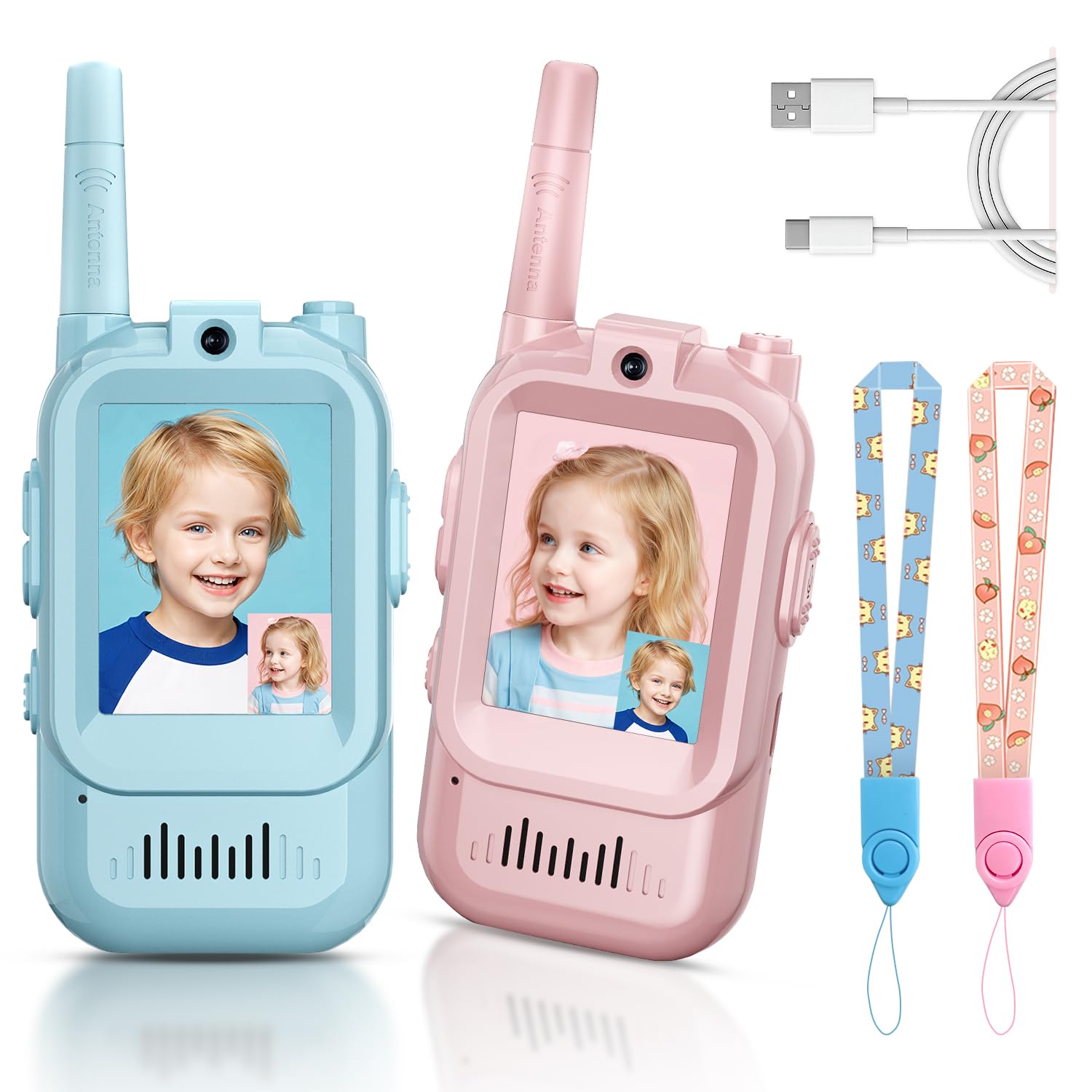
A camera and a screen in each handset, so the kids can see each other while they talk: that's a trick none of the other sets here can pull off, and for a certain kind of seven-year-old it's the difference between a toy that gets used and one that gets shelved next to the scooters.

The catch is that it isn't really a walkie talkie. The link is a 2.4 GHz connection on a single channel rather than an FRS radio, the range is quoted as 100 m indoors and 400 m in the open, and a couple of interior walls is where the picture starts to break up. The built-in 650 mAh battery is quoted at two to two and a half hours of continuous use, which is a session, not a day.

So buy it for indoor play, video-call novelty, and the voice-changer modes that have no practical purpose and get used constantly. Don't buy it for the kid who wants to ride to the end of the street with one in a backpack; the Inspireyes set goes further, lasts longer, and comes back charged for the next day.

Bottom line: Buy it for the screen appeal and indoor play; it's a video intercom toy, not the set for a kid roaming the neighborhood.

#6

SANJOIN 3-Pack

SANJOIN 3-Pack

Drop-prone preschoolers

Doodle Score 8.8/10
Check Price

Worth Noting

  • Twelve AAA batteries, none included
  • Sound turns tinny at distance
Battery
12 AAA, not included
Channels
22
Handsets
3
Claimed Range
3 km
Read the full review

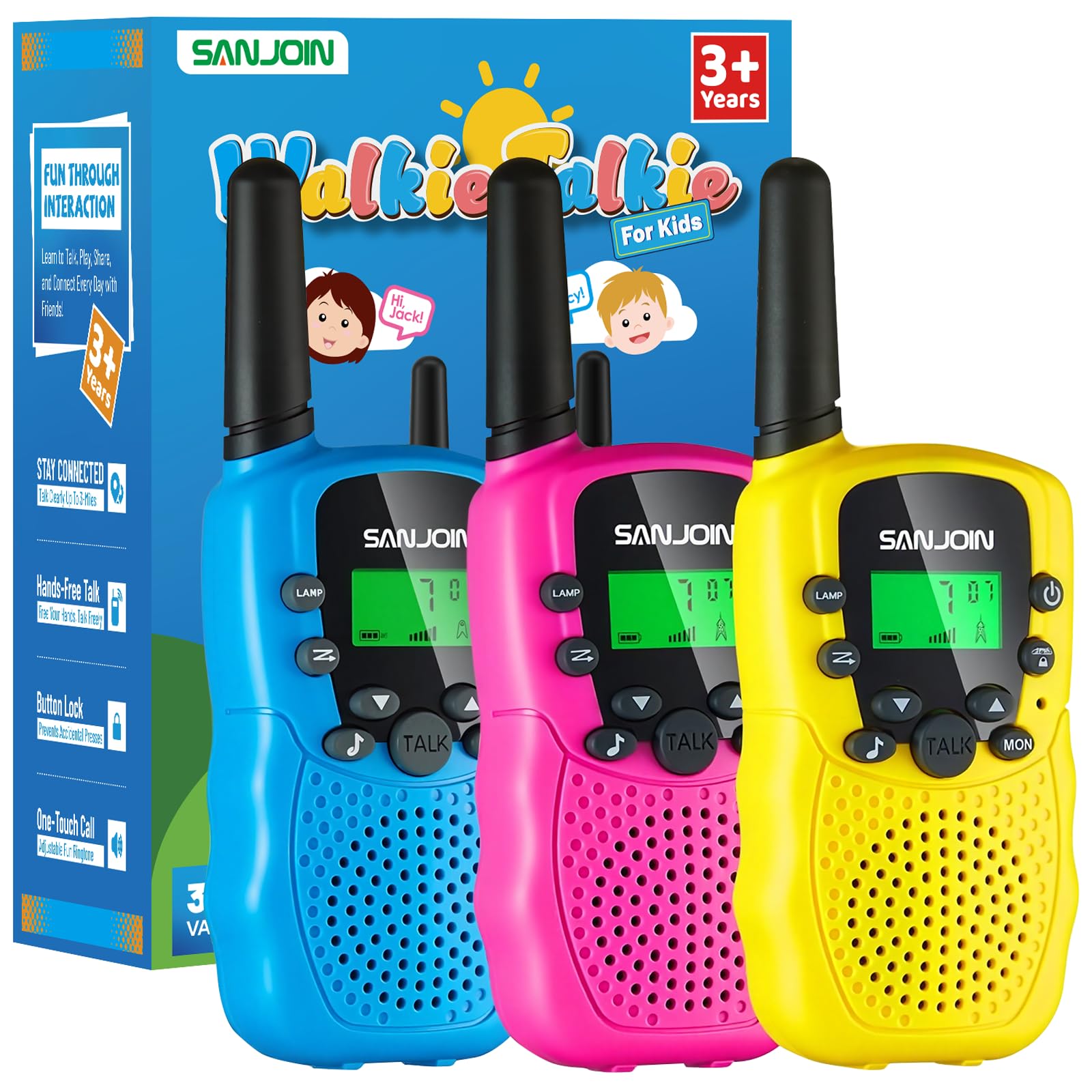
Most toy radios here are sold on range. This one is sold on surviving: the listing claims ASTM F963 compliance, non-toxic ABS, and a 1.5 m drop rating, plus a two-year warranty. That's the sort of thing that matters when the set is going to a three-year-old who drops everything on the patio.

In use it behaves like a normal 22-channel UHF toy: simple push-to-talk, a keypad lock that younger kids can't undo, three colors so each child has theirs, and a 3 km claim. Two things stood out. The sound thins out and goes tinny once the kids are at opposite ends of the yard, and the appetite for batteries is the worst in this group — four AAA per handset, twelve in the box, none of them included.

Buy it if toughness and a warranty matter more than audio quality, and put a bulk pack of AAA on the same order so the first afternoon isn't cut short. If your kids are careful with toys and you'd rather the sound held up at distance, the Retevis pair does that for less and only asks for six cells.

Bottom line: A three-pack for kids who treat toys like projectiles; the drop rating and warranty are why it earns a place, not the audio.

#7

Aikmi Camo 2-Pack

Aikmi Camo 2-Pack

Camo army play

Doodle Score 8.6/10
Check Price

Worth Noting

  • Costs more than most sets here
  • Battery compartment is hard to open
Battery
3 AAA per handset
Channels
22
Claimed Range
3 miles
Water Resistance
IP65 rated
Read the full review

Camouflage, a flashlight, and a name that sounds like a mission: this is the pair for the kid who plays soldier in the garden. Twenty-two channels, a three-mile claim, VOX, a screen lock, lanyards, belt clips, and a genuine two-year manufacturer warranty, which is more cover than most of this group offers.

They're smaller than the photos suggest — about five inches tall and two wide, roughly palm-sized. That's an advantage for a five-year-old and a letdown for a nine-year-old expecting a proper radio, so match the size to the child rather than to the theme.

Performance is fine but not exceptional. In the open the range is good; through houses and trees it's a backyard toy like everything else here. Sound is clear up close and scratchy with distance, and a handset that arrives dead is the thing that ruins a birthday. The battery door is the fiddly bit: three AAA per unit, and the compartment takes some persuasion to seat and close, which is an adult job the first few times.

So our advice narrows to this: pay the premium when the theme is what gets the set used, because the finish and the warranty are the reasons to choose it. If it's going into a camping bag rather than a costume box, the cheaper Retevis pair does the same radio work and won't ask you to fight a battery door.

Bottom line: Buy it for the army-play kid rather than the spec sheet: the camo, flashlight, and two-year warranty are the case, and the radios inside are merely fine.

How We Picked and Tested the Best Walkie Talkies for Kids

We started with every set actually marketed to kids — not adult radios with a cartoon sticker slapped on — and narrowed to 16 based on price, recommended age, and how the battery compartment opened. Anything that needed a screwdriver and an adult got cut early, as did sets where you had to dig through a menu just to find a channel.

Testing ran four months, in backyards, through two-story houses, on bike rides around the block, and in the back seat on a couple of road trips. We handed the sets to kids between four and ten and then mostly stayed out of it, which is the only honest way to learn whether a press-to-talk button is reachable with small thumbs or whether the speaker is loud enough to hear over wind. We measured range ourselves, walking apart until the signal broke up, and did it twice each time — once across an open field, once with a house and a hedge in the way.

Durability got tested the way kids test it: dropped on pavement, clipped to a belt and swung around, left in damp grass overnight, and shoved in a backpack next to a water bottle. We timed battery life on a fresh set of AAs and again on rechargeables, since a dead walkie talkie on a Saturday morning is what ends the game. And we watched whether kids came back to a set after the novelty wore off — the ones with clear sound and two or three obvious buttons got picked up again, while the twelve-feature models with a fiddly dial stayed at the bottom of the toy bin.

How to Choose Walkie Talkies for Kids

How Many Handsets, and Who Keeps Them Charged

Two handsets is two kids, three is two kids and a parent, and four is a whole afternoon of nobody being left out. The battery decision matters more than the count. A non-rechargeable set takes three or four cells per handset, so a four-pack can want a dozen cells or more before the first game — check that before you order, not after. If the child leaves a radio face-down and switched on, pay for a rechargeable set; if it lives in a camping box for occasional weekends, AA is easier to revive with a fresh pack.

What the Range Number Actually Means

A kilometre, three miles, five miles — these are open-ground figures measured with nothing in the way. Put a house, a hedge, a hill, or a body between the two radios and you get a fraction of it. A one-kilometre set and a five-mile set behave much the same across a backyard, so don't pay a premium for the bigger number; pay it for the batteries, the build, or a warranty. If your child needs to reach you three streets away, this whole category is the wrong tool.

Channels, Locks, and Other People's Conversations

A 22-channel radio with privacy codes lets you move the kids off a channel that's picking up a baby monitor or another family at the campsite; a single-channel character set has nowhere to go. That's fine indoors and maddening on a busy weekend. The other half of the equation is a keypad lock, which stops a small person changing the channel by accident and then insisting the radio is broken. If more than one set will be in play — cousins, neighbors, a scout group — buy the 22-channel kind.

Size, Buttons, and Surviving the Drop

Weights here run from 87 grams to nearly half a pound, and the difference is obvious in a six-year-old's hand. For a three- or four-year-old, the right radio is one big push-to-talk button, no menu, and a strap or clip that keeps it off the ground. An older child can handle a keypad and a channel display. Look for a stated drop rating or a real warranty rather than the word durable in the marketing copy — and check that the belt clip actually grips, because that is what saves the radio.

Frequently Asked Questions

Final Verdict

If you're buying one set this year, make it the Inspireyes three-pack. It's the only pick here that pairs a rechargeable battery with three handsets, real 22-channel range, and a body light enough for a five-year-old — which is why it gets used after the first weekend instead of living in a drawer. On a tight budget, the Retevis pair covers backyard play for less and asks only for AA batteries. And if there are four kids in the game, the WisHouse four-pack is the one that keeps everyone holding a radio.