STEM & Learning

Best Kids Cameras of 2026

Handing a kid a camera is an act of faith. You picture the birthday party photos and the worm on the sidewalk, then the camera face-down on the driveway. A good kids camera survives that drop and is simple enough that they keep using it — the wrong one has tiny buttons, blurry pictures, and a menu that makes a 6-year-old hand it back. Over the past four months, we've put 14 kid cameras through backyard photo shoots, road trips, and more than a few drops on concrete.

What separates the keepers from the drawer clutter isn't a spec sheet. It's whether a small hand can grip the body without fumbling, whether the shutter responds on the first press, whether it looks like a real camera, and whether the pictures are good enough to print. We also paid attention to battery life — a camera that dies halfway through a playground session kills the fun — and to how each one held up after weeks in a backpack. The picks below are the ones my kids reached for on their own.

#1

Cimizi Dinosaur H33

Cimizi Dinosaur H33

Dinosaur fans

Doodle Score 9.2/10
Check Price

Worth Noting

  • Only an 8GB card included
  • Can freeze during play
Lenses
Dual lens (selfie and rear)
Screen Size
2 inches
Included Storage
8GB card
Stated Battery Life
3 to 4 hours
Read the full review

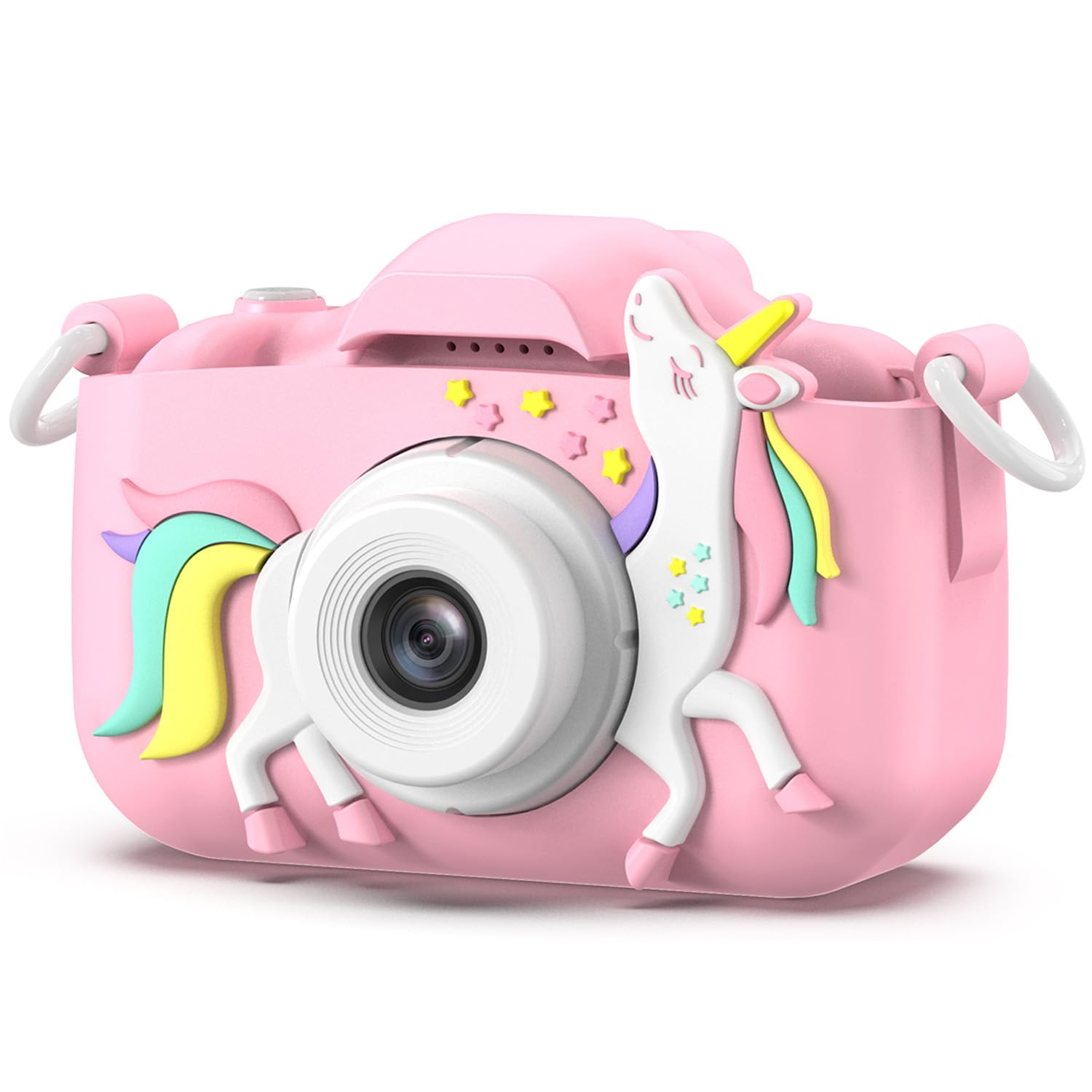
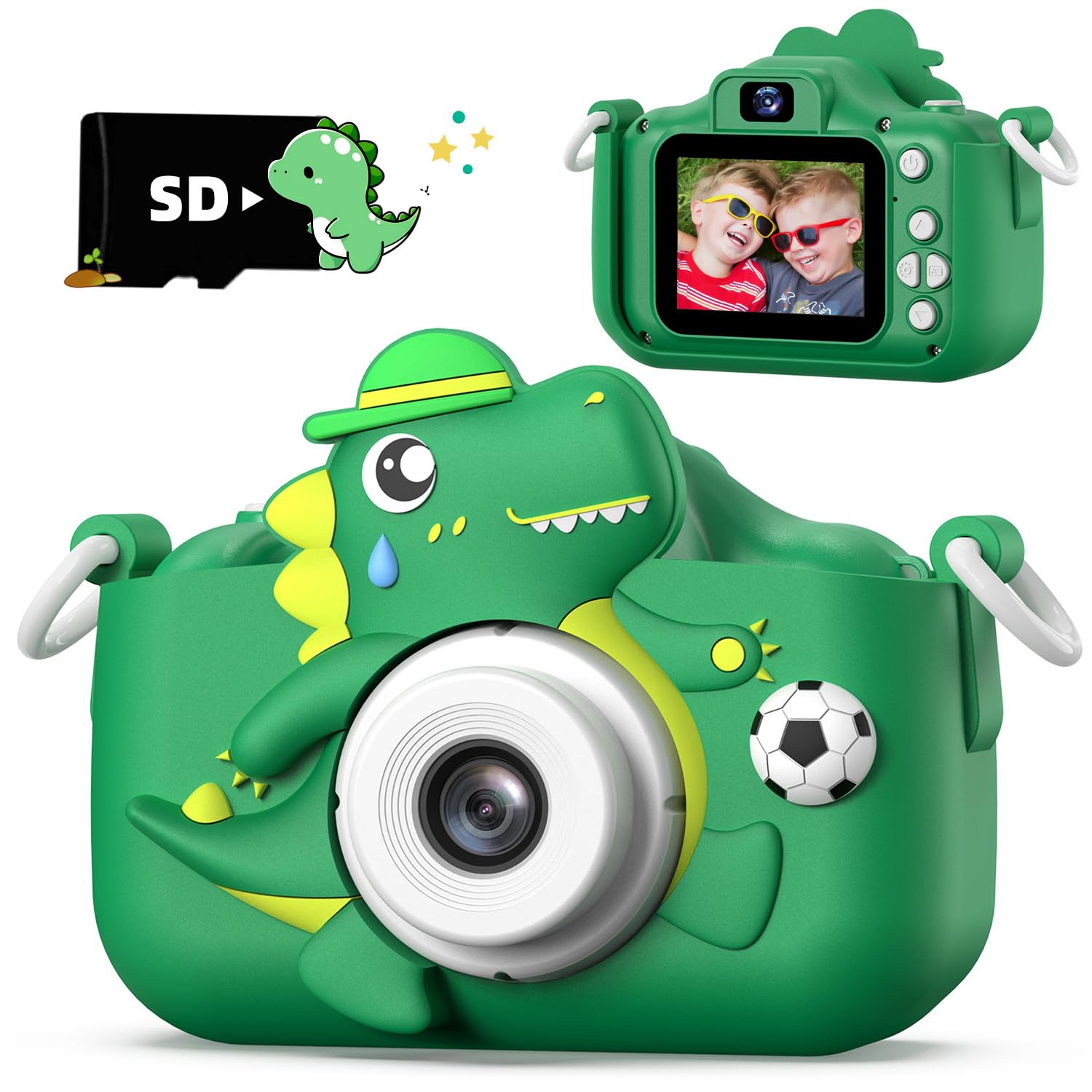
The dinosaur-shaped silicone case is doing a lot of work here. It's the version of this camera a four-year-old reaches for, and the molding gives small hands something to grip that a flat rectangle doesn't.

The selfie lens is the feature that gets used. Kids point it at themselves, at each other, at the dog, and a front camera makes that possible without turning the camera around and guessing at the framing. Add 28 frames, 6 filters and 3 puzzle games and you have a camera designed around the way children actually play with one.

Battery is claimed at 3 to 4 hours of shooting, enough for a car trip, and the screen is a standard 2 inches. Nothing here is premium, and nothing here feels flimsy either.

What holds it back is the box and the occasional glitch. The card is 8GB — fine for photos, tight once video starts — and the play modes can freeze mid-game, which is worth checking before a long journey. Worth a look if the dinosaur is what gets the camera picked up off the shelf; otherwise the Desuccus does the same job with four times the storage.

Bottom line: A dinosaur case and a selfie lens a four-year-old will actually use, though the 8GB card is the smallest here and the extras are novelty first.
#2

ESOXOFFORE Instant Print

ESOXOFFORE Instant Print

Instant prints

Doodle Score 9.0/10
Check Price

Worth Noting

  • Only black-and-white prints
  • Heavy, boxy body for small hands
Weight
13.8 oz
Charging
USB-C
Print Type
Black-and-white thermal
Screen Size
2.4 inches
Read the full review

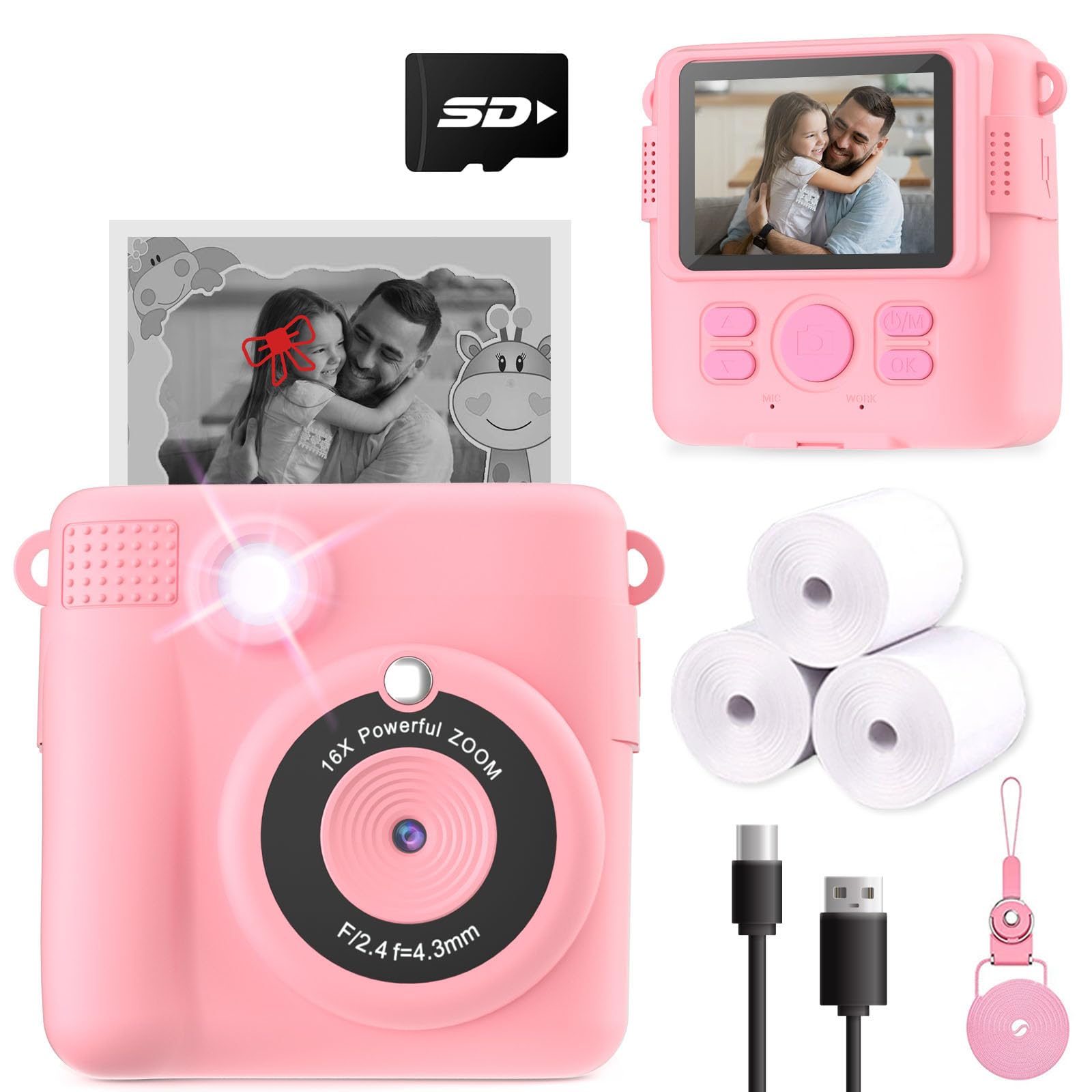
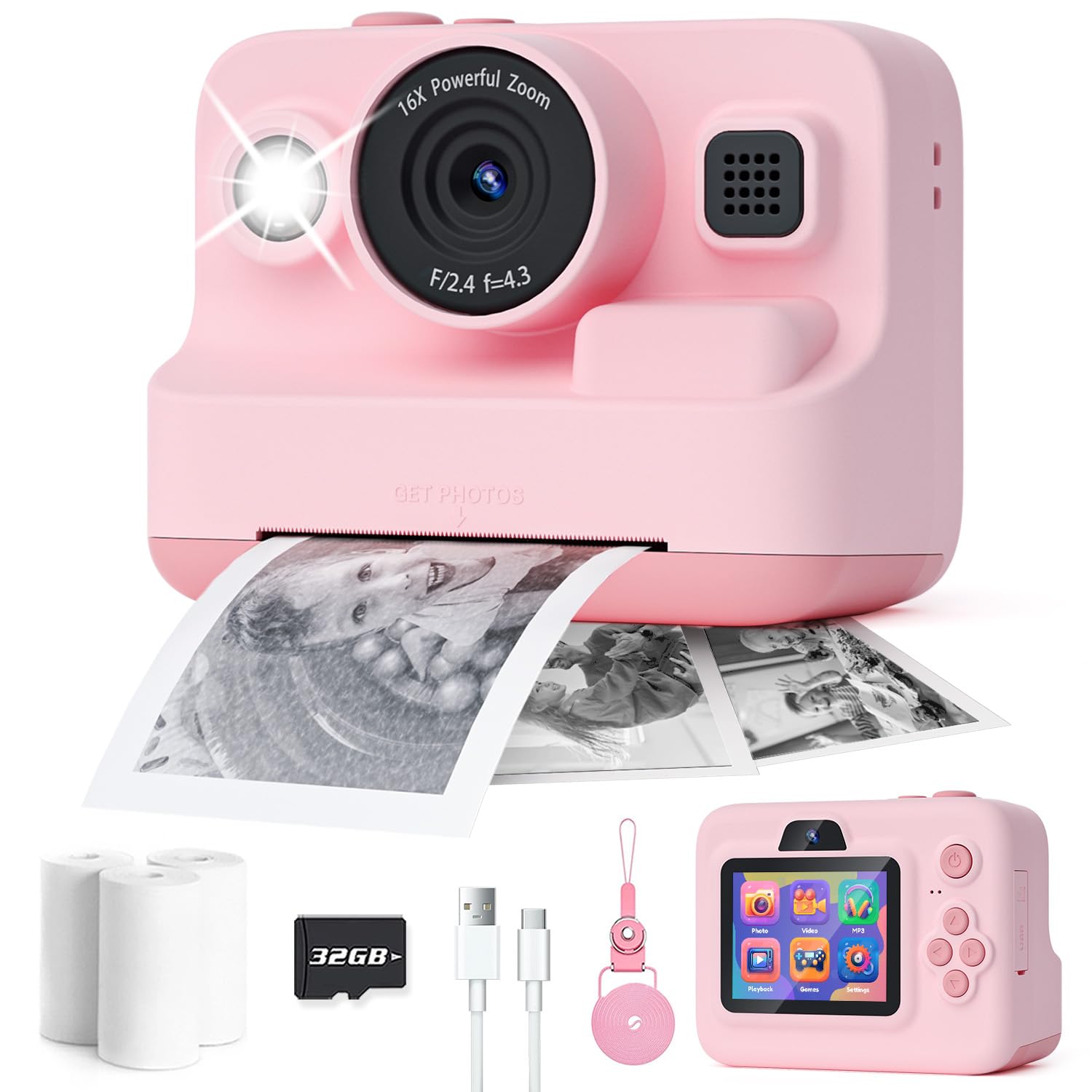
A whirr, a second of waiting, and a strip of paper comes out of the top of the camera. That's the trick the ESOXOFFORE does, and it's a better trick than any menu of filters — a five-year-old will take a photo specifically to watch it print, then take another one to make sure.

Underneath the printer it's a proper digital camera: 1080p video, 16x digital zoom, filters, time-lapse and a few games, all driven from a 2.4-inch screen that is the largest of the printing models here. Charging is over USB-C, which we've come to treat as a minimum requirement in a house with one cable drawer and three children.

The paper is thermal, so there's no ink and nothing to refill — the photographs stay on the card and the printer turns out a black-and-white image with the contrast of a pencil sketch, which reads as charming rather than broken. What you also get is a camera that weighs just under a pound and stands taller than the toy cameras here, so it lives in a backpack rather than a coat pocket.

Run a test print on the first day. Blank or streaky output is the fault to catch while the return window is open, and it's much easier to sort out in week one than in week six.

Bottom line: Buy it if the print is the fun: a photo lands in your child's hand about a second after the shutter, with no ink to buy.

#3

Dylanto BLL2

Dylanto BLL2

Long days out

Doodle Score 9.0/10
Check Price

Worth Noting

  • Bulkier than the pocket-sized picks
Print Type
Black-and-white thermal
Battery Capacity
2000 mAh
Included Storage
32GB card
Stated Battery Life
4.9 hours
Read the full review

The figure that got our attention is the battery: 2000mAh and a claimed 4.9 hours of shooting, roughly double what the other printing camera here claims. A kids camera that dies at the beach is a camera that stays home, so this is the printing model we pack for a day out rather than a party.

The split between what gets printed and what gets kept is the clever part. The printer puts out a black-and-white strip on BPA-free thermal paper, no ink involved, while the full-color file goes onto the 32GB card. Kids stick the strip to a wall; you keep the actual photograph, which is the arrangement most families end up wanting.

Everything else is standard for the type and none the worse for it: a 2.4-inch screen, 1080p video, 16x digital zoom, Type-C charging and a claimed 12MP still. The paper has to sit square in the feed — when it doesn't, prints come out streaked — so load it with the child watching rather than fixing it quietly later.

For a five- to eight-year-old who wants the print more than the picture, this is the better of the two printing cameras here. Younger than that, the bulk and the paper handling get in the way, and the plain pocket cameras suit them better.

Bottom line: The printing camera for a full day out: a bigger battery, BPA-free paper, and color files saved to the card while the strip prints.

#4

goopow H11

goopow H11

Ages 3 to 5

Doodle Score 9.0/10
Check Price

Worth Noting

  • Short 1.5 to 2 hour shooting time
  • Small screen for reviewing shots
Weight
3.7 oz
Dimensions
4.17 x 2.71 x 1.88 inches
Screen Size
2 inches
Included Storage
32GB card
Read the full review

At 105 grams and about four inches across, this is the lightest camera here. That isn't a spec-sheet footnote. It's the difference between a toddler carrying a camera around their neck for an afternoon and a toddler putting it down after ten minutes because it pulls.

The soft molded cartoon cover is the other half of the idea. It's padding rather than a hard shell, and it means the camera goes into a bag with the snacks without a case around it. We take this over a better sensor for a three-year-old every time: the camera that survives the first month gets used, and the one that doesn't becomes a lesson about expensive gifts.

Inside it's the usual package — a 2-inch screen, a 32GB card in the box, a lanyard, photo frames, a few games and a claimed 1080p video. The built-in battery is good for something like an hour and a half of continuous shooting, which is roughly one outing. The size cuts both ways: it's smaller than the listing makes it look, and a five-year-old will notice the screen more than a three-year-old will.

Bottom line: The one for a three- or four-year-old: 105 grams, a soft padded cover and a lanyard, so a drop is a bounce rather than a tragedy.

#5

Desuccus X2

Desuccus X2

First camera

Doodle Score 8.8/10
Check Price

Worth Noting

  • Small 2-inch screen for reviewing photos
  • Soft, grainy indoor shots
Weight
5 oz
Charging
USB-C
Screen Size
2 inches
Included Storage
32GB card
Read the full review

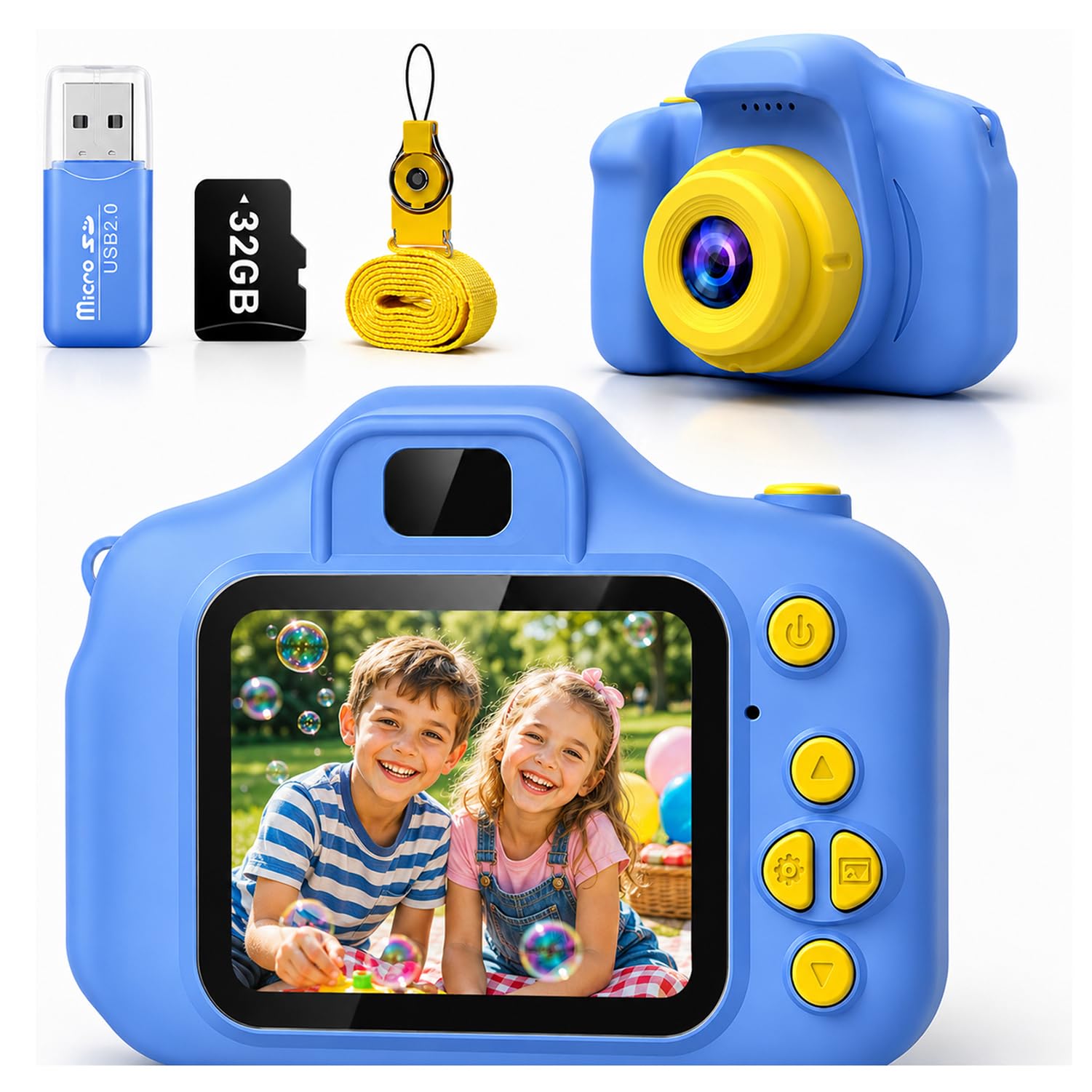
The camera we hand over first is this one. Not because it looks special — it's a small blue rectangle with a 2-inch screen and a ring of chunky buttons — but because it's the one where a child stops asking for help fastest. The menu is a single loop: shutter, mode, playback, games. Nothing in it requires reading.

Open the box and everything needed to actually use it is there: a 32GB microSD card, a card reader and a USB-C cable. That last detail matters more than it sounds. The camera charges off the same cable as half the house, so a dead battery on a Sunday morning isn't a hunt for a proprietary plug. The built-in 1000mAh cell is good for a day out as long as the child isn't filming everything in sight.

Picture quality is the honest floor of this category. Bright outdoor shots come back recognizable, indoor ones go soft and grainy quickly, and we stopped judging it against a phone after about a day. The 15 frames and 6 filters are the feature that earns its keep here: a five-year-old will take twenty more photos of the dog if each one comes out with a star border on it.

It's small, and smaller than the listing photos suggest — which suits the hands it's for and frustrates the adult reviewing shots on that 2-inch screen. If you want a bigger viewfinder, the Camkory gives you three inches. For a first camera, small is the right answer.

Bottom line: Our default pick: a four-year-old can take, review and keep photos without help, and the card and USB-C cable come in the box.

#6

YEEHAO DHC-LCL5

YEEHAO DHC-LCL5

Tight budgets

Doodle Score 8.8/10
Check Price

Worth Noting

  • Battery falls short of the listing's claim
  • Power faults can appear early
Case
Soft silicone cover
Lenses
Dual lens (selfie and rear)
Screen Size
2 inches
Included Storage
32GB card
Read the full review

If the camera is going to a three-year-old who drops things, the case matters as much as the sensor. The YEEHAO arrives wrapped in a soft silicone cover with the padding built into the design rather than sold as an extra, and that is most of why it's on this list at all.

The rest of the spec sheet is generous for the money: a dual lens so kids can take selfies without turning the camera around, 16x digital zoom, a 2-inch screen, a 32GB card in the box and a lanyard. Claimed 48MP stills are not what this camera delivers — treat that number as marketing and judge it on whether a three-year-old can turn it on, point it and get a recognizable photo.

That's exactly what earns it a place. The buttons are big, the mode switch is one press, and the whole thing fits a small hand without the strap being compulsory. For a first camera that will end up on a driveway, this is the sensible spend, and the money you don't spend here buys the second one when the first goes under a car.

Battery is the weak point. The listing promises hours of shooting; a full day out is optimistic, so charge it the night before. A camera that won't power on at all is the other fault to watch for, so switch it on and shoot a dozen frames before you wrap it.

Bottom line: Spend the least and still get a working first camera: a selfie lens, a 32GB card and a soft silicone case a toddler can drop.

#7

Camkory DC403

Camkory DC403

Older kids

Doodle Score 8.4/10
Check Price

Worth Noting

  • No bumper or case for drops
  • Heaviest and boxiest body here
Weight
5.6 oz
Batteries
Two, with charger
Screen Size
3 inches
Included Storage
32GB card
Read the full review

Three inches is the biggest screen here, and it changes how the camera gets used. Instead of squinting at a thumbnail, a kid frames the shot, checks it and takes another — which is most of what learning to take photographs actually is.

It's a point-and-shoot rather than a rubberized toy: 44MP stills claimed, 1080p video, 16x digital zoom, a lanyard, a storage bag, two batteries with a charger, and a year of warranty. The two-battery arrangement is the detail we appreciate most. One charges while the other sits in the camera, so a flat battery stops being the end of the afternoon.

Hand this to the eight- or nine-year-old who has outgrown the cartoon cases and wants the camera the older kids have. It looks and behaves like a grown-up camera, which is the entire appeal, and the bigger screen makes the photos worth looking at rather than just taking.

What it doesn't have is armor. There's no silicone bumper, it's the heaviest camera here at just under 160 grams, and a drop onto concrete is a real drop. The pictures have a deliberately lo-fi look that children tend to love and parents tend to find grainy.

Bottom line: For a nine-year-old who wants a real camera, not a toy: a three-inch screen, two batteries and a 32GB card in the box.

How We Chose and Tested Kid Cameras

We started by pulling together every kid camera we could find from brands with a track record in kids' electronics, then narrowed the list by size, price, and the controls a preschooler could actually manage. We ended up with 14 models and handed them to families with kids ages 4 to 9 for four months. Each camera went home in a backpack and came back with a memory card full of real photos.

At home and in the backyard, we watched how quickly kids figured out the shutter and the playback buttons without an adult stepping in. On a Saturday morning at the playground, we checked whether the camera survived a waist-high drop onto concrete and whether the battery still had a charge after an hour of shooting. During a weekend road trip, we had kids take photos through the car window and then reviewed the images on a laptop to see how much detail held up — faces, signs, the dog's fur. We also printed a handful of 4x6 shots from each camera to judge whether the pictures were worth keeping or just a blurry mess.

Back in the kitchen, we compared what each camera offered for the money — not just megapixels, but the strap, the case, and whether the menus were in plain language. We noted which ones felt solid in a small hand and which ones looked like a toy that would crack by week two. After four months of drops, sticky fingers, and one accidental trip through the washing machine, we knew which cameras kept working and which ones started glitching.

How to Choose Kids Cameras

Start with the hands, not the age on the box

A three-year-old needs a shutter button their index finger finds without looking, an obvious on/off switch, and a menu with maybe three screens. A seven-year-old can handle zoom, playback, filters and games, and will be bored by a camera that only does one thing. The age band on the box is marketing; the button count is the real signal.

The test we apply is whether a child can hold it one-handed and reach the shutter without shifting their grip. If they can't, wait a year or pick something smaller — the goopow at 105 grams and the Desuccus at five ounces are the two that pass for a four-year-old.

Judge picture quality by the light, not the number

Toy camera sensors are tiny, and the resolution figures on the box — 44MP here, 48MP there — come from interpolation rather than a bigger sensor. What that means in a living room is soft, grainy shots once the sun goes down, and perfectly usable ones outdoors.

We think the sensible split is a phone for the birthday party and the kids camera for the garden, the walk to school and the holiday. Paying more for a bigger number on the box is the most common way to waste money in this category. Paying more for a bigger screen or a better battery is not.

Decide whether you actually want a printer

An instant print kids camera uses thermal paper rather than ink or film, so the running cost is rolls of paper instead of cartridges. That's cheaper per print than instant film and far cheaper than a real instant camera. The trade is that the prints come out black and white, with roughly the contrast of a pencil sketch.

Whether it's worth it depends entirely on the child. Some will burn through a roll in an afternoon and never look at the digital files. Others take three prints and go back to the screen. If you're unsure, buy a spare roll with the camera and treat the printer as a bonus rather than the reason you bought it.

What the battery figures actually mean

Stated battery life across these cameras runs from a couple of hours to a claimed five, and the claims are optimistic. Video drains a cell far faster than stills, and a camera left powered on in a bag drains it faster still. A built-in cell charged over USB-C is the simplest arrangement and the one most of our picks use.

Charge the night before anything that matters, and treat one day out as the realistic ceiling. If the camera is going to spend weekends away from a socket, look at the biggest stated capacity in the group rather than the smallest body.

Frequently Asked Questions

Final Verdict

The Desuccus X2 is the camera we name first for most families: a short menu, a card in the box, USB-C charging, and a body small enough for a four-year-old to hold one-handed. It's the one that gets used rather than admired.

Step up to the ESOXOFFORE or the Dylanto BLL2 if the print is the point. Watching a photo come out is what makes the hobby stick for a lot of children, and the Dylanto's bigger battery is the better bet for days away from a socket. For a nine-year-old who wants to look like they're using a real camera, the Camkory's three-inch screen is the upgrade that matters.