STEM & Learning

Best Telescope for Kids of 2026

Almost every kids' telescope is sold on the same promise: a picture of Saturn on the box, reachable minutes after opening. What usually arrives instead is a wobbly tube, a finder that points somewhere other than the main lens, and a gray smudge where the rings should be. The difference between the ones that get used and the ones that get shelved is rarely the glass — it's the mount, the finder, and whether a kid can set the thing up without an adult hovering over every knob.

I've spent the past six months with 12 kids' telescopes in my garage, and my two young testers plus a rotating crew of neighborhood kids have run each one through the same after-dinner routine. The keepers all had a steady tripod, a finder that actually matched the tube, and instructions a nine-year-old could follow alone; the rejects are instructive too. One thing I'd tell any first-time buyer: ignore the headline magnification number, because a steady 50x beats a shaky 400x every night, and the good ones aren't automatically the expensive ones. The picks below are the ones I'd hand a kid without a lecture attached.

#1

MEEZAA 80mm Travel Scope
MEEZAA 80mm Travel Scope

Growing young astronomers

Doodle Score 8.8/10
Check Price

Worth Noting

  • Planets stay small without the Barlow
Aperture
80 mm
Included
Backpack and phone adapter
Focal Length
500 mm
Tripod Height
16.92–44.48 in
Read the full review

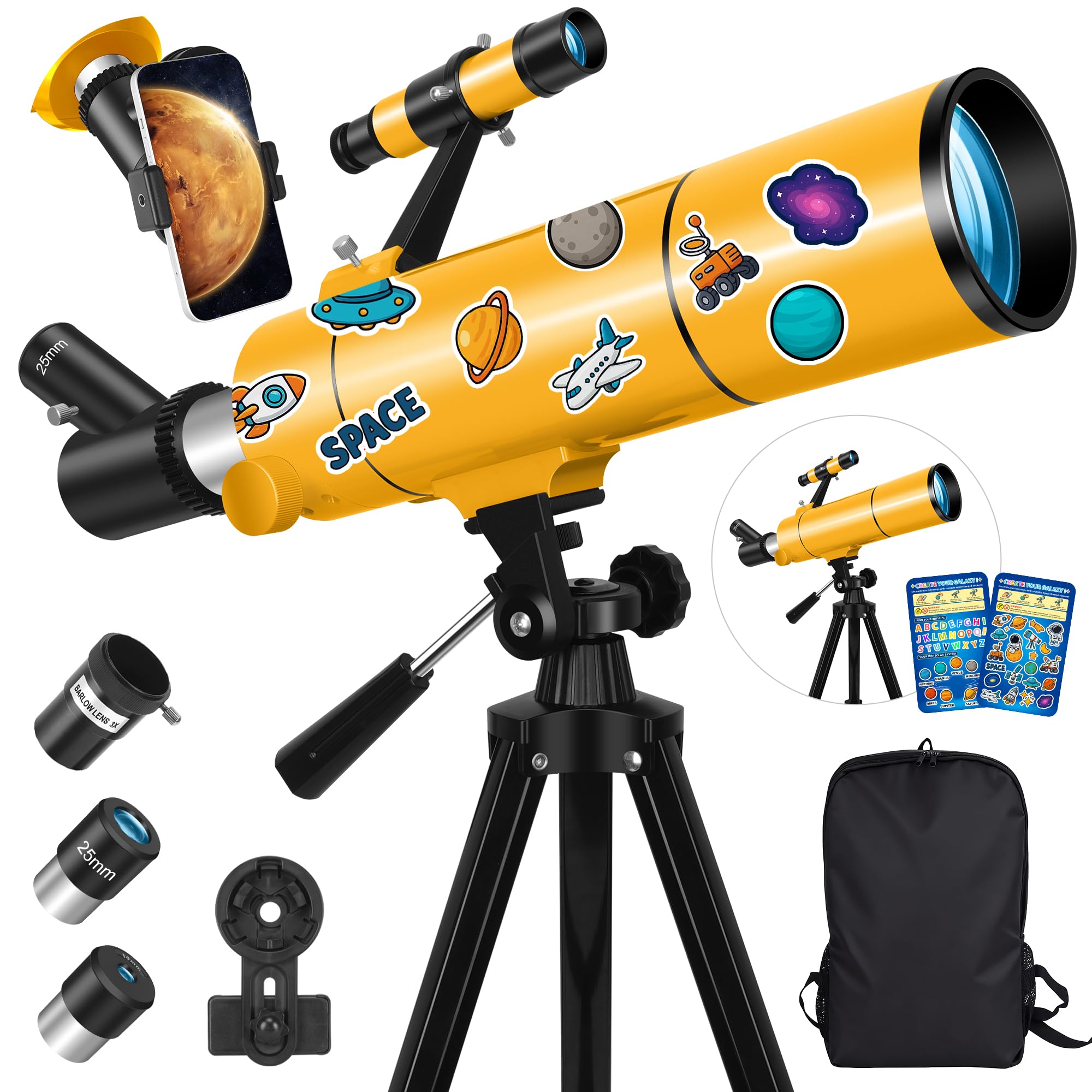
The first thing we notice about the MEEZAA is the aperture: 80mm rather than the 70mm most family scopes start with. That extra glass gives the Moon and bright planets more presence, and it makes the step up from a first look feel worthwhile. The tube is still light enough to carry outside without a second trip.

What we appreciate most is the tripod range. It adjusts from about 17 to 44 inches, which means a seven-year-old can use it low and an adult can stand behind it later. The backpack, phone adapter, and 3x Barlow add real family value. We think it is the better long-term buy for a child who is already asking about Jupiter rather than just the Moon.

The 500mm focal length keeps the tube manageable, but it also means planets are small without the Barlow. The highest power settings need a still night, and the lightweight tripod is happiest when it is not fully extended in a breeze. Tighten the leg locks, start at 20x, and save 150x for the Moon.

Bottom line: If you want more light grasp without giving up the backpack, the MEEZAA's 80mm lens is the best-value step up here for a family that will grow into it.

#2

LeapFrog Magic Adventures Telescope

LeapFrog Magic Adventures Telescope

Screen-first learning

Doodle Score 8.8/10
Check Price

Worth Noting

  • Best for Moon and daytime views
  • Requires 4 AA batteries
Power
4 AA batteries
Screen
2.4-inch video screen
Age Range
5 years and up
Magnification
Up to 110x
Read the full review

Not every five-year-old will press an eye to a small eyepiece and hold still. The LeapFrog solves that with a 2.4-inch screen and a game layer, while still offering a real digital telescope mode with up to 110x zoom. It is the one here built for the child who needs instant feedback.

The 100-plus NASA videos and images are the part we think earns its place. They turn a cloudy night into something to do, and the cosmic cards and spacecraft game give kids a reason to come back. We also appreciate that it works indoors and outdoors, so the learning does not stop when the sky does.

This is not the scope for a child who wants to see Saturn's rings. The digital view is best on the Moon and daytime nature, and the small screen cannot match a good eyepiece for faint detail. It also runs on four AA batteries, so rechargeables are worth keeping on hand. Buy it from a retailer with an easy return policy and test the telescope mode in the first week.

We think that is a fair trade for a five- or six-year-old who needs a screen to stay engaged. The LeapFrog is less a junior astronomer's instrument than a guided space toy that happens to look at the real Moon, and for the right child that is exactly the point.

Bottom line: If your child is more likely to engage with a screen than an eyepiece, the LeapFrog is the kid-first digital telescope that actually gets used.

#3

Gskyer 70mm AZ Telescope

Gskyer 70mm AZ Telescope

All-round first scope

Doodle Score 8.6/10
Check Price

Worth Noting

  • Deep-sky objects stay faint at this aperture
Weight
5.7 lb
Aperture
70 mm
Included
Carry bag, phone adapter, wireless remote
Focal Length
400 mm
Read the full review

The 70mm Gskyer is the scope we point to when a family wants a real first telescope without turning the first night into a project. Its 400mm tube is short enough to handle, the 70mm aperture is large enough to show the Moon's craters and Jupiter's moons, and the altazimuth mount keeps aiming simple. We like that balance more than any single specification: it is small enough to use often and capable enough to reward the effort.

The kit is unusually complete for a beginner. You get a carry bag, a phone adapter, and a wireless remote, so a child can photograph what they see without holding a phone against the eyepiece. We especially like the bag, because a telescope that has a home is a telescope that comes back out. Setup is straightforward, and the adjustable tripod can be kept low for a child or raised for an adult.

Our expectations need to stay in line with the aperture. This is a Moon-and-bright-planets telescope; galaxies and nebulae remain faint smudges, and Saturn is a tiny ring rather than a postcard. The highest useful power also needs calm air and a gentle hand on the focuser. Start with the low-power eyepiece, align the finder in daylight, and move up only after the Moon is sharp.

Bottom line: Our default pick for most families: the 70mm Gskyer is easy to set up, light enough for a child to carry, and the most complete first-scope kit here for the money.

#4

CELTICBIRD 80mm Refractor

CELTICBIRD 80mm Refractor

Lunar detail

Doodle Score 8.6/10
Check Price

Worth Noting

  • Supplied eyepieces top out at 66x
Aperture
80 mm
Included
Backpack and moon filter
Eyepieces
20 mm and 9 mm
Focal Length
600 mm
Read the full review

A longer focal length is the quiet hero of lunar viewing. The CELTICBIRD pairs an 80mm aperture with a 600mm tube, so the Moon fills more of the view than it does through the shorter 70mm scopes here. That extra scale makes craters easier to pick out and gives the whole session a stronger payoff.

The kit stays simple: a 20mm eyepiece for 30x and a 9mm for 66x, plus a moon filter, backpack, and phone adapter. We like the moon filter for a full Moon, which can be bright enough to make a child squint. The backpack is a useful addition rather than a throwaway; it holds the tube and tripod for a trip to a darker spot.

Simplicity cuts both ways. With only two eyepieces, the scope tops out at 66x unless you add a Barlow, so it is not the most flexible high-power kit here. What it does, it does cleanly: the Moon looks sharp, the mount is easy to aim, and there is less for a child to lose. If lunar detail is the goal, that trade is easy to make.

Bottom line: The CELTICBIRD's longer 600mm tube gives the crispest lunar views in this group for the money, and its backpack makes it easy to take outside.

#5

ToyerBee 70mm Travel Scope

ToyerBee 70mm Travel Scope

Small-space stargazing

Doodle Score 8.6/10
Check Price

Worth Noting

  • 150x is a stretch for the short tube
Weight
3.5 lb
Aperture
70 mm
Included
Phone adapter and star chart
Focal Length
300 mm
Read the full review

Storage is the unglamorous deciding factor in a lot of homes. The ToyerBee's 300mm tube and 3.5-pound build are small enough to live on a shelf or in a closet, and the 70mm aperture is still in the same class as larger beginner scopes. It is the pick for a family that wants a real refractor without a permanent footprint.

The short focal length keeps the tube compact. A 20mm eyepiece gives 15x, the 6mm gives 50x, and the 3x Barlow stretches those to 45x and 150x. We like the lower powers for a child learning to aim, and the included star chart and phone adapter give the kit a little more life after the first Moon session.

The trade-off is scale. The Moon is smaller here than through the Gskyer or CELTICBIRD, and 150x is optimistic for a 300mm tube on most nights. This is a telescope for quick looks and easy storage, not for someone chasing planetary detail. Keep the tripod low and the sessions short, and it does the job it was bought for.

That is the trade we accept: a small scope that gets used, rather than a bigger one that stays indoors. It earns its place for a child who wants to look at the Moon now and then, not for a family planning long planetary sessions.

Bottom line: The ToyerBee is a compact 70mm kit for a family short on storage, with a short tube and a phone adapter that make quick backyard sessions easy.

#6

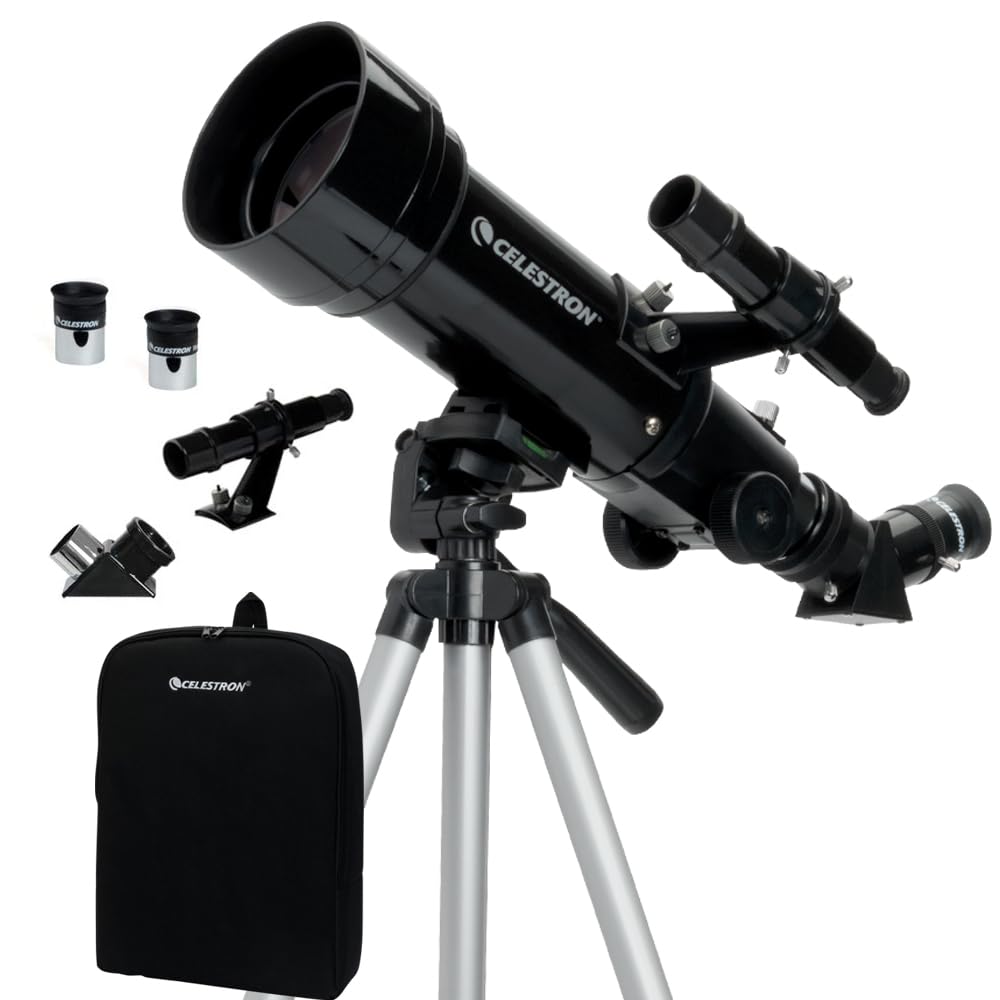
Celestron Travel Scope 70

Celestron Travel Scope 70

Camping and travel

Doodle Score 8.4/10
Check Price

Worth Noting

  • Tripod wobbles at full height
Weight
4.2 lb
Aperture
70 mm
Included
Backpack and Starry Night software
Focal Length
400 mm
Read the full review

A telescope that stays in the closet is no better than a poster of the Moon. The Travel Scope 70 is the one we reach for when the viewing spot is a campsite, a beach, or a grandparent's backyard. It weighs a little over four pounds and packs into a padded backpack with room for the eyepieces and finder.

Celestron keeps the first night simple: the tube and mount arrive preassembled, the tripod sets up without tools, and the 20mm and 10mm eyepieces cover wide and close views. We like the 45-degree erect-image diagonal, because it makes daytime nature viewing natural for a child who is not yet sold on astronomy.

The 70mm aperture is best on the Moon and the brightest planets, not faint deep-sky targets. For a child who wants to see Saturn's rings, that is enough; for a family chasing galaxies, it is not. The Travel Scope's real strength is that it gets packed and used, rather than sitting out the trip because it is too much trouble.

Bottom line: For the family that will actually carry a scope to a campsite, the Celestron's backpack, full-height tripod, and no-tool setup make it the travel pick.

#7

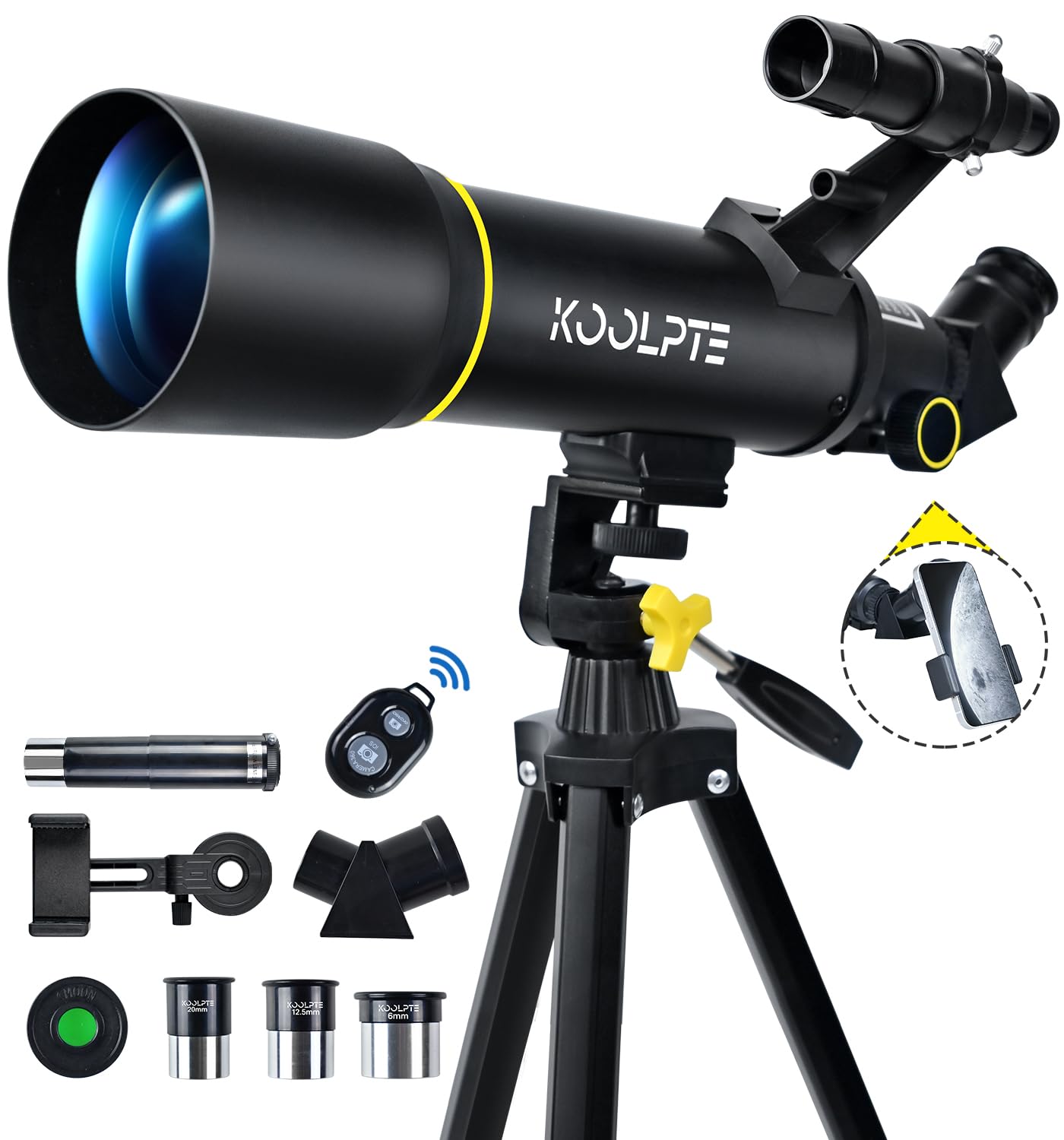
Koolpte 70mm Travel Scope

Koolpte 70mm Travel Scope

Budget 70mm starter

Doodle Score 8.4/10
Check Price

Worth Noting

  • 200x setting is optimistic for 70mm
  • Instructions can leave beginners guessing
Aperture
70 mm
Included
Phone adapter and wireless remote
Eyepieces
K6mm, K10mm, K25mm
Focal Length
400 mm
Read the full review

Budget telescopes usually ask you to give up either aperture or accessories. The Koolpte gives you both: a 70mm lens, three eyepieces, a 3x Barlow, a phone adapter, a wireless remote, and an adjustable aluminum tripod. That is a lot of kit for a budget 70mm, and it is the one we recommend for a first serious try without a big outlay.

The 25mm eyepiece is the place to start, with a wide view that makes it easier to find the Moon. The 10mm and 6mm eyepieces add power, and the Barlow triples each one; on a steady night the Moon takes the extra magnification well. We like the wireless remote for family photos, though the phone holder takes a little patience to line up.

The weak spot is the paperwork. Setup is not complicated, but the instructions can leave a first-timer guessing about the finder and the Barlow stack. The 200x combination is also more than a 70mm scope can support on most nights; treat it as a Moon-only setting. Keep the tripod low, and the core experience is still a good one.

Bottom line: The Koolpte is the budget 70mm we point to when the budget is tight but the goal is still real Moon viewing, not a plastic toy.

#8

Luzsco 50mm Kids Scope

Luzsco 50mm Kids Scope

Young first-timers

Doodle Score 8.4/10
Check Price

Worth Noting

  • 50mm aperture limits detail quickly
Weight
1.32 lb
Aperture
50 mm
Included
Two eyepieces, Barlow lens, finderscope, moon filter
Age Range
Kids 6–8
Read the full review

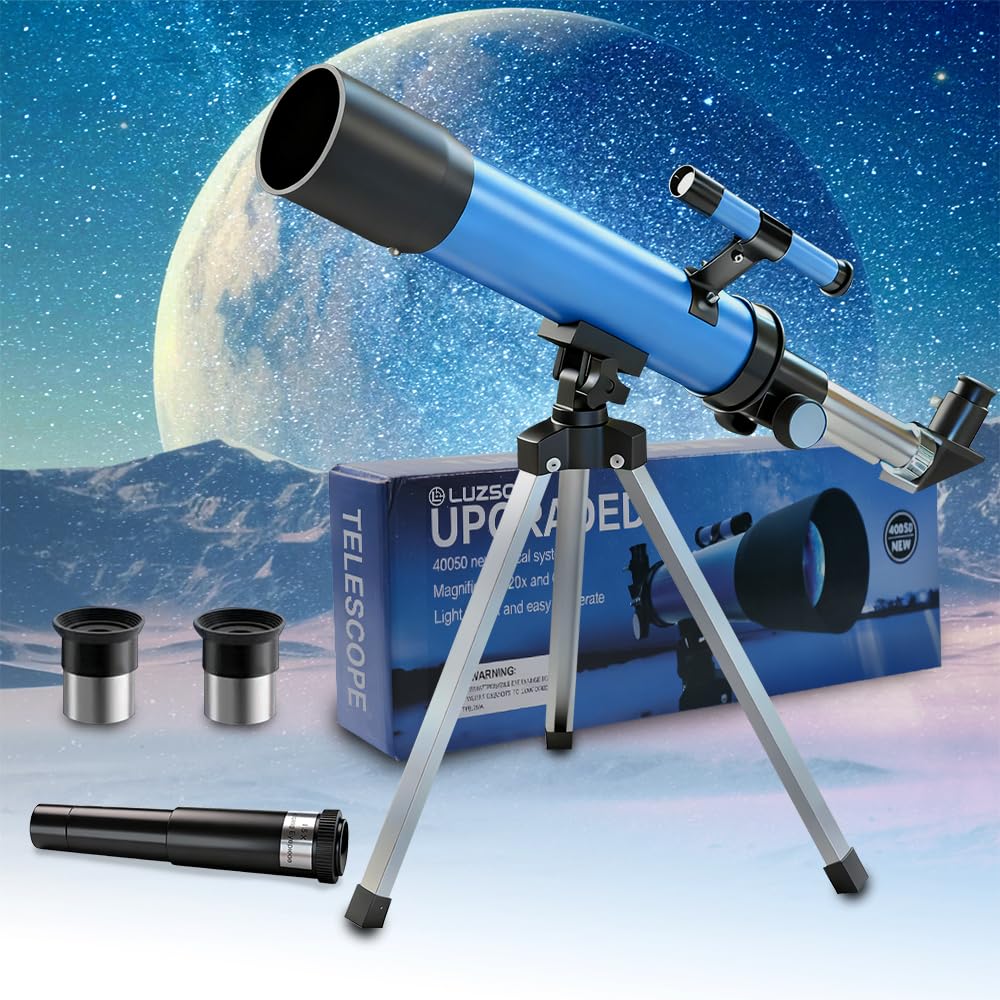
The Luzsco is not trying to be the family's forever telescope. It is a 50mm refractor that weighs 600 grams, and that lightness is the point: a six- or seven-year-old can carry it out and help set it up without a parent doing everything. For the youngest stargazer, that ownership matters.

The kit includes two eyepieces, a Barlow lens, a finderscope, and a moon filter, so there is enough to chase the Moon without buying extras. Assembly is simple, and the scope is small enough to store on a shelf. We like it as a first taste of astronomy, the kind that can live in a bedroom and come out for twenty minutes before bed.

The 50mm aperture runs out of detail quickly. The Moon and the brightest planets are the realistic targets; faint nebulae and fine planetary bands are not. That is the trade we accept for a scope this light: it gives a small child a real telescope to handle, while asking an adult to help with the finder and focus on the first few nights.

Bottom line: For a younger child who needs a light, inexpensive first scope, the Luzsco is the least intimidating way into Moon watching we found here.

How We Tested These Kids' Telescopes

We started by pulling every kids' telescope we could find, from toy-aisle models up through serious beginner rigs, and read the spec sheets like skeptics — aperture first, mount second, magnification last, since the biggest number on the box is usually the least useful. Anything with a ball-joint mount, a finder that couldn't be adjusted, or no real tripod got cut before it shipped. That left 12 telescopes, which we ran for six months.

Setup got timed, not eyeballed. I handed each telescope to a nine-year-old with the manual and a stopwatch running, and noted whether they got the tripod level, the tube mounted, and the finder aligned without help. Tubes that arrived assembled with wordless pictogram instructions were tracking the moon in under five minutes; a couple ate an entire evening, and one needed a screwdriver that wasn't in the box.

Stability was tested the way it fails in real life: focus on the moon, then let a kid tap the eyepiece. Steady mounts held the target; the wobbly ones slid out of frame and kept drifting. We kept a log of what each scope could actually show from a driveway with a streetlight at the fence line — craters and the Galilean moons came easily to most, Saturn's rings only resolved on the models with real aperture, and the highest-power eyepieces turned Jupiter into a soft orange blob on nearly all of them. A weekend camping trip away from porch lights was the fairest test of the optics.

Build quality got judged at a sleepover: four kids, one telescope, an hour unsupervised. Plastic focus knobs and friction-fit diagonals came back loose. For value, we weighed what each scope could show against what it cost and how often it came out of the closet, since a modest one used twice a week beats a fancy one that frustrates a seven-year-old. Enjoyment was the simplest measure of all — whether anyone asked to look again.

How to Choose the Right Telescope for Kids

Start With Aperture, Not the Magnification Number

A telescope's aperture is the front lens diameter, and it decides how much light reaches your eye. For a child, 50mm is the minimum for a usable Moon view, 70mm is the sensible all-round size, and 80mm gives a little more brightness and detail without becoming a heavy instrument. Magnification is just focal length divided by eyepiece; a 400mm scope with a 20mm eyepiece gives 20x. Ignore 300x claims on a small tube. Pick 70mm or 80mm first, then look at the eyepieces.

The Mount Decides Whether the View Holds Still

An altazimuth mount moves up-down and left-right, which is what a child needs. Equatorial mounts look technical and add a learning curve before the first view. A tabletop tripod is steady but needs a table; a full tripod is more flexible if it adjusts low enough. The mount is also where budget scopes cut corners: a light tripod at full height can shiver in a breeze or drift while focusing. Check the height range and leg locks, and set it low when the wind picks up.

Plan the First Night Around Setup

Align the finder in daylight on a distant object before you try the Moon. Start with the lowest-power eyepiece, focus slowly, and only then move to higher power. Before any of that, set the rule: the telescope never points at or near the Sun without a proper solar filter over the front lens. A first session that ends with a sharp Moon and no frustration is worth more than a box full of accessories.

Choose Eyepieces the Child Can Actually Use

A 20mm or 25mm eyepiece gives a wide, bright view and is the right starting point. A 10mm eyepiece adds power for the Moon, but it also narrows the view and makes every bump more visible. A 3x Barlow can multiply the power, yet it can push a small scope past what the atmosphere supports. We recommend starting with two eyepieces and adding a Barlow only after the child is comfortable aiming. A phone adapter is a nice extra; a moon filter helps on bright nights.

Match the Scope to the Child Who Will Carry It

A telescope that is too heavy or too awkward gets left inside. For a five- to seven-year-old, a 50mm to 70mm scope around six pounds with a simple tripod is plenty. Older children can handle a 70mm or 80mm refractor and a full-height tripod. A carry bag matters more than it sounds: it keeps the eyepieces together and makes the scope easy to take to a darker spot. Make the child carry the packed kit before you commit.

Frequently Asked Questions

Final Verdict

For most families, we recommend the Gskyer 70mm. It has the best balance here of aperture, weight, and first-night simplicity, and the included bag and phone adapter make it easy to keep using after the novelty wears off.

If your child is ready for more light, the MEEZAA 80mm is the step up we choose. If the child is five or six and needs a screen to stay engaged, the LeapFrog is the exception; just test the telescope mode early and keep the return window open.