STEM & Learning

Best Crystal Growing Kits for Kids of 2026

The appeal of a crystal growing kit is easy to explain: dissolve a packet in water, set the container on a shelf, and check it every morning until something jewel-like appears. But the gap between that promise and a cloudy puddle or a crumbled crystal is wide. A good kit fixes the wait, turning a few days of patience into something worth checking on—and it has to be simple enough that a kid can run it without an adult rescuing the whole project.

We tested 14 kits over four months with kids and adults, looking at whether the instructions made sense out of the box, whether crystals actually formed, and whether the result was worth showing off. Some were genuinely fun and educational; others left us with a disappointing crust and lots of explaining. The standouts got the details right, from measuring tools to crystals that looked close to the box art. They made better gifts because everything needed was included and the payoff arrived without a fight. The picks below are the ones that earned shelf space.

#1

National Geographic Mega Crystal Kit
National Geographic Mega Crystal Kit

First-time growers

Doodle Score 9.2/10
Check Price

Worth Noting

  • Only two chambers for six colors
  • Growth can vary between batches
Display
USB light-up stand
Age Range
8 years and up
Crystals To Grow
6
Growing Chambers
2
Read the full review

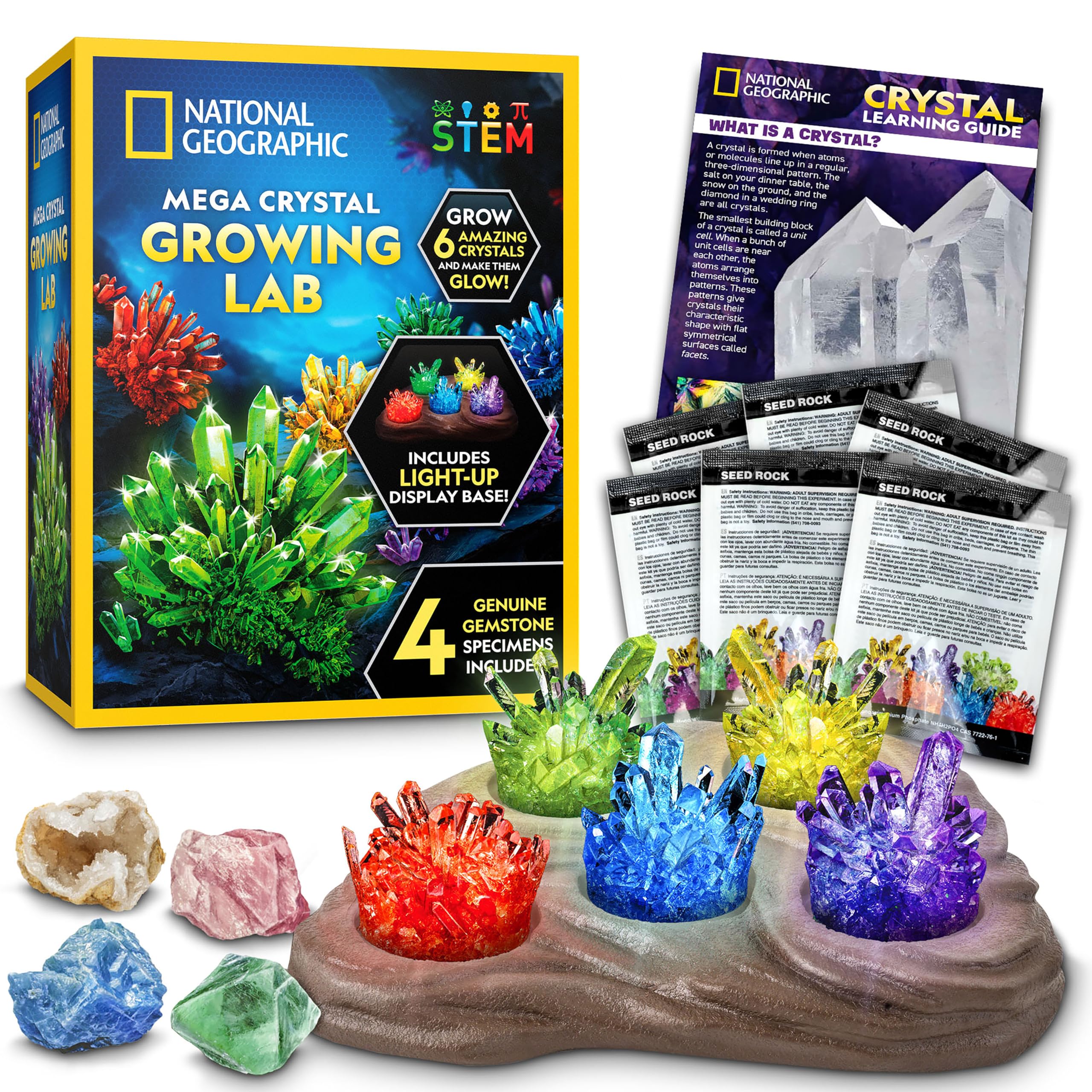
Six colors in one box is what makes this kit the most complete option here, but the two silicone chambers are what make it livable. You start two crystals at a time, so the full set is a staggered project rather than a single afternoon. We like that rhythm: it gives a child something to check over three or four days, and it keeps the kitchen table from disappearing under six cups at once.

The payoff is a light-up display that holds five finished crystals, and the four real specimens — rose quartz, fluorite, blue calcite and a quartz geode — give the kit a second life after the growing is over. For a kid who likes rocks as much as experiments, those specimens are the part that stays on the shelf. The display is worth checking as soon as the kit arrives; a dead light undercuts the finished look.

Ages 8 and up is the right guide. The process is simple enough for a supervised eight-year-old, but it still asks for careful measuring and a steady hand with the growing solution. Our advice is to treat the first batch as the trial run: mix thoroughly, keep the chambers level, and leave them alone. Results can vary from one batch to the next, which is the main caveat. The two-chamber design also means six colors take several rounds.

That trade-off is worth it for the child who wants a proper project and a display at the end. The kit feels like an event rather than a quick craft, and the specimens mean there is something to examine while the next batch grows. If you need same-day results, look at the tree kit instead; if you want the fullest crystal-growing experience here, this is the one.

Bottom line: For a kid who wants a substantial six-crystal project and a display worth keeping, this is our top pick here, provided you're ready to grow in two batches.

#2

National Geographic 3-Crystal Light-Up Kit

National Geographic 3-Crystal Light-Up Kit

Display-focused kids

Doodle Score 9.2/10
Check Price

Worth Noting

  • Single chamber limits growing batches
Light Modes
7 colors, rainbow, 3 brightness levels
Real Specimens
3 gemstones
Crystals To Grow
3
Growing Chambers
1
Read the full review

This is the three-crystal version of our top pick, and for some kids it is the smarter buy. You get one flexible growing chamber, three colors, and a light-up base with seven single-color modes, a rainbow mode, and three brightness levels. The display is the star: it turns the finished crystals into a small night light, and the three included gemstones — a geode, green fluorite and blue calcite — give the kit a collection angle beyond the grown pieces.

The shorter project is the point. One chamber means less counter space and a simpler setup, but it also means you are growing in sequence rather than three at once. We found the lighting controls easy to live with; the base is the part to test as soon as the kit arrives, because a display that does not light changes the value of this version. Crystal growth can be uneven, so keep the chamber still and follow the mixing ratio rather than topping it up by eye.

For a child who wants a prettier finished object and does not need six crystals, this is the better fit. It is also the easier kit to store between batches. The catch is that you are paying for the light show as much as the science, and the single chamber keeps the growing modest.

Bottom line: For a child who wants a prettier display and a shorter project, this is the three-crystal kit we suggest, as long as you test the light base early.

#3

Dan&Darci Light-Up Crystal Kit

Dan&Darci Light-Up Crystal Kit

Budget starters

Doodle Score 9.0/10
Check Price

Worth Noting

  • No real gemstone specimens included
  • Light-up base can be unreliable
Age Range
8 years and up
Growing Cups
3
Colors To Grow
Red, blue, clear
Crystals To Grow
3
Read the full review

The budget kit is the one we point to when a family wants to try crystal growing without committing to a big box. It includes three growing cups, three powders in red, blue and clear, starter rocks, tweezers, a stirrer, and a USB light-up display. For a first attempt, that is a generous collection of parts. The cups are the practical part: three separate grows can happen at once, so a child does not have to wait through one crystal before starting the next.

Instructions are simple enough for a supervised younger kid, and the tools make the project feel more like a real experiment than a toy. The results can be small or uneven, so follow the ratios and give each cup the full growing window. The red, blue and clear palette is a good introduction to how the powder changes as it grows, and the light-up display gives the finished crystals a place to go.

We think this is the right choice for a first kit, a gift for a child who is not sure about the hobby, or a household that wants three crystals without a long project. It does not have the display polish or the specimen extras of the top pick, but it gets the core experience right for the least money here.

Bottom line: This is our budget pick for a first crystal project: three cups, clear instructions, and a light-up display, though the base is the part to treat as a bonus.

#4

Ooze Labs Colorful Crystal Lab

Ooze Labs Colorful Crystal Lab

Science-minded kids

Doodle Score 9.0/10
Check Price

Worth Noting

  • Many small parts to manage
  • More setup and cleanup than simple kits
Age Range
6 years and up
Display Dome
Included
Crystal Salts
3 types
Experiment Types
4
Read the full review

This is not a single crystal kit so much as a small laboratory. The base station holds rods, clips, a crank, test tubes, a petri dish, and a display dome, and the experiments produce different shapes: a crystal volcano on a paper cone, spindly crystals on a rock, crystals in a dish, and crystals on a string. For a kid who asks why one crystal looks different from another, that range is the whole point.

The kit is aimed at ages 6 and up, and the salts are described as safe and non-toxic, but there are many small parts and several solutions to manage. We see it as a sit-down-with-an-adult project rather than something to hand over and walk away from. Setup and cleanup take more effort than the single-chamber kits, and the reward is a series of experiments rather than one polished display piece.

The Ooze Labs format is compatible with other kits in the line, which is a nice path if your child gets hooked. It is also the most science-fair-like option here after the 4M kit, with a broader look at how crystals form in different conditions. We recommend it for the curious kid who likes the process, not the child who wants a pretty crystal by the weekend.

Bottom line: This is our pick for a science-minded kid who wants to grow several crystal shapes and run a proper little lab, not just make one display piece.

#5

National Geographic Crystal Garden

National Geographic Crystal Garden

Fast craft projects

Doodle Score 8.8/10
Check Price

Worth Noting

  • Finished trees are fragile and decorative
Growing Time
6 hours
Real Specimen
1 geode
Trees To Grow
3
Watercolor Pens
5
Read the full review

The six-hour growing window is the reason to choose this tree garden. Instead of checking a chamber for days, a child can color the trees, add the growing liquid, and see crystals forming within minutes; the full garden is meant to be done in about six hours. We like that there are three trees, because it lets one child make a pair and save one for a friend, or gives siblings a tree each without turning the project into a production line.

The markers are not decoration; the crystals absorb the ink, so the color comes from how the child colors the branches. That is a neat bit of science and craft in one, and the five pens give enough range to make each tree different. For us, that color-it-yourself step is the most engaging part of the kit. The real geode and learning guide add something to examine afterward. The finished trees are delicate, though: they are display pieces, not toys to carry around, and the color can come out softer than the marker strokes suggest.

For a rainy afternoon or a kid who needs to see a result fast, this is the most satisfying kit here. It gives up the specimen-growing depth of the chamber kits in exchange for near-instant gratification and a craft project that keeps hands busy. We reach for it when the child is more interested in making a scene than in running a multi-day experiment.

Bottom line: For a child who wants to see crystals grow before dinner, this tree garden is our fastest, most craft-minded pick, though the finished trees are for looking at, not handling.

#6

4M 7 Crystal Growing Kit

4M 7 Crystal Growing Kit

Older experimenters

Doodle Score 8.8/10
Check Price

Worth Noting

  • Requires hot water and adult help
  • Crystal results can be slow or uneven
Water
Hot, distilled recommended
Display Cases
7
Recommended Age
10 to 15 years
Crystal Experiments
7
Read the full review

Seven experiments and seven display cases make this the most old-school science-fair kit here. It is aimed at ages 10 to 15, and that range is the honest guide: the kit expects hot water, careful measuring, and the patience to watch a crystal develop over time. For an older child who wants to compare results rather than just make one pretty object, the breadth is the appeal.

The display cases are a real advantage. They turn each experiment into something to label, keep, and line up on a shelf, which is more than most kits here offer. The kit expects a proper setup: hot water, measured powder, and an undisturbed spot. We appreciate that it gives an older child a reason to keep notes and compare shapes. The growing is a longer experiment than the tree kits, and the results are not as predictable as the top pick's; that is the cost of running seven different trials in one box.

We see this as a kit for the kid who likes the procedure as much as the payoff. It is not the first choice for a younger child or a same-day craft, but it rewards an older experimenter with more to do and more to display. The variable results are the trade-off for that breadth.

Bottom line: This is the pick for an older child who wants seven experiments and display cases, not a quick craft; expect more careful setup and less consistent results.

#7

National Geographic Crystal Tree Forest

National Geographic Crystal Tree Forest

Family growing sessions

Doodle Score 8.8/10
Check Price

Worth Noting

  • Crystals crumble easily when touched
Growing Time
6 hours
Trees To Grow
6
Tree Varieties
4
Watercolor Pens
5
Read the full review

The trouble with crystal trees is that they are prettier to grow than to keep. These six trees are no exception: the crystals are soft and crumble if you handle them, so the finished forest belongs on a shelf, not in a child's hands. That caveat out of the way, this is the version to choose for a family or a party. You get six trees across four shapes — dragon blood, bonsai, cherry and evergreen — plus five watercolor pens and a real geode.

The same six-hour timeline as the smaller garden kit applies, and the coloring is the creative hook: the crystals take up the ink from the markers, so each tree can be different. More trees means more chances for siblings to each own one, and the bases make it easy to line them up as a temporary display. For a group, that volume is worth the fragility. The growing results can be uneven, and the finished pieces may shed crystals at the slightest bump.

We keep this one for a group activity where the making is the memory and the trees are the table decoration. It is not the kit for a child who wants a durable collectible, and it is not the one to choose if you are only growing with one kid; the three-tree garden is a better fit there. For a party or a family afternoon, the extra trees earn their place.

Bottom line: For a family or party where several kids want their own tree, this six-tree kit is the one to get, provided everyone treats the results as fragile decorations.

How We Tested Crystal Growing Kits

We started with a shortlist of kits that included the growing container, solution, and a way to display the finished crystal, since a kit that sends you hunting for distilled water, a jar, and a safe spot is already behind. We also filtered out anything with instructions that were vague about measuring or supervision, then bought 14 kits to test over four months.

We set them up on kitchen counters, windowsills, and a kids' craft table, following each instruction sheet step by step and noting where an adult had to step in. We timed the initial setup, checked the containers daily, and recorded when the first crystals appeared, how large and clear they got, and whether the solution leaked, evaporated, or grew a disappointing cloudy crust. We also watched how the included tools held up—whether measuring cups were marked clearly, lids sealed, and display bases actually held the finished crystal—and whether cleanup was a quick rinse or a scrub, and whether the box contents matched what the kit actually produced.

Because most people buy these as gifts, we also handed several kits over as birthday presents and asked for honest feedback: whether the packaging felt complete, whether the recipient needed extra supplies, and whether the fun lasted beyond the first afternoon. We compared the educational payoff, too, by seeing whether the instructions explained the science in a way kids could follow and adults wouldn't have to translate. Kits that produced small, dull, or fragile crystals—or that required more adult intervention than play—did not make the cut.

How to Choose Crystal Growing Kits for Kids

How much waiting can your child handle?

Crystal growing is a patience project. Traditional chamber kits can take three or four days, while the tree kits here promise crystals in minutes and a full garden in about six hours. Neither is better; they suit different attention spans. A younger child who needs to see something happen may lose interest in a multi-day chamber, while an older kid may enjoy the daily check-in. Choose the faster kit for a same-day craft, and a chamber kit when the waiting is part of the science. Fast tree crystals are usually decorative and delicate, so decide whether you want an activity or a keepsake.

Count chambers, not just colors

Six colors sounds generous, but the number of growing chambers decides whether you grow them together or in rounds. The top kit here has two silicone chambers for six crystals, so it is really a project in batches; a three-cup kit can start all three colors at once. For siblings or an impatient child, parallel cups matter more than total color count. Check the chamber count before buying, and plan a level, undisturbed spot where the cups can sit. A kitchen counter that gets bumped is a poor place for any crystal to form.

Decide between a specimen, a display, and a craft

The finish changes the purchase. A classic crystal kit gives you grown crystals and often a light-up base or display case; a tree garden turns the crystal into a colored craft, with markers doing much of the visual work. Specimen kits add real minerals, which is a nice extra for a rock-obsessed kid. We think the display matters most when the child likes showing things off, while the craft matters when the making is the point. Be honest about fragility: tree crystals crumble, so they are not travel toys or long-term keepsakes.

Age, hot water, and the adult's job

Most kits here are labeled for ages 8 and up, but the real dividing line is hot water and measuring. The 4M kit is aimed at ages 10 to 15 and asks for hot distilled water; tree kits are simpler but still need a steady hand with liquid. A 6-year-old can enjoy the coloring and assembly with an adult handling the hot steps. Read the age range as a supervision guide, not a guarantee that the child can run the kit alone. Set up away from carpet, keep the instructions, and give the crystals the full time before judging the result.

Frequently Asked Questions

Final Verdict

National Geographic's Mega Crystal Growing Kit is the one we recommend first. It gives a child six colors, four real specimens, and a display that keeps the finished crystals visible, which is a fuller experience than the smaller kits provide. The two chambers mean growing in batches, so if same-day results matter more than variety, choose the Crystal Garden. If you want the lowest-risk first try, the Dan&Darci kit is the budget entry.