STEM & Learning

Best Dance Mats for Kids of 2026

A dance mat that gets stomped on twice and then slides under the couch is a particular kind of birthday-present disappointment. Kids ask for one because the box looks like a party; parents buy it hoping the party lasts past the first rainy Saturday. What a good mat actually fixes is simpler than it sounds: it turns a screen into a floor and twenty minutes of chaos into twenty minutes of exercise nobody has to negotiate over. The fun has to hold up, though, and so does the mat itself.

I've watched a lot of these get unboxed in my own living room, and my team has now put 15 mats through three months of stomping, jumping, and the occasional juice spill. The pattern was clear early: the mats that kept kids coming back were the ones a five-year-old could figure out without an adult hovering, and the ones that got abandoned were either too hard to follow, too loud to leave running, or too flimsy to trust under a sock foot. Here's what earned its spot on the floor.

#1

Kizjorya Dance Mat

Kizjorya Dance Mat

Growing dancers

Doodle Score 9.0/10
Check Price

Worth Noting

  • One dancer at a time
  • Priciest single mat here
Music
Bluetooth plus built-in tracks
Players
1
Mat Size
39.4 x 41.1 x 1.7 inches
Difficulty
9 levels, 5 speeds
Read the full review

Every mat in this group ships with a short list of built-in tunes, and by the second week you can hum all of them from the next room. The Kizjorya is the one that hands the music back: pair a phone over Bluetooth and the same light-up pad becomes a mat for whatever song your kid is actually obsessed with this month. On paper that is a small addition. In a living room it is the difference between a toy that gets folded away in February and one that comes back out in March.

We made it our top pick because it solves that problem without giving anything else up. The dance area measures 39.4 by 41.1 inches, the biggest single-mat floor space here, and the surface is cushioned with non-slip silicone particles set into the underside, so it stays where you put it on hardwood instead of skating toward the bookshelf. For a kid who jumps rather than shuffles, those extra inches do more than any light show.

Difficulty is where it surprised us. Most mats hand you three levels and wish you luck; this one has nine, plus five separate speeds, so a five-year-old can stay on the bottom level at a walk while an older sibling climbs. That range is what keeps a mat useful past the birthday, and it is why this one is worth handing down rather than replacing.

Four AA batteries, adjustable volume, and a surface that wipes clean: standard housekeeping for the category. What is not standard is how long it stays in rotation once the lights stop being the point.

Bottom line: The one we hand over when the dancing is the main event: Bluetooth for their own songs, a big cushioned pad, and nine levels to climb.

#2

Handwell Double Dance Mat

Handwell Double Dance Mat

Two kids

Doodle Score 9.0/10
Check Price

Worth Noting

  • Needs a clear five-and-a-half-foot run of floor
Players
1 or 2
Controls
Wireless remote
Mat Size
30.2 inches x 66.5 inches
Play Modes
Five, including Bluetooth
Read the full review

Sixty-six and a half inches is a long mat. Laid out, the Handwell runs most of the way across a small playroom, with twelve light-up buttons divided into two play zones so two kids can work the same panel side by side instead of arguing over one square of floor.

The wireless remote is the detail we did not expect to care about and ended up using constantly: switch between single and two-player mode, change the level, drop the volume, all without stepping onto the mat or reaching over a dancing child. Anyone who has tried to change a setting on a mat that a six-year-old is currently jumping on will understand the appeal.

Five modes cover dance, memory, Bluetooth, piano and drums, so the long mat still works as a solo toy — one kid uses one half and the other side simply sits there. That flexibility is what makes it our pick for siblings rather than a specialist two-player toy, and it is the reason we reach for it over a pair of joined mats when only one child is home.

It is a considered design rather than a bigger version of the same thing, and the remote alone makes it easier to live with than pads where every control sits underfoot.

Bottom line: For two kids at once, this is the mat: 66 inches with two button zones, and a remote that changes modes and volume without stepping on the panel.

#3

Sunlin Dance Mat

Sunlin Dance Mat

First mat

Doodle Score 8.8/10
Check Price

Worth Noting

  • Few built-in tunes, thin sound
  • Step pads want a centred step
Power
Battery powered
Surface
Padded vinyl, wipe clean
Mat Size
35.4 X 36.6 inches
Difficulty
3 levels
Read the full review

No console, no TV, no cables — the Sunlin runs on batteries and the mat alone, and that is exactly why it is the one we hand to a four-year-old. There is nothing to pair and nothing to trip over on the way back to the sofa. It is also the smallest mat here at 35.4 by 36.6 inches, and at 0.75 kg it is light enough to hang on a hook between sessions.

Three levels is the whole ladder, and for this age that is a feature rather than a shortfall: a preschooler steps on the lit panel, hears the note, sees the score, and understands the game in about ninety seconds. The vinyl wipes clean with a damp cloth, which matters more than any feature list when a kid is dancing in socks straight after a snack.

The one thing we tell gift-givers: run it the day it arrives, not the night before the party. A mat that powers up and then ignores every step is the failure that turns up with this model, and a week of lead time turns a disaster into an exchange.

Buy it for the youngest dancer in the family, or for a small room where a 40-inch mat would live under the bed half the time. Older kids will exhaust the three levels quickly, and that is the point at which the Bluetooth mats earn their keep.

Bottom line: Simplest mat here, and the one we buy for a four-year-old: no screen, no cables, three levels, and a footprint that fits a small bedroom.

#4

Surelect Frozen Dance Mat

Surelect Frozen Dance Mat

Budget gift

Doodle Score 8.8/10
Check Price

Worth Noting

  • One dancer at a time
Surface
Waterproof PE, non-slip backing
Mat Size
40.6 x 33.5 x 0.78 inches
Game Modes
Dance, piano, Bluetooth, memory
Challenge Levels
9
Read the full review

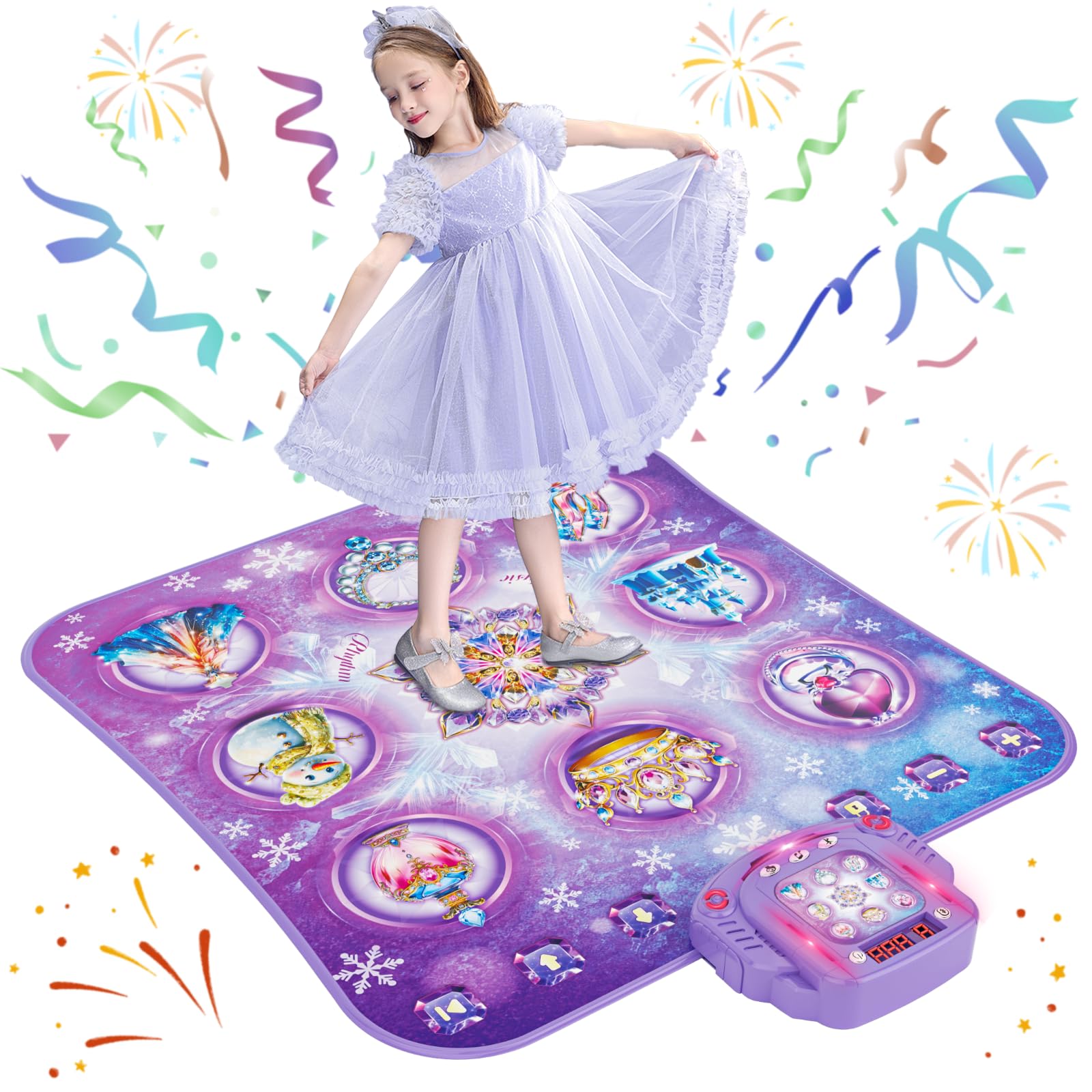
The box does some of the work here: the mat, a sheet of Frozen stickers, a piece of sheet music and an instruction booklet, all in Elsa blue. If this is going to be unwrapped in front of grandparents, that is not a small thing.

Under the theme it is the value pick of the group. Eight light-up buttons, three game modes spread across nine challenge levels, piano and memory modes alongside them, and Bluetooth for when the built-in music runs out. It folds up, wipes down and takes a smaller patch of floor than the top pick.

Build consistency is what we watch. Mats from this range turn up both sturdy and flimsy, and sound is the part most likely to give out first. Open it, run every mode, and keep the packaging until you have — a gift that fails on day three is much easier to sort out while the box still exists.

For a five- or six-year-old who is going to shriek at the Frozen branding anyway, this is the one we buy: real levels, a piano mode and Bluetooth, doing the same job as the more expensive single mats.

Bottom line: Best value in this group — Frozen stickers and sheet music in the box, eight buttons, nine levels, Bluetooth, and the lowest price here.

#5

Surelect 2-Player Dance Mat

Surelect 2-Player Dance Mat

Playdates

Doodle Score 8.8/10
Check Price

Worth Noting

  • Two mats plus a control centre to store
Modes
Five, including Bluetooth and light show
Layout
Two opposing mats plus control centre
Buttons
12 light-up buttons
Players
1 or 2
Read the full review

Two mats, facing each other, one control centre: this is the setup we choose when two kids will be dancing at the same time. Where a long mat puts them shoulder to shoulder, this one sets them opposite, so they watch each other's feet instead of the panel in front of them and nobody's foot lands where their sister's already is.

Each mat carries its own set of light-up buttons, twelve in total across the pair, and the set switches between solo and two-player play. Five modes cover dance, memory, Bluetooth, instrument sounds and a light show that children seem to enjoy considerably more than the adults in the room.

Bluetooth means the built-in tracks are not the ceiling, the PEVA surface is waterproof and wipes clean after a socks-and-snacks session, and both mats fold. It all runs on batteries with no console involved, so it sets up in any room with enough floor.

The catch is the shape of the thing: two separate mats plus a control unit is more to lay out and more to gather up than a single square pad, and it only earns its keep if there is usually a second child around.

Bottom line: Buy this if playdates are routine: two facing mats give each child their own buttons and a rival to watch instead of one crowded panel.

How We Chose and Tested Kids' Dance Mats

I started with roughly 40 mats sold by the major retailers and filtered them using the boxes themselves: the age range printed on the front, whether the mat needed a TV or tablet to work at all, whether it ran on batteries or a cord, and whether the surface could be wiped down. That left 15 mats, which my team and I rotated through our own homes for three months.

Testing happened where these things actually live: a living room rug, a bare basement floor, and one very long rainy Saturday with seven kids between the ages of 4 and 9. I timed how long each mat took to get from box to first song and noted whether batteries were included, since several weren't, which is a rough experience for a gift. Kids played in socks, bare feet, and sneakers to see whether the sensors registered the difference, and I stepped on and off the edges twenty times to check whether the mat slid across the floor or curled up at the corners.

Difficulty was what separated them. I watched whether a 5-year-old could follow the arrows without an adult reading the screen, and whether a missed step triggered a restart or just kept the song moving. On music, I ran every mat at full volume and listened for whether it was shrill enough to send me out of the room, plus whether there was any way to quiet it. After three months of near-daily use, I went back through and checked which buttons had gone mushy, which sensors were missing steps, and which mats were still getting pulled out on a Tuesday evening, because those were the ones actually worth the money.

How to Choose Dance Mats for Kids

Start with the difficulty ladder

Plenty of kids' mats offer three levels where the top one is barely harder than the bottom, which gives the toy a shelf life of about three weeks. Mats with nine levels and separate speed settings, like the Kizjorya and the Surelect pads, let a five-year-old start at a walking pace and still have somewhere to go at eight.

If the dancer is four or younger, an easy first level matters more than a big number on the box: look for a mode that genuinely slows the tempo rather than one that just dims the lights. In a mixed-age house, buy for the older child — the younger one catches up faster than the older one slows down.

Music runs out before the mat does

Built-in song lists are short on every mat in this group, and the tunes loop. Under five, that is survivable: the beat and the lights are the whole point. By six or seven, repetition is what gets a mat folded away and forgotten.

Bluetooth is the fix, and it is worth choosing a mat for it — the same pad becomes a disco for whatever the family already streams. Volume matters as much, because a small speaker pushed loud turns harsh; look for adjustable volume rather than a simple on/off switch.

How much floor, and how many dancers

Single mats run roughly 34 to 41 inches across, enough for one child dancing in socks and not much more. If two kids will be on it most afternoons, you have a choice: one long mat that splits into two button zones, or a pair of opposing mats wired to a single control unit. The long mat is easier to store and still works solo; the opposing pair keeps feet and elbows apart.

Measure before ordering. A 66-inch mat needs a clear run of about five and a half feet, and every mat wants a flat surface with the non-slip backing down — hardwood as much as carpet.

Step sensing, and the first-week test

The usual failure on these mats is the same one every time: a pad stops registering, or the unit powers on and then ignores every step. The electronics live under the feet of a jumping child, so buy somewhere with a straightforward return window and run every button the day it arrives — not the night before a birthday.

Keep the packaging until you have done that. A mat that survives its first week has cleared the hurdle that most failures show up at.

Frequently Asked Questions

Final Verdict

Our top pick is the Kizjorya, because it is the one that stays interesting: Bluetooth so the songs can change, nine levels with five speeds so the difficulty can, and a big cushioned pad that holds up to a kid who jumps rather than shuffles.

If two children will be on the mat at the same time, take the long Handwell instead — the split play zones and the remote are worth the extra money. And if the dancer is four and the budget is tight, the Sunlin's no-screen simplicity is the safer first mat; just test it the day it arrives.