STEM & Learning

Best Rock Tumblers for Kids of 2026

Most kids' rock tumblers sound like a shortcut to a science-fair trophy, but the first batch tells you everything: does the barrel spin, can a 9-year-old seal the lid without help, and do the grit steps make sense on a school night? Over eight months, my team and I ran eleven kid-friendly tumblers through after-school batches, weekend rock hunts, and forgotten overnight runs. A good one turns a pile of driveway rocks into a reason to keep going; a bad one turns them into a racket nobody wants in the house.

The difference is rarely the motor alone. Kids need to load the barrel, add grit, tighten the lid, and wait; if any step is fussy, the hobby dies before the polish stage. We noted how loud each tumbler was in a bedroom or garage, whether the lid stayed sealed through days of spinning, how the plastic held up after repeated cleanouts, and whether the price felt fair after a month. The picks below kept spinning with minimal fuss and produced a batch worth showing off.

#1

National Geographic Hobby Rock Tumbler Kit

National Geographic Hobby Rock Tumbler Kit

First family tumbler

Doodle Score 9.0/10
Check Price

Worth Noting

  • Motor can fail within weeks on some units
Controls
One-touch timer
Grit Stages
4
Recommended Age
8 years and up
Rough Rocks Included
9 gemstone types
Read the full review

The box does most of the persuading. Four grits carry a batch from coarse grind to polish, a sifter handles the rinses, and the rough rock is nine different gemstone varieties rather than a bag of anonymous gravel. That means the first batch can start the evening the kit arrives, and what comes out is a set of stones a kid can sort, name and keep. The barrel is rubber rather than hard plastic, which takes some of the clatter out of a machine that runs for days at a stretch.

For a first tumbler in a house with an eight-year-old, this is the one we name. Nothing needs programming: fill the barrel, press the one-touch timer for the cycle you want, and let it run while the guide tells you which grit comes next. It is also the kit of the three with the least standing between the box and a finished stone, since the grit, the rocks and the fastenings for a first necklace are already in it.

The caveat is the motor, and it is worth taking seriously. These machines run for weeks at a stretch, and motors on this model can quit within a few weeks. Buy it from a seller with painless returns, keep the box through the first batch, and the risk becomes a nuisance rather than a lost gift. If a big batch matters more than simplicity, the KomeStone below is the alternative; for a first machine, this one is enough.

Bottom line: Our default for a first family tumbler: four grits, nine kinds of rough stone and a one-touch timer arrive together, so a kid can be polishing stones from the first evening.

#2

Dan&Darci Advanced Rock Tumbler Kit

Dan&Darci Advanced Rock Tumbler Kit

Set-and-forget cycles

Doodle Score 9.0/10
Check Price

Worth Noting

  • Durability record is the weakest of the three
Controls
3 speeds, 9-day LCD timer
Grit Stages
4 grit packets
Barrel Capacity
1 lb
Rough Rocks Included
1/2 lb assorted
Read the full review

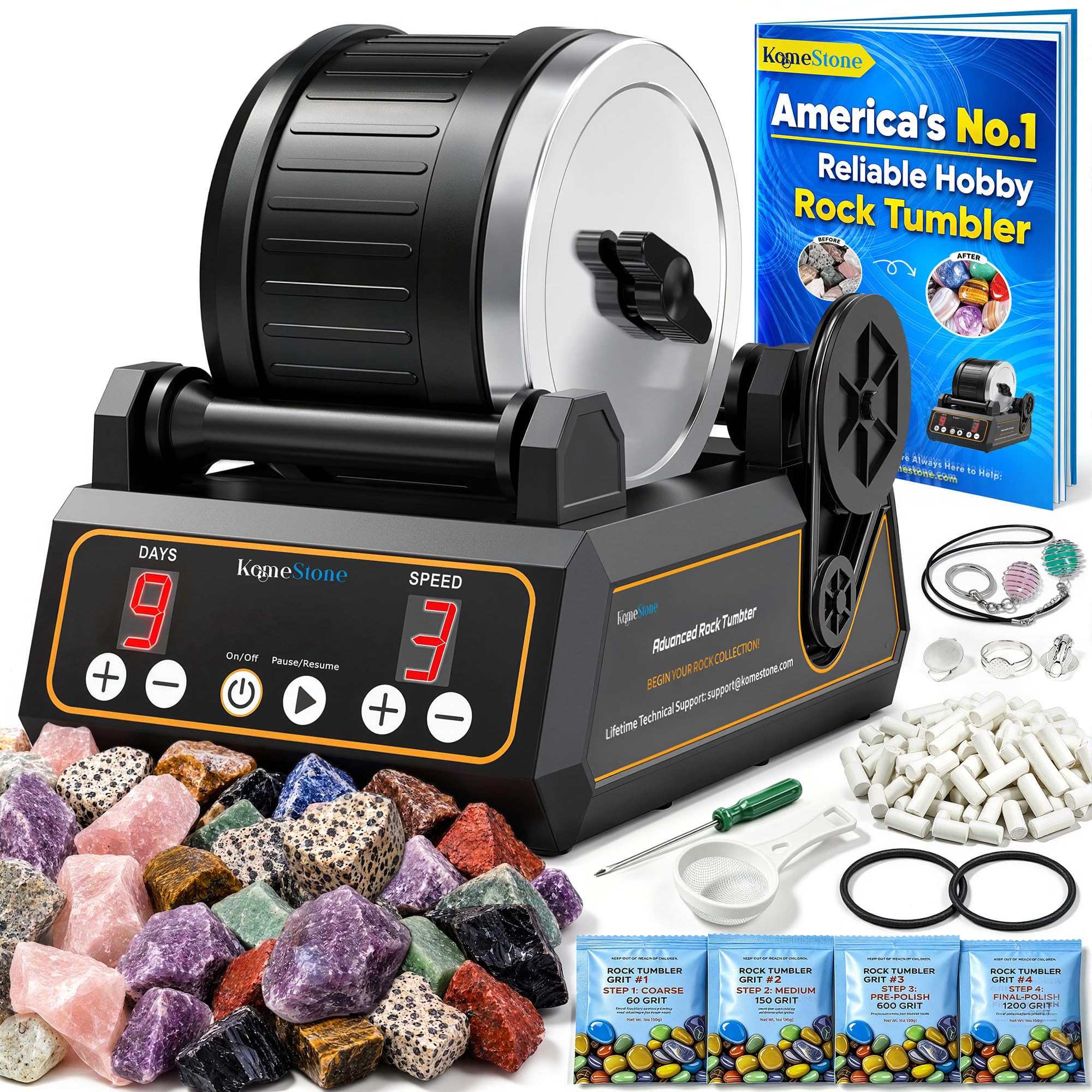
Three speeds, a nine-day timer and a pause button put the whole schedule on the front panel behind an LCD, and that changes how the machine gets used. Fill the drum, dial in the days for the stage, and the batch stops on its own instead of running until somebody remembers it is going. For a kid old enough to read the screen, setting the next stage becomes part of the hobby rather than a job for a parent.

Setup is quick, which matters when the machine is a gift: the base, belt and drum go together in a couple of minutes, and the box includes a spare belt, a mesh strainer, jewelry fasteners and a bag for finished stones. The body is metal rather than the usual plastic. Where the kit is thinner than it looks is supplies. The half pound of rough rock will not fill a one-pound barrel on its own, and the four grit packets are one batch's worth, so the refill order goes in early.

As a small, programmable machine for a kid who tumbles a handful of finds at a time, it works, and it is the one we suggest for a household that wants tidy scheduled batches rather than volume. The barrel is the smallest of the three, so the extra capacity the other two offer is the thing you give up. Judge it on that trade rather than on the display.

Bottom line: We rate this one for scheduled small batches: three speeds and a nine-day timer do the remembering, and setup takes minutes. Expect a shorter working life than our other two picks.

#3

KomeStone K1 Rock Tumbler Kit

KomeStone K1 Rock Tumbler Kit

Bigger batches

Doodle Score 8.8/10
Check Price

Worth Noting

  • Belts and motor are the wear items
Controls
3 speeds, 9-day timer
Barrel Capacity
2.5 lb
Recommended Age
8 years and up
Rough Rocks Included
1 lb, 9 varieties
Read the full review

Two and a half pounds of barrel is the whole argument. A one-pound drum turns a jar of beach finds into three separate batches and a month of waiting before anyone sees a finished stone; the K1 takes the lot in one load, and the drum itself is thick rubber, which is the difference between a machine that lives in the house and one that gets banished to the garage.

The controls earn their place too. Three speeds and a nine-day timer are ordinary at this level, but pause-and-resume with settings memory is not, and it is what makes the K1 pleasant with kids: pull the drum out mid-stage to see how the stones are coming along, put it back, and the cycle picks up where it stopped. Ceramic tumbling media comes in the box, which neither of our other picks includes, along with two spare belts, and the media cushions stones so edges do not chip. Add the guidebook that assumes zero prior knowledge, and this is the one we point to when a whole family tumbles together.

Where it gives ground is wear. Belts and the motor are the parts that show up as failures, and for a machine that runs unattended for weeks that is the risk you are accepting; the two spare belts in the box soften it but do not remove it. What offsets that is the absence of a learning curve. Nobody in this group is easier to start with, and nobody makes a bigger batch look ordinary.

Bottom line: We recommend the K1 when one big batch beats three small ones: a 2.5 lb rubber barrel, pause-and-resume control, and a guidebook that assumes you know nothing.

How We Tested Kid-Friendly Rock Tumblers

To build the shortlist, I started with tumblers sold for kids rather than full-size hobby machines, then filtered out models with vague grit sequences, tiny barrels that would need constant reloading, and lids that reviewers repeatedly called hard to seat. We landed on eleven units, all in the beginner-friendly range, and tested them for eight months in the same homes where they would actually live: kitchen counters, garage benches, and a few bedroom corners during school weeks. Each one got a first batch of mixed driveway rocks, then a second batch after we had learned its quirks.

With kids doing the loading, we watched how easily they opened the barrel, measured grit by the included scoop, and tightened the lid without an adult cranking it down. We checked for leaks at the first turn, logged any stalls or restarts over the next few days, and listened from a closed bedroom door and the next room to judge whether the noise was tolerable during homework or sleep. After each cleanout we inspected the barrel, lid threads, and base for cracks, stripped plastic, or grit that had crept into places it should not.

For instructions and beginner suitability, a 10-year-old followed the first two grit stages using only the included guide, with an adult stepping in only for safety notes. We noted where the wording lost them, whether the grit amounts were clear, and if the timing made sense for a kid's schedule. The fun test was the reveal: we compared the final shine, checked for bruises or grit scratches left in the barrel, and asked whether the batch was worth another week of waiting. We also factored value after the first month, weighing what survived against what the tumbler cost.

How to Choose Rock Tumblers for Kids

Barrel size sets the rhythm

A one-pound barrel is the standard kids' size and the right place to start. Smaller loads finish faster, use less grit, and put a polished stone in a child's hand before their patience runs out. Two and a half pounds or more suits a family tumbling together, because a jar of finds becomes one batch instead of three.

Bigger is not automatically better. A drum run half full tumbles badly and bruises the stones, so match the barrel to how many rocks you actually collect. If the answer is a handful every few weeks, the small drum is the honest choice.

The lid is where hobbies die

Every stage begins and ends with opening a drum full of grit slurry, and a lid that jams or a barrel that will not seal turns a gift into a shelf ornament. Look for a rubber barrel with a simple gasket rather than a hard plastic drum, and try the lid before the first batch: if it takes both hands and a tool to close, a child will never manage it alone.

A leak is worse than a jam. It ruins the batch, the grit and whatever surface the tumbler is standing on, which is why the seal is the first thing we check on any kit.

Noise picks the room

Rotary tumblers run around the clock for weeks, so the sound, closer to a washing machine than to a rock polisher, has to go somewhere it will not be anyone's problem. Plan on a garage, basement or utility room, on a flat surface that stops the machine walking, and skip the bedroom entirely.

Rubber barrels are quieter than hard plastic ones, but quiet in a listing still means quieter than another tumbler, not silent. Set it on a mat and give it a shelf of its own.

The motor is the part that wears

These are small motors asked to turn a heavy drum twenty-four hours a day, and motor or belt failure turns up on every kit in this group. Treat that as the cost of the hobby rather than a way to choose between brands: buy from a seller with straightforward returns, keep the packaging through the first batch, and note whether spare belts come in the box. A machine that stops mid-stage takes the stones with it.

Grit, rocks and the second purchase

A four-stage kit takes stones through coarse, medium, fine and pre-polish before the final shine, and most kits ship roughly one batch's worth of grit. Put the refill in with the first order, and expect to buy rough rock too once the included selection is gone, since the half pound or pound in the box is a start rather than a supply.

Skipping a stage to stretch the grit shows in the finished stone. Dull results are almost always patience, not a bad machine.

Frequently Asked Questions

Final Verdict

The National Geographic Hobby kit is the one we point a first-time family to. Four grits, nine kinds of rough stone and a one-touch timer arrive together, so there is nothing to order and nothing to program before the first batch starts, and more families run this kit than anything else here.

Choose the KomeStone K1 instead if you are tumbling a whole jar of finds at once and want a quieter rubber drum with pause-and-resume control. Choose the Dan&Darci if a programmed nine-day cycle on a small machine is the feature you care about, and accept the shorter working life that comes with it.