STEM & Learning

Best Microscopes for Kids of 2026

The fear with any kids' microscope is that it's a toy in disguise: you peer in, see a blurry smudge, and the box is back in the closet by Sunday. A microscope that can't hold focus teaches a kid nothing except that science is disappointing. What a good one fixes is narrower than "STEM enrichment" — it turns a leaf from the backyard or a drop of pond water into twenty quiet minutes of concentration.

Over the past six months, 12 microscopes have rotated through my kitchen table, handed around by kids between four and eleven. We looked at onion skin, pond water, salt crystals, and a great deal of whatever was in the yard that afternoon. What separated the keepers had little to do with the magnification number on the box — a big number means nothing if the image won't resolve — and a lot to do with the light, the focus knob, and whether the thing survives a desk drawer and a sleepover. The picks below earned a permanent spot on the shelf.

#1

Edubini Pocket Digital Microscope
Edubini Pocket Digital Microscope

App-free use

Doodle Score 9.6/10
Check Price

Worth Noting

  • 30-day warranty is short for a kids' toy
  • No case included
Screen
2.0-inch IPS
Weight
5.4 oz
Warranty
30 days
Magnification
Up to 1000x
Read the full review

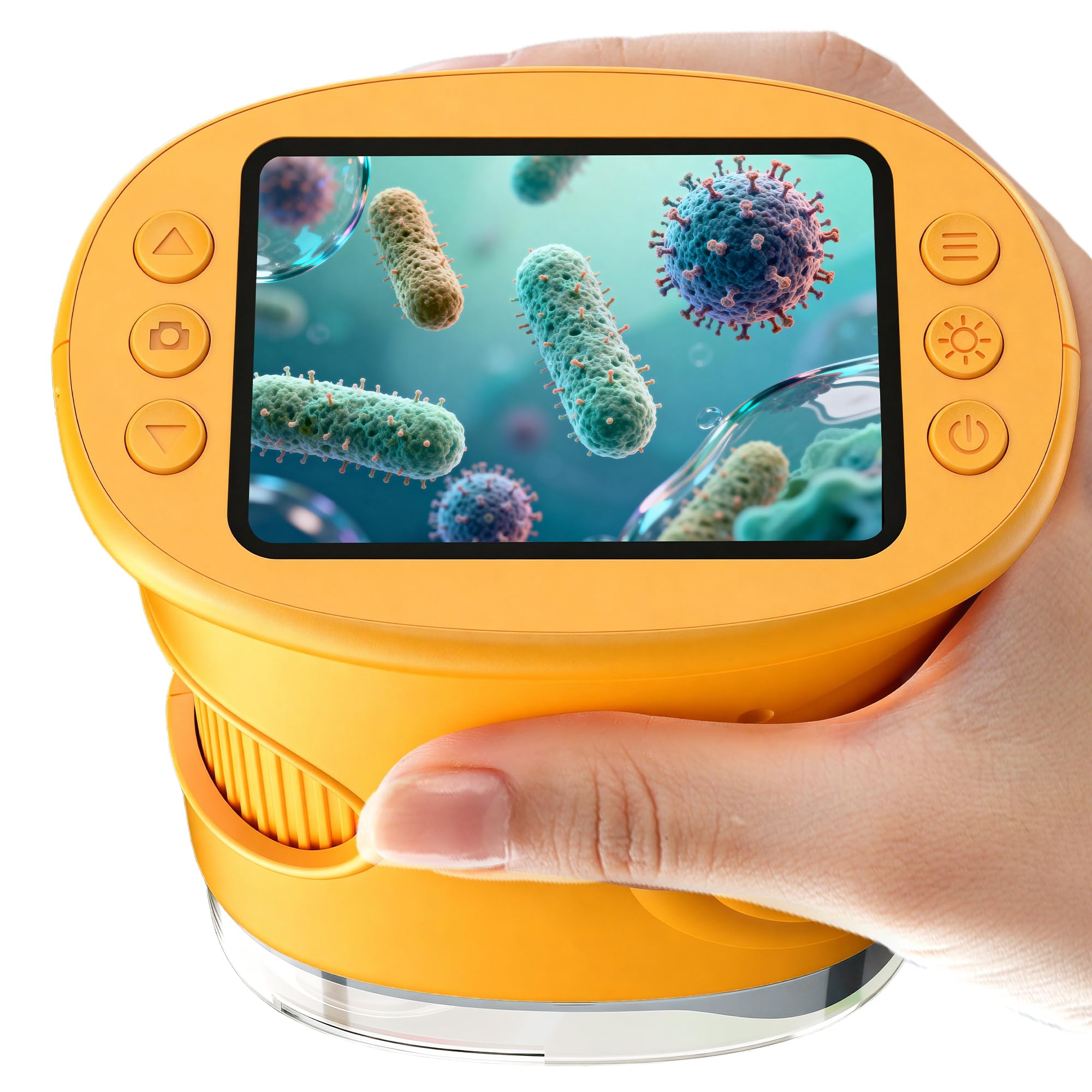
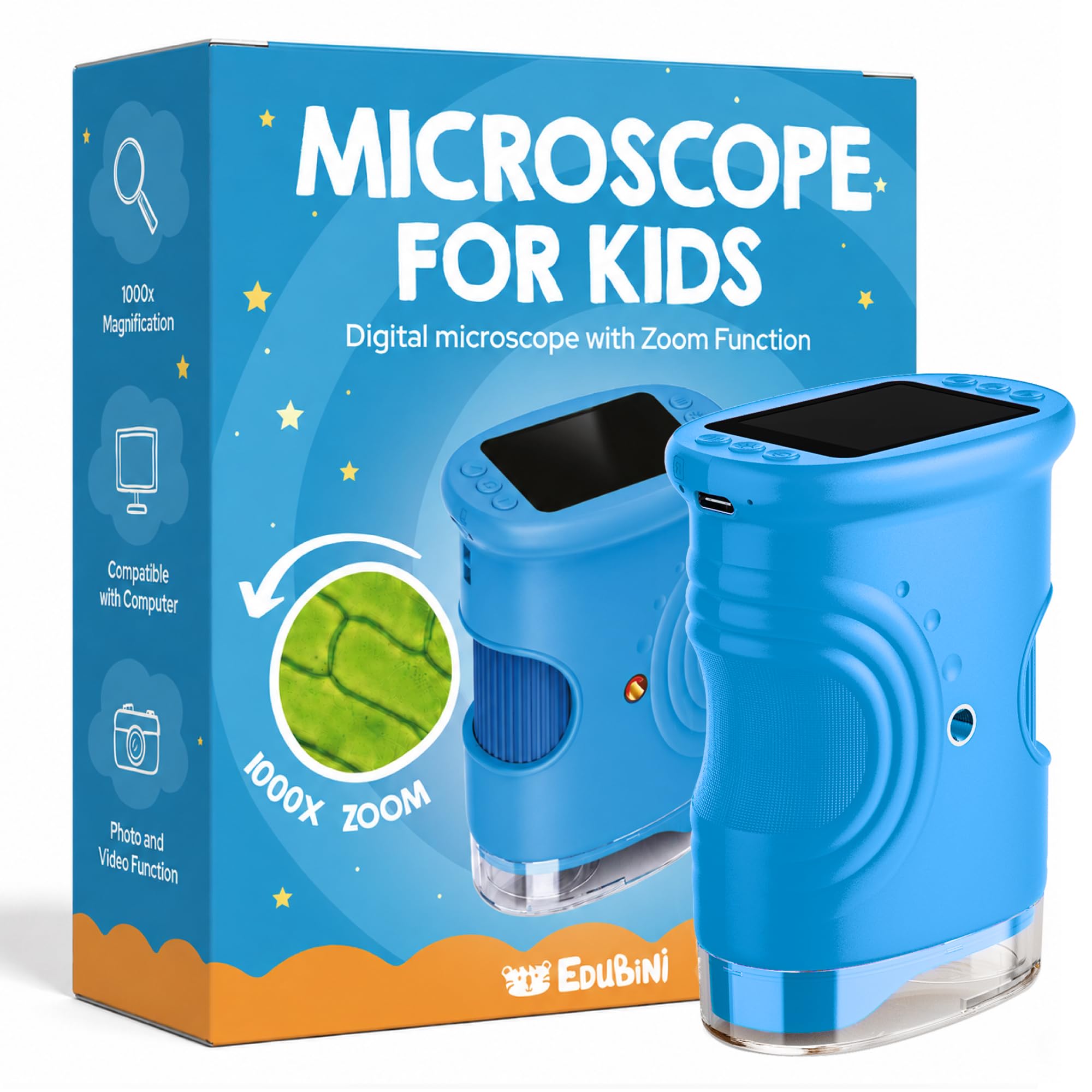
No app, no pairing, no borrowing a phone: the Edubini is the self-contained version of the screen microscope. Switch it on, twist to zoom, and watch the 2-inch screen fill in.

That independence is worth something in a house where the tablet is already a battleground. It weighs 5.4 ounces, charges over USB, comes with a lanyard and has a screen that stays where the child points it. Treat the 4K and 1000x figures as listing language: on a pocket scope the top of the range is a finder rather than a laboratory view, and the same is true of every scope in this group.

What we can judge is the shape of the thing. A pocket scope with nothing to install is the version a five-year-old can own outright, and at 5.4 ounces it is lighter than most of the screen scopes here. The catch is a 30-day warranty, the shortest window in this group, so open it, charge it and put it through a week of real use while that window is still open.

Bottom line: Worth a look if you want a self-contained screen scope with no app, no pairing and nothing to install.
#2

WINWEND Handheld Microscope

WINWEND Handheld Microscope

First microscopes

Doodle Score 9.2/10
Check Price

Worth Noting

  • Only six prepared slides included
Light
8 LEDs, six levels
Connection
USB to PC
Magnification
100x to 1000x
Prepared Slides
6 included
Read the full review

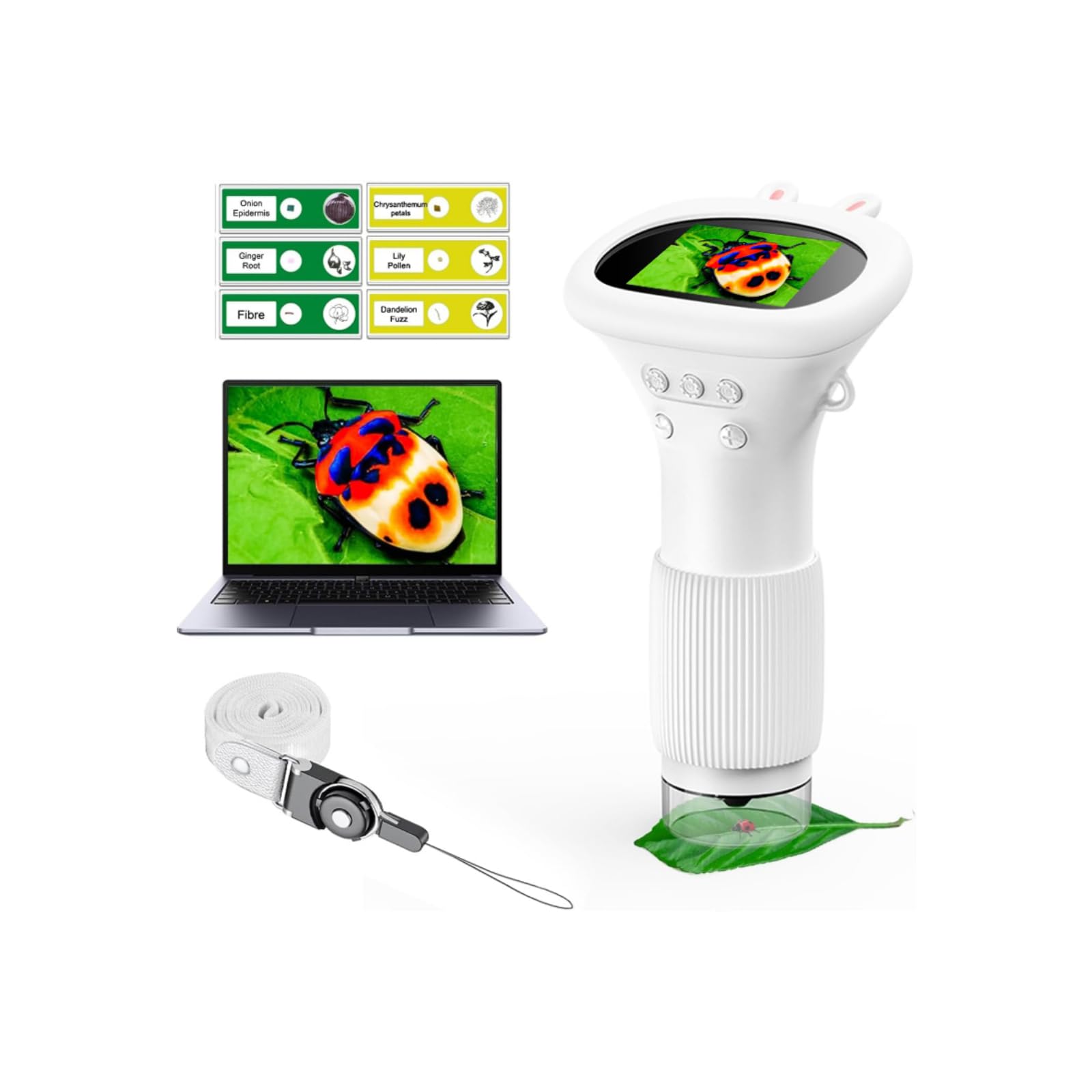
The USB socket on the side is the detail that decided this for us. Plug the WINWEND into a laptop and the view from the little screen fills the bigger one, so a child can show you the wing of a fly without handing the scope over. Add a twist-to-focus ring and no eyepiece to squint into, and you have the microscope we recommend first to most families.

The handheld shape does most of the work. A kid points the lens at a leaf, a coin or a moth and looks at a screen — no dark tube, no closing one eye, no slide to prepare before anything appears. We paid attention to that because it is where cheap microscopes lose children: the moment the image will not come, the toy goes in a drawer. Eight LEDs with six brightness levels let you dim the light for a shiny coin and push it up for something solid.

The 100x to 1000x range needs translating. It is a zoom rather than lab magnification, and the top end is soft and hard to hold steady; the useful view sits much lower. Six prepared slides come in the box, and the built-in memory saves photos without a card, so a child can keep a record of what they found without borrowing your phone.

The limits are the ones that come with the format. Six prepared slides are a starter set rather than a collection, and you will be buying more if the hobby sticks. If a hard case and a memory card matter more to you than the laptop connection, the BEBANG kit covers the same ground with better packaging. That is a preference, not a correction — this is still the microscope we point to for a first look at the very small.

Bottom line: We recommend it first because a child can point it, focus it and see the result on a screen without an adult holding the other end.

#3

National Geographic Dual LED Microscope

National Geographic Dual LED Microscope

Older beginners

Doodle Score 9.2/10
Check Price

Worth Noting

  • Focusing the higher lens takes practice
  • Premium price for a first microscope
Lenses
20x and 50x
Kit Size
50+ pieces
Illumination
Upper and lower LED
Prepared Slides
10, plus 10 blank
Read the full review

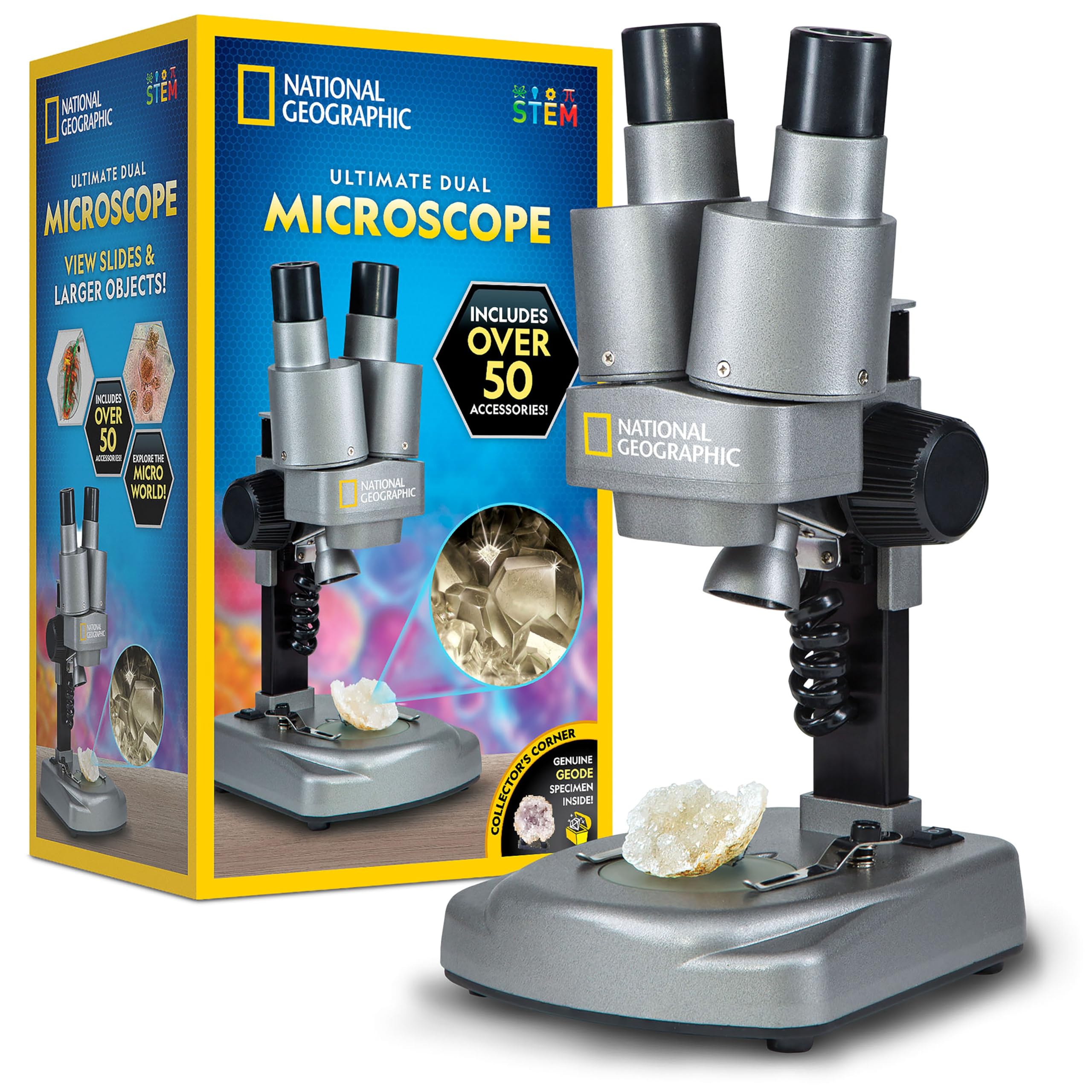
This is the only scope here that is a microscope in the school-lab sense: two optical lenses in a tube, a stage for a slide, and a light that shines up through the specimen. It is also the most expensive pick in this group by a wide margin, which is the honest place to start.

The second light is what keeps it in use. Switch to the upper illumination and the stage becomes a lit surface for a coin, a leaf, a scrap of fabric or the geode that comes in the box — real three-dimensional objects rather than the flat silhouettes a slide-only scope gives you. In practice that upper light gets used more than the lenses do, because a seven- or eight-year-old would rather examine a dead beetle than a prepared onion root.

The kit is generous: ten prepared slides, ten blanks with covers, tweezers, a dropper and a full-color lab guide, all in a padded case that weighs about two pounds. The guide is the part that matters most. It hands a child the next thing to look at instead of leaving them with an empty stage and no idea what to put on it.

For the patient eight-to-twelve-year-old who wants the real ritual — slide, stage, focus knob — this is the pick we point to, and the extra money buys a tool rather than a toy. Just be ready to sit beside a younger child at first: finding focus at the higher lens takes a steady minute, and impatience is what ends these sessions early.

Bottom line: For a patient eight-to-twelve-year-old who wants real lenses and a slide tray, we think this is worth the extra money.

#4

Ashfly Handheld Microscope

Ashfly Handheld Microscope

Backpack duty

Doodle Score 9.2/10
Check Price

Worth Noting

  • No computer connection for group viewing
  • No case included
Screen
2 inches
Weight
8.5 oz
Storage
400 photos built in
Magnification
Up to 1000x
Read the full review

Ashfly's little orange scope does nearly everything our top pick does, and it is the one we reach for when the microscope is going into a backpack. The lanyard is the reason: fifty centimeters of strap means a dropped scope swings instead of hitting the pavement, which is more protection than most of these come with.

The rest is familiar in a good way. A 2-inch screen, a three-level LED, twist-to-focus, and storage for about 400 photos built in, so there is no card to lose and nothing to plug into a computer. The detachable screen decoration kit is the kind of silly extra that makes a present land with a six-year-old.

The middle of the zoom range is where a child will spend nearly all their time, and that is where this one is happiest; push it to the top and the picture goes soft like the rest. What you give up against the WINWEND is the computer connection, so if the appeal was the whole family gathered around a laptop, go the other way.

Bottom line: A close second to our top pick for backpack duty, with a lanyard and enough built-in memory to leave the card at home.

#5

GeoSafari Jr. Talking Microscope

GeoSafari Jr. Talking Microscope

Preschoolers

Doodle Score 9.2/10
Check Price

Worth Noting

  • Slides are printed images, not specimens
  • Three AAA batteries not included
Modes
Fact and quiz
Slides
20 slides, 60 images
Batteries
3 AAA required
Eyepieces
Two
Read the full review

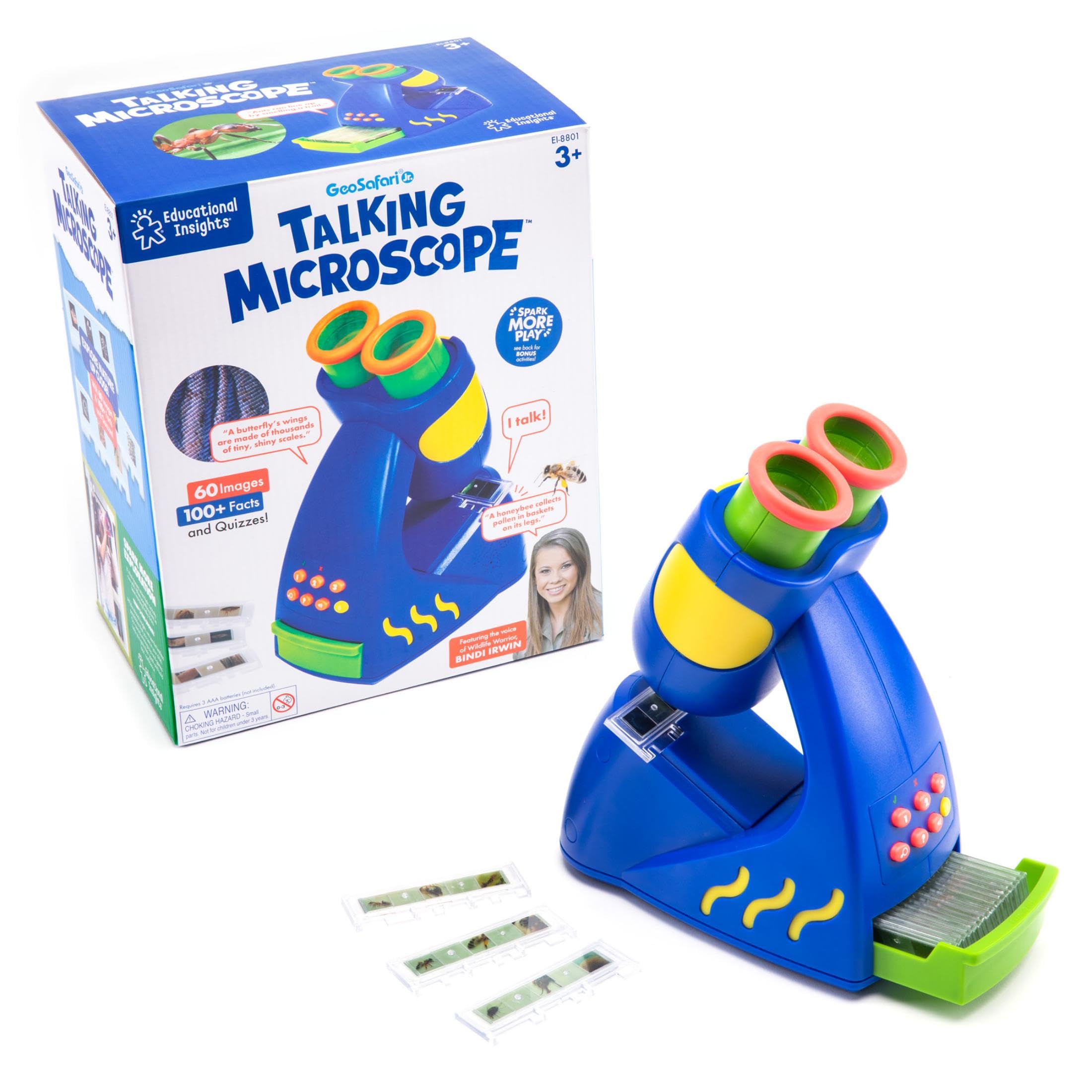
A four-year-old cannot close one eye and squint into a tube, which is the whole argument for the GeoSafari. Two wide eyepieces sit on a chunky plastic body so both eyes stay open, and Bindi Irwin's voice tells them what they are looking at.

Twenty slides carry sixty full-color images, and two modes do the teaching: Fact Mode narrates and Quiz Mode asks. There are more than a hundred facts in there, plus a storage compartment for the slides. Three AAA batteries run it, and the whole thing is about a pound and a half of plastic built for small hands.

The thing to understand before you buy is that those slides are printed pictures, not specimens, and nothing from your yard goes under this lens. You are buying a narrated picture viewer shaped like a microscope. For a three- or four-year-old that is the right trade, because it teaches the ritual — choose a slide, look, ask a question — months before the optics would mean anything.

One practical warning: the slide drawer does not latch firmly, so carry it flat and the slides stay where they belong. For a preschooler who wants to do exactly what an older sibling is doing, this is the one we point to; for a six-year-old, put the money into a screen scope instead.

Bottom line: The right first microscope for a three- or four-year-old, as long as you know the slides are pictures, not specimens.

#6

BEBANG PM1000 Digital Microscope

BEBANG PM1000 Digital Microscope

Gifts and travel

Doodle Score 9.0/10
Check Price

Worth Noting

  • Images turn grainy at the highest zoom
  • Only five prepared slides in the kit
Case
Hard EVA case
Storage
32GB card included
Magnification
200x to 1000x
Prepared Slides
5 glass slides
Read the full review

The first thing out of the box is a hard EVA case with a molded slot for every piece: the scope, the charging cable, the neck strap and a small box of five real glass slides. For a present, that is the difference between a microscope that survives a car trip and one that ends up in a drawer with the slides lost.

It is the kit we suggest when the microscope is a gift, because nothing else needs buying on the day. Five magnification steps run from 200x to 1000x, the 32GB card means photos and video without a computer, and the scope itself weighs almost nothing in a small hand. We also noted the slide holder was widened from 2mm to 3mm so real glass slides pass through instead of catching — a small change that makes the five included slides genuinely usable.

Where it gives ground is at the top of the zoom range, where the picture turns grainy and the extra magnification stops buying detail. Five glass slides are also a sampler rather than a collection. Neither matters much for a first year of looking at pond water and insect wings, and the one-year warranty covers the usual drop.

Bottom line: Buy this one when the microscope is a gift: the case, card and glass slides mean it works the moment it is unwrapped.

#7

BMDSAE 382 Handheld Microscope

BMDSAE 382 Handheld Microscope

Dim rooms

Doodle Score 9.0/10
Check Price

Worth Noting

  • No case in the box
Light
8 LEDs, three modes
Battery
600mAh rechargeable
Storage
200+ photos built in
Magnification
Up to 1000x
Read the full review

The 1000x on the front of the BMDSAE is the number that sells it and the number to ignore. On any of these pocket scopes that figure is a digital zoom, and the picture softens long before you get there. What separates this one sits on the other side of the lens.

Eight LEDs with three brightness settings, plus a diffuser over the emitters, mean you can turn the light down for a coin or a glossy beetle instead of blowing out the highlights. That control is why we reach for this one in a dim room: many cheap scopes have a single brightness level and it is too bright. The 2MP camera saves more than 200 photos to built-in memory, the 600mAh battery recharges over USB-C, and a one-year warranty sits behind it. The one thing missing from the box is a case.

Bottom line: We reach for this one in a dim room, where its adjustable eight-LED light keeps the picture usable.

#8

Carson Pocket Micro MM-450

Carson Pocket Micro MM-450

Nature walks

Doodle Score 8.8/10
Check Price

Worth Noting

  • Side-mounted light is blocked by thick objects
Light
Built-in LED
Height
3.9 inches
Weight
2.1 oz
Magnification
20x to 60x
Read the full review

At 3.9 inches tall and about two ounces, the Pocket Micro is the scope that actually leaves the house. It goes in a jacket pocket next to a bag of trail mix, and it does not need a slide, a screen or a flat surface to be worth carrying.

Twenty to sixty power is a modest range, and that is the point. The low end gives a wide field of view, so finding the subject — a lichen, a leaf margin, a beetle's back — takes a second rather than a minute of hunting around. The built-in LED does the lighting and the aspheric lens keeps the edges reasonably sharp.

The light sits off to the side, though, so anything thick shadows its own surface and thin subjects look best. For a kid who would rather turn over a log than work through a box of prepared slides, this is the pick, and the limited lifetime warranty suits a pocket tool. It also rewards a steady hand: freehand, in the air, it is fiddly for anyone, and a seven-year-old will want a table and a moment of patience.

Bottom line: Our pick for pockets and nature walks: twenty to sixty power in a body small enough to forget you packed it.

How We Tested the Best Microscopes for Kids

We started with more than 30 microscopes sold for kids and narrowed the list by reading spec sheets, prices, and one-star reviews — the complaints that repeat are almost always about a focus knob that slips or a light too dim to see through. Anything with optics that couldn't be refocused or a light that only worked in a bright room got cut before we bought it. That left 12 scopes, and they've been in rotation for six months.

Testing happened where these actually live: the kitchen table after school, a card table in the backyard next to a jar of pond water, and a sleepover where four kids argued over one eyepiece. Each child, ages four to eleven, was handed a prepared onion-root slide and told to bring it into focus alone, and we noted who got there and who handed it back. We ran that same slide at every magnification setting to see whether the higher numbers resolved new detail or simply went dark and grainy, and viewed specimens by a bright window and in a dim living room to judge how much the built-in light carried.

Slides got their own scrutiny: we counted usable prepared slides per kit, checked whether the plastic ones scratched within a week, and watched whether the stage clips held a slide steady while small hands turned the focus knob. Every scope was dropped from table height onto hardwood, wiped with a damp cloth, and carried in a backpack to a grandparent's house. We tried each one on a kid's desk shelf and in a drawer, judged the guidebook by whether a child could follow one experiment alone, and noted which scopes the kids returned to without being asked.

How to Choose Microscopes for Kids

Screen or Eyepiece

The first fork is how your child looks. A screen scope lets a five-year-old work alone, keeps both eyes open and lets two people watch at once; our top pick and the BEBANG both work this way. A compound scope with an eyepiece teaches the school-lab ritual, but it needs a child who will sit still and a parent nearby for the first few sessions.

Our rule is a screen up to about seven, either after that. The trap is buying the compound kit because it looks like the one from school: for a preschooler it sits unused while the box stays sealed.

What the Magnification Number Means

Pocket digital scopes advertise 1000x, and what they deliver is a digital zoom that softens long before the top. A 20x to 60x pocket scope with real optics often shows a clearer, wider view than a digital scope cranked to maximum.

So look at the starting magnification and the light instead. A wide, bright 20x view gets a child hooked, and detail can come later. If a listing brags only about its highest number and says nothing about illumination, the light is probably an afterthought.

Slides, Specimens and the Second Light

Prepared slides are the easy start, but they run out. Check that the scope can light an opaque object — a coin, a leaf, a beetle — because that is what keeps it in use once the slides have been memorised. A compound scope with only a below-stage light gives you silhouettes; an upper light or a ring of LEDs around the lens lets a child examine solid things.

If the scope is slide-only, price in a refill set at the same time, or the kit is finished in a week.

Batteries, Cases and Where It Lives

Check what powers it and what it comes in. Three AAA cells are an ongoing cost and a chore, while a rechargeable scope with a charging cable is easier for a child to own. A hard case matters if it travels and a lanyard matters more than it sounds if it goes outside.

Then plan its home. A microscope that lives on the kitchen counter gets used; one that goes back in the toy bin does not. That is the cheapest upgrade you can make.

Frequently Asked Questions

Final Verdict

For most families the WINWEND is the one to buy: a screen instead of an eyepiece, six slides in the box, and a USB port that turns a solo toy into something the whole table can watch.

If the child is eight or older and wants real lenses and a slide stage, the National Geographic Dual LED is the better instrument and worth the premium. And if the microscope is going outside, the Carson Pocket Micro is the one that ends up in a pocket rather than a drawer.