STEM & Learning

Best Marble Runs of 2026

A marble run looks like an easy win: drop a marble in, watch it spiral, listen to the clatter. Then you get it home and discover that some sets collapse mid-run, some instructions are harder to decode than the marble maze itself, and some are so simple that kids lose interest before dinner. The best ones keep the fun going beyond the first build. They assemble without a family argument, survive being taken apart and rebuilt, and feel worth the money whether you are buying for your own kids or as a gift.

I've spent the past six months with 12 marble runs, building them on living-room floors and kitchen tables and watching kids who definitely do not read instructions. We paid attention to how clearly the steps were explained, whether pieces held tight after repeated rebuilds, and whether the complexity matched the age on the box. A few sets looked impressive but were a chore to assemble; others were easy but got old fast. The picks below balance quality, gameplay, and value so you can choose by the builder you're buying for.

#1

MAGBLOCK 176-Piece Magnetic Marble Run

MAGBLOCK 176-Piece Magnetic Marble Run

Magnetic tile play

Doodle Score 9.6/10
Check Price

Worth Noting

  • Only 12 marbles for group play
  • Tube connections need adult help
Pieces
176
Marbles
12 glass marbles
Compatibility
Magblock and major magnetic blocks
Recommended Age
8 years and up
Read the full review

Magnetic tiles turn the marble run into a colorful wall or box. This 176-piece set leans into that: 74 magnetic pieces, 56 pipeline parts, a turntable, a windmill, and 12 glass marbles give kids several ways to route a marble, and the magnets are strong enough that a finished structure does not sag the moment it is nudged.

The open-ended building is the real draw, but it comes with a learning curve. The tubes need a deliberate push to seat in the tiles, and younger builders will need help getting them connected without knocking the walls apart. The listed age of 8 and up fits that. Once the frame is up, a child can build upward, sideways, or around a corner, which is a different kind of play from a conventional chute tower.

The 12 marbles are modest for a set this size, so a race with friends will run short unless you add more. That is a small trade-off for the flexibility. If your child already builds with magnetic tiles, this is the set that turns those tiles into a working track rather than a stack of pretty shapes.

Bottom line: We recommend this for magnetic-tile families who want a marble maze that can grow sideways as well as up.
#2

GraviTrax Starter Set

GraviTrax Starter Set

Engineering-minded builders

Doodle Score 9.6/10
Check Price

Worth Noting

  • Requires patience and planning
Pieces
122
Included
Construction plan booklet
Accreditation
MESH accredited STEM toy
Recommended Age
8 years and up
Read the full review

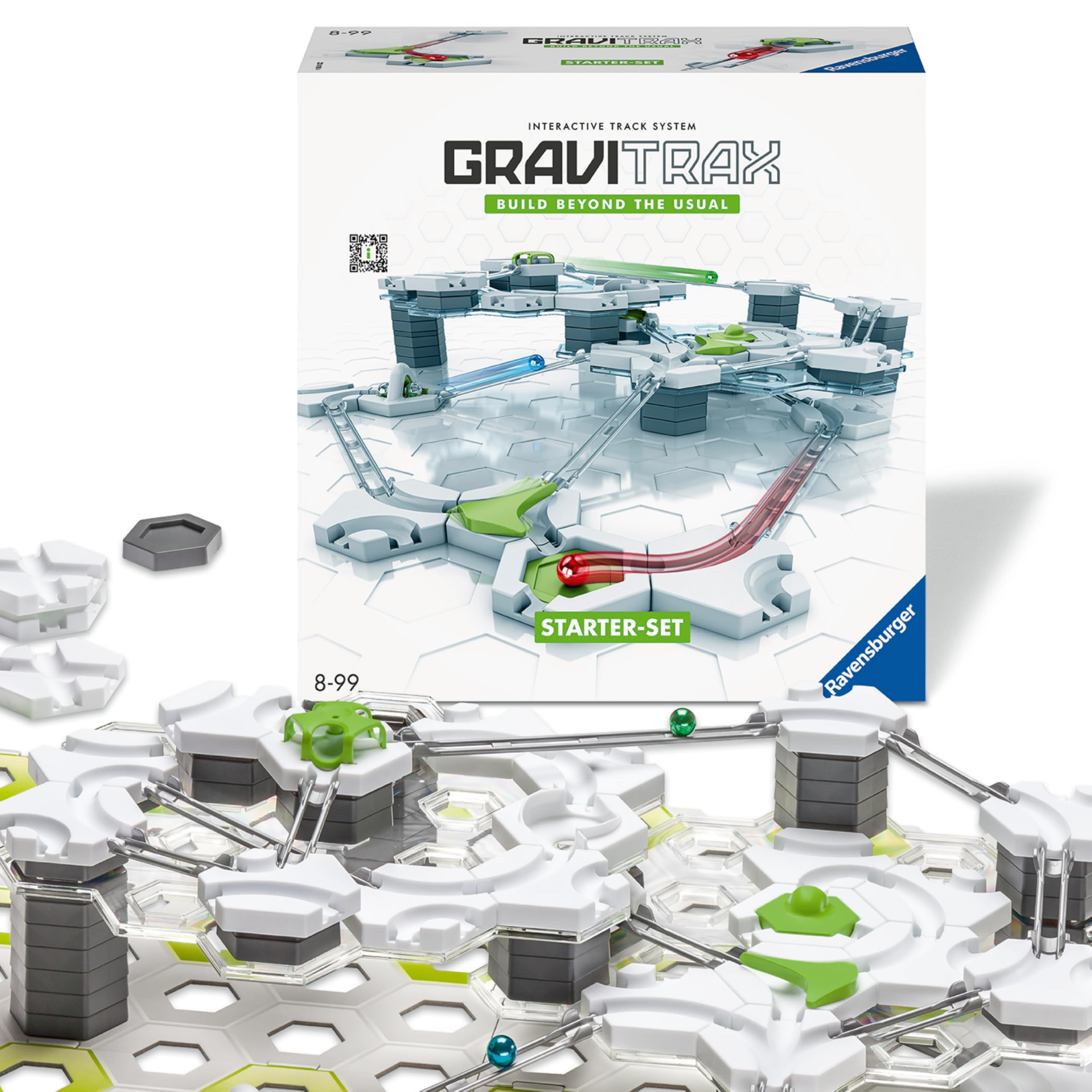
GraviTrax is less a toy you dump on the floor than a kit you design with. The 122-piece starter set uses gravity, magnetic elements, and stackable levels to send marbles through a run you have planned rather than improvised, and the included construction booklet gives that planning a place to start.

What we appreciate is the discipline of it. The pieces are precise, the levels ask you to think about height and momentum, and the whole thing rewards a child who likes to test a theory and then change one variable. It is not the set for a four-year-old who wants a marble to go down a chute right now; the listed age of 8 and up is doing real work here, and younger builders will need an adult to keep the structure square.

The trade-off is that GraviTrax can feel more like a project than a toy. A run that works is satisfying, but it may take several tries, and the starter set leaves obvious room for expansion. For the right kid, that is the point: it is a system to grow with, not a single afternoon's build.

Bottom line: We point engineering-minded kids and their adults here when the pleasure is in planning a run, not just watching it.

#3

National Geographic Glowing Marble Run

National Geographic Glowing Marble Run

First marble run

Doodle Score 9.4/10
Check Price

Worth Noting

  • Small starter capacity limits bigger builds
Pieces
80
Storage
Storage bag
Glow Marbles
15
Recommended Age
8 years and up
Read the full review

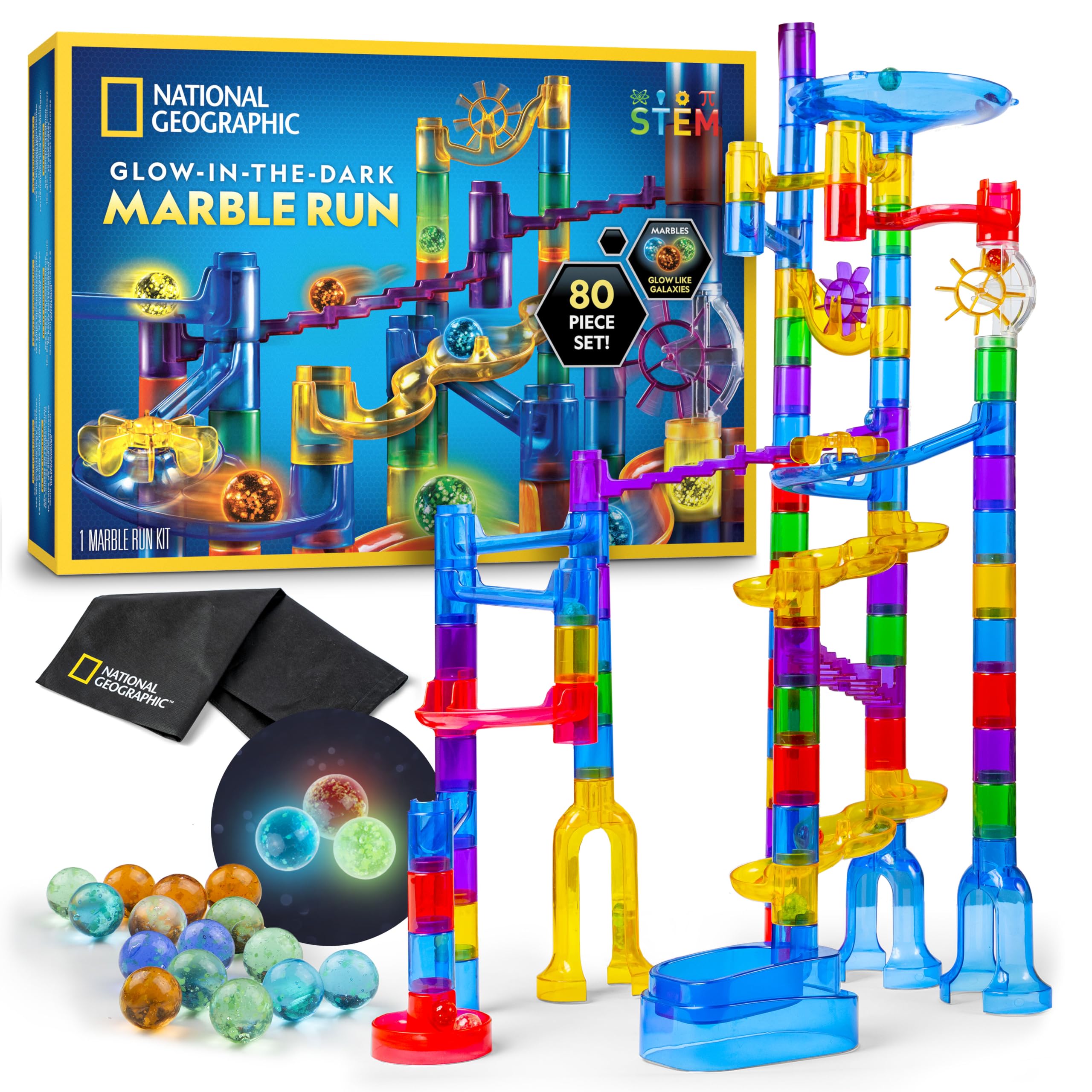
Five sturdy bases and 15 glow-in-the-dark glass marbles make this the set we reach for first. The 80-piece kit is big enough for a run worth watching, but not so big that a new builder spends the afternoon sorting plastic. The pieces fit tightly, and the action pieces give marbles a few unexpected turns on the way down without making setup feel like a construction project.

We like the storage bag more than we expected. Marble runs create a lot of small parts, and one place for the bases, tubes, and marbles makes the difference between a toy that comes out often and one that stays in the closet. The glow marbles are a genuine second act: charge them in light, dim the room, and the same track feels new. They are glass, so the listed 8-and-up age is worth respecting.

The set's size is its main limitation. This is a starter kit, not a table-filling installation, and ambitious builders will run out of pieces before they run out of ideas. That is also why it works so well as a first set: learn the joints and the flow, then add another kit when the habit sticks. The marble does the rest.

Bottom line: We recommend this as the first marble run for most families: manageable to build, glow-in-the-dark fun, and a storage bag that makes cleanup painless.

#4

Marble Genius Super Set

Marble Genius Super Set

Large family builds

Doodle Score 9.4/10
Check Price

Worth Noting

  • Taller builds can wobble or pop apart
App
Marble Genius app
Pieces
150
Build Guide
In-app projects
Recommended Age
4 years and up
Read the full review

With 150 translucent pieces, this set turns a coffee table into a proper marble city. The mix of tubes, chutes, and connectors gives kids enough parts to build something tall and tangled, and the Marble Genius app adds step-by-step projects for families who want a plan rather than a blank canvas. It is listed for ages 4 and up, though the part count tells you this is a family kit rather than a solo project for a preschooler.

The reason to choose it is the scale. A bigger set means longer runs, more junctions, and more chances for two kids to build together instead of taking turns with a handful of pieces. The catch is fit. Some pieces need a firm push to seat, and taller builds are more likely to wobble or pop apart when someone brushes past. We found that building low and wide first makes the taller towers behave much better.

For a family that wants one large shared set, it earns its place. For a younger child who wants to build alone, the fit and the part count make it a harder first choice. A big set like this is less about one perfect run than about the afternoon of trying, failing, and adding another curve.

Bottom line: We choose this when you want one large, expandable set to build together, and accept that the taller runs need a steady hand.

#5

Marble Mania 162-Piece Set

Marble Mania 162-Piece Set

Young builders

Doodle Score 9.2/10
Check Price

Worth Noting

  • Builds can come apart with a bump
Marbles
36 glass and 36 plastic
Storage
Storage tub
Building Pieces
90
Recommended Age
4-8 years
Read the full review

The storage tub is the first thing that makes this set easy to live with. Marble runs are notorious for scattering parts, and Marble Mania includes a sturdy plastic tub plus a full-color guidebook, so the 90 building pieces and 72 marbles have a home after the run comes down.

The set is aimed at roughly ages 4 to 8, and the parts suit that crowd: the chutes pull apart and push together without much force, and the guidebook gives four builds to copy before a child starts improvising. A four-year-old can help with the lower chutes while an adult presses the upper frame into place, which turns setup into part of the play. We like that the tub is part of the toy rather than an afterthought; it makes cleanup quick enough that the set is more likely to come back out tomorrow.

Sturdiness is the compromise. The pieces connect easily, which also means a bump or a younger sibling can knock a build apart, and the taller designs need a patient hand. For a starter set, the marble count is generous and the storage is genuinely useful. This is the one we choose when the priority is a manageable toy that tidies away.

Bottom line: We choose this when quick cleanup matters, because the storage tub and generous marble count make it the easiest set here to live with.

#6

ThinkFun Gravity Maze

ThinkFun Gravity Maze

Solo logic play

Doodle Score 9.2/10
Check Price

Worth Noting

  • Fixed kit limits open-ended building
  • Later cards are tough for younger kids
Pieces
75
Players
Single player
Challenges
60 challenge cards
Recommended Age
8 years and up
Read the full review

Gravity Maze is the marble run we recommend for the child who likes a solvable puzzle more than a free-build toy. A marble drops through towers you place, and the 60 challenge cards move from beginner to expert, so the goal is to get from start to target rather than to invent a track from scratch. The single-player setup means a child can work through a problem without waiting for a sibling or an adult to build first.

We like that it teaches without announcing itself. The towers are only part of the puzzle; the fun is in testing a layout, watching the marble miss, and adjusting the next tower. The 8-and-up age recommendation fits the later cards, though younger kids can start on the easy levels with help. The set is compact enough to leave on a table between sessions, which is a real advantage over a floor-filling run.

The limitation is variety. This is a puzzle with a fixed kit, not an open-ended construction set, and a child who wants to invent a new track every day will get less from it. As a solo challenge or a quiet gift for a patient thinker, it earns its place.

Bottom line: We recommend it for the child who likes a solvable puzzle more than a free-build toy.

#7

JOYIN 236-Piece Motorized Marble Run

JOYIN 236-Piece Motorized Marble Run

Motorized looping runs

Doodle Score 9.2/10
Check Price

Worth Noting

  • Elevator and motor can jam
  • Instructions can be unclear
Pieces
236
Feature
Motorized elevator
Glow Marbles
30
Recommended Age
3 years and up
Read the full review

A motorized elevator changes the rhythm of a marble run: instead of building a track and starting over, you can watch marbles loop back up and go again. JOYIN's 236-piece set puts that elevator at the center, along with 30 glow-in-the-dark marbles, so the draw is a run that keeps moving after the first drop.

There are enough track pieces to build a proper circuit, and the glow marbles give it a second life in a dim room. The elevator is the feature that sets the set apart, and it is also the part we treat as a family-build project rather than a solo toy for a young child. Give it a clear, level base and an adult nearby the first time, and the loop is the reward.

Assembly is the other friction point. The pieces snap together, but younger kids will need help keeping the frame steady. That is not unusual for a set this size, but it is worth knowing before you hand it over as a gift.

For the price, the piece count is generous, and the looped play is genuinely different from a one-way run. We recommend it to families who want the motorized feature and will build it together; if you want a set a child can run alone, a simpler gravity track is the better first step.

Bottom line: We recommend this for families who want a motorized looping run and will build it together, not for a child who needs solo play.

#8

National Geographic Magnetic Marble Run

National Geographic Magnetic Marble Run

Fridge play

Doodle Score 9.2/10
Check Price

Worth Noting

  • Magnets can shift on a hard knock
Pieces
75
Marbles
15
Mounting
Vertical magnetic surfaces
Recommended Age
10 years and up
Read the full review

The fridge door becomes the track here. National Geographic's magnetic marble run uses 42 tracks and connectors plus 17 trick pieces that cling to any vertical magnetic surface, so a child can build a maze at eye level instead of kneeling on the floor. That is a genuinely different way to play, and it is the reason this set stays in our list despite a narrower fit.

The magnets are the whole story. When they hold, the pieces snap together neatly and the marble drops through a run that looks impossible from the outside. The problem is that a hard drop or a slammed fridge door can shift a piece out of line, and the run is only as good as its weakest joint. We treat it as a tabletop-style building project for a patient kid, not a toy to leave on a busy family fridge.

The listed age is 10 and up, and that fits. Younger children can help place pieces, but the planning and the delicate alignment are better for older builders. If you want a freestanding run with room to expand, choose one of our other picks.

If the vertical challenge is the appeal, this is the set that does it. It is not the first marble run we hand a young child, but for an older builder with a magnetic wall and a taste for careful work, it turns the kitchen into a workshop.

Bottom line: We recommend this for older builders with a magnetic wall who want a vertical puzzle, not a freestanding track.

How We Tested the Best Marble Runs

We built a shortlist from marble runs sold in stores and online, filtering by age range, piece count, footprint, and price, and dropping sets with vague age guidance or no clear assembly support. Then we brought in 12 and spent six months living with them. They were built on living-room floors and kitchen tables, taken apart for storage, rebuilt by kids and adults, and carried to a grandparent's house for a weekend. We timed first-time assembly, noted whether instructions relied on pictures or paragraphs, and watched which builders could follow them without help.

Every set went through the same routine: build from the box without help, send a handful of marbles down, rebuild twice, and store it. We recorded whether pieces needed excessive force, whether joints loosened after a week assembled, and whether marbles jumped the track or stalled. For ease of use, we watched younger kids try to snap pieces together without adult hands; for complexity, we compared the boxed age range with what actually happened at the table. A set could look impressive and still lose points if it was a chore to assemble.

We also treated them like gifts rather than lab equipment: did kids come back to the set after the first build, and did adults feel the piece count and price matched the play? Sets that survived repeated rebuilds, kept marbles moving, and stored without a fight rose to the top. We'll keep rebuilding these with our test families and update if anything changes.

How to Choose Marble Runs

Match the set to the builder

A first marble run does not need to be the biggest one. A set in the 70-to-100-piece range is enough to learn how the joints work and watch a marble finish a run; a 150-piece set is better for a family that wants one shared build with more branches and a longer track. Check the age on the box against the child, not the other way around. A 4-year-old can help place chutes, but an adult usually handles the frame.

Stability beats a tall tower

A wobbly run is not fun to play with, no matter how many pieces it has. Look for a wide base, connectors that seat firmly, and pieces that do not need a fight to separate. Build low and wide first; height comes later. Magnetic runs depend on strong magnets and a clean, flat surface, and a vertical set on a fridge door has to survive a slam. A short track that stays put beats a tall one that needs rebuilding every few minutes.

Decide whether a special feature is worth it

Glow marbles, motorized elevators, and magnetic tiles each change how the set is played. Glow is a second act rather than a reason to buy; motors add a looping run but also a mechanism that can stop; magnetic tiles trade a traditional chute tower for vertical, open-ended building. We prefer a simple track that stays together over a feature that needs troubleshooting, unless the feature is the whole point for your child.

Plan for storage and expansion

Marble runs create small parts, so a storage bag or tub is not a luxury. It decides whether the set comes out again next week. If you expect to add pieces, check compatibility before buying a second brand: MAGBLOCK says it works with Magblock and other major magnetic blocks, while GraviTrax is designed as a system with expansions. A storage tub and a known system are worth more than a few extra pieces in a flimsy box.

Frequently Asked Questions

Final Verdict

Start with the National Geographic Glowing Marble Run. Of the sets here, it has the best balance of a manageable build, tight joints, and a glow feature that gives the same track a second life. If your family wants one big shared build, choose Marble Genius. If the child is an engineer who likes plans, GraviTrax is the better fit. The right choice follows the builder's patience and the amount of help available.