STEM & Learning

Best Handwriting Aids for Kids of 2026

Homework time used to end with my son flopping sideways in his chair, pencil balled up in his fist. The problem wasn't his effort—it was the tool. A good handwriting aid takes the guesswork out of where fingers should sit, keeps the wrist steady, and makes the page feel less like a hill to climb. Over the past three months, my team and I have tested 14 aids—pencil grips, ergonomic and weighted pencils, slant boards, and grooved writing tablets—during homework sessions, after-school practice, and long car rides where the only flat surface was a lap desk.

The aid that works is the one your child forgets they're wearing—it should feel like a natural extension of the hand, not a piece of equipment to manage. That means paying attention to grip size, material softness, and whether the thing stays put after twenty minutes of pressing down. We looked for aids that earned their place in the pencil case and kept performing after weeks of sharpening, erasing, and being shoved into backpacks. The ones below did exactly that.

#1

Carson Dellosa Printing Workbook

Carson Dellosa Printing Workbook

Kindergarten printing

Doodle Score 9.4/10
Check Price

Worth Noting

  • Sparse tracing guides on some pages
Pages
80
Page Size
8.3 x 10.8 in
Grade Range
K-2
Read the full review

Eighty pages, ordinary paper, and nothing to refill: that combination is why this is the printing workbook we recommend first. Each letter gets its own page with a model to trace and lines to repeat it on, and the book works up to words and sentences. There is nothing clever about it, and for daily practice that is a feature rather than a flaw.

What struck us while working through it is how much repetition fits on a page. A child still forming letters slowly can spend a week on four of them and come out with something deliberate, and the ruling gives a first-grader enough room that letters do not collapse into each other. The grade range is honest, too: kindergarten through second grade is exactly the stretch in which printing is being taught.

The limit is the youngest end of that range. The lines sit closer together than a just-turned-four manages comfortably, so a three- or four-year-old does better with a grooved copybook where the page does more of the guiding, and this book makes more sense at five and six.

Bottom line: Eighty pages, ordinary paper and nothing to refill — that combination makes this the printing workbook we recommend first for kindergarten and first grade.

#2

Carson Dellosa Beginning Cursive

Carson Dellosa Beginning Cursive

Cursive beginners

Doodle Score 9.4/10
Check Price

Worth Noting

  • 32 pages will not last a keen writer long
Pages
32
Page Size
8.45 x 10.85 in
Grade Range
1-3
Read the full review

Cursive is a narrow job: the shape and order of joined letters, and not much else. This book starts with single letters and their strokes, groups them by similarity, and works up to words and then sentences, which is the sequence a beginner needs.

The models are the useful part. Each letter is shown large enough to see where the pencil starts and which way it travels, and there is enough space to produce three or four decent versions before the page runs out. The lines are generous for a first-grader, which is not something every cursive book manages.

Our judgement is that it is worth buying for the practice and not for the teaching. There are no notes for an adult and no explanation of why a letter is formed the way it is, so it works alongside whatever school is doing; if you are teaching cursive from scratch, work out the strokes yourself first. Buy it when joined letters are on the timetable, and keep the printing workbook going if the pencil hold is still shaky.

Bottom line: Cursive beginners in grades one to three get the stroke order and a page to repeat it on, in a 32-page book that stops when the job is done.

#3

The Pencil Grip Original

The Pencil Grip Original

Everyday grip correction

Doodle Score 9.2/10
Check Price

Worth Noting

  • Snug fit needs a firm twist to install
Fits
Pencils, pens, crayons, markers
Pack Size
6 grips
Grip Style
Contoured tripod
Handedness
Ambidextrous
Read the full review

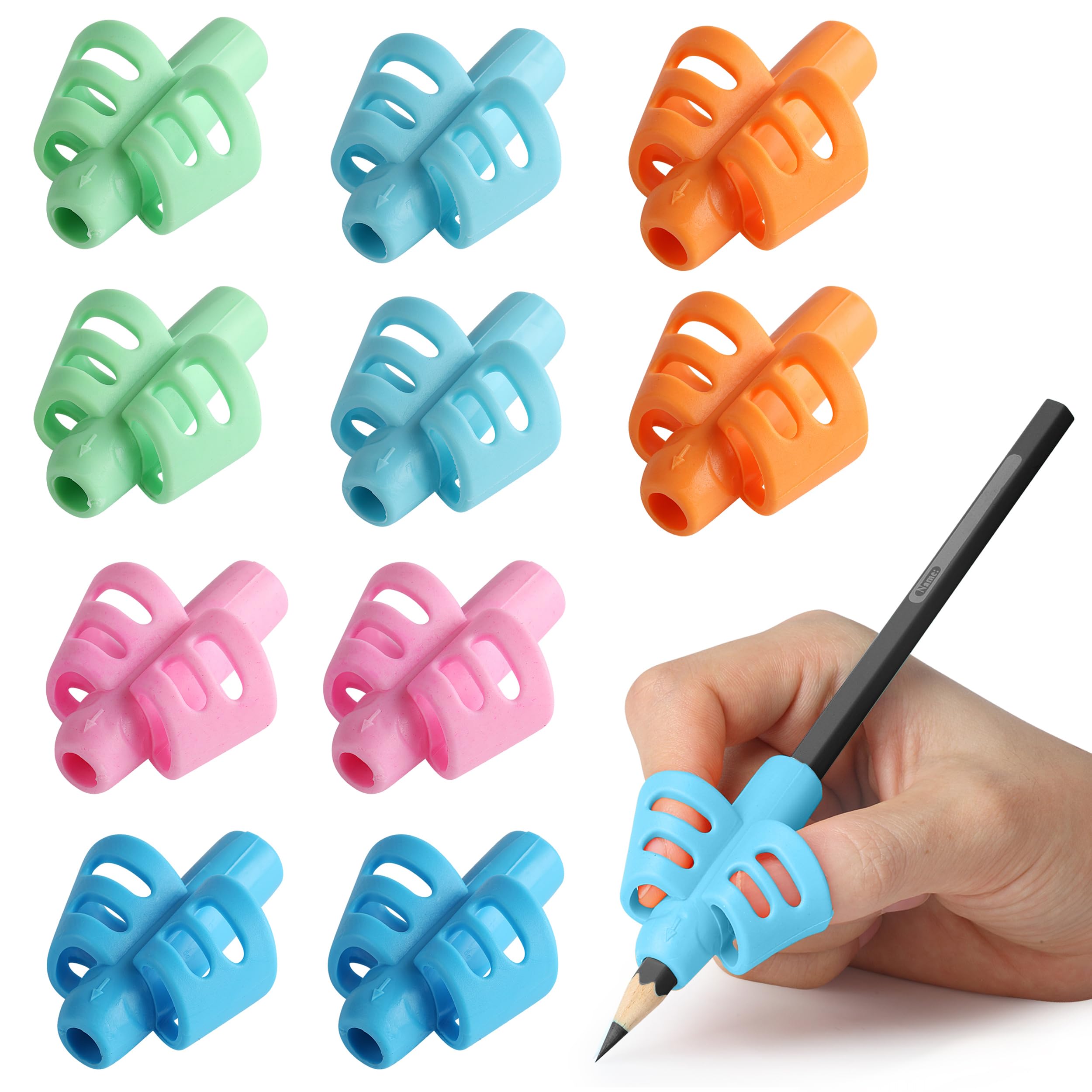
The shape does most of the teaching, and that is why this is the grip we hand to most families first. It is a contoured sleeve that a small hand wraps around so the fingers land close to a tripod hold instead of a fist; it works the same way in either hand, and it slips onto pencils, pens, crayons and markers, so the grip learned on a crayon at home is the one waiting at school.

Range is the other reason we keep coming back to it. The same sleeve suits a five-year-old learning the hold and an adult with a sore thumb, the rubber is soft enough that a long homework session does not leave fingers aching, and the finger cushion takes some of the pressure a nervous writer applies. Six to a pack means one can live in the pencil case, one at the kitchen table and one at the bottom of a bag.

Where it stops short is progressiveness. This is one shape, so a child still trying out different holds gets more from the Stylo assortment, and a thumb that tucks under the pencil needs the looped Firesara instead. What it does well, it does identically every time, which is exactly what a habit needs — and a lost grip does not end the week when there are five more in the drawer.

Bottom line: The grip we hand to most families first: the contoured shape lands small fingers in a tripod hold, it works in either hand, and it fits the pencils, pens and crayons already in the house.

#4

Stylo Pencil Grips

Stylo Pencil Grips

Toddlers learning grip

Doodle Score 9.0/10
Check Price

Worth Noting

  • Pitched at toddlers 2-5, so older writers outgrow it
Material
Silicone
Pack Size
6 grips
Grip Style
Assorted tripod shapes
Handedness
Ambidextrous
Read the full review

A two-year-old's first grip and a five-year-old's independent one are not the same thing, which is the idea behind this pack. Six grips, no two the same shape: wider, softer sleeves for small hands, narrower ones closer to a plain tripod, and a couple in between. They are silicone, ambidextrous, and they slide onto standard pencils, crayons and markers.

What we like most is how little friction there is. These go on with a push rather than a fight, which matters when the person using one is two and has no patience for adult help, and because the shapes differ, a child can try one, reject it and try another without the whole exercise turning into a lesson. The softness helps too: a toddler squeezing hard gets some give back instead of a hard ridge digging into a finger.

The silicone wipes clean after a marker-heavy afternoon, and a grip lost to the sofa does not end the experiment. Six in a bag means there is always another shape to try when the current favourite goes missing.

Bottom line: Start a two- to five-year-old here: six shapes for small hands, soft silicone that goes on without a fight, and enough variety to find the hold that finally clicks.

#5

Firesara Training Grips

Firesara Training Grips

Finger placement

Doodle Score 9.0/10
Check Price

Worth Noting

  • Highest cost per grip of these packs
Material
Silicone
Pack Size
4 grips
Grip Style
Finger holes with third loop
Handedness
Ambidextrous
Read the full review

Some grip problems are general and some are specific. A thumb that hides under the pencil, or a middle finger that climbs over the top and takes over the writing, is specific, and this is the grip built for it: thumb and index finger go into their own holes, and a third loop at the back holds the middle finger where it can support the pencil instead of steering it.

The elephant shape is not decoration. The trunk and ears give a child something to hold and something to like, and these are the grips that get picked up without an argument — which, in practice, is half the battle with a six-year-old who has decided grips are for babies. Four to a pack, silicone, and they work in either hand.

It is the most prescriptive grip here, and that is the point. It holds the fingers in one position rather than nudging them toward it, so a child whose hold is already reasonable can find it fussy, while a child with one bad habit gets the same correction every time the pencil comes out. For that child it changes the habit rather than working around it.

Bottom line: The grip for one specific habit — a thumb that hides under the pencil or a middle finger that climbs over the top — with a third loop that puts both back where they belong.

#6

Big Tree Magic Copybooks

Big Tree Magic Copybooks

Reusable letter practice

Doodle Score 9.0/10
Check Price

Worth Noting

  • Refill pens are the consumable to track
Ink
Fades in 30 minutes
Extras
Silicone grip aid included
Page Size
10.2 x 7.2 in
Trace Design
3D grooves
Read the full review

The trick is the ink. Trace a letter in the groove with the supplied pen and the line fades within half an hour, leaving the page blank for the next attempt. That is what turns a grooved copybook from a workbook with an expiry date into something a family can hand around.

Pages are the first thing we check on a copybook, and these are among the largest in this set at 10.2 by 7.2 inches, on paper heavy enough that the grooves hold their shape instead of flattening after a few passes. The set covers English letters, numbers to 100, addition and subtraction, multiplication and division, and drawing, and it comes with a silicone handwriting aid for the pencil.

What it does better than the paper workbooks is stretch across a family. A four-year-old can trace numbers while a seven-year-old works multiplication, and the drawing book absorbs the child who does not want to write at all; nothing gets used up, so the same box comes out for the next child. The included grip is a plain silicone sleeve rather than a shaped trainer, so treat it as a spare rather than a reason to buy.

Our verdict: it earns its place as the reusable option, with one condition. The grooves are shallow enough that a pen can drift out of the track, which makes this practice for a child who already knows what a letter should look like, not the thing that teaches the first stroke. Work through a grip and the Carson Dellosa printing book first, then let this set run the repetitions.

Bottom line: Buy this one for a household with more than one child at different stages: large pages, fading ink, and letters, numbers, sums and drawing in a single box.

#7

JuneLsy Pencil Grips

JuneLsy Pencil Grips

Budget first grips

Doodle Score 8.8/10
Check Price

Worth Noting

  • Won't fit jumbo pencils or chunky crayons
Age Range
3-7 years
Pack Size
3 grips
Grip Style
Hollow sleeve
Handedness
Ambidextrous
Read the full review

Three grips and a shape that is wider at the top than the bottom. The JuneLsy set is the lowest-cost way into grips here, and for a parent who is not sure whether a sleeve will be tolerated at all, that is a reasonable place to start rather than a compromise.

The design is a hollow sleeve that steers the fingers toward a three-finger hold, with an open feel that suits a child who complains about anything tight or sweaty. The pack is sized for three- to seven-year-olds and the grips are ambidextrous, and the plastic is soft enough for short sessions at the kitchen table.

For a first try on ordinary school pencils, three grips are enough to learn whether your child will use one. If the answer is yes, buy a bigger pack: a single grip that lives on one pencil ends up in a drawer, while a six-pack ends up in the case, at the table and in the car.

Bottom line: The least expensive way to find out whether your child will tolerate a grip at all: three soft sleeves for small hands, with a fit that suits ordinary pencils best.

#8

Mr. Pen Pencil Grips

Mr. Pen Pencil Grips

Classroom packs

Doodle Score 8.8/10
Check Price

Worth Noting

  • Loose on some standard pencils
  • Finger holes tear with daily use
Colors
5
Material
Silicone gel
Pack Size
10 grips + 10 clips
Handedness
Ambidextrous
Read the full review

Ten grips and ten little clips in one bag, in five colours. The Mr. Pen set is the bulk purchase of the group — the sort of thing a teacher buys for a table of second-graders rather than a parent for one pencil case. The silicone is soft and has no rubbery smell, which we appreciate more than we expected to.

Where they earn their place is a room with a lot of pencils. Ten grips mean a class set does not get chased around the room, the softness suits a child who presses hard, and the colours let you give each table one shade so the grips come back at the end of the lesson. The little clips are a novelty rather than a writing aid, pleasant but not the reason to buy.

What you are buying is volume rather than refinement. These are plain soft sleeves rather than shaped trainers, so they hold the fingers more comfortably without dictating exactly where each one goes — for a child whose hold only needs a reminder, that is often enough.

Our take: buy the ten-pack when you are outfitting a group, or when you want spares in every colour a reluctant writer might accept. For one child on one pencil, the tighter sleeve of the Pencil Grip is the more reliable fit, and the Stylo assortment is easier to get onto small pencils.

Bottom line: Buy the ten-pack when the pencils outnumber the children: soft silicone grips for a classroom table, with a fit that varies from one barrel to the next.

How We Tested Handwriting Aids for Kids

We started by narrowing a long list of pencil grips, ergonomic and weighted pencils, slant boards, and grooved writing tablets down to 14 options based on size ranges, material safety, and price—skipping anything that looked like a novelty toy or required a manual to use. For three months, those aids went home with families on my team and into a local classroom, showing up at kitchen tables during homework, on clipboards during after-school practice, and in backpacks for car rides.

During each session, we watched how quickly a child could pick up the aid and start writing without a reminder—ease of use mattered more than any feature list. We checked fit by having kids with different hand sizes try each grip and noted whether fingers slipped, cramped, or rested naturally after ten minutes. For grooved tablets and slant boards, we measured groove depth with a ruler and compared page size against standard notebook paper, then asked kids to write for twenty minutes straight to see if the surface helped or hurt their stamina.

Durability got its own round of abuse: each aid was tossed into a pencil case, dropped on the floor, and used through several erasing sessions. We noted which grips stretched out, which boards warped, and which surfaces wore smooth. At the end, we compared what each aid actually delivered against its cost—a simple grip that lasted all semester counted for more than a fancy set that fell apart in a week. The shortlist below reflects the ones that held up.

How to Choose Handwriting Aids for Kids

Start With the Hand, Not the Workbook

Grips and workbooks do different jobs. A grip changes how the pencil sits in the hand; a copybook or workbook builds the letter shapes. Before ordering either, watch your child write for thirty seconds. A fist around the barrel, a thumb tucked under the index finger, or a wrist hooked over the page all point to a grip first. Letter practice laid on top of a poor hold usually produces a tired hand and a child who starts avoiding writing.

If the hold looks reasonable and the letters are still uneven, skip the grips and put the money into practice material instead — the Carson Dellosa printing book gives more useful repetition than any sleeve will.

Match the Grip to the Problem

A grip can nudge or it can correct, and buying more correction than the problem needs is why some children refuse to wear one. A contoured sleeve such as the Pencil Grip nudges the fingers toward a tripod hold and suits most children. A trainer with finger holes and a third loop, like the Firesara, fixes one position and only makes sense when a specific finger is the problem. An assortment, like the Stylo pack, is for a younger child still finding any hold at all. Buy the least prescriptive grip that solves the issue.

One check before you commit: make sure a left-hander's grip is ambidextrous or shaped for the left hand. A right-handed moulded grip puts a left-hander's fingers in the wrong place and is worse than no grip at all.

Check the Page and the Groove Before You Buy

Grooved copybooks look self-teaching, and the two things that decide whether they are never appear on the front of the box: groove depth and letter size. A track that is barely an indent lets the pen slip out mid-letter, and lettering sized for adult eyes is hard for a five-year-old to follow. Compare page dimensions rather than trusting words like large or enlarged — the sets here list pages from about 9.4 by 6.3 inches up to 10.2 by 7.2.

A shallow-groove book is still useful. Treat it as practice for a child who already knows the letter, not as first instruction.

Reusable Ink or Plain Paper

The fading-ink sets reset themselves, which is the whole appeal, and a set that ships with a couple of refills becomes an ordinary workbook once they run dry. Plain paper has no such failure point and no pen to lose, and an 80-page workbook holds more repetition on a single letter than a grooved set manages across a whole subject.

Two children at different stages get more from the reusable box. One child drilling letters usually gets further with paper, a pencil and a grip on the end of it.

Print and Cursive Are Separate Purchases

A book aimed at the wrong script wastes the practice. The printing workbook here covers kindergarten through second grade; the cursive book starts at grade one and runs to three, roughly when joined letters arrive at school.

When you are unsure, buy print first. A child who forms print letters cleanly moves into cursive quickly, while one still fighting the pencil tends to produce a worse version of both.

Frequently Asked Questions

Final Verdict

The Pencil Grip Original earns the default spot because it treats the hold rather than the letters: it works in either hand, fits the pencils and crayons already in the house, and the shape does the correcting without a lesson attached.

Start with the Stylo assortment instead if your child is two or three and still finding any hold at all. When one specific finger is the problem, the Firesara's third loop is the fix, and once the hold is settled, the Carson Dellosa printing workbook supplies the repetition.