STEM & Learning

Best Globes for Kids of 2026

A kids’ globe has a funny job: it has to survive being spun like a top, look good enough to leave on a shelf, and still teach something after the novelty wears off. I remember the globe in my childhood bedroom mostly as a nightlight, which is exactly the trap—some models glow prettily but are too dim to read, while others are bright enough to keep a kid awake. The right one fixes all of that: clear labels, a stable base, and a finish that doesn’t chip when a sibling knocks it over.

Over the past five months, my team and I have lived with 12 kid-size globes—spinning them, reading them at bedtime, and testing whether they survive a bump. We looked at how each one lit a dark room, whether the print stayed legible up close, and whether the base stayed put on carpet. Value matters here too: a globe is a gift, and it should feel substantial without costing a fortune. The ones ahead earned their spots by being sturdy, readable, and fun to keep around.

#1

Smart Wallaby 9-Inch Globe

Smart Wallaby 9-Inch Globe

Everyday home learning

Doodle Score 9.2/10
Check Price

Worth Noting

  • Light needs a cord and a nearby outlet
Included
Constellation guide and geography card game
Lighting
Built-in LED
Map Type
Political and celestial
Sphere Diameter
9 inches
Read the full review

Daylight map, constellation chart, quiz game: the Smart Wallaby is the only globe here that does all three, and it does them at nine inches — the size where the print stops being decoration and becomes something a child can actually read.

That combination is why it takes our top spot. A plain globe gets consulted twice and then gathers dust; this one gives a child a reason to switch it back on, and the card game pulls a sibling or a parent into the same ten minutes.

The map itself is legible where it matters for a five- to nine-year-old: continents, oceans, big countries and the labels around them. Small Caribbean nations and the tightest African borders still need a finger on the sphere — the honest limit of a nine-inch print, and a limit a child grows into rather than out of.

Two details we appreciated: the internal assembly is locked against shipping knocks, and the bulb can be replaced rather than the whole light unit being sealed. That's the sort of thing nobody notices until a light dies two winters in.

Bottom line: Our pick for most families: a readable 9-inch political map that turns into a constellation lamp and a family quiz game after dark.
#2

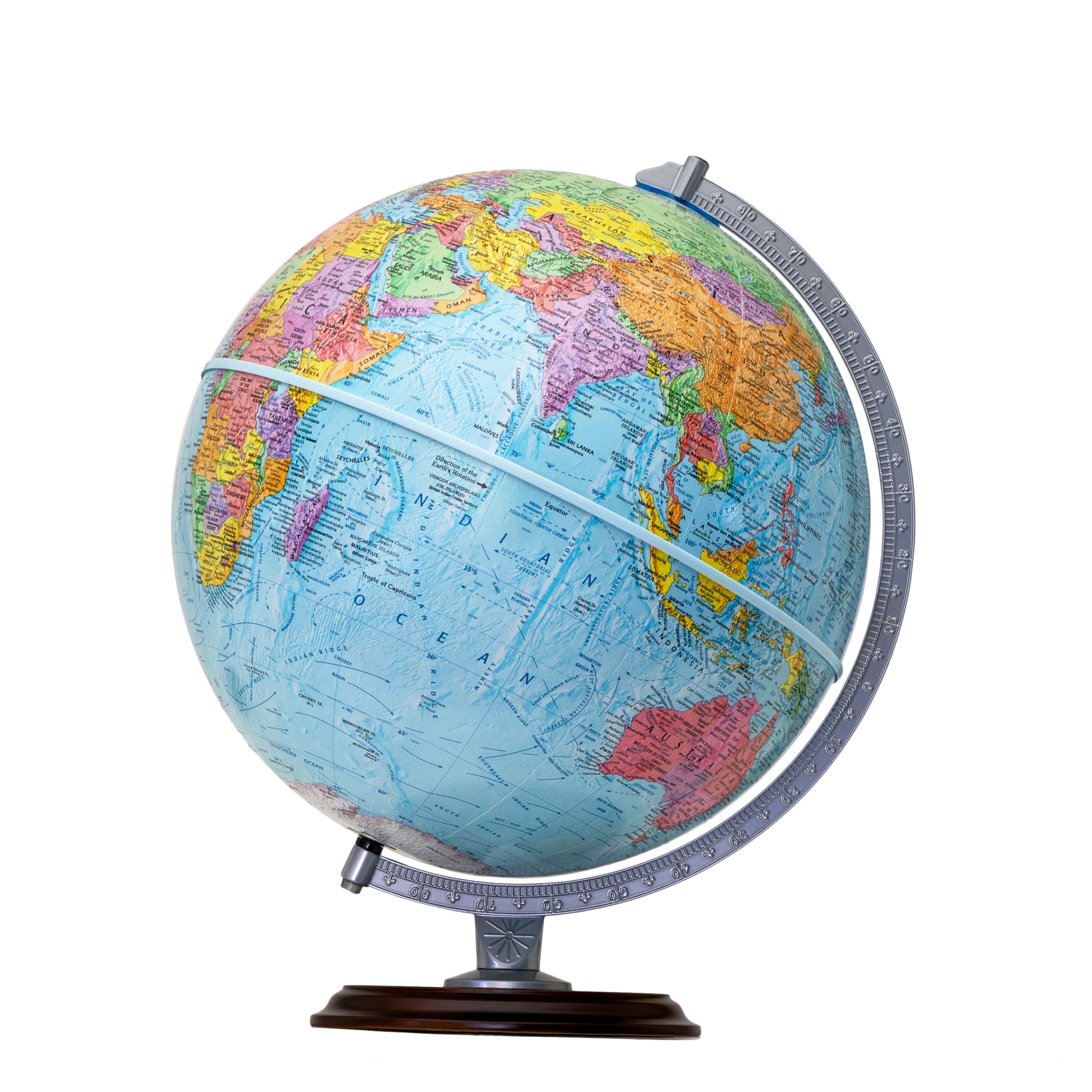
Replogle 12-Inch Student Globe

Replogle 12-Inch Student Globe

Classroom and homeschool

Doodle Score 9.2/10
Check Price

Worth Noting

  • Sphere arrives flat and must be assembled
  • Plastic top fitting feels light for a 4-pound sphere
Origin
Made in USA
Relief
Raised relief
Map Type
Political
Sphere Diameter
12 inches
Read the full review

Twelve inches of sphere is the whole argument for this globe. At that diameter the print finally has room, and Replogle fills it with a political map that colours every US state separately, marks population centres, adds a time dial on the meridian and embosses the mountain ranges so a fingertip can find the Andes. This is the one we point at when a family says the eight-inch model on the desk is too small to read.

It arrives flat. The map ships as segments you curve into a sphere yourself, and the pre-planned trimming lines that let a flat map close into a ball stay faintly visible once it's built — so assembly is a kitchen-table job with an adult doing the folding, not a two-minute unboxing.

There's no light and no game here, which is the trade. A child who wants a glowing object for the bedroom shelf will be underwhelmed; a child who asks why the sun sets earlier in December gets a tilted axis and a time dial to work it out on. The raised relief is the detail we ended up using most — running a finger over the Himalayas lands the scale in a way a flat map never does.

Bottom line: Buy it when the globe is meant to be read rather than admired: 12 inches, raised relief, a time dial, and no light to fail.

#3

USA Toyz Illuminated Globe

USA Toyz Illuminated Globe

First lit globe

Doodle Score 9.2/10
Check Price

Worth Noting

  • 7.2-inch print crowds smaller countries
Base
Chrome steel
Height
9.75 inches
Lighting
Built-in LED
Sphere Diameter
7.2 inches
Read the full review

The chrome base is the part we kept noticing. It's broad, it sits flat on the desk, and the 360-degree meridian grips the sphere hard enough that a determined five-year-old can spin the globe without tipping it or setting up a wobble. On a globe this small, that's worth more than it sounds.

Above the base sits a 7.2-inch political sphere with a decent print — continents, oceans, the bigger countries and their capitals — and a switch that turns it into 88 constellations, stars and navigation lines once the room is dark. The little book on the constellations is a better companion than it sounds: the star map only shows up in the dark, so the book is what turns the lamp into a lesson.

Seven inches is the compromise, and it decides the buy. Country names across Europe and the Caribbean run together at that size; the map is clear at the scale of continents and large nations and crowded below it. We rate it the lit globe to reach for when the glow matters most, and a step behind the nine-inch picks for a child who is properly learning country names.

It plugs in and it's rated for children three and up, which makes it a workable first globe in a way the bigger, heavier ones aren't.

Bottom line: The lit globe we reach for first with a young child: a broad chrome base that won't tip, and a star map bright enough to be the reason it stays on.

#4

POOCCI 8-Inch Writable Globe

POOCCI 8-Inch Writable Globe

Hands-on map practice

Doodle Score 9.2/10
Check Price

Worth Noting

  • Base screw can work loose
Extras
Magnifying glass, marker, cleaning cloth, USB cable
Lighting
Built-in LED
Map Type
Political
Sphere Diameter
8 inches
Read the full review

A globe you can write on sounds like a gimmick until you watch a child circle the country a grandparent came from, quiz themselves on five capitals, then wipe it clean. The POOCCI ships with a marker, a cleaning cloth and a magnifying glass, and the coated eight-inch surface takes all three.

That's what makes it the pick for a hands-on learner. Tracing a route or labelling countries before a quiz turns the globe from something you look at into something you use, and the magnifier answers the obvious problem with an eight-inch sphere — the small print. We found the pair works better than either alone: mark a country, then read its neighbours under the glass.

The built-in LED is bright enough to read the map by in a dim room, which is more than the unlit picks manage, and bright enough that it isn't really a night light. The marker and cloth store in a drawer; the magnifier earns its place the first time a child goes hunting for a capital in Europe.

Bottom line: A globe a kid can write on and wipe clean — we like it for the child who learns by circling, labelling and testing themselves.

#5

Waldauge 9-Inch LED Globe

Waldauge 9-Inch LED Globe

School-age desk

Doodle Score 9.2/10
Check Price

Worth Noting

  • Needs a nearby outlet for the light
Base
Stainless steel
Height
11.8 inches
Lighting
E14 LED bulb
Sphere Diameter
9 inches
Read the full review

The base is a disc of stainless steel, and that one choice changes how the globe behaves: when a child spins the sphere hard to find Brazil, the whole thing stays put instead of skating toward the edge of the desk.

Above it sits a nine-inch HD-printed political map — the size we keep coming back to for kids, big enough for country names and small enough to live on a homework desk. The 11.8-inch height is measured to the top of the meridian, so check the shelf before you commit to a spot.

The light projects constellations rather than illuminating the map: an E14 LED bulb behind the sphere picks out 88 constellations, stars and navigation lines once the room is dark. A bulb you can change is a small mercy on a kids' product — when the light dims you swap a bulb instead of retiring the globe.

We rate it the best-balanced lit globe for a school-age child's desk: a base that doesn't move, a map that reads, constellations after dark, and nothing to pair, charge or update. It's the one we leave set up.

Bottom line: We rate it the desk globe to beat for young kids: a weighted steel base, a readable 9-inch map and 88 constellations after dark.

#6

Get Life Basics 13-Inch Globe

Get Life Basics 13-Inch Globe

Shared family room

Doodle Score 9.0/10
Check Price

Worth Noting

  • Map goes dark in constellation mode
  • Heaviest and most expensive globe here
Base
Stainless steel
Lighting
Illuminated constellations
Map Type
World map
Sphere Diameter
13 inches
Read the full review

Thirteen inches across makes this the biggest sphere here, and size does the work: the print clears up, the colours are vivid enough to read from a sofa, and the globe has the presence of a piece of furniture rather than a toy. It's also the priciest in this set, and the one we recommend when the globe is going to sit in a shared room.

The light does constellations rather than geography. Switch it on and the LEDs pick out the constellations while the political map goes dark — beautiful in a dim room, useless as a reading lamp, and worth knowing before anyone plans a bedtime routine around it. The illumination is also the first thing to check when the box arrives, while the packaging is still around.

The stainless steel stand and the glossy PVC sphere are why it photographs the way it does, and the cord detaches, so carrying it into another room isn't a wrestling match.

At five pounds it stays where it's put. A child won't be ferrying this to the kitchen table, which is fine for a home-school corner or a living-room shelf and wrong for a first globe you want handled.

Bottom line: We recommend the 13-inch sphere when the globe has to be readable across a room and handsome enough to leave out; the light is a bonus, not the point.

#7

Jowhol 8-Inch Globe

Jowhol 8-Inch Globe

Bedroom shelf

Doodle Score 9.0/10
Check Price

Worth Noting

  • Needs a USB outlet to light up
Lighting
Built-in LED
Map Type
World map
Sphere Diameter
8 inches
Read the full review

The tiffany-blue sphere is the reason to look twice at this one. On a nightstand or a bedroom shelf it reads as a lamp rather than a school supply, and for a globe that has to earn its place in a child's room, that counts for more than it sounds.

Underneath the finish it's a straightforward eight-inch political globe with a high-definition print and a standard legend. The built-in LED lights the map from inside for evening reading — no constellations here, just a soft glow behind the world.

We rate it the decor pick of the group rather than the study pick. If the globe is going on a bookshelf and you want something a child will look at while lying in bed, the finish earns its keep; if it has to survive a home-school lesson with a magnifying glass, a nine- or twelve-inch sphere gives you more map to work with.

The base screw sits where you can't easily get at it once the sphere is mounted, so tighten it before the globe goes up and check it again after a few weeks of spinning — a wobble here is a loose screw, not a broken globe.

Bottom line: We like it as the bedroom globe: a turquoise sphere that glows, on a stand that suits a shelf better than a classroom.

#8

KISEER 8-Inch World Globe

KISEER 8-Inch World Globe

Tight budgets

Doodle Score 9.0/10
Check Price

Worth Noting

  • No light or interactive features
Base
Removable
Weight
15.9 oz
Map Type
Political
Sphere Diameter
8 inches
Read the full review

The base unscrews, and that turns out to be the useful part: take the sphere off the stand and pass it around the table, then screw it back on. For a family with a classroom corner, or a teacher moving between rooms, a globe that comes apart is easier to hand to a child than one that doesn't.

The eight-inch political map is bright and clearly labelled, with colour doing most of the work — a five-year-old finds continents and big countries quickly on it. At 450 grams it's the lightest globe in this set, light enough for a child to carry to the table and back without ceremony.

What you don't get is any light or interaction, and the plastic shell is thin enough that we treat this as a counter-and-kitchen globe rather than an heirloom. That's the job it's being asked to do here, and it does it without anything to plug in or recharge.

Which is why we keep it in the set: a light, readable globe is the right thing to buy for a spare room, a grandparent's house or a first geography lesson, and the sensible choice when spending more would be wasted on a child who isn't sure maps are their thing yet.

Bottom line: We keep it as the first-globe pick for tight budgets: light enough for a child to carry, clear enough to read, and nothing that needs charging.

How We Tested Kid-Size Globes

We began by pulling together more than 30 kid-focused globes from educational toy brands, museum shops, and mainstream retailers, then filtered by labeled continents, recommended age range, base footprint, light source, and replacement policy. That left 12 models, which we tested for five months in homes with kids ages 4 to 10. Each globe moved between a bedroom nightstand, a living-room shelf, and a homework table—so it had to be carried, spun, and occasionally rescued from a younger sibling.

At night, we turned off the overheads and checked whether the illuminated map was bright enough to read without becoming a bedside lamp; we also noted how even the glow was across oceans and landmasses. During the day, we compared print size and color contrast from arm’s length and from across a room, because a globe that’s too small or too busy becomes decoration instead of a learning tool. We measured base diameter and height against typical nightstands and bookshelves, then watched whether kids could reach the equator without tipping it.

We spun each globe repeatedly, let kids trace routes with a finger, and bumped the base to see if it wobbled or slid. We checked seams, meridian rings, and bases for sharp edges or loose screws, and looked at how the finish held up after five months of dusting and handling. For value, we weighed what came in the box—stand, light, map detail—against the price tier, and whether it felt gift-worthy without needing batteries every week. By the end, the standouts were the ones kids reached for without being asked, not just the ones that looked best on a shelf.

How to Choose Globes for Kids

Sphere size sets how much there is to read

An eight-inch globe is an ornament with a map on it unless someone is holding a magnifier; nine to ten inches is the workable middle for a child learning country names; twelve or thirteen inches is what you want for a classroom, a home-school corner or a shared living room. Be careful with compact in a listing — it means the globe fits on a shelf, not that a six-year-old can find Ukraine on it.

If the child is under seven and the globe is meant to be used rather than admired, start at nine inches. If it is meant to sit on a desk beside a laptop, eight inches with a magnifier is perfectly workable.

Light is engagement, not extra geography

Illumination gives a child a reason to switch the globe on after homework, and on several models it doubles as a bedside light. Two cautions. Constellation mode usually means the political map goes dark while the stars come out, so it is a second subject rather than a better map. And the light is the first thing to fail on these globes, so switch it on the day the box arrives rather than a month later.

If the globe will live away from an outlet, buy an unlit model instead of running an extension cord across a bedroom floor.

App and pen globes need a tablet that still works

Talking pens and augmented reality turn a globe into an interactive lesson, and they suit a child who won't look twice at a static map. But the globe is only as good as the software behind it: the app has to run on the tablet you already own, and it has to keep running as operating systems move on.

Confirm your exact device is supported before you buy. After that, expect the sphere to become an ordinary globe the day the app stops working — which is why we wouldn't make one a first globe.

Read the cartography, not the colour scheme

Political maps name countries and capitals; physical maps show relief and terrain. The best globes for schoolwork do both, with raised relief a fingertip can follow and US states separated by colour. Reputable map publishers update borders; cheap prints sometimes don't, and a globe with a wrong border teaches the wrong thing.

Check two or three countries you know well when it arrives, look for a legend, and make sure the axis is properly tilted. A time dial is worth having once a child is old enough to ask why it's dark in Sydney while it's lunchtime in Chicago.

Base, spin and where it will live

A globe gets spun hard, so a weighted base and a meridian that grips the sphere matter more than the finish. A stand that skates or a sphere that wobbles turns geography into a small daily frustration. Measured heights run from under ten inches to around a foot, so measure the shelf before you fall for a picture.

The widest spheres need a table rather than a shelf, and anything plug-in needs a socket within reach. Keep cords off the floor and away from a toddler's route past the desk.

Frequently Asked Questions

Final Verdict

If you want one globe that will actually get used, the Smart Wallaby is our pick: a readable nine-inch political map, 88 constellations after dark, and a card game that pulls the family around it. It covers reference, bedtime and homework in one object, which is more than any other globe here manages.

Buy the Replogle instead when the globe's job is geography rather than atmosphere — twelve inches, raised relief, accurate cartography, no bulb to burn out, provided you're willing to assemble the sphere. And if a young child needs something that lights up and can take a knock, the USA Toyz is where to start.