STEM & Learning

Best Flash Cards for Toddlers of 2026

A set of flash cards sounds innocent until you watch a 2-year-old fold one in half and try to eat the corner. The right deck survives that phase—and actually teaches something while it does. The wrong one turns into confetti before you've finished sorting the first ten cards. What you're really shopping for is a set that fits small hands, keeps a toddler's attention past the first minute, and holds up to daily use without costing a fortune. If you're considering a talking set, the audio needs to be clear enough for a toddler to imitate, not just loud enough to hear. The best cards turn a waiting room or a rainy afternoon into a game you can pull out and put away in seconds.

Over the past three months, my team and I have tested 14 sets with our own toddlers, and the differences are not subtle. A common mistake is buying a giant box of 200 cards; toddlers do better with a small stack you rotate, and the cards themselves need to be thick enough to survive a chew. The picks below are the ones that earned a permanent spot in the diaper bag—and the ones we'd buy again with our own money.

#1

Skillmatics Flash Cards

Skillmatics Flash Cards

All-around toddler learning

Doodle Score 9.6/10
Check Price

Worth Noting

  • Broad focus rather than deep vocabulary
Age Range
18 months - 4 years
Card Size
5.4"L x 3.5"W
Card Count
50 double-sided
Learning Focus
Letters, numbers, shapes, colors
Read the full review

The first thing we noticed about the Skillmatics set is how much card there is in a toddler's hand. At 5.4 by 3.5 inches, each one is big enough for a 2-year-old to hold with both hands and still see the whole letter, and the thick cardboard resists the reflexive bend that turns thin decks into creased rectangles. That matters more than the exact card count, because a deck a child can handle independently gets used.

The 50 double-sided cards split across letters, numbers, shapes, and colors, and that breadth is why this is our top pick. We like that one deck can follow a child from naming shapes to recognizing uppercase letters without switching boxes. The learning guide gives you sorting games and short activities, which helped us avoid turning every session into a quiz.

We also appreciated the double-sided design. It gives each card a second job, so the same stack can be used for matching, naming, or a quick game, and the set stays interesting longer than a one-side deck with the same footprint. The cards are comfortably above the tiny playing-card size that gets lost in a diaper bag.

At 50 cards, the set is small enough to finish a pass in a few minutes, which is about the right length for a toddler's attention. It is not the cheapest deck here, but it hits the practical middle: large enough for small hands, thick enough for repeat use, and varied enough to stay in rotation.

Bottom line: For a toddler who is just starting to name letters, numbers, shapes, and colors, this is the deck we reach for first.
#2

Learnworx First Words

Learnworx First Words

First words

Doodle Score 9.6/10
Check Price

Worth Noting

  • No alphabet or phonics cards
Age Range
12 months - 5 years
Card Size
3.15"L x 4.45"W
Card Count
101 double-sided
Learning Focus
First words, counting, games
Read the full review

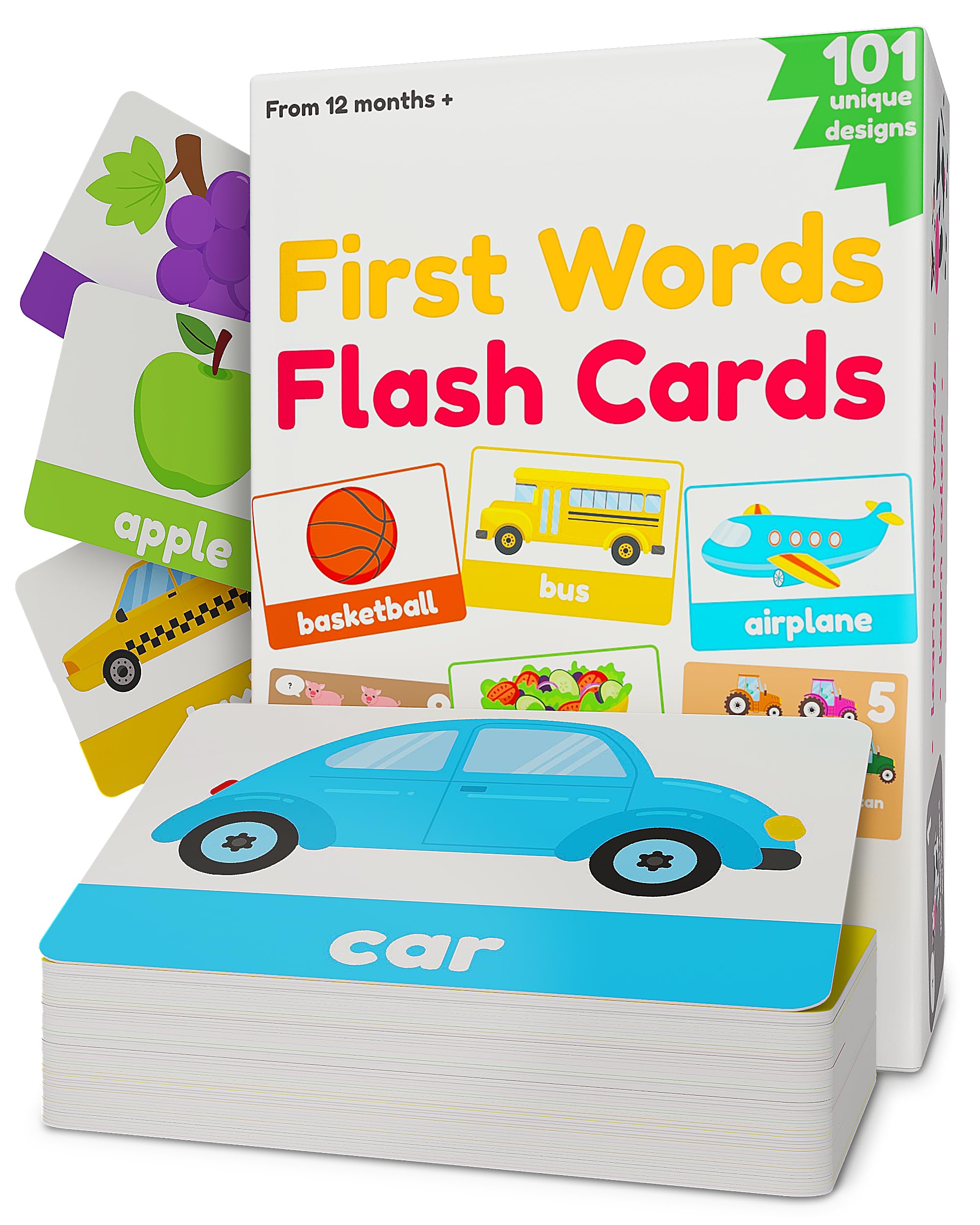
A first-words deck lives or dies on whether the pictures give a toddler something to say, and Learnworx is the one we keep recommending for that job. It puts 101 words across 202 sides, with bright, simple illustrations on one side and a small game on the other, so the set keeps working after your child has named the obvious animals. The cards are 3.15 by 4.45 inches and thick enough to survive the grab-and-stack treatment; we found they hold their shape better than a standard thin card.

What we like most is the vocabulary range. The words move beyond barnyard animals into food, vehicles, and household objects, and the reverse-side questions give you a way to stretch each card: what color is the car, what noise does the duck make, can you spot the difference? That turns a naming drill into a short conversation, which is where toddlers actually pick up language.

The cards are paper-based, so a dry wipe is safer than a wet one, and the box is worth keeping because the set is large enough to sprawl. For the vocabulary stage, the deck is generous without being overwhelming, and the reverse-side games give it more staying power than a plain picture set.

Bottom line: If your toddler is naming objects before letters, this first-words deck is the better fit, with enough cards to keep vocabulary work going.

#3

School Zone Alphabet

School Zone Alphabet

Budget alphabet

Doodle Score 9.6/10
Check Price

Worth Noting

  • Thin cards bend under rough handling
Age Range
3 years and up
Card Size
Large
Card Count
56 cards
Learning Focus
Uppercase and lowercase letters
Read the full review

There is nothing precious about the School Zone alphabet deck, and that is the point. You get 56 cards with uppercase and lowercase letters, bright pictures, and a parent card with game ideas, all for less than most of the other sets here. The cards are large enough to read across a table, with a glossy finish that wipes clean after snack time.

We used it as a quick letter-recognition drill: hold up a card, ask for the letter, then use the picture side to anchor the sound. The separate upper- and lowercase cards are useful because a child can match the pair, and the pictures give you a second question when the letter itself has stopped being interesting. It is a simple format, but it keeps a preschool session moving.

For a 3- or 4-year-old who is ready for letters, the format is right: one letter at a time, a picture to anchor it, and a parent card with a few game ideas. It is not the deck we reach for with a 1-year-old, but that is an age-fit question, not a defect. At the budget end, it leaves room to buy a second deck later, which is a sensible way to test whether your child takes to cards at all.

Bottom line: We reach for this alphabet deck when the goal is letter recognition on a tight budget; it is plain, clear, and priced like a stocking stuffer.

#4

Think Tank Scholar Sight Words

Think Tank Scholar Sight Words

Sight words

Doodle Score 9.6/10
Check Price

Worth Noting

  • Two words per card can complicate sorting
Age Range
3 - 10 years
Card Size
3.2"L x 5.3"W
Card Count
520
Learning Focus
Dolch and Fry sight words
Read the full review

Sight-word practice gets old fast when every card is at the same level. Think Tank Scholar's set splits 520 words across pre-K through third grade, so you can pull a small stack that matches the child in front of you instead of flipping through a monolith.

That progression is why we rate it so highly for the preschool-to-early-elementary stretch. The cards are 3.2 by 5.3 inches, with large, bold words and a small reference print on the back, and the storage box keeps the levels from turning into a living-room snowdrift. We liked the included games for the days when a straight drill felt like homework.

The set assumes a child is ready for sight words, not first words. For a 2-year-old, the pictures-first decks in this guide are a better start; for a 4-year-old who knows letters, the leveled stack makes more sense. We also found the sheer number of cards is best treated as a shelf of levels rather than one deck to work through, so the box earns its place.

The box is the practical hero here, giving each level a home and keeping the next stack out of the toy clutter. It is the difference between a 520-card curriculum and a pile of loose paper, and it is why the set can live on a shelf instead of taking over the table.

Bottom line: For a preschooler already working on sight words, this leveled set gives you years of material in one box; it is more progression than a first deck.

#5

Carson Dellosa 4-Pack

Carson Dellosa 4-Pack

Preschool bundle

Doodle Score 9.6/10
Check Price

Worth Noting

  • Four packs take more sorting than one deck
Age Range
4 - 9 years
Total Cards
216
Included Decks
4 packs
Learning Focus
Alphabet, numbers, sight words, colors and shapes
Read the full review

The Carson Dellosa bundle is the opposite of a single carefully curated deck: it gives you four packs, 216 cards total, and enough variety to run a different five-minute activity each day. You get first words, colors and shapes, numbers 0-25, and alphabet, with resource cards for phonics and math games. For a household that wants one box to cover preschool basics, that breadth is the recommendation.

We like the glossy cardstock and rounded edges for flipping and sorting; they make the decks feel a little more finished than plain paper flashcards. The cards are double-sided, with the alphabet, number, and word cards carrying content on both faces, so a quick session can move from recognition to a small game. The size is manageable for a 4-year-old, though these are not the chunky toddler cards in the Skillmatics set.

The four-pack is a preschool-to-kindergarten tool, not a first birthday gift. A 2-year-old will get more from a thicker, picture-first deck; a 4- or 5-year-old can use the separate packs for letters, numbers, shapes, and words without the whole box becoming a pile. At the midrange price, it saves you from buying each subject separately.

Bottom line: If you want one purchase that covers alphabet, numbers, first words, and shapes, this four-deck bundle is the practical preschool starter.

#6

Scholastic Sight Words

Scholastic Sight Words

Budget sight words

Doodle Score 9.6/10
Check Price

Worth Noting

  • Double-sided cards complicate sorting
Language
English
Age Range
4 - 6 years
Dimensions
3.31 x 0.91 x 5.98 inches
Learning Focus
Sight words
Read the full review

The Scholastic sight-word deck is refreshingly uncomplicated. There are no textures, no talking reader, and no game guide pretending to be a curriculum; just clear words in a bold font, printed on both sides of a card you can hold up. For a 4- to 6-year-old who is learning to recognize common words on sight, that directness is useful.

We like the size for a quick session: the cards are easy to fan and flip, and the print is large enough to read from across a small table. The set is also cheap enough that you can keep one in the car and one in the kitchen without feeling extravagant. That makes it easy to treat as a practice deck rather than a precious set.

The set is aimed at 4- to 6-year-olds, and that fit is the main thing to check: this is not a first-words set for a 1- or 2-year-old. For a kindergartener who knows letters and is starting to recognize whole words, the plain format is right. We also like that the words are printed on both sides, so a small stack gives you more practice than the card count suggests.

What we kept coming back to is the clarity. The words are plain, the font is readable, and there is no extra visual noise competing with the word itself. If your child is ready for sight words, this is the budget deck we hand over without worrying about the cost. It is also the one we are least precious about: a missing card does not ruin the set.

Bottom line: We keep this plain, affordable sight-word deck on the list for kindergarten repetition; it is simple, readable, and easy to replace.

#7

DK Touch and Feel Cards

DK Touch and Feel Cards

Sensory first words

Doodle Score 9.6/10
Check Price

Worth Noting

  • Limited word set for the price
Format
Touch-and-feel cards
Age Range
1 - 2 years
Dimensions
4.57 x 1.69 x 7.32 inches
Learning Focus
First words
Read the full review

The DK cards are the sensory option. Each picture card carries a textured patch matched to the word, so a child can feel the surface while you say the word. That combination of touch and language is the reason to choose this set over a plain picture deck.

The set is aimed at 1- and 2-year-olds, and the format suits that age: sturdy cards, bright images, and a pace that does not overwhelm. We like that the back of each card includes translations, which gives a bilingual household a way to use the same set in more than one language.

The textures are the star, but they also make the cards a little more precious. Sticky or fuzzy textures can collect lint, and a chewed corner is harder to clean than a plain laminated card. We treat this as a supervised lap-time set rather than a toss-in-the-bag deck.

The textures also match the way a 1-year-old explores: rubbing, turning, and mouthing are all part of the session. We stay nearby, not because the set is fragile, but because the back-and-forth is where the language happens. A card that goes in the mouth comes out of rotation until it is wiped down.

What we value most is the way the set slows a session down. A plain card asks a child to look and name; a textured card invites a touch, a pause, and a word. For a 1-year-old, that is a better fit than a stack of sight words, and it is why this one stays in our lap-time rotation even though it is not the broadest deck here.

Bottom line: We reach for this textured first-words set when a 1- or 2-year-old needs a lap-time activity that invites touch and talk.

#8

Merka Toddler Flash Cards

Merka Toddler Flash Cards

Compact starter set

Doodle Score 9.4/10
Check Price

Worth Noting

  • Small cards bend more easily
Finish
Laminated
Age Range
18 months - 4 years
Card Size
4.2"L x 2.4"W
Learning Focus
Alphabet, numbers, shapes
Read the full review

The Merka deck is the one that disappears into a diaper bag. At 4.2 by 2.4 inches, the cards are about deck-of-cards size, and the set covers alphabet, numbers, and shapes in one compact package. For a 1- or 2-year-old who is just starting to point and name, that small format can be easier to manage than a full-size card.

The compact format is the reason it travels well, and the laminated finish wipes clean after a snack. It is a starter deck, not a mastery set: there are enough cards to introduce letters, numbers, and shapes, but not enough to drill a full sequence in depth. We treat it as a first exposure tool, not the deck a 4-year-old uses to finish the alphabet.

The all-in-one content is the real draw: uppercase and lowercase letters, numbers, and shapes, with bright illustrations that keep a very young child's attention. We found the deck most useful when we followed the child's lead and let them pick a few cards, rather than working through the stack in order. For a 2-year-old, that is the right kind of session; for a 4-year-old, a larger, thicker deck is the better buy.

Bottom line: We like this compact all-in-one deck for very early learners: it puts letters, numbers, and shapes in a bag-friendly format.

#9

Airbition Talking Cards

Airbition Talking Cards

Talking practice

Doodle Score 9.2/10
Check Price

Worth Noting

  • Sound can get lost in noisy rooms
Format
Talking card reader
Age Range
1+ years
Word Count
224
Battery Life
Up to 4 hours
Read the full review

The Airbition reader changes the rhythm of a card session. Instead of holding up a card and asking a question, a toddler inserts one and hears the word in a clear American accent, often with an animal sound or a short prompt attached. That independence is the appeal: a child can work the reader without an adult running every turn.

The set covers 224 words across animals, vehicles, food, fruits, vegetables, colors, shapes, jobs, and everyday objects. We like that the repeat button sits on the reader, so a child can hear a word again without asking for help, and the auto-off function saves the battery when the reader gets abandoned mid-session.

The rechargeable battery is rated for up to four hours, and the USB cable means no disposable batteries. We did not have to think about topping it up between short sessions, and the reader is light enough for a child to hold. It is a tabletop or car-ride activity rather than a playground toy.

The real caveat is rough handling: the reader and cards are not built for the drop-and-stomp treatment some toddlers specialize in. We keep it for supervised sessions, where the spoken word is the point. If you want a deck a toddler can chew, bend, and sort independently, a thick cardboard set is the safer buy; if you want a child to hear and repeat words on their own, this is the one that does something the paper decks cannot.

Bottom line: For a toddler who wants to run the cards alone, this screen-free reader says the word, repeats it, and lets small hands take over.

How We Tested Toddler Flash Cards

We started by pulling together more than 40 sets from major retailers and specialty toy shops, then narrowed to 14 based on card size, stated age range, materials, and price per card. We skipped anything with cards smaller than a standard playing card, since tiny hands struggle and small corners are a choking risk.

Testing ran for three months in the messiest conditions we could find: high chairs, car seats, stroller trays, and the floor of a pediatrician's waiting room. We handed each deck to a 2-year-old and a 4-year-old and noted which ones they reached for without prompting and how long they stayed interested. We bent cards, wiped them with a damp cloth, and dropped the boxes on the floor. For sets with audio, we played the sound in a quiet room and again in a moving car with the windows down to check whether the words were clear enough to repeat.

We also looked at content: whether the pictures were easy to recognize, the words matched the images, and the sequence made sense for a first-time learner. We checked card size against a toddler's grip—could they hold it without bending it?—and compared price per card against how the set actually held up. By the end, the winners were the ones with thick card stock, rounded corners, and a box that survived being sat on.

How to Choose Flash Cards for Toddlers

Match the deck to the learning stage

A 1-year-old needs first words, animals, and everyday objects, not letter drills. Around 2 or 3, letters, numbers, shapes, and colors become useful; by 4 or 5, sight words and phonics take over. Buying a 520-card sight-word set for a 1-year-old usually means storing it for two years, while a first-words deck can be outgrown by a 4-year-old who is already reading. Pick the stage your child is in now, then size the set to the next six months rather than the next four years.

Card size and thickness matter more than count

Toddlers handle cards differently from adults. A 5.4-by-3.5-inch card is easy for small hands to hold and see; a 4.2-by-2.4-inch deck is closer to playing-card size and can be easier to bend or lose. Thick cardstock with a clean finish survives more sessions. “Compact” in a listing often means it fits a diaper bag, not that it fits a toddler’s grip. Check the dimensions and the material before you fall for a big card count.

One deck or a bundle?

A single deck keeps the choice simple: one box, one subject, less mess. A bundle covers more ground for a preschooler and can be better value per deck, but it also gives you four packs to store and sort. If your child is just starting, one thick first-words or all-in-one deck is enough. If you are running short preschool sessions across letters, numbers, shapes, and words, a four-pack like Carson Dellosa’s saves you from buying each set separately.

What extra money buys

At the budget end, you get a plain deck with clear print and little else; that is often all a kindergartener needs for sight-word repetition. Spending more can buy thicker cards, a larger word bank, leveled progression, or a talking reader. The premium is worth it when the set is doing a specific job for a specific stage: a 520-card sight-word curriculum for a 4-year-old, or a rechargeable reader for independent listening. Do not pay for volume a 2-year-old cannot use yet.

Talking and tactile formats

A talking reader adds audio and independence, but it also adds a battery, a speaker, and plastic parts that can be dropped. It suits a child who likes to run the activity alone, not one who still mouths or throws cards. Touch-and-feel cards are the opposite: they slow the session down and invite a 1- or 2-year-old to explore. Both formats are supplements to, not replacements for, a sturdy picture deck.

Frequently Asked Questions

Final Verdict

For most toddler households, the Skillmatics set is the one we hand over first. The cards are large enough for small hands, thick enough for repeat use, and broad enough to cover letters, numbers, shapes, and colors without turning into a box of loose paper.

If your child is still building first words rather than letter recognition, Learnworx is the better fit; its 101-word deck and travel-friendly size make more sense at that stage.