STEM & Learning

Best Electronic Learning Toys of 2026

Electronic learning toys are a gamble. You picture a plastic gadget that repeats one phrase until you hide it, or one your kid taps twice and never touches again. The right one does something better: it keeps a child absorbed in letters, numbers, or a second language long enough to feel worth the shelf space, whether it's a birthday gift or a rainy-Tuesday distraction.

Over the past four months, my team and I have rotated 14 of these toys through our homes—on the living-room rug, in the back seat, and at the kitchen table after school. The good ones share a few traits. They sound clear at low volume instead of tinny or too loud, respond when small fingers press instead of missing taps, and match the age on the box without talking down to the kid. The best also stretch: a bilingual mode that gets used past the novelty, or a game that still earns a spot in the toy rotation after week three. We'll get into which ones cleared those bars below.

#1

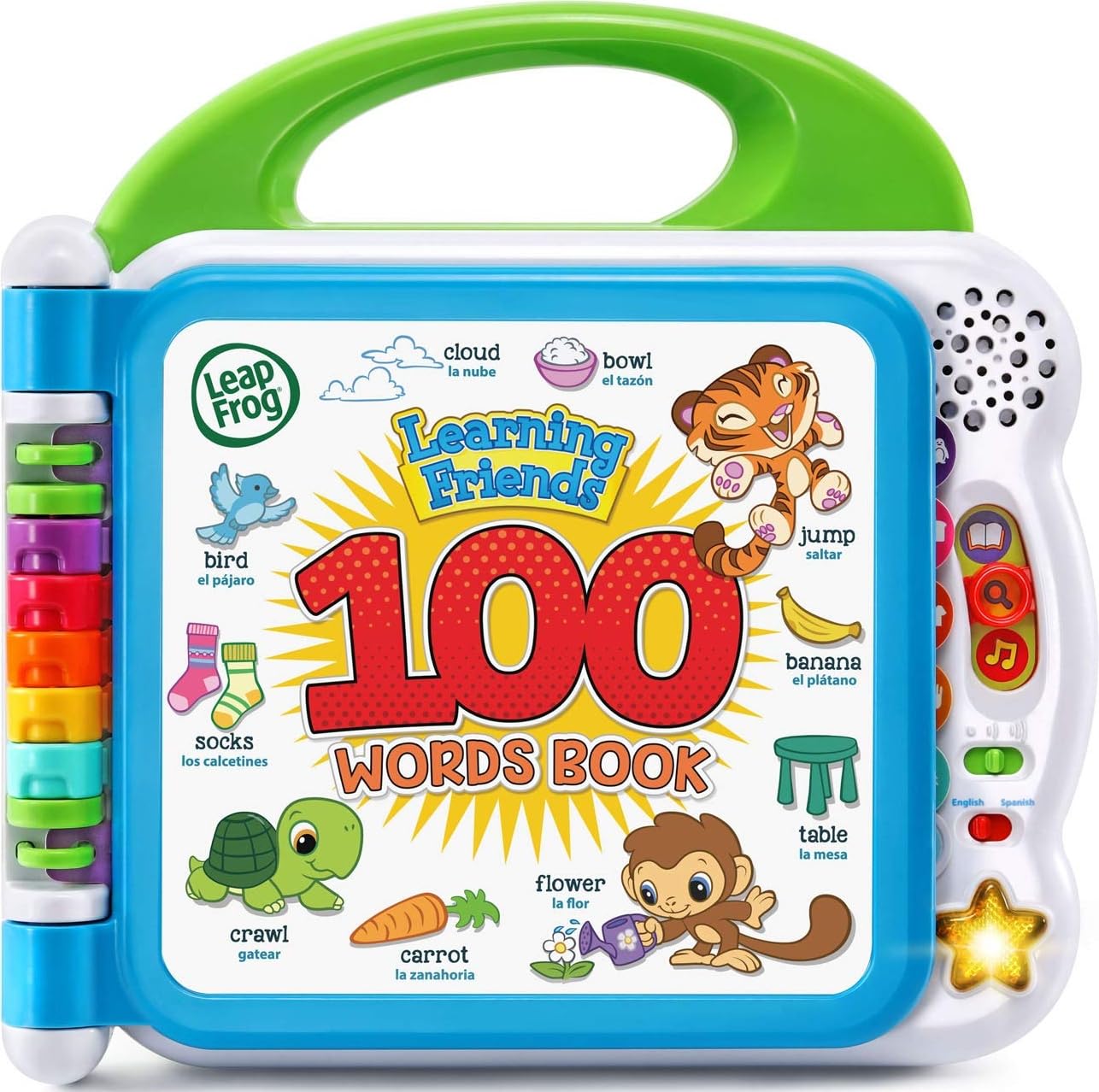
LeapFrog 100 Words Book
LeapFrog 100 Words Book

First word book

Doodle Score 9.6/10
Check Price

Worth Noting

  • Voice can wear on adult ears
Size
9.4 x 9.2 x 1.9 in.
Power
2 AA batteries (demo set included)
Recommended Age
18 months to 4 years
Words And Audio
100+ words in English and Spanish
Read the full review

The 100 Words Book earns its place by doing something few toys in this group manage: it lets a child lead. The pages are divided into categories—pets, food, colors, opposites, outside—and touching a picture plays the word, a sound effect, or a fact. In our testing, the light-up star button was the first thing children found, which is fine by us because it also plays the Learning Friends theme song and My Favorite Word. The book covers more than 100 words chosen for this age, and the pictures stay simple enough for a child to point at before they can say the word.

The bilingual switch is the feature we kept coming back to. The same words, songs, and instructions are available in English and Spanish, so a household can use one language now and the other later without buying a second book. The age range is unusually generous: the pictures are simple enough for an 18-month-old, but the categories and facts give a four-year-old something to talk about. That range is why it beats the more specialized picks here for a first purchase.

At 1.5 pounds and about nine inches square, it is light enough to carry and big enough for two children to share. The book runs on two AA batteries, and the included set is for demo use, so plan on fresh batteries for regular play. The narration is clear enough for a car seat, and the words are easy to follow. That battery change is a small trade-off for a toy that sits at the budget end of this group and asks so little of the adult. We still choose it first because it gives a child something to lead.

Bottom line: We recommend the 100 Words Book first for most toddlers because it turns pointing into vocabulary in English or Spanish, and it stays useful from 18 months to four.

#2

LeapFrog Mr. Pencil Write and Read

LeapFrog Mr. Pencil Write and Read

Preschool writing

Doodle Score 9.6/10
Check Price

Worth Noting

  • Demo batteries need replacing for regular use
Size
8.6 x 7.7 x 2 in.
Power
3 AA batteries (demo set included)
Learning Focus
Letter and number writing, phonics
Recommended Age
3 to 5 years
Read the full review

Letter tracing can be a hard sell for a four-year-old, but Mr. Pencil makes the practice feel like a reveal. A child follows the dotted lines for uppercase or lowercase letters, then watches the letter transform into an animated animal; numbers turn into objects to count. The steps are short enough that the next one feels like a reward rather than a test. That pacing is what won us over: the toy does not ask a child to write a whole word before it gives anything back.

The name customization is the detail we did not expect to matter as much as it did. You can enter a child's first, middle, and last name, so the toy practices the letters that appear on their cubby, lunchbox, and birthday cards. Sliding the stylus across the sound-it-out bar is the other feature we kept returning to. It lights up as it sounds out a word, which gives a beginning reader a physical action to connect with the sound. We found that more useful than a generic alphabet game because the child is working on the letters in front of them.

The screen and stylus are built around a narrow job, and that is the point. This is not a general preschool tablet or a replacement for drawing paper; it is a writing coach. For a child who already knows letters and is starting to form them, the focus is the advantage. It runs on three AA batteries and measures about eight and a half by eight inches, so it is easy to set on a table or pack in a bag. We liked it most for the in-between stage when a child wants to write like an older sibling but still needs the letters to be large.

Bottom line: We recommend Mr. Pencil for preschoolers who are ready to trace letters and numbers, because it turns handwriting practice into a character-driven game they can run themselves.

#3

VTech Sea Turtle Learning Book

VTech Sea Turtle Learning Book

Early toddler play

Doodle Score 9.6/10
Check Price

Worth Noting

  • Large footprint for travel
Size
14.3 x 10.5 x 2.6 in.
Power
2 AA batteries (demo set included)
Learning Focus
Vocabulary, letters, numbers, colors, music
Recommended Age
12 to 36 months
Read the full review

The Sea Turtle is built for the stage when a child is more interested in turning pages than sitting still for a lesson. The pages are touch-sensitive, so a finger on a sea creature, letter, or number brings back a word, a sound, or a fact. There are eight piano keys for music mode, and the book packs more than 225 songs, melodies, sounds, and phrases. We found the mix useful because it lets a child move between listening, pressing, and turning without needing a menu.

What we appreciated most is the age fit. The stated range is 12 to 36 months, and the content stays concrete: sea creatures, weather, letters, numbers, colors, and the music scale. That is the right level for a child who is just learning that a picture stands for a word. The piano keys were the surprise for us; the book stops being a book and becomes a little instrument, which gives a toddler a second reason to come back after the animal facts get familiar.

The buttons are easy to hit, and the plastic body has held up to the kind of handling a toddler gives a favorite toy. We keep it in the younger-toddler slot because it does not try to teach reading before a child is ready. That focus is why it still has a place when the older toys come out. It does not need a screen to hold attention, and that is the main reason we reach for it with a one-year-old.

Bottom line: We recommend the Sea Turtle for the youngest toddlers because its touch pages, animal sounds, and piano keys give a one-year-old plenty to do without a screen.

#4

Fisher-Price Smart Stages Chair

Fisher-Price Smart Stages Chair

Active toddlers

Doodle Score 9.6/10
Check Price

Worth Noting

Power
3 AA batteries
Weight Limit
55 lb
Learning Focus
Colors, shapes, numbers, counting, opposites
Recommended Age
12 months and up
Read the full review

A learning toy you sit on sounds like a novelty until you watch a toddler use it. The seat activates music and phrases when a child sits down or stands up, so the cause and effect is built into the body rather than hidden behind a menu. The chair also has an illustrated flipbook, a light-up pretend TV remote, and a lift-up seat cushion with hidden surprises. That combination kept our youngest testers moving between sitting, reaching, and opening, which is exactly the kind of play a one-year-old is ready for.

The three Smart Stages levels are the reason this chair lasts longer than the novelty suggests. They teach colors, shapes, numbers, counting, and opposites, and the content moves with the child instead of staying at the first level. The chair is rated for ages 12 months and up, with a maximum weight of 55 pounds. It is also furniture-sized—about 17 inches wide and 4.5 pounds—so it needs a corner rather than a toy bin. We did not mind that trade-off because the chair gives a toddler a place to go back to, and the storage under the seat gives small toys a place to land.

The songs and phrases are cheerful, and the seat activation is simple enough that a child can trigger it without help. We liked the chair most as a bridge between baby toys and pretend play: it teaches early academics, but it also invites a child to sit, stand, and imitate what they see at home. That is a different kind of learning from a book or a tablet, and it is the reason the chair earns a place in a playroom rather than a toy chest.

Bottom line: We recommend the Smart Stages Chair for active one-year-olds who learn through sitting, standing, and opening things, not through a screen.

#5

LeapFrog Prep for Preschool Book

LeapFrog Prep for Preschool Book

Preschool prep

Doodle Score 9.4/10
Check Price

Worth Noting

  • Marker is a separate piece to keep track of
Size
10.6 x 9.5 x 2 in.
Power
2 AA batteries (demo set included)
Learning Focus
Alphabet, counting, shapes, writing, phonics
Recommended Age
3 to 6 years
Read the full review

The Prep for Preschool book is the one we reach for when a child wants to do school, not just play at it. Six touch-sensitive pages cover counting, colors, shapes, the alphabet, and words; six marker pages add letter writing, number matching, shape tracing, and line drawing. The erasable pen means a mistake is not a permanent event, which matters more than it sounds for a child who is still learning to hold a marker.

The Dress for the Weather page is a smart little addition. Instead of only identifying a letter, a child chooses clothes for the weather, which turns a preschool skill into a decision. The phonics activities do something similar: children find beginning letters and rhyming words, so the book is working on sound awareness as well as letter names. We liked that the marker pages and the touch pages sit in one book; it keeps the leap from tracing to reading from feeling like two separate toys.

The age range is three to six, and the content fits that whole span better than most. A three-year-old can start with colors and shapes; a five-year-old can work on words and handwriting. The book is about 10.6 by 9.5 inches, so it is a tabletop toy rather than a take-along. It runs on two AA batteries and comes with an erasable marker. The writing pages are the reason to choose this over a plain touch book.

Bottom line: We recommend the Prep for Preschool Activity Book for children who are about to start preschool, because it combines touch-page learning with real marker practice on the same pages.

How We Tested Electronic Learning Toys

We started by pulling together electronic learning toys that kept showing up in parent recommendations, retail best-seller lists, and specialty catalogs, then filtered by age range, price, bilingual options, and whether each toy had a volume control and a clear on/off switch. That left 14 toys, which we placed with families on our testing panel, including our own. Testing ran for four months, long enough for the new-toy shine to wear off.

The toys lived where kids actually play: on the living-room rug, in the back seat on school runs, at the kitchen table after snack, and in the quiet stretch before bedtime. We watched whether a 3-year-old's jab or a 6-year-old's quick press registered on the first try, and whether buttons needed a hard push or were so sensitive that a sleeve set them off. For sound, we played each toy at its lowest and highest volume in a quiet room and again with a dishwasher running in the next room, noting whether voices stayed clear or turned tinny and whether the top volume made us wince.

To judge the educational content, we sat through the first 30 minutes with each child, then checked back after two weeks to see whether the activities introduced new challenges or repeated the same three prompts. We compared the language and difficulty to the age band on the box and watched whether older siblings drifted away. Bilingual modes got a separate pass with families who speak another language at home and with families who don't, since a clunky translation can confuse everyone. We also noted how kids reacted when a toy was handed over cold—no demo, no adult prompting—because that's closer to a birthday gift moment. Finally, we tracked how often each toy came back out after the first week and whether it needed fresh batteries, which is where value really shows.

How to Choose Electronic Learning Toys

Match the toy to the stage, not the school year

An 18-month-old and a four-year-old can both be ready to learn, but they need different help. Look at the stated age range and the physical skill it assumes: a touch page rewards a pointing finger, while a stylus asks for a pincer grip and control to follow a line. A toy labeled for three and up can frustrate a two-year-old who cannot work the buttons, and a toddler book can feel babyish to a child already writing letters. Choose the youngest age that fits, then check the top end so the toy has room to grow. The 100 Words Book spans 18 months to four years; the Sea Turtle is a first-toddler choice.

Pick the input your child can handle

Touch pages, chunky buttons, a stylus, and a screen are not interchangeable. Touch pages are the most forgiving because a child only has to land a finger on a picture; large, separate buttons are next. A stylus toy such as Mr. Pencil is a better fit once a child can hold a crayon and is starting to form letters, because the point is deliberate movement. If a screen is part of the design, check the display in a dim room or watch a demonstration before buying; a screen that washes out makes the rest of the toy harder to use. A toy that fits the hand and the attention span gets played with; one that needs hand-over-hand help becomes a shelf item.

Decide how much screen time you want

Electronic does not have to mean screen-based. Several strong choices here teach through touch pages, music, or a seat that responds to sitting and standing. That matters for families who want cause-and-effect play without another glowing rectangle. A screen can be useful for animated letter strokes or video, but it also adds a readability question and a common failure point. We do not pay a premium for video if the child is still learning to press a button; we put more value on a clear display that does not become the toy's weak point. Mr. Pencil uses animation to reward tracing, while the Sea Turtle and the 100 Words Book keep the interaction audio and touch.

Plan for batteries, volume, and survival

Most electronic learning toys run on AA or AAA batteries, and the set in the box is usually a demo set. Add a fresh pack to the gift budget and check the battery door before handing the toy over, especially with younger siblings around. Volume matters: a toy that is too quiet gets abandoned in a noisy room, while one that is too loud or repetitive wears down the adult hearing it on repeat. Look for a volume control and a clear speaker, and keep size in mind. The Sea Turtle is a floor book, the Prep for Preschool book is a tabletop toy, and the Smart Stages Chair needs a corner rather than a shelf.

Frequently Asked Questions

Final Verdict

The LeapFrog 100 Words Book is the one we recommend first for most families. It stays useful from 18 months to four, works in English and Spanish, and lets a child lead with a finger instead of waiting for an adult to run the show. If your child is already tracing letters, Mr. Pencil is the more useful next step; if you need a screen-free toy for a one-year-old, choose the Sea Turtle.