STEM & Learning

Best Abacus for Kids of 2026

An abacus looks simple until you watch a 5-year-old fight a bead that won't slide. The good ones turn counting into something a child can see and feel, while the bad ones wobble, shed parts, or lose a bead under the couch on day one. What you're buying is a piece of tabletop furniture: it should fit little hands, move smoothly, and survive being dragged from playroom to car. The right one makes math practice feel like play, not a worksheet.

I've watched kids ignore expensive toys and spend twenty minutes sliding beads back and forth, so I'm picky about mechanics. Over four months, we rounded up 16 abacuses—wood and plastic, compact and full-size—and used them for counting games, pretend grocery stores, homework, and quiet-time patterns. The keepers felt solid without being heavy, adjusted from floor play to tabletop use without wobbling, and arrived with every bead and rod accounted for. A few were too small for kindergarten hands or too clunky for a backpack, and one felt overpriced for what it did; those didn't make the list.

#1

Melissa & Doug Classic Abacus
Melissa & Doug Classic Abacus

Counting to 100

Doodle Score 9.6/10
Check Price

Worth Noting

  • No storage bag or carrying case
Age Range
3 to 5 years
Bead Layout
10 rows of 10 beads
Frame Material
Solid wood
Item Dimensions
12.2 x 12.01 x 3.15 in
Read the full review

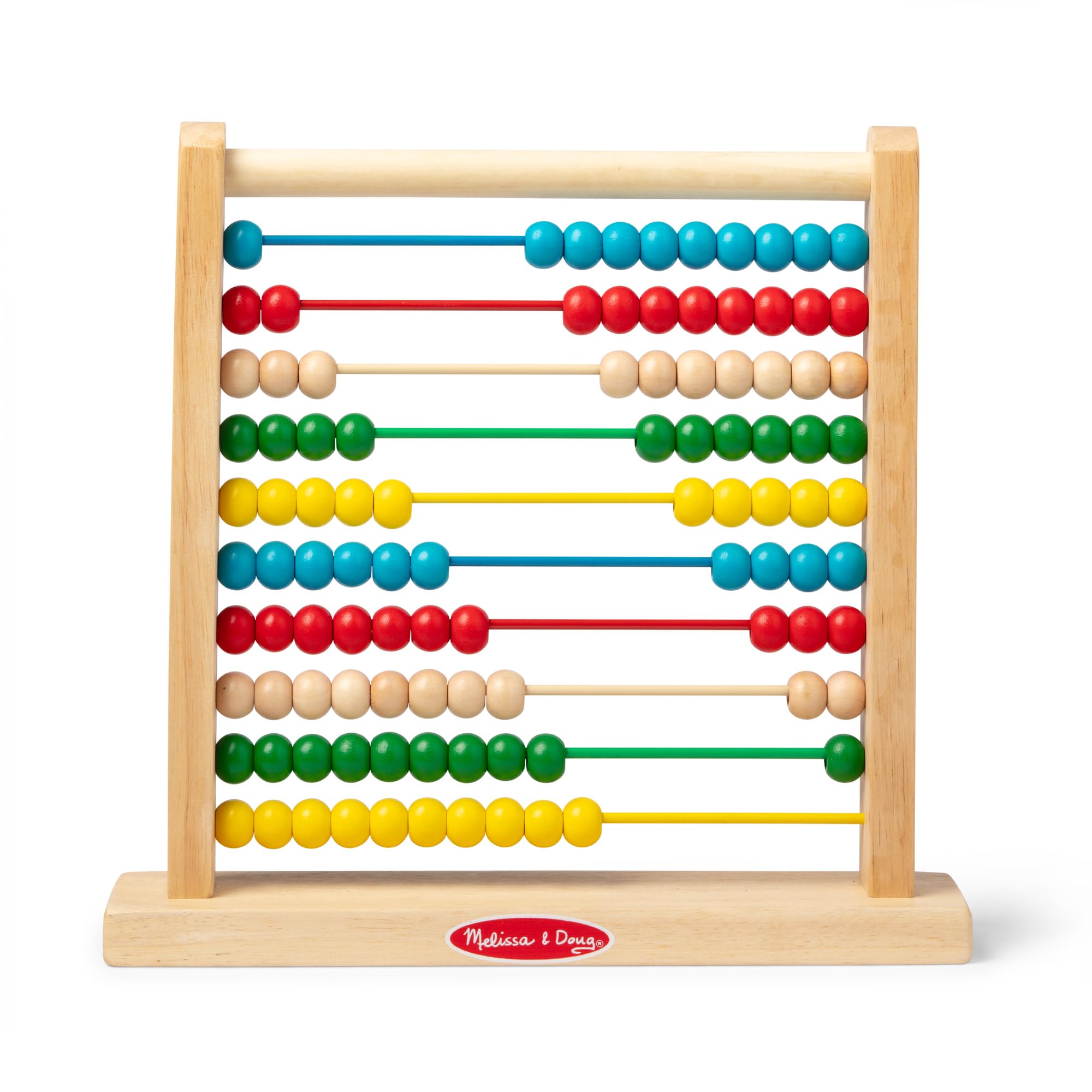
Ten rows of ten beads is the layout we recommend first because it lets a child see the whole hundred at once. Melissa & Doug gives each row its own color, so counting by tens becomes a visual rhythm rather than a memorized chant. We like that the frame is solid wood and the beads are easy to pinch and slide; it feels like a toy that can be handed down rather than a worksheet with beads.

The 12.2-inch width is the part to plan for. This is a tabletop abacus, not a lap toy, and it needs a shelf or a dedicated spot at the kitchen table. In exchange, the beads are large enough for a three-year-old to move deliberately, and the open frame makes it simple to reset a row with one finger. We kept reaching for it because it covers the longest stretch: counting to ten, skip-counting to a hundred, and the first idea of place value.

It does not come with cards, sticks, or a guide, so you are buying the frame and nothing else. That is fine if you already know how to use an abacus with a child; less so if you want a ready-made lesson. We still think the simplicity is a strength, because there is nothing to lose and nothing to set up.

Bottom line: We recommend the Melissa & Doug Classic as the default first abacus for most families starting counting to 100 and early place value.

#2

hand2mind 100-Bead Rekenrek

hand2mind 100-Bead Rekenrek

Number sense

Doodle Score 9.6/10
Check Price

Worth Noting

  • Fewer extras than bundle kits
  • Takes up more table space than compact frames
Age Range
4 to 10 years
Bead Layout
100 beads, two colors grouped by fives
Frame Material
Wood
Item Dimensions
13.4 x 10.1 x 2.7 in
Read the full review

The beads are grouped in twos and fives by color, and that is the feature that separates this rekenrek from a standard hundred-bead frame. A child can see five without counting it, then ten, then twenty. We found that useful for the stage just before formal addition, when the goal is number sense rather than getting the right answer.

The frame is larger than the mini classroom racks, at 13.4 by 10.1 inches, and the wood gives it enough stability to stand on a table while a child works with both hands. We like the included activity guide because it gives a parent or teacher four starting points, though the real strength is the bead layout. It is built for children from four to ten, which means it can stay in use after the first counting lessons.

Compared with a ten-color abacus, this one gives up the color-by-row cheer and the hundred-chart look. What it gains is a clearer path to mental arithmetic: groups of five and ten are visible at a glance, and a child can slide beads to make a ten without counting each one. We recommend it when the goal is number sense, not just counting to one hundred.

Bottom line: We recommend this rekenrek for a child who is ready to see numbers in groups of five and ten, especially when a parent wants a clear number-sense tool.

#3

Melissa & Doug Add & Subtract Abacus

Melissa & Doug Add & Subtract Abacus

Preschool addition

Doodle Score 9.6/10
Check Price

Worth Noting

  • Boards can lift out during play
Age Range
2 to 6 years
Bead Count
55 beads
Activity Boards
2 double-sided boards
Item Dimensions
4.75 x 9.55 x 12.7 in
Read the full review

The two sliding boards are the reason this abacus exists. They sit above the beads and show an addition or subtraction problem, so a preschooler can match the equation to the beads instead of working from a worksheet. We like that the boards are double-sided and interchangeable; one side handles addition and subtraction, the other color matching.

With 55 beads, this is a smaller frame than the classic hundred-bead abacus, and that fits the 2-to-6 age range. A four-year-old can scan the whole thing without feeling like they are looking at a wall of beads. The wooden construction is sturdy, and the beads move easily enough for small hands. We found it most useful for short, guided sessions rather than open-ended counting to one hundred.

The trade-off is that it stops at 55 beads, so it will not carry a child into place-value work the way a 100-bead frame can. For a preschooler who needs the operation right next to the visual, that is a fair exchange: the smaller set keeps the lesson focused. It is a table toy, not a classroom demonstration piece, and it works best when an adult sits alongside.

Bottom line: We recommend the Add & Subtract Abacus for a preschooler who is ready to see an equation and move beads to match it.

#4

Cltoyvers Wooden Abacus Kit

Cltoyvers Wooden Abacus Kit

Home lessons

Doodle Score 9.6/10
Check Price

Worth Noting

  • Extras need a storage plan
Included
100 counting sticks and 110 cards
Age Range
3 to 5 years
Bead Layout
10 rows of 10 beads
Item Dimensions
8.3 x 2.5 x 9.5 in
Read the full review

The card slot across the top is the detail that makes this kit more than another wooden abacus. You can stand an equation card above the beads, so a child sees the problem and the visual in one line. We like that the set arrives with 100 counting sticks and 110 math cards, because it gives a parent a lesson to start with instead of a frame and a hope.

The frame is 10 rows of 10 beads, the same hundred-bead layout as the classic, but the whole thing is smaller at 8.3 by 9.5 inches. That makes it easier to keep on a child's desk or a shelf. We found the compact size handy for one child working at a table; it is not the frame to choose if you want a big demonstration piece.

The extras are the reason to pick this over a plain abacus: cards, sticks, and the frame give a parent a lesson to start with. The cards are also the reason this kit asks for a little organization. For a homeschool starter set or a grandparent looking for a complete gift, that is a strong package.

Bottom line: We recommend the Cltoyvers kit to a parent who wants the beads, cards, and counting sticks in one box for a first structured lesson.

#5

hand2mind Mini Rekenrek Class Set

hand2mind Mini Rekenrek Class Set

Classroom sets

Doodle Score 9.4/10
Check Price

Worth Noting

  • Racks can loosen under heavy classroom use
  • No storage bin included
Set Size
25 rekenreks
Age Range
3 years and up
Bead Layout
20 beads per rack
Frame Material
Wood
Read the full review

This is a classroom purchase, not a family one. The set gives you 25 mini rekenreks, each with 20 beads, so a whole class can work on the same five-and-ten structure at once. We like the 20-bead layout for the early grades because it keeps the number small enough to see without counting and large enough to build addition and subtraction strategies.

The racks are compact and designed for little hands, and they stand up on their own. That matters in a classroom: a teacher can hand them out, let children work, and collect them without a setup routine. The wooden frames feel more substantial than plastic counters, though they are still small enough to store in a bin.

For a single child at home, the set is far more racks than you need. For a teacher buying for a class, the per-student value is the reason to consider it. The racks are small enough to live in a drawer and light enough for children to move around, which makes them easy to work into a lesson rather than a special occasion.

Bottom line: We recommend the hand2mind class set to a teacher who wants a full classroom of 20-bead rekenreks without buying individual racks.

#6

edxeducation 10-Row Abacus

edxeducation 10-Row Abacus

Small hands

Doodle Score 9.2/10
Check Price

Worth Noting

  • Too small for group demonstrations
Age Range
5 years and up
Bead Layout
10 rows, two-color beads
Frame Material
Plastic
Item Dimensions
7.9 x 3.5 x 8.3 in
Read the full review

The red-and-white rows are the whole point of this frame. Instead of ten different colors, the beads are split into two-color groups, so a child can see five and ten without counting every bead. We think that makes it a better choice for early number sense than a standard ten-color abacus, even though it looks plainer.

It is a 10-row frame with a plastic body, and it can stand upright or lie flat on the table. We liked that it stands on its own, because a child can use both hands to move beads instead of holding the frame steady. The size is 7.9 by 8.3 inches, so it fits on a small desk or a lap tray. The plastic is light and easy to wipe, but it does not have the heft of the wooden frames here.

The trade-off is that it feels like a classroom tool rather than a keepsake. The plastic frame is light and easy to wipe, but it does not have the heft of wood. What it does well is make groups of five and ten obvious for a child who is just starting to add and subtract. For a small space or a tight budget, that is a useful trade.

Bottom line: We recommend this plastic frame for a child who needs to see fives and tens at a glance and for a parent who wants a light, wipe-clean tool.

#7

Ranqibo Magnetic Board Abacus

Ranqibo Magnetic Board Abacus

Desk practice

Doodle Score 9.2/10
Check Price

Worth Noting

  • Many loose pieces to store
Board
Double-sided blackboard and whiteboard
Included
100 magnetic numbers and 40 fruit stickers
Age Range
3 years and up
Bead Layout
10 rows of 10 beads
Read the full review

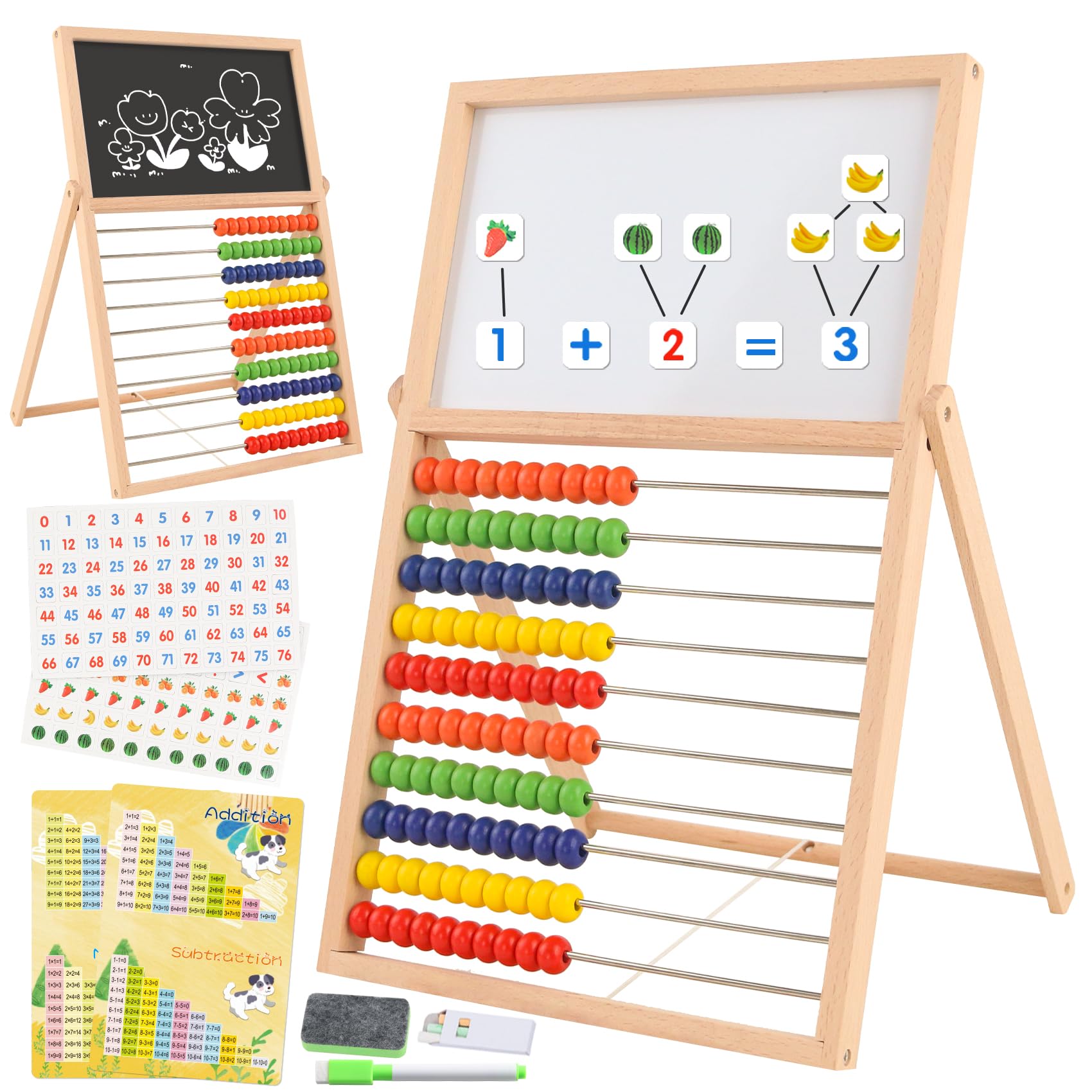
The double-sided board is what makes this abacus feel like a small desk workspace. One side is a blackboard, the other a whiteboard, and the set includes magnetic numbers and fruit stickers, so a child can write a number, stick it on the board, and then build it on the beads. We like that for a visual learner who wants to draw the problem as well as count it.

The abacus itself is a 10-row, 100-bead frame with a wooden body and metal rods. The beads slide smoothly, and the frame is compact enough to sit on a child's desk. The magnetic numbers are useful for place-value labels and simple games. It is a more playful setup than a plain frame, and that can be the difference between a child choosing it and ignoring it.

This is not the frame for a classroom demonstration or a child who still puts small magnets in their mouth. The pieces are small, and the board is better suited to supervised table play. For a homeschool parent who wants a compact math station with a writing surface, the combination is genuinely useful. For everyone else, a plain 100-bead frame is simpler.

Bottom line: We recommend the Ranqibo board for a supervised homeschool desk where a child can write, stick, and count in one compact station.

#8

Yellow Mountain Soroban Abacus

Yellow Mountain Soroban Abacus

Mental math

Doodle Score 9.0/10
Check Price

Worth Noting

  • Beads shift when the frame is bumped
Weight
0.26 lb
Columns
17
Frame Material
ABS plastic
Item Dimensions
10.5 x 2.4 x 0.8 in
Read the full review

A soroban is a different tool from a hundred-bead counting frame, and this one is honest about it. The 17 columns and plastic frame are built for quick bead movement, not for a three-year-old pushing beads around. We like it for an older child who is learning the soroban method or wants a calculator they can hold in one hand.

At 10.5 inches and about a quarter pound, it slips into a backpack and takes up little desk space. The beads have a light, quick action that suits the soroban method. We found the compact size best for a child's hands, while an adult demonstrating may find the beads small.

The 17 columns give plenty of room to grow, though a beginner will spend most of their time in the first few. The plastic frame does not feel as substantial as the wooden abacuses here, but it keeps the price low and the weight down. If you want a first counting frame, this is not it. If you want a real soroban for mental arithmetic, it is a sensible place to start.

Bottom line: We recommend this soroban for an older child who is ready to learn mental arithmetic, not for a first counting frame.

How We Chose and Tested Abacuses for Kids

We started by comparing specs and parent feedback on bead count, frame size, material, and whether the abacus worked flat, propped, or standing on its own. From that pool, we ordered 16 models that covered the range: compact plastic frames for travel, larger wooden ones for the table, and a few with stands or storage bags. Before any kid touched them, we counted every bead, rod, and washer against the packaging and checked edges for splinters, sharp seams, and loose joints.

For four months, they lived in our playroom and rotated through after-school homework, pretend grocery-store games, restaurant waits, and backseat car rides. We watched whether beads slid freely or jammed, whether one bead could be moved without shifting a whole row, and whether the frame stayed put when a child pushed hard. We also carried each one around the house and packed it into a backpack with a lunchbox to see how much space it took up and whether it survived the trip.

Durability got its own round of less gentle handling: we dropped each abacus from table height, tugged on the rods, and checked after a week whether beads had cracked or paint had chipped. To judge the educational side, we tracked which ones kids returned to without prompting and whether they used them for counting, patterns, or making up shop totals. At the end, we compared what each one offered for the money—bead count, solidity, and extras like a stand or storage bag—and eliminated any that felt flimsy or overpriced.

How to Choose the Right Abacus for Kids

Match the frame to the counting stage

A 20-bead rekenrek is enough for a child who is still learning to count a group and recognize five or ten without counting. A 10-row, 100-bead frame becomes useful when the child is ready to count to 100, skip-count by tens, and see place value. A soroban is a later tool for mental arithmetic. We prioritize the 100-bead frame for most families because it has the longest useful life, but we keep a 20-bead rack for the earlier stage. Buying a 17-column soroban for a four-year-old usually means the tool sits unused.

Look at how the beads are grouped

Color is not decoration here. One color per row makes a hundred chart easy to read and helps a child skip-count by tens. Two-color beads grouped in fives do a different job: they let a child see five and ten as quantities, which is the foundation for addition and subtraction. A ten-color frame can still teach counting, but it does not automatically teach five-and-ten structure. We prefer two-color grouping for a child who is starting addition, and one color per row for a child who is learning to count to 100.

Check the frame and bead action

A wooden frame is not automatically better than plastic; the important question is whether the rods are fixed and the beads stay on. For a young child, choose a sealed frame with no detachable beads and check the manufacturer's age. Bead action matters too: a frame that is too stiff is frustrating, while a soroban is designed to move easily and can shift when bumped. We check that the frame sits flat and that a child can reset a row without pinching fingers.

Decide how much kit you need

Cards, counting sticks, and activity boards can turn an abacus into a ready-made lesson, but they also add pieces to store and keep track of. We suggest buying the simplest frame that matches the lesson, then adding cards only if you will actually use them. For a classroom, a set of 25 mini rekenreks makes sense; for one child, a single 100-bead frame is easier to manage. Check dimensions before ordering, because compact kits can be smaller than the photos suggest.

Frequently Asked Questions

Final Verdict

Start with the Melissa & Doug Classic Abacus if you want one frame that will carry a child from counting to 100 into early place value. It is the simplest, most broadly useful default here, and it does not bury the beads under cards or boards.

If your child is younger and you want to practice addition and subtraction, choose the Melissa & Doug Add & Subtract Abacus instead; for a classroom, the hand2mind class set is the practical bulk buy.