Outdoor Play

Best Pool Floats for Kids of 2026

The saddest sight at a summer pool party is a deflated unicorn ring slumped on the deck by 2 p.m. A good kids' pool float should keep your child comfortably buoyant, survive more than a handful of afternoons, and actually make them want to get in the water. I've watched my own kids burn through cheap rings in a week, so this year my team and I tested 14 floats over the course of a summer—rings, loungers, character shapes, and a few oddballs—to see which ones held up.

What separates a keeper from a pool toy graveyard is rarely the design on the box. It's the valve (does it seal tight after inflation?), the seams (do they stress when a 7-year-old launches themselves on top?), and the size (a float that swallows a 5-year-old is just as useless as one they've outgrown). We also paid attention to what kids actually reached for—appearance matters more than parents like to admit—and whether the price felt fair once we saw how a float handled a full season of sun, chlorine, and lake water. The picks below are the ones still inflated when September rolled around.

#1

EZIGO Baby Pool Float with Canopy
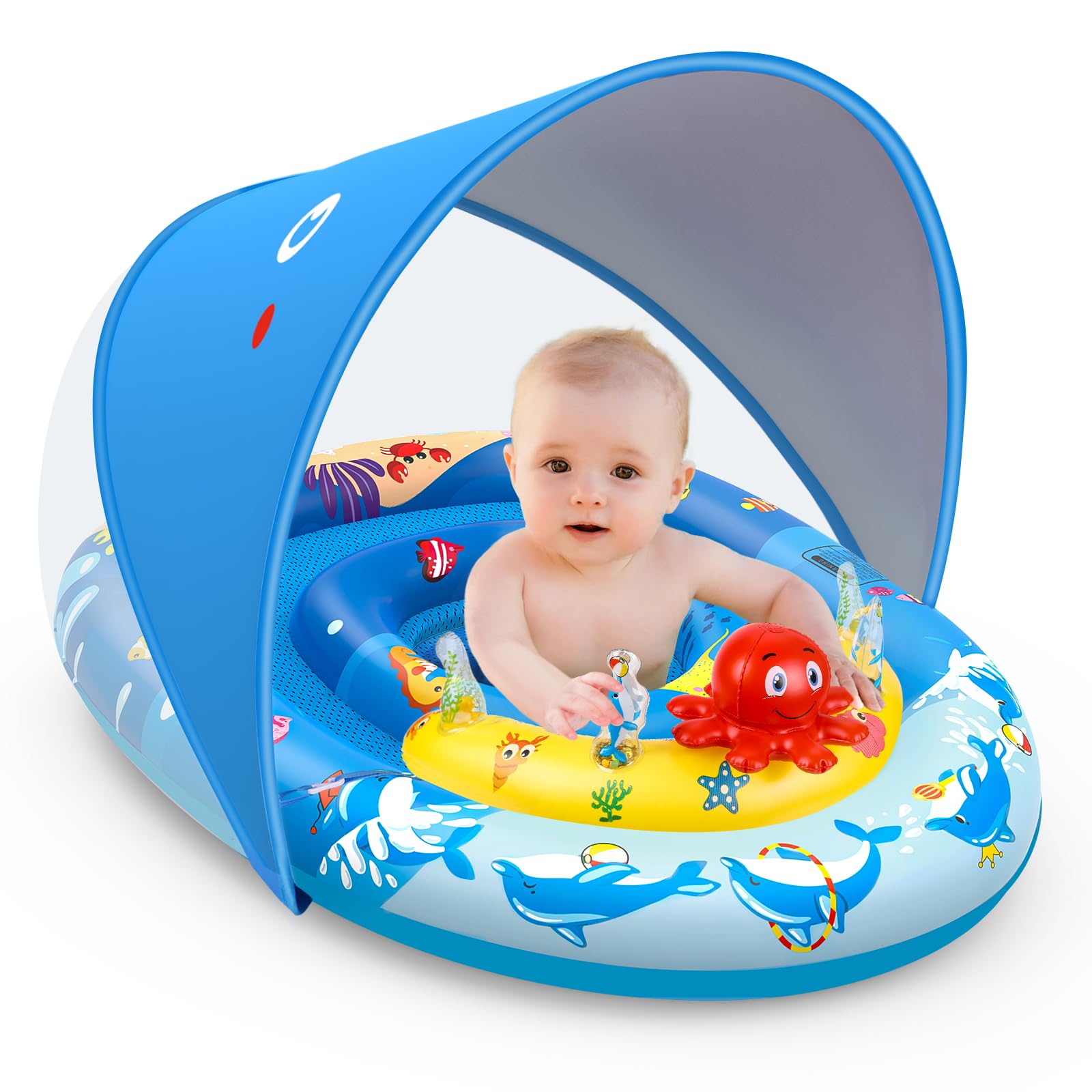
EZIGO Baby Pool Float with Canopy

Babies 6-36 months

Doodle Score 9.2/10
Check Price

Worth Noting

  • Outgrown around the third birthday
Canopy
Adjustable, UPF 50+
Age Range
6 to 36 months
Weight Limit
33.1 lb
Inflated Size
34 x 27 in
Read the full review

Six months to three years is the age at which a float has to do almost all of the work. A baby that size can't grip a handle for long, can't right themselves if they slide forward, and can't tell you the sun has moved into their eyes. The EZIGO is built around those three problems and not much else, which is why it earns the top spot: a seat with a harness running underneath so a baby can't slip through, dual air chambers, and a canopy that tilts through 120 degrees to shade from the side as well as overhead.

The seat is where baby floats usually fall apart, and it's where this one earns its keep. The harness adjusts, and the mesh seat lets a baby's legs dangle and kick instead of perching them on top of a bladder. What we watched for was the lean — the moment a baby reaches over the side and the float follows them. It holds, and that steadiness is the thing worth paying for here, because everything else about a baby float is decoration if the float rolls.

The canopy surprised us. Adjustable shades on kids' gear are usually a token flap; this one swings far enough forward to cover a baby's face at midday and stays where you put it. It's also why we don't mind that this costs more than the plain baby rings in this guide: sunscreen reapplication on a wet, squirming baby is the worst five minutes of a pool day, and shade means fewer of them.

Two things to plan around. The stated ceiling is 36 months and 15 kg, which is optimistic for a big three-year-old — by their third summer most kids want one of the ring floats here. And the canopy mounts are the part to check when you unpack it and again each spring, because a shade that tears at the corner stops being shade. Otherwise this is a float that does its job without being asked twice.

Bottom line: We recommend it first for six-to-36-month-olds: a harnessed seat, dual chambers and a canopy that blocks sun from the side, not just overhead.

#2

JOYIN Fruit Ring 3-Pack

JOYIN Fruit Ring 3-Pack

Tweens and parties

Doodle Score 9.2/10
Check Price

Worth Noting

  • Seams can tear within a season
  • Too big for small children, snug for adults
Pack Size
3 rings (watermelon, kiwi, lemon)
Age Guidance
9 years and up
Weight Limit
220 lb
Ring Diameter
32 in
Read the full review

Three 32-inch rings — watermelon, kiwi and lemon — turn a pool into a party. That's how these make sense: as a set you hand out, not as one child's everyday float. The size lands on tweens, roughly ten to twelve, and on petite adults; younger kids rattle around inside them and grown adults sit low in the water.

What we appreciate is how little there is to them. No seat, no canopy, no animal head to inflate first: a couple of minutes each, then they stack flat in a bag and take up almost nothing in the car, which is why sets like this end up on every lake trip. The trade is durability — a three-pack of rings will lose one to a seam before the season ends, and the nine-and-up age guidance on the listing is worth taking at face value rather than as a suggestion. Buy them for a group, let each kid claim a fruit, and keep the third in the trunk for the day a friend turns up.

Bottom line: Our pick for tweens and pool parties: three bright 32-inch rings that keep a group happy without costing much.

#3

Intex Animal Head Ring 3-Pack

Intex Animal Head Ring 3-Pack

Toddlers and preschoolers

Doodle Score 9.0/10
Check Price

Worth Noting

  • Little room for kids wearing swim vests
  • Animal styles vary between packs
Age Range
3 to 6 years
Pack Size
3 rings, styles vary
Ring Diameter
24.5 to 30 in
Read the full review

Three rings in one pack is the whole argument, and it holds up better than we expected. Intex sizes them differently — the smallest around 24.5 inches, the largest around 30 — so one set covers a three-year-old and a six-year-old at the same time, or the same child across two summers. For the years when a kid wants their own ring and you want a spare in the bag, this is the set that makes sense.

The smaller rings are the reason to buy it. A 24-inch ring sits around a small child's middle, so they ride in it rather than falling through it, which is exactly the problem with handing a four-year-old a 32-inch tube. The 8-gauge vinyl isn't the heaviest in this guide and doesn't need to be: a ring worn around the waist is inflated firm and used gently, and the part that takes the real abuse is the animal head meeting the pool edge, not the ring itself.

Two things to know. The sets ship with mixed animal styles, so don't promise a flamingo. And the small sizes leave very little room for a child wearing armbands or a swim vest — if your kid swims in a vest, go straight to the 30-inch ring or one of the larger tubes here. As a first proper ring for a confident three-year-old, three sizes in one pack beats a single ring that fits for one summer.

Bottom line: We recommend this set for the preschool years: three rings in genuinely different sizes, so one pack covers siblings and the smallest ones actually fit.

#4

Intex My Baby Float

Intex My Baby Float

Babies and toddlers

Doodle Score 9.0/10
Check Price

Worth Noting

  • No canopy or shade of any kind
Seat
Backrest with leg straps
Diameter
36.5 in
Air Chambers
2
Weight Limit
33 lb
Read the full review

No canopy, no toys, no strap-and-buckle seat: the My Baby Float is a big yellow ring with a smaller ring inside it, a pillow backrest and two smooth straps that run under a baby's legs. That's the entire design, and it's the reason this is the simplest recommendation in the guide.

The two-ring construction is the part that matters. The outer ring gives the float its footprint, which is what stops it flipping when a baby kicks or leans, and the inner ring holds the child. Two air chambers mean a puncture on one side leaves you with a soft float and a baby at the surface rather than a deflated ring. It blows up in a couple of minutes and weighs next to nothing once it's flat.

Our read is that this is the float for a child from about 18 months to three years who is already happy in water, and one to hold off on for a baby under a year. The seat sits low — deliberately, so a toddler is half in the water with their legs kicking — and a small baby slides forward until their chin is at the waterline. Once they're upright and steady, that low ride is the whole appeal: they're in the pool, not perched on top of it. Add a hat and someone in the water beside them, and it does what the expensive seats do, minus the shade.

Bottom line: Our pick for a confident toddler: a low-riding ring that stays stable, inflates in minutes and skips the canopy and toys entirely.

#5

LAYCOL Baby Float with Canopy

LAYCOL Baby Float with Canopy

Bigger babies

Doodle Score 9.0/10
Check Price

Worth Noting

  • Canopy frame is thin metal
Canopy
Four-position, UPF 50
Age Range
3 to 36 months
Weight Limit
36 lb
Inflated Size
34 x 27 in
Read the full review

The LAYCOL covers the same ground as our top pick — canopy, mesh seat, baby from three months to three years — so the useful question is what it does differently. Two things. The canopy clicks through four set positions instead of tilting continuously, and the float is built wider, with 0.35 mm PVC and a seat the maker describes as 20 percent wider than a standard baby float.

That width is a real advantage for a bigger baby. A chunky nine-month-old in a narrow seat ends up wedged, and the extra footprint helps keep the float level when they lean over the side after a toy. There are four toys on board too — a squeaky crab, seahorse, dolphin and fish — which is more entertainment than the EZIGO offers, and worth something on a day when the pool is busy and you want the baby occupied.

Stability is where the two floats part company. Plenty of babies ride this one steady; on others it rocks from side to side, and leaning is the specific behaviour behind that. On a baby float this matters more than it would on a ring, because a baby can't correct it. Try it in the shallow end with your own child before committing to a whole afternoon with it.

So it stays behind the EZIGO here, because staying upright counts for more than a wider seat. But if your baby is big for their age and the extra width is the difference between comfortable and wedged, this is the one to look at — and the four-position canopy is easier to set one-handed, with a baby on your hip, than a shade that slides.

Bottom line: A wider-seated alternative to our top pick, best for a big baby — worth a look as long as you check the canopy frame on arrival.

#6

Jasonwell Unicorn & Flamingo 2-Pack

Jasonwell Unicorn & Flamingo 2-Pack

Teens and up

Doodle Score 9.0/10
Check Price

Worth Noting

  • Too big for young children
  • Loses air between sessions
Pack Size
2 floats (unicorn, flamingo)
Air Chambers
2 per float
Weight Limit
500 lb
Ring Diameter
42 in
Read the full review

Sold as a kids' float, sized like an adult one. Forty-two inches across and rated to 500 pounds, the unicorn and the flamingo are big — big enough that a ten-year-old disappears into the middle of one and a teenager floats properly with room to spread out. That gap between the marketing and the measurements is the thing to understand before you order.

For the right kid it's a good float. Two air chambers per ring mean a soft side is survivable, the valves are the fast sort that empty a ring in seconds rather than minutes, and the shapes look genuinely good in a pool — a pink flamingo and a unicorn read better from the kitchen window than a stack of plain tubes. These are also the floats most likely to be claimed by an adult once the kids are out.

Air retention is where this pair is weakest in our group. Plan on topping both rings up before a session rather than inflating them once in spring, and inflate them a day early the first time: a slow leak shows up overnight, and a half-soft 42-inch ring is a lot of vinyl to climb out of.

So this is the float for a confident nine-year-old and up, or for a family that wants a ring the adults can use too. It's the wrong size for a five-year-old, and the wrong buy if you want something you inflate once and forget. For the teenager who still swims, though, it's the only float here with room to actually lie across — which is the difference between a big kid using a pool toy and quietly deciding they've outgrown them.

Bottom line: We recommend it for a confident nine-year-old and up, or a family that wants one ring the adults can climb on too.

#7

Jasonwell Fruit Ring 2-Pack

Jasonwell Fruit Ring 2-Pack

School-age kids

Doodle Score 8.8/10
Check Price

Worth Noting

  • Seams give out after a summer in the sun
  • No seat or backrest for inexperienced swimmers
Age Range
Child
Pack Size
2 rings (watermelon, kiwi)
Weight Limit
200 lb
Inflated Size
30.5 in diameter
Read the full review

Thirty and a half inches is the size that fits the widest span of kids. A five-year-old sits inside it with room to spare, an eight-year-old still floats without their shoulders jammed against the vinyl, and it stays small enough to pack. The pair comes as watermelon and kiwi, and two distinct fruits are more useful than they sound: each kid claims one, and the ownership argument that ends pool afternoons early never happens.

We rate the shape over the print. A plain round tube is the most forgiving float a kid can use — no seat to slide out of, no head to tip over — so they can sit in it, kneel on it, lie across it or hang off it with their arms over the sides. That also makes it the right second float after a baby seat: it asks a little balance of the child instead of doing everything for them.

The honest caveat is lifespan. This is a float that gets a family through a summer of normal use, but it isn't one to leave inflated on a hot deck for three months and expect to hand down; seams are what go, and sun is what makes them go. Deflate it between trips and dry it out of direct sun, and you'll get more than one season. As a first proper swim ring, that's a trade worth making.

Bottom line: Our pick for the five-to-eight stretch: a 30-inch tube with no seat to outgrow, sold as a two-pack so siblings each get their own.

How We Tested Kids' Pool Floats

We started by scanning top-rated floats across major retailers, then narrowed the field by reading specs and customer reviews for age ranges, weight limits, and valve types. We ruled out anything with a pattern of seam complaints or a deflated-by-day-two reputation, and we made sure the final list covered a range of prices, sizes, and styles—from simple rings to lounge seats to character shapes—so we weren't just comparing apples to pool noodles.

Fourteen floats made the cut, and we tested them from June through August in backyard pools, at a community pool, and on a lake weekend. Each one was inflated with a hand pump and timed; we noted whether the valve required a firm twist or popped loose, and how easy it was to top off. We measured inflated dimensions and seat depth, then had kids ranging from tall 4-year-olds to average 9-year-olds climb in, sit, jump, and clamber out repeatedly. After each session we checked seams for stretching, ran a hand along the material for weak spots, and left a few inflated overnight to see how much air they lost by morning.

Appearance and fun got equal weight: we watched which floats kids grabbed first and how long they stayed engaged before drifting back to the shallow end. We also tracked value by noting how each float looked after a month of sun, chlorine, and lake water—faded colors, sticky valves, or seams that started to bulge counted against them. By the end of the summer, the ones still holding air and still getting dragged into the pool were the clear winners.

How to Choose Pool Floats for Kids

Start with age, not with the picture

A seat float with a canopy and a harness is a baby product. It holds a child who can't yet hold themselves up, and it is outgrown somewhere around the third birthday. A ring or tube is a swimming toy: it assumes the child can balance and grip, and it stays useful until they would rather have a bodyboard. Between the two sits the toddler ring, small enough to wear around the middle.

Buy for the child you have this summer, not the one you'll have next, and check the age and weight printed on the float against them both. A float bought a size large is a summer of slipping through it.

What keeps a float upright

Two things: the number of air chambers and the width of the base. A single-chamber ring goes flat the moment it is punctured; two chambers leave you with a soft side rather than a swim. A wider footprint, or a seat that sits low in the water, resists the lean that happens whenever a child reaches over the side for a toy.

When a float arrives, put it in the shallow end and let your child lean out while you hold the ring steady. That is the moment that tells you whether it is stable, and it takes a minute of the first swim rather than a whole afternoon.

Reading diameters and weight limits

Ring diameters in this category run from about 24 inches to 42, and the number tells you who fits. A 24-to-26-inch ring sits around a preschooler's middle rather than swallowing them; 30 to 32 inches fits school-age kids and smaller adults; 42 inches is a teenager's float, whatever the packaging says.

For seat floats, the weight limit matters more than the diameter. A baby seat rated to 33 pounds is a different product from one rated to 36, and the second number is the one a big baby will hit first.

What a canopy does, and what it doesn't

A UPF 50 canopy shades a face. It does not replace a hat, sunscreen or a plan for the middle of the day. What is worth checking is the range of movement: a shade that only sits overhead stops helping once the sun drops behind the pool fence, while one that tilts forward covers a baby at noon.

Frame construction matters as much as the fabric, because a bent frame turns the whole thing into a hat. Inflate a canopy float at home and set the shade up and down a few times before you take it anywhere.

How many floats you actually need

Packs of two and three look like value and often are, but only when the extras have a job: a second ring for a sibling, a spare for the cousin who turns up, a set to hand out at a party. For one child swimming most days, a single well-fitted ring beats three loose ones.

If you are buying a pack for a group, buy the size that fits the youngest child in it. An older kid can always sit in a bigger ring, but a small child can't hold on to one.

Frequently Asked Questions

Final Verdict

If your child is under three, buy the EZIGO. A secure seat, two air chambers and a shade that tilts to follow the sun are the three things that make a baby's pool time work, and it does all three more dependably than the other canopy float here.

Past the seat stage, the Jasonwell fruit two-pack covers the school years. The purchase to avoid is the one a size too big: a 42-inch ring around a five-year-old is a summer of sliding through it.