Outdoor Play

Best Baby Pool Floats of 2026

The first time you lower your baby into a pool, your hands don't leave the float. That's the right instinct. A baby pool float has one job — to keep a small, wriggly person stable and shaded while you stay within arm's reach — and a bad one makes that job harder, not easier. The right one buys you a calmer, cooler stretch in the water and gives your arms a break without ever pretending to replace them. I spent a summer with 14 of them, and the differences showed up on day one.

A canopy is only as good as the harness under it, and a slow leak is worse than no float at all. The ones that made the cut stayed inflated through a full afternoon, kept a wiggly 9-month-old from slipping through the leg holes, and didn't demand a 20-minute pump session before every swim. You don't need to spend a lot for a safe float, but you do need to look at the seams and valves. Below are the ones I'd hand to a friend without a caveat.

#1

HINZER Baby Pool Float with Canopy
HINZER Baby Pool Float with Canopy

Long-term use

Doodle Score 9.6/10
Check Price

Worth Noting

  • Bulky and awkward to carry once inflated
Seat
Adjustable seat strap
Canopy
UPF 50+, removable and adjustable
Age Range
6 to 36 months
Weight Capacity
50 lb
Read the full review

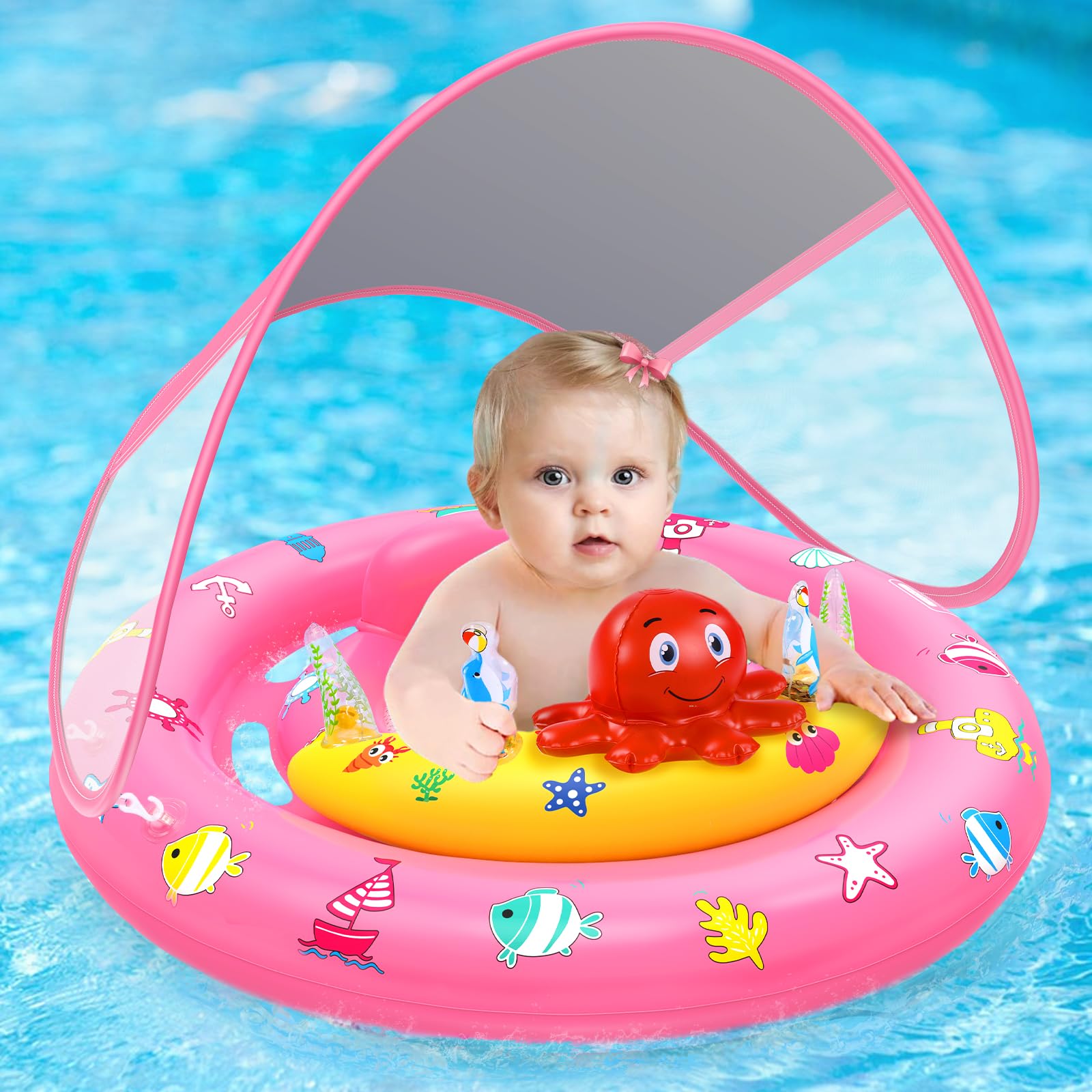
Six months to 36, and rated to 50 pounds — no other float here covers a baby for as long. The adjustable seat strap underneath is the mechanism: slide it back and the same float that cradles a small six-month-old takes a tall two-year-old without their shoulders riding up. Set that against the SwimWays, which is finished at 22 pounds, and you can see why this is the one that goes back in the car the following summer.

What we did not expect is how upright it holds a baby. The float is a 31-inch square rather than a ring, so there is a back to lean against and shoulders stay clear of the waterline; the babies we put in it sat and watched the pool instead of sliding down into it. It is steady enough that a tired one can doze off mid-float, which says more about the shape than any figure on the box.

The canopy adjusts and lifts off, the toy console carries a squeaky octopus, a sparkly dolphin, and a string of bells that survive being chewed, and the mesh side panels keep a face visible from above. Deflated it rolls up small enough for a suitcase; the bulk only becomes a problem once it is full of air.

Bottom line: We point bigger babies here: the seat adjusts through six months to three years and a 50-pound rating, and it stays upright as they grow.
#2

GLOPUS Baby Pool Float with Canopy

GLOPUS Baby Pool Float with Canopy

A second float

Doodle Score 9.4/10
Check Price

Worth Noting

  • Canopy hooks slip off the frame
Age Range
6 to 36 months
Air Chambers
Dual
Sun Protection
Removable UPF 50+ canopy
Weight Capacity
33 lb
Read the full review

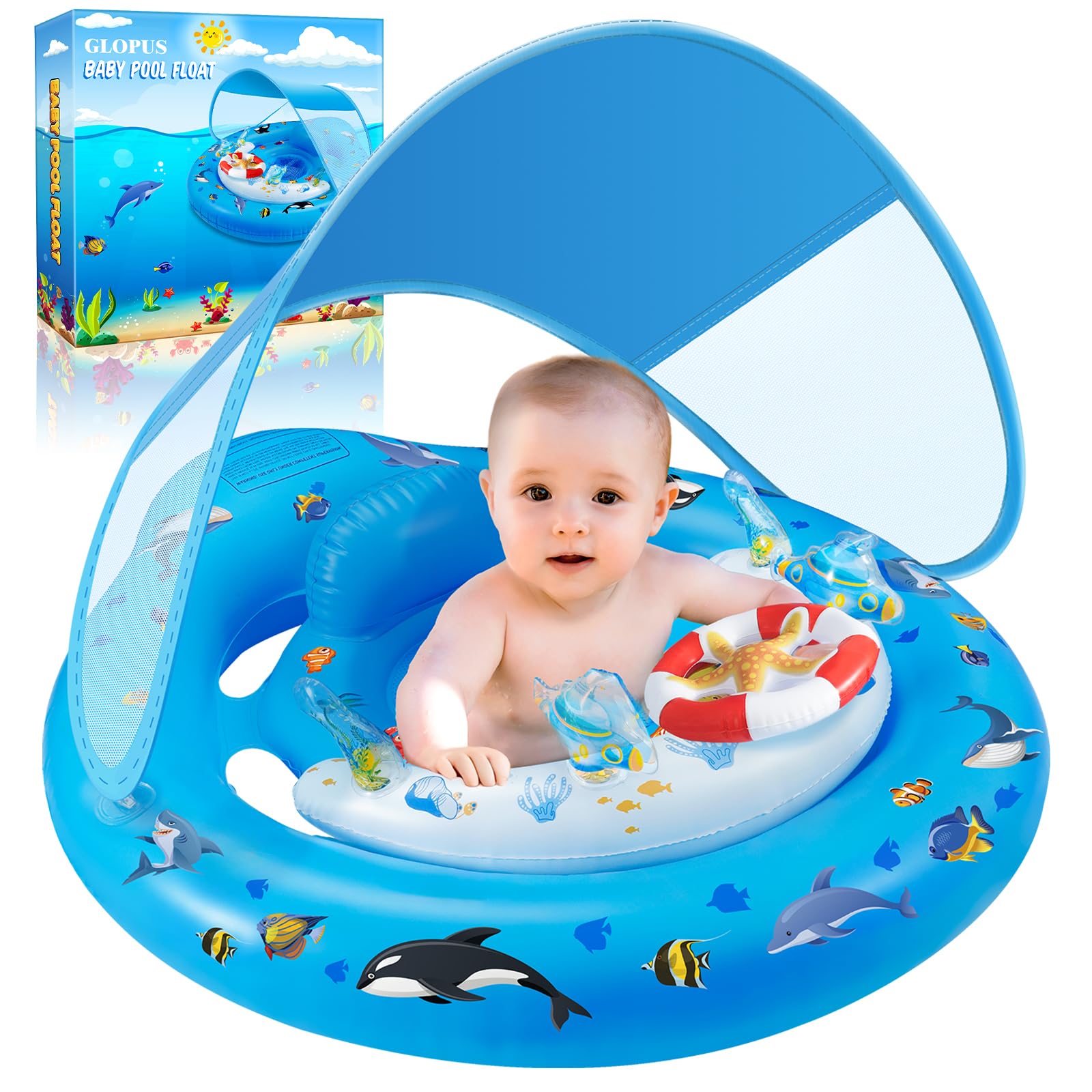
Two pieces of this float come off: the canopy, and the toy console with its squeaking starfish and pair of sequined submarines. That sounds like a small thing until you have spent an afternoon with a baby who has decided the canopy is a hat and the toys are in the way. Strip it back to the bare seat and it is a plain, wide float with a strap underneath that adjusts; clip everything on again when the mood changes.

It is rated from six months to 36 and to 33 pounds, and the seat sits low enough that a baby's legs are in the water rather than on it, which is the position that gets them kicking. Stability is where it is less settled than the picks above: the float is wide and flat, but it leans when a baby shifts their weight to one side, so a calm pool suits it better than one full of bigger children.

Set it beside the EZIGO and the two are close — a seat strap that adjusts underneath, a canopy that lifts off, a different cast of toys — but the EZIGO is the steadier of the two when a baby leans, and at a pool that is the whole decision. This one earns its place as the second float, the one that lives at a grandparents' pool or travels in a suitcase, and it does that job without fuss.

Bottom line: A competent float whose canopy and toy console both come off, which makes it easy to strip down for a baby who wants to see the water.

#3

SwimWays Baby Spring Float

SwimWays Baby Spring Float

Everyday pool use

Doodle Score 9.2/10
Check Price

Worth Noting

  • Rated 9 to 24 months and 22 pounds
Age Range
9 to 24 months
Inflated Size
34"L x 30"W x 20.5"H
Sun Protection
UPF 50+ removable canopy
Weight Capacity
22 lb
Read the full review

There is a spring sewn into the outer chamber of this float, and once it is inflated you can feel what it does: the rim keeps its shape instead of curling up around a baby's shoulders, so the float sits flat and level in the water. That matters most when a baby leans forward over the mesh play space at the front, which is exactly what a curious nine-month-old does. The base is wide, the air is split across two chambers with child safety valves, and the whole thing is fabric-wrapped rather than bare PVC, which makes it far less slippery to grab with wet hands. Of everything here, this is the design we trust most with a baby who is still deciding whether they like water.

The canopy is the feature that matters most on a hot afternoon, and this one is done properly. It is UPF 50+, it lifts off entirely when you move into the shade, and the side panels are mesh, so you can look straight down at your baby's face while they are underneath it. That is the difference between a canopy you leave on and one you end up fighting with: the shade stays useful because you can still see each other.

Packing it away is where the design shows its age. The float folds flat into three rings and slides into the included tote, which is genuinely useful for a trunk or a suitcase, but coaxing out the last of the air takes patience, because it hides in the spring rim. We deflate ours most of the way, fold it flat, and let it finish drying in the sun rather than chasing a perfectly empty float. Nothing here is complicated; it is just a five-minute job that wants doing properly before the float goes into storage.

Bottom line: Our default pick for a baby who can sit up: the spring rim holds the float level, the mesh seat lets them kick, and it folds into its own bag.

#4

Mambobaby Float with Canopy

Mambobaby Float with Canopy

Newborns and infants

Doodle Score 9.2/10
Check Price

Worth Noting

  • Canopy sinks if it comes off in the water
Age Range
3 to 24 months
Construction
Foam core, no pump
Sun Protection
UPF 50+ canopy
Weight Capacity
40 lb
Read the full review

There is nothing to inflate. The Mambobaby is built around a foam core under a fabric cover, so instead of a pump, a valve, and twenty minutes hunched over in a parking lot, you unfold it and put it in the water. The buoyancy comes from the foam rather than a sealed air chamber, so the slow leak that retires most inflatable floats is not part of the deal here.

The range runs 13 to 40 pounds and three to 24 months, which makes this the pick for the youngest baby in the house: the back-float position is rated for under six months, and the fabric cover is soft against skin in a way the bare vinyl floats are not. Five support points and a buckle at the back hold a small baby in place, and the canopy clips on above them.

You are paying for the foam and the fabric rather than for extra features — this is comfortably the most expensive float here, and the harness and canopy are no more elaborate than the inflatables'. What the money buys is the ten minutes you do not spend pumping and the confidence that a pinhole will not strand you at the pool. Push each snap home and give the harness a tug every time you buckle up; that is the one habit this float asks of you.

Bottom line: The float for a very young baby: foam instead of air means nothing to pump, nothing to slowly leak, and a harness that fits a three-month-old.

#5

EZIGO Baby Pool Float with Canopy

EZIGO Baby Pool Float with Canopy

Keeping babies busy

Doodle Score 9.2/10
Check Price

Worth Noting

  • Canopy corners can tear with heavy use
Canopy
Adjustable through 120 degrees
Age Range
6 to 36 months
Inflated Size
34" x 27"
Weight Capacity
33 lb
Read the full review

The toy bar is the whole argument for this one. A squeaking octopus, two dolphins with sequined bellies, and a pair of bells sit on the front rim within reach of a baby's hands — enough noise and color to keep those hands busy while their legs get used to the water. For a first afternoon at a pool with a baby who is not sure about any of it, that is worth more than another inch of float.

The canopy pivots through 120 degrees, more adjustment than any other float here, and that is the reason it stays useful from mid-morning to late afternoon. Swing it forward and it shades a face without blocking the view; lay it back and a baby can look straight up at the sky. The mesh sides mean you are not staring at the back of a canopy all day, and it unclips in a second when you move into the shade.

At 34 by 27 inches it is the roomiest flat float in the group, and it weighs about as much as a paperback, so it goes into a suitcase without an argument. Watch a strong baby who leans hard on the toy bar: the front end is light, and a determined yank can tip it forward. It suits a baby who is still mostly sitting back, and it is a better float for a calm pool than a busy one.

Bottom line: The pick for a baby who needs convincing: squeaky sea creatures up front, and a canopy that swings to block the sun from almost any angle.

#6

LAYCOL Baby Pool Float, 5-Point Buckle

LAYCOL Baby Pool Float, 5-Point Buckle

Wriggly babies

Doodle Score 8.8/10
Check Price

Worth Noting

  • Seams and strap hardware are the weak points
Harness
Five-point buckle with crotch strap
Included
Manual pump and two toys
Age Range
3 to 36 months
Weight Capacity
48 lb
Read the full review

Getting a baby into a pool float is the moment these things usually fall apart: you are holding a wet baby, the float is drifting away, and there is nothing but a leg hole between them and the water. This one answers that with a five-point buckle, a crotch strap, and shoulder straps, so a baby who arches backwards on principle is going nowhere. It is the most secure seat in this group. The trade-off is speed — loading a baby takes two hands and a moment of wrestling — and that slowness is the same thing that keeps them in place.

The harness works in two orientations: face down for a breaststroke kick, face up for a back float. Switching between them is a matter of re-buckling rather than re-inflating, which is the difference between a float that adapts to a tired baby and one that does not. For a baby learning to kick, face down is the useful position; face up is what you want when the sun is high and they have had enough.

Sun cover is a removable UPF 50+ canopy on a frame, and the box carries a manual pump and two small toys as well, so you are not improvising with lung power on the first afternoon. The pump matters more than it sounds: a float this size takes a while by mouth, and having the right nozzle in the box means it is ready in the time it takes to get a baby into a swim diaper.

Bottom line: The one we reach for with a wriggly baby: a five-point buckle, a crotch strap, and shoulder straps hold a determined arch-backer from three months up.

How We Picked and Tested Baby Pool Floats

We started with a long list of baby pool floats from major retailers, then narrowed it by three non-negotiables: a canopy or shade option, a harness or leg openings that looked genuinely secure, and valves that weren't an afterthought. That left us with 14 floats, which we tested over one summer — in a backyard pool, a shallow community pool, and a bathtub for inflation and drying checks.

Each float was inflated with a hand pump and timed, then left overnight to see how much air it lost by morning. In the water, we lowered babies in and out repeatedly, watched whether a wiggly 9-month-old could slip through the leg holes or tip sideways, and checked if the canopy stayed put in a breeze or left too much sun on bare shoulders. We also noted how long each took to deflate and dry, and whether the seams held up after a week of daily use.

Safety was never a checkbox: we kept an adult within arm's reach for every test and paid attention to buckles, seams, and whether the float felt stable when a baby leaned forward. Value came down to whether the thing survived the summer without a patch kit — a cheap float that leaks by August isn't a bargain. We also considered ease of use on tired parents: how fast it inflated, whether it fit in a beach bag, and whether the valves sealed without a fight.

How to Choose Baby Pool Floats

Choose the seat for your baby's stage

There are two designs here and they suit different babies. A mesh-seat ring, like the SwimWays, lets a baby sit with their legs through holes and kick freely — ideal for a baby who can sit with some control and wants to move. A harnessed seat, like the LAYCOL, buckles around the waist, chest, and crotch, which suits a baby who arches, wriggles, or is still a little floppy.

The trade is freedom against security, and neither is wrong. Pick the one that matches what your baby does when you put them down on a changing mat.

Weight limits matter more than the age on the box

Months are a rough guide; pounds are the number that decides. A float rated to 22 pounds is finished with a big one-year-old, while one rated to 50 pounds will still be right at two and a half. Check the bottom of the range too — a float that starts at 13 pounds has a smaller seat and holds a small baby better than a roomy one does.

If your baby is already near the top of a range in spring, buy for the size above. You will get a second summer out of it instead of a season of watching the waterline creep up.

A canopy is worth having, but check how it adjusts

UPF 50 fabric shades the head, shoulders, and face. It does nothing for the arms and legs dangling in the water, so sunscreen still goes on everything. The feature that separates a good canopy from an annoying one is adjustment: a fixed low canopy blocks the baby's view and yours, while one that swings forward and back — the EZIGO's moves through 120 degrees — can be set to shade a face without cutting off the world.

Canopy frames, clips, and fabric corners are also the most fragile part of any of these floats, so treat them as the delicate component they are.

Decide how much pumping you are willing to do

Every inflatable here is more pleasant with a pump, and only some arrive with one. Two chambers are standard and worth having: you inflate them in stages, and a puncture in one still leaves you a slow trip to the shallow end rather than a deflated baby.

Foam floats skip the whole ritual — nothing to pump, nothing to deflate, nothing to fold back into a bag at the end of the day. If your pool trips are spontaneous rather than planned, that convenience is worth paying for.

Toys keep a baby in the float longer

A toy console — squeaky sea creatures, bells, a rattle — does real work. It gives a baby something to do with their hands while their legs get used to the water, and it buys the ten minutes it takes them to relax.

It also adds a light front end that a strong baby can pull against, which is how some of these floats end up tipped forward. If you have a leaner on your hands, choose a float without a front console, or one where the console unclips before the first trip.

Frequently Asked Questions

Final Verdict

The SwimWays Baby Spring Float is the one we hand to parents first. The spring rim keeps it level when a baby leans forward, the mesh seat lets them kick, and the whole thing folds into its own tote at the end of the day.

It stops at 22 pounds, and that is the only real reason to look elsewhere. For a bigger toddler or a longer run, the HINZER covers six months to three years with a 50-pound rating and an upright seat. For a baby under six months, skip both and start with the Mambobaby.