Outdoor Play

Best Skateboards for Kids of 2026

A skateboard seems like the simplest toy in the shop until you watch a 45-pound kid try to steer a board whose trucks came cranked so tight it only rolls in a straight line. The real tradeoff in kids' boards sits between stability and responsiveness: stiff enough that a beginner doesn't wobble, loose enough that leaning actually turns. Get it right and your kid is rolling down the driveway the first afternoon; get it wrong and the board lives in the garage by week two.

We've spent four months with 14 kids' skateboards, handing them to riders ages 4 to 11 and riding them ourselves in driveways and at the neighborhood skate park. What separated the good ones wasn't graphics, it was build quality — decks that didn't flex underfoot, wheels that spun freely out of the box. One thing worth knowing before you shop: a board sized slightly small is easier to learn on than one a kid has to grow into. The picks below all earned their place.

#1

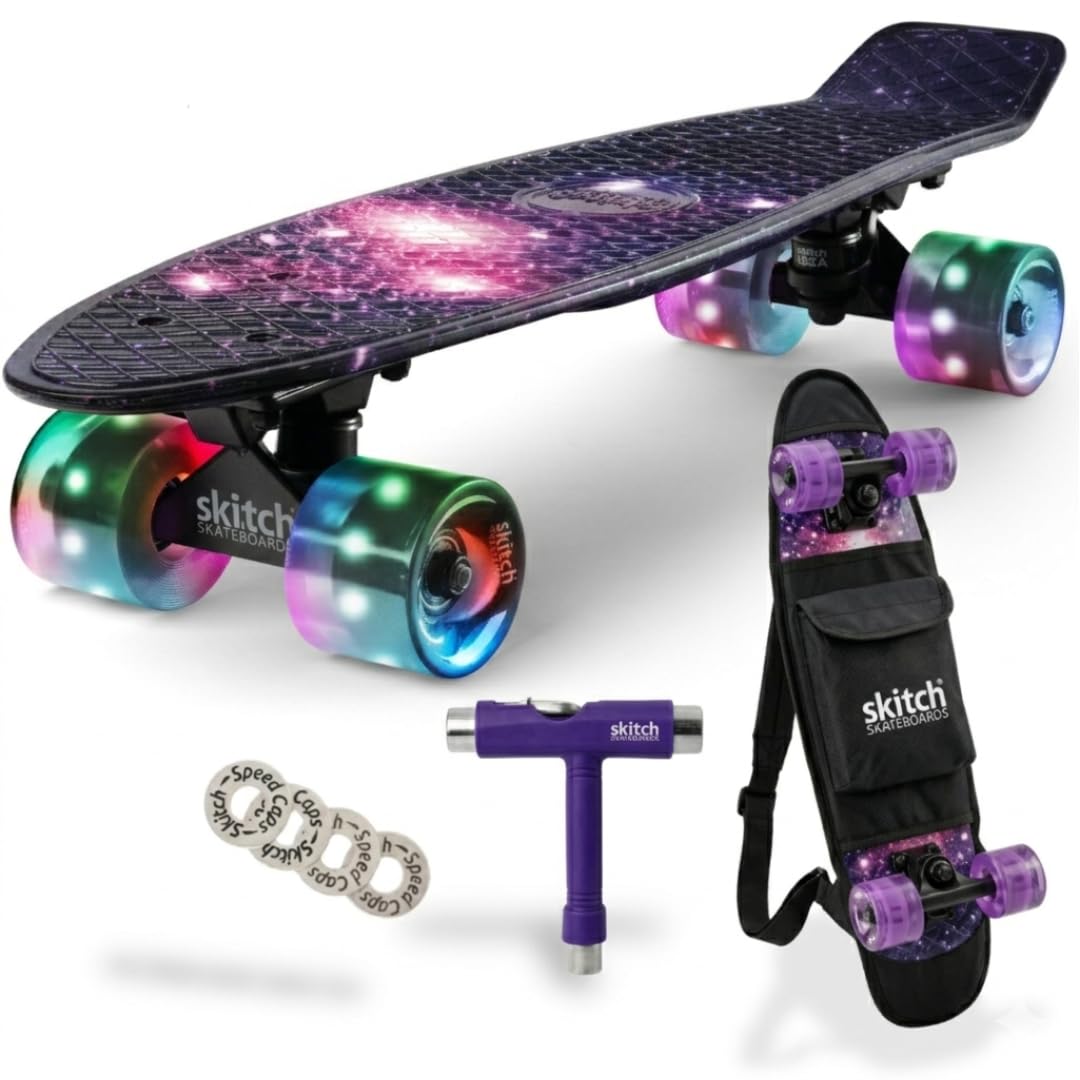
SKITCH 22-Inch Gift Set
SKITCH 22-Inch Gift Set

Gift and travel

Doodle Score 9.4/10
Check Price

Worth Noting

  • Premium price buys the bundle, not the ride
Deck Size
22 x 6 in
In The Box
Backpack, tool, speed caps, tote, video course
Weight Limit
200 lb
Deck Construction
Molded plastic
Read the full review

What arrives is a box, not just a board: a 22-inch mini cruiser, a backpack shaped to carry it, a skate tool, speed caps, a tote bag and a video course. That is the whole pitch, and it is a good one for a present, because a kid who unwraps a skateboard and a bag to carry it in gets to use both the same afternoon.

The board underneath is an ordinary molded-plastic cruiser with a 6-inch waffle deck, 60mm 82A wheels and a 200-pound limit. It rolls the way a plastic cruiser rolls: light, forgiving, quiet on smooth pavement, and not much use for tricks. For the ride to a friend's house or a scooter path, that is plenty.

The backpack is the part that gets used every week; it turns a board into something a kid can take on a trip or hang on a hook by the door. The tool covers the adjustments every new complete needs, and the video gives a nervous beginner something to watch before the first push, which matters more than it sounds.

Buy it as a gift, or for a kid who needs to be talked into skating at all, and skip it if you simply want the best board for the money: the Retrospec does the same pavement job for considerably less, and the difference buys a helmet and pads. Where this one wins is the morning it is opened.

Bottom line: Buy it as a gift, not as a first serious board: the bundle is genuinely useful and the plastic cruiser underneath is ordinary.

#2

CLYCTIP 31-Inch Complete

CLYCTIP 31-Inch Complete

Bigger, heavier kids

Doodle Score 9.4/10
Check Price

Worth Noting

  • No warranty stated on the listing
Wheels
54mm, 95A PU
Deck Size
31 x 8 in
Weight Limit
220 lb
Deck Construction
8-ply maple
Read the full review

Eight plies of maple is the reason to look at this one. Every other full-size board here uses seven, and the extra layer makes the deck noticeably stiffer, which is the right call for a heavy kid or a rider who lands hard and the wrong one for a light beginner who benefits from a little give. For a rider over about 130 pounds, that stiffness is worth more than the springiness a smaller kid would want.

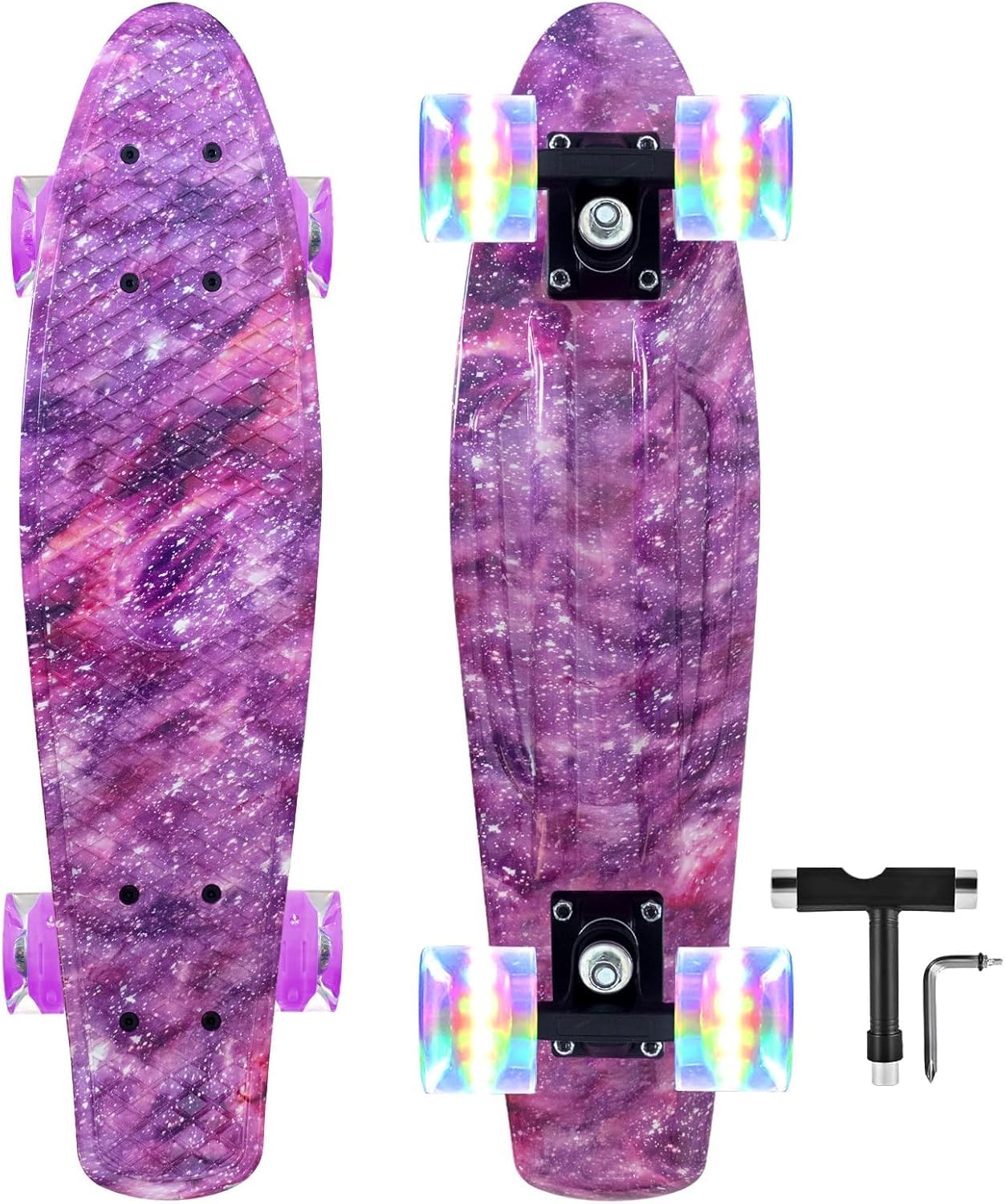
The rest is standard issue and none the worse for it: 31 by 8 inches, aluminum trucks, 54mm 95A wheels on ABEC-11 bearings and a 220-pound limit. The pink graphic does a lot of the selling for a kid who has been promised a board of their own, and it is a lot more appealing in person than a plain maple deck.

What you are accepting is thinner ground underneath: the body of feedback is much smaller than the CAPARK's or the WhiteFang's, so there is less to go on if something goes wrong in month two. That is the reason it sits below them here rather than beside them, not any fault in the way it rides.

Bottom line: A solid eight-ply full-size for a bigger kid, as long as you accept that nothing stands behind it if the deck goes.

#3

Nattork 22-Inch Cruiser

Nattork 22-Inch Cruiser

Youngest riders

Doodle Score 9.4/10
Check Price

Worth Noting

  • No rider weight limit is stated
Wheels
60mm PU, 78A
Deck Size
22 x 6 in
Light-up Wheels
Self-powered LEDs
Deck Construction
Polypropylene
Read the full review

Twenty-two inches reads bigger on a product page than it looks in a driveway. This is a small board, 6 inches across and 22 long, and the families who end up disappointed are the ones who pictured a full-size skateboard and got something closer to a scooter deck. Go in knowing that and it does its job well.

For the right rider it is a good little thing: a polypropylene deck that shrugs off a wet driveway, soft 60mm 78A wheels that roll quietly over pavement seams, and light-up wheels that need no batteries because they generate their own power as they spin. At 1.8 kg it is light enough for a five-year-old to pick up by the truck and carry inside.

We like it for the very youngest riders, where the lights and the weight matter more than a long stance or a premium deck. The catch is documentation: no rider weight limit is stated anywhere on the listing, so if your kid is heavy for their age, ask the seller before you order rather than assuming it will hold.

Set against the other small cruisers, it is the fun one rather than the precise one. The KO-ON has the better deck and the Retrospec the better roll; this one wins on being the board a reluctant kid actually wants to stand on.

Bottom line: We like it for the youngest riders, where light-up wheels and a light deck matter more than a long stance.

#4

CAPARK Complete 31

CAPARK Complete 31

First real board

Doodle Score 9.2/10
Check Price

Worth Noting

  • Firm 95A wheels chatter on rough pavement
  • A 31-inch deck is a lot for a six-year-old
Wheels
54mm, 95A PU
Deck Size
31 x 8 in
Weight Limit
220 lb
Deck Construction
7-ply maple
Read the full review

Eight inches of deck is the number that decides this one. Most of the mini cruisers here run six inches wide, which is fine for a small kid rolling to the corner and cramped the moment that kid wants to stand sideways and push properly. The CAPARK gives a growing rider a 31-inch stance and enough width to move their feet around, so the same board still works when the driveway stops being enough and the skatepark starts.

Seven plies of Canadian maple sit under that, with aluminum trucks and a 220-pound limit that covers most adults, so a parent can step on to demonstrate without feeling the deck sag. The 54mm, 95A wheels are on the firm side, which is what flat-ground tricks and park concrete want, and the grip tape is coarse enough that a beginner's sneakers stay where they are put.

It comes assembled, and like most completes it wants a tweak before the first ride. Take a wrench to the trucks: a board that rattles when you shake it will steer badly, and a board cranked down tight will not lean into a turn at all. Setting the kingpin nut flush with the end of the bolt is the usual starting point.

Against the other full-size boards here, the Ryvorbe adds a tool and a longer warranty and the WhiteFang runs marginally longer, and both are good boards. We keep coming back to this one because the width and the weight limit make it the more forgiving place to learn, and a kid who gets a confident first month is a kid who keeps skating.

Bottom line: Our pick if you want to buy once: the 8-inch deck, 220-pound limit and maple build give a kid room to learn, then start tricks.

#5

Retrospec Quip 22.5

Retrospec Quip 22.5

Pavement cruising

Doodle Score 9.2/10
Check Price

Worth Noting

  • Six-inch deck puts bigger feet half off
  • Plastic deck can crack on a hard impact
Wheels
60mm PU, soft
Deck Size
22.5 x 6 in
Weight Limit
220 lb
Deck Construction
Injection-molded plastic
Read the full review

A plastic deck sounds like a compromise until you pick this one up. At about a kilogram it is the lightest board here by a distance, and the molded waffle pattern gives a beginner's feet somewhere to sit instead of sliding on flat grip tape. It measures 22.5 inches long and 6 inches wide, with a 220-pound limit that is generous for something this small.

The ride is why we keep recommending it. Soft 60mm polyurethane wheels on ABEC-7 bearings roll over sidewalk seams that the hard-wheeled 31-inch boards here rattle across, and the whole thing turns with so little effort that it flatters a nervous beginner. It is the board we grab for a quick run down the block and the one we hand a kid who wants to come along.

It is not a trick board: there is no meaningful pop, and it is happiest on smooth pavement and bike paths rather than the lip of a ramp. Treat it as a cruiser that happens to look like a skateboard and it does exactly what it promises.

Bottom line: We reach for this one when a kid just wants to roll: light, soft-wheeled and easy to carry to the end of the street.

#6

WhiteFang 31.75 Complete

WhiteFang 31.75 Complete

Tweens and teens

Doodle Score 9.2/10
Check Price

Worth Noting

  • Deck failures show up under heavy, hard use
Wheels
52mm, 95A PU
Deck Size
31.75 x 7.88 in
Weight Limit
220 lb
Deck Construction
7-ply Canadian maple
Read the full review

At 31.75 inches this is the longest deck in the group, and at 7.88 inches it is a shade narrower than the 8-inch boards beside it. Neither difference is dramatic on paper. Both show up once a kid is tall enough to care where their back foot lands, and the extra length is the reason it suits older riders better than the smaller full-size boards here.

Seven plies of Canadian maple, 95A wheels on ABEC-9 bearings, a 220-pound limit and a one-year warranty make it a conventional board done properly. It is the one we hand a 10-to-13-year-old who has outgrown a cruiser and wants something that looks like the boards at the park rather than a toy.

Consistency is where we hesitate, and it is the one thing to manage on delivery. Wheel spin is the variable: some arrive free and fast, some arrive with bearings that drag until they are broken in or swapped. Spin all four before the return window closes, back the axle nuts off an eighth of a turn if they stop almost immediately, and send it back rather than living with a board that will not roll.

Between this and our top pick, the choice is length against width. This one has the longer tail and the more grown-up proportions; the CAPARK is a full 8 inches wide and easier to place your feet on. For a tall kid in adult shoes we take the width, and for a twelve-year-old who wants the tail, this one earns it.

Bottom line: We recommend it for a tween moving up to a real board, as long as you spin the wheels on arrival and treat the deck as the risk.

#7

KO-ON 22-Inch Cruiser

KO-ON 22-Inch Cruiser

Ages four to seven

Doodle Score 9.2/10
Check Price

Worth Noting

  • Small 45mm wheels slow down on rough ground
  • A 22-inch deck is outgrown by about eight
Wheels
45mm PU
Deck Size
22 x 6.69 in
Weight Limit
275 lb
Deck Construction
6-ply maple
Read the full review

The rider this is built for is small, and the size gives it away. A 22-inch deck with 6.69 inches of width puts a little kid's feet close to both rails, which is exactly the confidence a first-timer needs when standing on something that rolls. Nothing about it feels like a toy underfoot.

What we did not expect at this size is maple. Most 22-inch cruisers here are molded plastic; this one is six plies of maple, which gives it a firmer platform and a livelier feel than the plastic boards. The light-up wheels won it a lot of goodwill with the kids who tried it, and they need no batteries because the motion does the work.

It arrives assembled, and the listed 275-pound capacity is the highest here, though we would not put an adult on a 22-inch deck for anything beyond a demonstration push. The grip tape is decent, the trucks needed the usual quarter-turn out of the box, and at 1.6 kg it is easy for a small kid to pick up and carry.

We hand this one to the smallest rider in the family without hesitation. Between the small cruisers, the maple deck is what decides it: the Retrospec rolls more smoothly and the Nattork lights up just as brightly, but neither feels as solid under a kid who is still finding their balance.

Bottom line: This is what we hand a four-to-seven-year-old: short, light, maple instead of plastic, with lights that make the first week exciting.

#8

Ryvorbe 31-Inch Complete

Ryvorbe 31-Inch Complete

Tricks and park

Doodle Score 9.2/10
Check Price

Worth Noting

  • Firm 95A wheels buzz on cracked pavement
Wheels
52mm, 95A PU
Deck Size
31 x 8 in
Weight Limit
220 lb
Deck Construction
7-ply Canadian maple
Read the full review

A T-tool in the box is the detail we look for on a kids' complete. It costs the maker almost nothing and it means the trucks get adjusted on day one instead of after a week of rattling around. This one also carries a two-year manufacturer warranty, which is more cover than most boards here offer.

That combination makes it the most complete package in this group. Underneath is a 31-by-8-inch deck of seven-ply Canadian maple, a 220-pound limit and aluminum trucks, and the double-kick concave is the part that earns its keep over a year: it is the shape that makes an ollie possible, which is why this board does not need replacing the moment a kid moves from rolling to tricks.

The wheels are what to look at on arrival. Any complete can ship with axle nuts tight enough to drag, so spin each wheel, back the nuts off an eighth of a turn and spin again. Check the tool actually shipped before the packaging goes out, too.

Sturdiness is the strongest part of this board's record among the ones we tested, and it shows in the ride: the deck feels planted under a heavier kid rather than springy. If your rider is small and light, our top pick is the friendlier board; if they are big for their age, this one has more to give.

Bottom line: Our most complete 31-inch package: a sturdy 8-inch maple deck, a tool in the box and a two-year warranty behind it.

How We Picked and Tested Kids' Skateboards

We started with a list of more than 40 kids' skateboards sold at big-box stores, skate shops, and online, then filtered by deck material, size range, wheel hardness, and price. Any board with no size guidance, or one whose listed weight crept close to the rider's, got cut early. That left 14, which we bought at retail so we'd be testing the same box your kid would open.

Most of the testing happened where kids actually skate: driveways, a flat cul-de-sac, a paved schoolyard, and the beginner section of a skate park, on Saturday mornings and after school with riders from 4 to 11, plus three adults who still skate. We pushed each board from a standstill and counted how far it coasted, spun every wheel by hand to see whether it free-spun or dragged, and leaned hard into turns looking for wheel bite or a truck that shifted under weight. We also checked the trucks as shipped, since a board that arrives overtightened teaches bad habits.

Durability got its own beating: decks dropped flat onto pavement from waist height, boards left in a hot car for a week, grip tape scuffed by sneakers and curbs. We re-checked wheel spin and truck tightness after a month of regular use, and noted which decks stayed stiff and which started to flex at the nose. And we kept score of which boards the kids grabbed without being asked — enjoyment is the whole reason to buy one, and it sorted the ridden from the abandoned faster than any checklist.

How to Choose Skateboards for Kids

Deck length before anything else

Almost every disappointing purchase here comes from buying too much board or too little. The mini cruisers in this guide run 22 inches; the full-size completes run 31 to 31.75. Up to roughly seven years old, a 22-inch cruiser with a 6-inch deck fits better and gets carried more easily. From about eight, or for any kid already in adult-sized shoes, a 31-inch board with an 8-inch deck finally gives them somewhere to put their feet.

The quick test is stance, not age. Have your kid stand heel to toe on a sheet of paper and mark the distance: past about 8 inches and a 22-inch deck feels cramped the first time they try to push properly.

Maple or plastic, and what ply counts mean

Plastic decks are lighter, cheaper to make and untroubled by a wet driveway, but they flex, they have no pop, and they are cruiser-only. Maple is the material for a board a kid will learn tricks on, and it is what we look for on anything 31 inches long.

Ply counts get used as a selling point and mean less than they sound. Seven plies of Canadian maple is the standard for a full-size complete. Eight or nine plies is stiffer rather than stronger, which suits a heavy rider and fights a light one.

Wheels and bearings decide where the board feels good

Wheel hardness, not bearing count, is what a beginner notices. Soft wheels in the 78 to 85A range roll quietly over sidewalk seams and hold their speed on rough pavement. Hard 95A wheels are quicker on smooth concrete and skatepark surfaces but telegraph every crack. Neighborhood riding calls for soft; a park habit calls for hard.

ABEC numbers describe bearing tolerance class, not speed, and the practical scale tops out at 9 — a listing advertising ABEC-11 is describing its marketing.

What to check before the first ride

Assume nothing is set up, even on a board that says it is ready to ride. Spin each wheel: it should coast for a few seconds. If it stops almost at once, back the axle nut off an eighth of a turn and spin again. Check the truck bolts are snug, then lean on the deck to feel how the trucks turn and set them where they lean without rattling.

Weight limits run 200 to 220 pounds on these boards, and a rider close to the limit will feel the deck flex underfoot.

Frequently Asked Questions

Final Verdict

The CAPARK is the board we point most families toward: an 8-inch maple deck, a 220-pound limit and a shape that still works when a kid moves from pushing to popping. Nothing else here balances those three things as well.

If your rider is under seven, change the recommendation rather than the budget. The KO-ON's short maple deck fits a small stance, and the Retrospec is the better buy for a kid who only wants to roll to a friend's house. Buy for the rider you have now, not the one you are hoping for.