Games & Puzzles

Best Trivia Games for Kids of 2026

Family game night has one buzzkill: a trivia card that leaves a 7-year-old staring at the ceiling while the adults argue over whether an answer counts. A good kids' trivia game fixes that by meeting every player where they are—short rounds, questions pitched to the age on the box, and pieces that don't scatter the moment someone gets excited. We put 14 games through four months of dinners, rainy Saturdays, and back-seat waits, and the keepers made everyone feel smart.

Kids' trivia isn't adult trivia with easier words: a game can have thick cards and still fail because the questions are too obscure (What year was the Treaty of Ghent signed?) or too easy (What color is the sky?). The best layer difficulty—a point for a basic answer, a bonus for a harder follow-up—so siblings of different ages can play the same round, and come with rules a 9-year-old can explain. Card size matters: if a 6-year-old can't fan the deck, they'll lose interest before the first turn. Below are the games that survived our table and our toughest critics.

#1

The Magical World of Disney Trivia

The Magical World of Disney Trivia

Disney-loving younger kids

Doodle Score 9.6/10
Check Price

Worth Noting

  • Large, heavy box stays home
Ages
6 years and up
Theme
Disney films and parks
Format
Board game
Players
6 players
Read the full review

The kids' cards are the reason this Disney trivia game reaches down to age six without turning the adults into spectators. They use pictures of characters, so a younger player can answer without reading a paragraph, while the adult cards dig into films, parks, and vintage Disney. That split is more thoughtful than simply printing easier questions in the same tiny type.

We appreciated that the game gives a family a reason to choose a character and settle in. The questions are not all gentle, though. Some adult cards go deep into park history and older films, and a kid who only knows Frozen will need help or a teammate. That is a fair trade if your family already speaks Disney; it is a rough start if the box is a gift for casual fans.

The sculpted locations and character movers make the table feel like a Disney display, and we liked the way younger players gravitate to a character before the first question. It is the most presentation-heavy game here, and that is exactly why it earns a spot when the box is meant to be part of the gift.

Bottom line: Disney families with kids around six and up get the crowd-pleaser here: picture cards for younger players and enough park lore for adults.

#2

Trivial Pursuit Family Edition

Trivial Pursuit Family Edition

Family quiz nights

Doodle Score 9.4/10
Check Price

Worth Noting

  • Difficulty varies between decks
Ages
8 years and up
Players
2 or more
Questions
1,200
Card Decks
100 kid cards, 100 adult cards
Read the full review

The two card decks are what make this edition more than a relabeled Trivial Pursuit. There are 100 questions for kids and 100 for adults, 1,200 in all, so a nine-year-old and a grandparent can sit at the same table without one side carrying the other. We like that the split is visible before the first question: everyone knows which deck they are drawing from.

In play, the faster wedge rule is the detail we appreciated most. You can earn a wedge on any colored space, so the game keeps moving instead of sending players around the board for one exact category. The box says two or more players, and we found teams are the natural fit for a mixed-age group: put a younger reader with an adult and the questions become a conversation rather than a test. Collect six wedges and you are done.

The box is a stay-home object: a 10.5-inch board, 36 wedges, and a first setup that takes a few minutes to punch and sort. After that the trays keep it manageable, and the board gives the game a beginning and an end that a deck of cards cannot.

What makes it the default here is that both decks feel legitimate: the kids are not answering throwaway questions, and the adults are not carrying the game. We can finish a game in a sitting, and a younger player has a deck that belongs to them.

Bottom line: For families with kids around eight and up, this is the trivia game we recommend first: separate kid and adult decks, a quick board, and room for teams.

#3

Mount Cleverest

Mount Cleverest

Mixed-age quick rounds

Doodle Score 9.2/10
Check Price

Worth Noting

  • 300 questions can become familiar
Ages
6 years and up
Players
2-12
Questions
300
Betting Pieces
30 discs
Read the full review

A 50/50 question sounds too easy to be interesting, but that coin flip is exactly why Mount Cleverest works with younger kids. A six-year-old has a real chance against an adult, and the betting discs give everyone a reason to lean in instead of waiting for their turn. The triangular cards and mountain-shaped box also make it feel like a gift, not a printable quiz.

We played it as a quick after-dinner game and appreciated that the rules fit on a card: read a statement, bet true or false, lose a disc for a wrong call. The betting is what turns a simple quiz into a group activity; even a player who has no idea still has a stake. There are 300 questions across science, history, animals, and ordinary-life oddities, so the table stays conversational, and with 30 discs and room for 12 players it is one of the better choices here for a birthday party or a classroom reward. Compared with the Trivial Pursuit family box, it gives up depth and board-game ritual, but it gains speed and a lower age floor. We reach for it when the table has more ages than patience for a long board game.

Bottom line: If your table spans six-year-olds and adults, this true-or-false game is the easiest way to keep everyone guessing and laughing together.

#4

Trivial Pursuit Harry Potter

Trivial Pursuit Harry Potter

Harry Potter fans

Doodle Score 9.2/10
Check Price

Worth Noting

  • Assumes deep Potter knowledge
Ages
8 years and up
Format
Compact card game
Players
2 or more
Questions
600
Read the full review

This is not a board game, and that is the point. The Harry Potter edition packs 600 questions, a die, and a wedge-shaped case, with six categories covering the Dark Arts, Hogwarts, spells and potions, magical objects, magical people, and magical creatures. The first player to collect six cards wins, which means twelve correct answers—a quicker finish than a full Trivial Pursuit board.

We liked it best as a travel game: the case is small enough for a backpack, and the card-only format means there are no tokens to lose under a seat. The six categories give a table a reason to split into teams, and a round moves quickly because every correct answer counts toward the same six-card goal.

There is no board or scoring track, so the six-card race is the whole structure. We did not mind that on a train, but it makes a longer game night feel thin. If you want the full board-game ritual, the family edition is the better fit; this is the quiz you bring to a small table and a short window.

Bottom line: Harry Potter fans who want a quiz they can carry get 600 questions in a tidy wedge case; casual fans should look elsewhere.

#5

The World Game

The World Game

Geography-minded kids

Doodle Score 9.2/10
Check Price

Worth Noting

  • Small cards are easy to misplace
Ages
7 years and up
Players
2-5
Countries
194
Play Time
45 minutes
Read the full review

Geography trivia can turn into a recitation of capital cities, but The World Game puts a map in the box and makes the map part of the answer. The deck covers all 194 countries, with questions on flags, capitals, and location; players can also use the cards as flashcards or a straight trivia round. For a child who already pores over an atlas, that is an invitation rather than a test.

We liked that the difficulty can move without changing boxes. A younger player can start with flags and continent matching, while an older sibling goes after capitals and country facts. The two-to-five-player limit keeps it a family game rather than a classroom set, and the 45-minute playing time gives it more weight than a quick card round.

The box is compact enough for a purse or backpack, and the map folds out without turning the table into a classroom. This is not the only trivia game we want for a general-knowledge family. It is the one we choose when the kid in question lights up at flags, borders, and country facts.

Bottom line: The kid who memorizes flags and capital cities gets the best geography-focused pick here, and the map keeps it from feeling like homework.

#6

Top Trumps Disney Quiz

Top Trumps Disney Quiz

Disney travel quiz

Doodle Score 9.2/10
Check Price

Worth Noting

  • Questions can be too deep for casual fans
Ages
8 years and up
Players
2 or more
Contents
Two 52-card decks
Questions
500
Read the full review

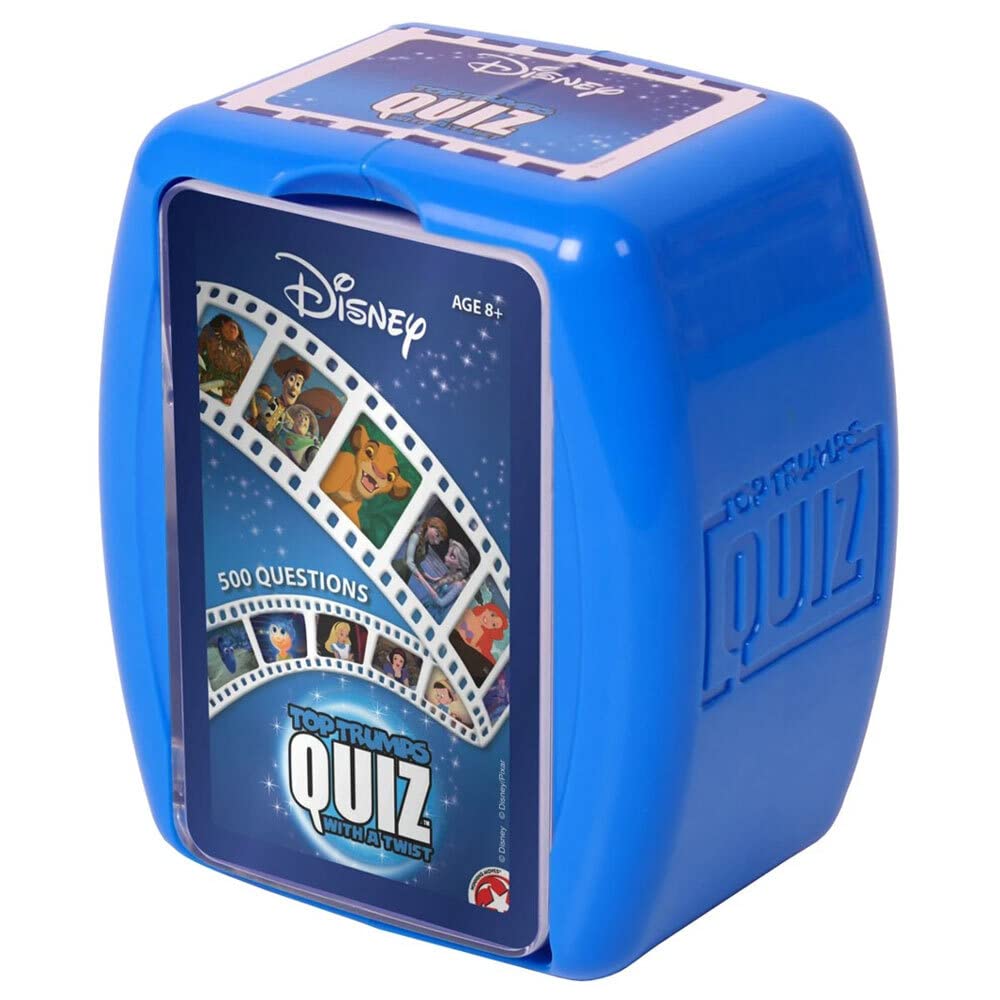
Top Trumps takes the quiz format and strips it to two decks in a small pack: 500 questions on classic Disney films, from Frozen and Bambi to Encanto and Ralph Breaks the Internet. There is no board and no pile of pieces—just question cards and answers. That makes it easy to tuck into a bag, and easy to understand before the first turn.

We found it works best as a supplement rather than the main event. A Disney-obsessed eight-year-old can rattle off answers while the rest of the table waits, and it is a good choice for a car ride or a short wait. The two decks also give a small group something to pass around without setup. For a family that wants a board and character pieces, the PlayMonster Disney game is the more forgiving fit.

The cards are small enough for a child to hold and deal, and the two-deck split means a round can stay short. That is a narrow job, but a useful one: a focused quiz for a fan. The box is small enough to leave in the car without noticing it, which is exactly how it gets played.

Bottom line: A compact Disney quiz for kids who already know the films, this is a travel extra or stocking stuffer rather than a full game-night centerpiece.

How We Played and Tested 14 Kids' Trivia Games

We built our shortlist of 14 trivia games by reading parent-group threads, teacher recommendations, and the age ranges on the box—then filtering out anything that required reading above a third-grade level or had a footprint too big for a standard shelf. We wanted games that worked for mixed-age groups, not just a single birthday party, so we looked for adjustable difficulty and simple rules.

Over four months, we played each game at least three times: at the kitchen table after school with a 7- and a 10-year-old, on a rainy Saturday with four kids ages 6 to 12, and in the car or at a restaurant while waiting for food. We read the rules once, then handed the box to a 9-year-old to see if they could run a round without adult help—an easy-play check that separated the smooth games from the ones that needed a referee. We also shuffled each deck and tracked how many questions a 6-year-old could answer versus a 10-year-old, noting when questions were too cryptic or too babyish.

We checked card size by handing the deck to smaller kids to fan and deal; cards that were too wide or too slick ended up on the floor. Game pieces—timers, buzzers, tokens—got inspected after every session for cracks or loose parts, and we noted whether the box survived being tossed in the back seat. For educational value, we favored questions that taught a fact rather than just testing recall, and we screened every card for content that would make a parent wince. Value for money came down to repetition: after four months, we counted how many times we reached for each game unprompted, and the ones that kept coming back to the table were worth their shelf space.

How to Choose Trivia Games for Kids

Match the age grade to the reader

Age grades on trivia boxes usually signal reading load as much as question difficulty. A 6+ true-or-false game can work for a beginning reader because every answer is a call between two options; an 8+ general-knowledge game expects a child to read a question and retrieve a fact. If your group spans ages, look for separate kid and adult decks, picture prompts, or a format where a guess is part of the fun.

Ask what the child can do independently: read the card, understand the question, and answer without an adult rescuing every turn. If the answer is no, choose a game that invites teams or adult reading. The age number is a starting filter, not a guarantee that the questions will fit your particular kid.

Weigh question count against how often you play

Question count is the clearest proxy for replay value, but it is not the only one. A 1,200-question family board game can survive years of holidays; a 300-question card game is better for occasional use, short rounds, and households that move on after a few sessions. Themed decks feel even shorter if players already know the films or subject well.

Check whether the questions are split by age or difficulty. A large pile of general questions is less useful for a mixed-age table than a smaller set with clear kid and adult cards. If you play weekly, prioritize the bigger pool; if the game comes out on rainy afternoons and vacations, a compact deck may be the smarter buy.

Choose a board game or a card deck

Board games turn trivia into an event: a board to move around, pieces to collect, and a visible finish line. That suits a planned family night, but it also means table space, setup, and a box that stays home. Card decks are quicker, easier to pack, and often better for travel or a restaurant wait, though they can feel thin as the whole evening's entertainment.

Look at the table you actually have. A 10-inch board and a few hundred cards need room for drinks and elbows; a compact quiz can live in a backpack. Neither format is better in the abstract—our top pick is a board game because family night is the main job, while our travel pick is deliberately just cards and a die.

Pick a theme your child already loves

Theme is not decoration in a trivia game; it changes who can answer. A Disney or Harry Potter set rewards prior knowledge, so a fan can shine and a casual player can feel locked out. General-knowledge games are more even across a group, while geography or animal themes give a child a subject they may already study for fun.

Choose the theme for the child who will play most often, then ask whether the rest of the table shares it. If the answer is no, a general family edition or a true-or-false format is the safer buy. A themed game is at its best when the obsession is already in the house.

Frequently Asked Questions

Final Verdict

The Trivial Pursuit Family Edition is our default because it solves the hardest part of family trivia: giving kids and adults different questions without splitting the table into separate games. The faster wedge rule keeps a school-night game from stretching past bedtime, and the team option lets a younger reader play alongside an adult. If the youngest player is closer to six, choose Mount Cleverest instead; its true-or-false format is the better equalizer.