Games & Puzzles

Best Card Games for Kids of 2026

A rainy Saturday with a seven-year-old and a nine-year-old is its own kind of test. You have maybe forty minutes before someone announces they're bored, and a screen is the easy answer. A good card game buys you that afternoon — small enough to live in a backpack, quick enough that nobody's attention drifts, and simple enough that a kid can teach it to a grandparent at the other end of the table. What it fixes isn't really boredom, it's the friction around it: the rules explanation that eats the whole game, the rounds that drag past everyone's patience, the deck that's shredded by week two.

My team has played 16 of these games over the past four months — at the kitchen table, in the back seat on a long drive, and once on a restaurant floor while we waited for a table. The pattern that kept repeating: the games kids come back to aren't the cleverest ones, they're the ones that start in under two minutes and end while everyone still wants another round. The picks below all cleared that bar, sorted by who they suit best.

#1

Five Crowns

Five Crowns

Rummy players

Doodle Score 9.8/10
Check Price

Worth Noting

  • Cards stick and shuffle in clumps
  • Plain cardboard box won't travel
Ages
8 and up
Players
1 to 7
Contents
Cards and rulebook
Item Weight
6.4 oz
Read the full review

A fifth suit of stars is the visible gimmick; the rotating wild card is the one that changes how the game feels. Each hand has a different rank wild, so the card that rescued your last round is dead weight in the next one. It is a real rummy game rather than a children's version of one, and that is exactly the point of it.

Books and runs work the way rummy players expect, so an adult can teach it while dealing, and a child who has played any matching game will follow the first hand without much help. Up to seven can play at once, which is more than most of the boxes here, and the hands are quick enough that nobody is stuck with a bad one for long.

We rate it near the top of this group for replay value — the changing wild is why it keeps coming back out — but it asks a child to hold a plan in their head across a whole hand. Eight is about right; a six-year-old will be having their cards played for them, and the memory load rather than the rummy is what trips them up.

Bottom line: It's the rummy game we hand to families with an eight-year-old: a star suit and a shifting wild give a child something to plan around, not just match.
#2

Sleeping Queens

Sleeping Queens

Younger kids

Doodle Score 9.8/10
Check Price

Worth Noting

  • Card stock feels thin
Ages
8 and up
Players
2 to 5
Contents
Cards and rules
Play Time
About 20 minutes
Read the full review

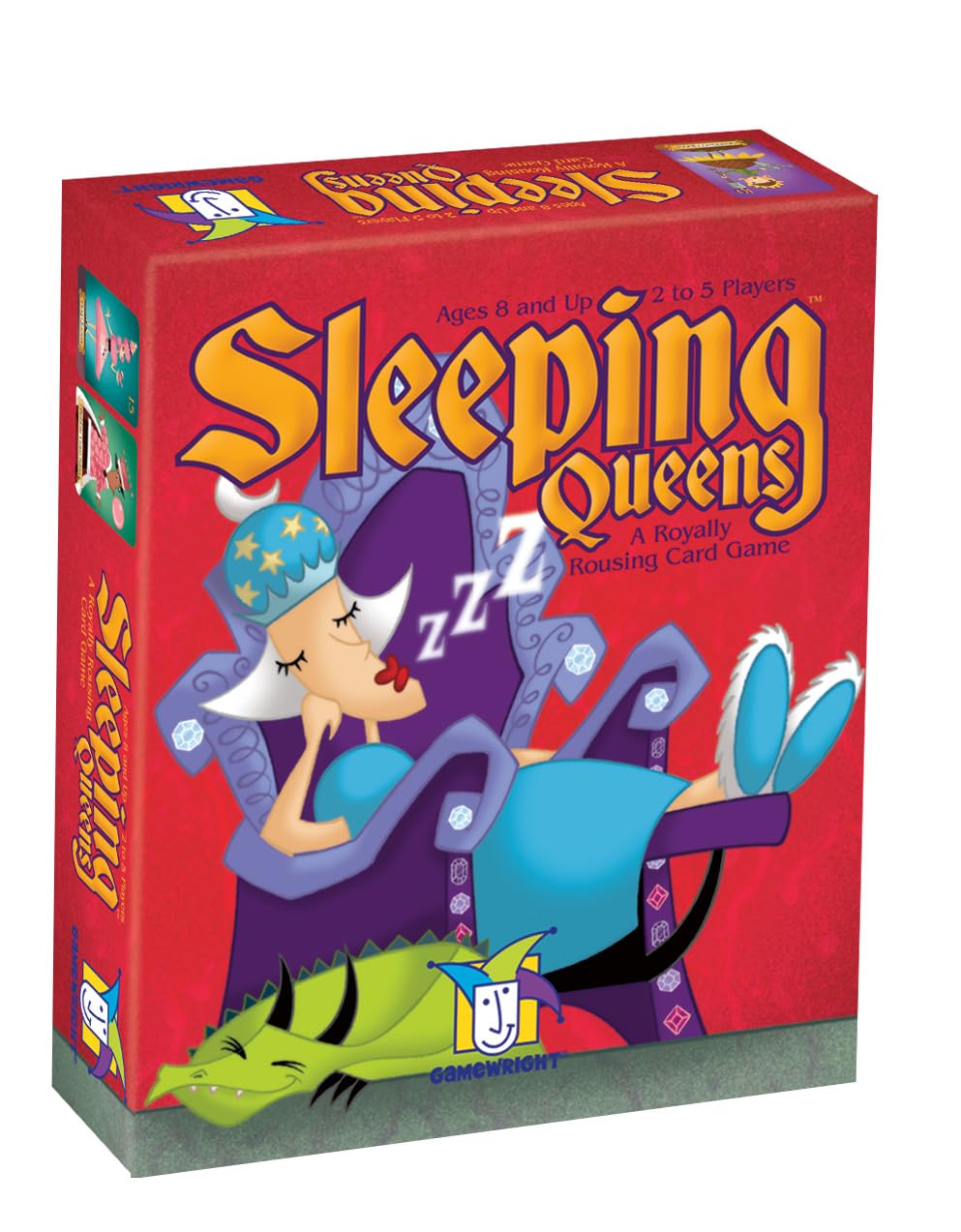
The idea came from a six-year-old, and it shows in the best way. The queens have names and personalities, the art gives a child someone to root for, and the whole thing feels invented at a kitchen table rather than assembled by a marketing department.

Underneath the drawings is a real game: knights steal queens, jesters turn over something better, and number cards have to be turned into little equations before they can be discarded. That last part is the arithmetic, and it arrives as a way to get rid of a card rather than as a worksheet. Twenty minutes a round, and a five- or six-year-old can join with an adult alongside for the first few games.

We were struck by how much game is in the box — and by how much rule there is. There are more card types than the sweet artwork suggests, and the first two games will be played with the instructions open on the table. After that it clicks and the age range opens up; before that, expect to run the table for the youngest player.

Bottom line: We reach for it with the youngest player in the house: gentle rules, artwork that pulls children in, and arithmetic they don't notice they're doing.

#3

Flip 7

Flip 7

Risk takers

Doodle Score 9.8/10
Check Price

Worth Noting

  • Needs at least three players
Ages
8 and up
Players
3 or more
Contents
94 cards and rules
Play Time
About 20 minutes
Read the full review

There is a specific pause in Flip 7, right before someone takes a seventh card: one more and the round is theirs, one duplicate number and they are out with nothing. The whole game is built around that pause, and it is why a table of eight can play something this simple for an hour.

We like how little sits between the box and the first round. Deal a card, decide whether to stay or flip again, then total what is in front of you when you stop — the arithmetic is the score, so a child practicing addition is doing it because the total decides the game. The action cards are the only thing to teach, and they are what stops a round feeling like pure chance.

Busting three rounds running is a real thing that happens to a child, and the Second Chance card softens it without removing the sting; agree before the first deal that nobody gloats. It is also a game where luck can flatten an adult, which some grown-ups mind more than the children do.

Bottom line: We like it best at a table that enjoys a gamble: quick rounds, a real bust, and addition practice disguised as scorekeeping.

#4

SKYJO

SKYJO

Family game night

Doodle Score 9.6/10
Check Price

Worth Noting

  • Scoring needs the pad and a pen
Ages
8 and up
Players
2 to 8
Contents
150 cards, notepad and manual
Play Time
About 30 minutes
Read the full review

Two players or eight, one box. SKYJO is the game here that never leaves anyone waiting at the edge of the table, and that is why it takes the top spot: the player count works in both directions instead of being a compromise in one of them. You uncover and exchange cards in front of you, and whatever numbers are still showing when the round ends count against you.

We think it is the best all-round choice in this group because the rules are short enough to explain between two deals, and the balance is deliberately generous to whoever is youngest. Luck decides plenty of rounds, but the decision each turn is small enough for an eight-year-old to weigh and still interesting for an adult.

The arithmetic is the quiet bonus. Adding up the cards against you at the end of a round means real two-digit addition, and a child doing it to win does not experience it as practice. The one thing to plan for is length: about 30 minutes is a full game, so with a six- or seven-year-old, agree on a set number of rounds and total the pad at the end rather than playing to the last card.

Fifteen minutes is a perfectly good game of SKYJO, and the cards have held up in our hands better than the thinner decks in this group. The whole box slides into a tote bag, which is more than the games with flimsier packaging can claim.

Bottom line: We recommend it as the default family card game: two to eight players, rules you explain once, and enough luck that the youngest at the table stays in it.

#5

UNO

UNO

Youngest players

Doodle Score 9.6/10
Check Price

Worth Noting

  • Two-player games fall flat
Ages
7 and up
Players
2 to 10
Contents
112 cards and instructions
Packaging
Metal tin
Read the full review

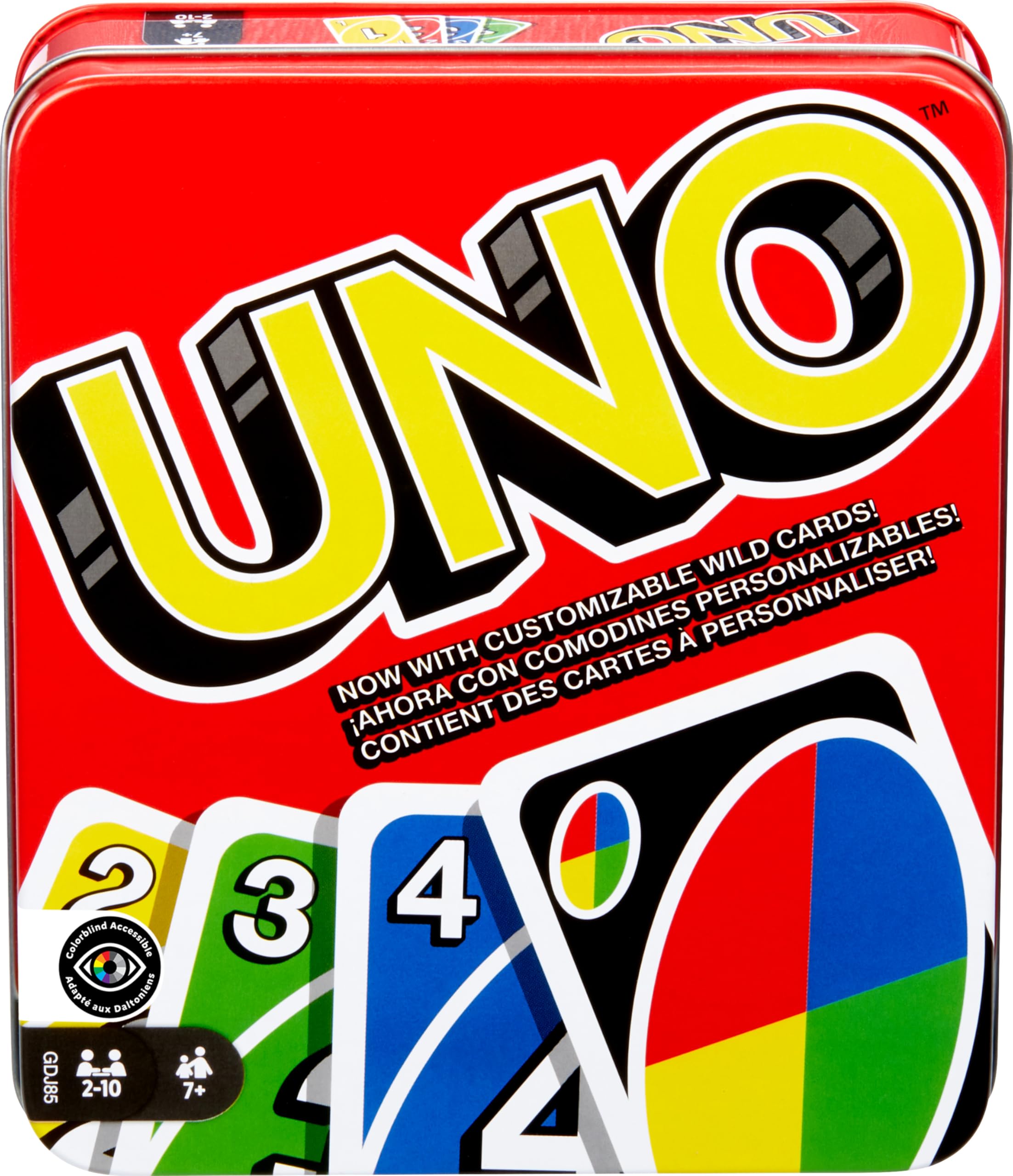
The cards in this tin run smaller than a standard UNO deck, and the tin itself is roomier than it needs to be — the mismatch is the first thing we noticed on opening it. In practice the smaller cards are easier for a five-year-old to fan and slower for an adult to shuffle, so it is a trade rather than a fault.

What keeps UNO in a guide full of newer games is how little it asks of the player: colors and numbers, no text on the play, and action cards taught inside a single round. The printed symbols on every card make the deck usable by colorblind players too — a small design decision that opens the game to more of the family.

The metal tin is the other reason it stays in the bag. It survives being sat on, which the cardboard boxes here do not, and it keeps 112 cards from becoming a loose handful in a suitcase. Three blank wild cards can be written on and wiped clean, so a family that wants house rules has somewhere to put them — an easy handicap to add if the youngest needs one.

Bottom line: This is the deck we start every youngest player on: colors and numbers only, ten seats at the table, and a tin that takes a beating.

#6

Taco Cat Goat Cheese Pizza

Taco Cat Goat Cheese Pizza

High-energy groups

Doodle Score 9.6/10
Check Price

Worth Noting

  • Too loud and physical for quiet places
Ages
8 and up
Players
2 to 8
Box Size
2.5 x 3.6 inches
Play Time
About 15 minutes
Read the full review

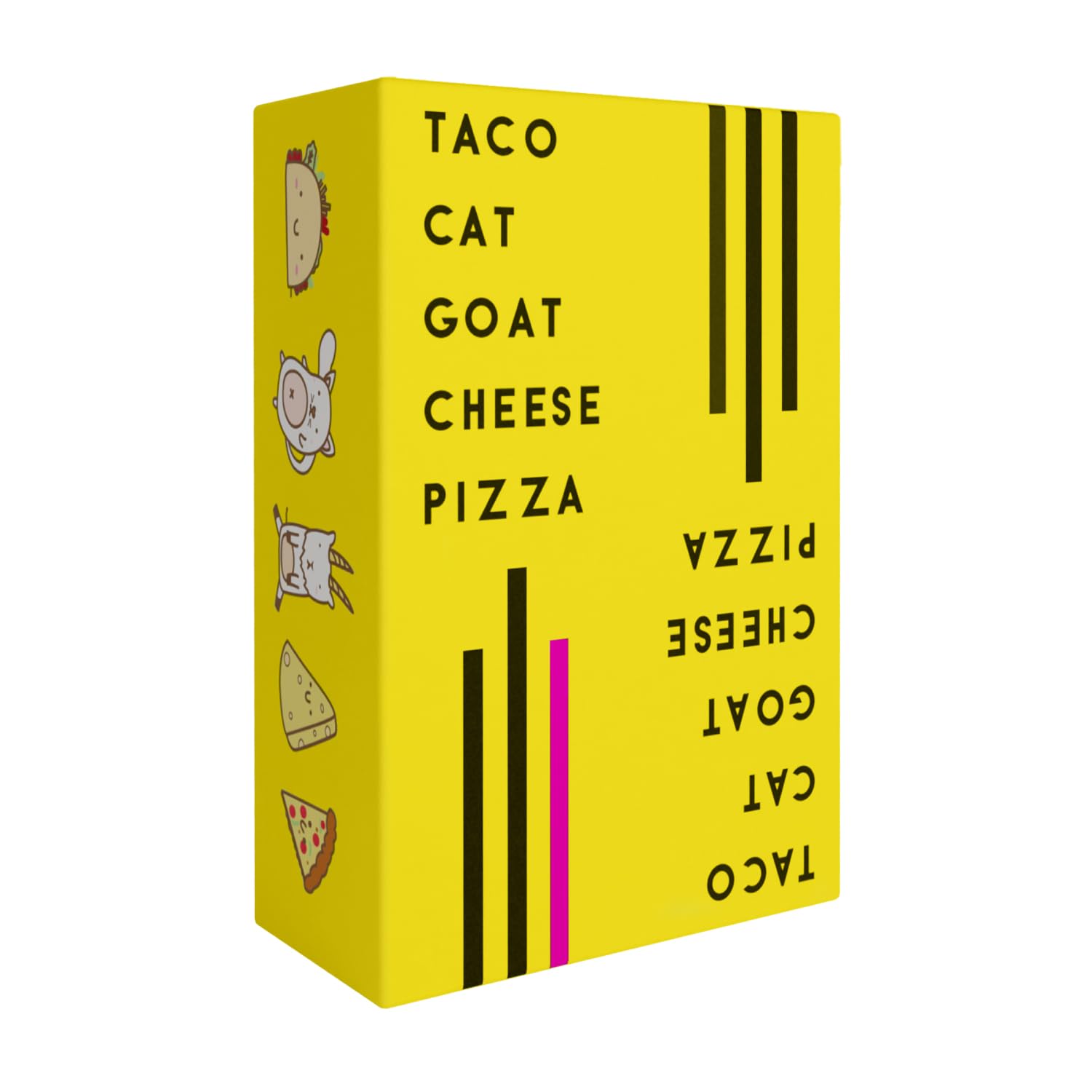
The end of a round looks like a pile-up: four hands stacked on the table, somebody insisting they were first, a card bent at the corner. Taco Cat Goat Cheese Pizza is built for that exact moment. Everyone chants the sequence, flips a card, and the instant the spoken word matches the picture, the whole table slaps the pile.

It got the biggest reaction of anything we tested, and it got it from adults as quickly as from kids. There is no reading, no turn order to police and no strategy to explain, so a five-year-old with the rules bent slightly and a grandparent who has never played a modern game start level. The box is genuinely pocket-sized, which is why it ends up in bags rather than on shelves.

The cost is physical and worth naming. Cards bend in the scramble and hard slaps land on fingers; short nails and a table you don't mind thumping make it a non-issue, and the action cards break the rhythm often enough that rounds don't blur into one. Fifteen minutes is accurate, so it works as a closer rather than a whole evening.

Bottom line: We keep it for the laugh rather than the strategy: ten minutes of shouting and slapping that works from five-year-olds to grandparents.

#7

Monopoly Deal

Monopoly Deal

Quick strategy

Doodle Score 9.6/10
Check Price

Worth Noting

  • Caps at five players
Ages
8 and up
Players
2 to 5
Contents
110 cards and instructions
Play Time
15 minutes
Read the full review

Monopoly without the four-hour sentence: that is the pitch, and it holds. You are still collecting property sets and charging rent, but it happens in a hand of cards, three complete sets ends the game, and a round is done in about fifteen minutes. We think it is the strongest strategy game in this group for the eight-to-twelve crowd.

The action cards do the heavy lifting — rent, steal, swap, and a birthday card that takes money from everyone at once — so there is always a move that costs somebody else, which is what children actually want from a game about property. Reference cards mean nobody has to hold the rulebook in their head. Three or four players is the sweet spot; with five, the steal cards turn the last stretch into a pile-on.

Bottom line: Our choice for kids ready to plan two moves ahead: fifteen minutes, real property stealing, and none of the board game's dead time.

#8

Dutch Blitz

Dutch Blitz

Speed play

Doodle Score 9.6/10
Check Price

Worth Noting

  • Stops at four players
Ages
8 and up
Players
2 to 4
Contents
160 cards, four decks
Play Time
About 15 minutes
Read the full review

Nobody waits their turn. Everyone builds at once, adding to runs in the middle of the table while trying to empty a personal stack, and the speed is the entire appeal. The first round is usually chaos, with everybody apologizing and then asking to play again.

The box holds four decks, one per player, so nobody is dealing to a crowd. It is the most competitive game in this group, and the one where a fast eight-year-old can genuinely beat an adult — we like that more than any of the educational claims on the packaging. Fifteen minutes start to finish, and there is no downtime to drag because there is no waiting.

The rules are the weak spot. The order cards go into the middle piles takes a round or two to settle, and the instruction sheet is not much help; one slow, open round with cards face-up does more than reading it twice. Everyone also needs elbow room for their own layout, so it is a table game rather than a sofa game.

Bottom line: For competitive families of four or fewer, we think it's the most exciting fifteen minutes here — no waiting, no turns, no mercy.

#9

Piles

Piles

Mixed-age groups

Doodle Score 9.6/10
Check Price

Worth Noting

  • Setup gets fiddlier with more players
Ages
8 and up
Players
2 to 8
Reading
None required
Play Time
About 10 minutes
Read the full review

Nothing on these cards needs reading — only matching — so a four-year-old and a grandparent can play the same round on equal terms. That is rarer than it sounds, and it is the reason Piles earns a place in a guide this size.

The game is a free-for-all: spot your card, react faster than everyone else, keep your stack from growing. No turns, ten-minute rounds, two to eight players, which makes it the best mixed-age option here. The box has a magnetic lid that stays shut in a bag, a small thing we appreciated every time it came out of a tote.

Bottom line: Our mixed-age pick: no words on the cards, everyone plays at once, and a four-year-old can genuinely beat an adult.

#10

Regal Games 6-Pack

Regal Games 6-Pack

Preschool and classroom

Doodle Score 9.6/10
Check Price

Worth Noting

  • Thin cards for heavy play
Decks
36
Games
Six classics
Players
2 to 6
Card Size
Oversized
Read the full review

What turns up is a lot more than one family needs: six classic games — Go Fish, Crazy 8's, Old Maid, Slap Jack, War and Garbage Monsters — printed on oversized cards built for hands still learning to hold a fan. It ships in bulk, six of each game, which makes it a classroom or party-favor purchase as much as a family one.

For a four- or five-year-old, oversized cards are genuinely easier to hold, deal and shuffle than a standard deck, and having Old Maid and Go Fish in the same box means following the child's mood instead of the rulebook. Our reservation is the volume: nobody needs thirty-six decks, and unless you have a playgroup, a classroom or a birthday party to supply, most of it will sit in a cupboard.

The rules sheets tucked into each pack are the practical touch — an adult who has forgotten how Slap Jack works can check in ten seconds without hunting through a box. What it is not is one good game played to death; if that is what you want, buy one of the single boxes above instead.

Bottom line: Our pick for the preschool shelf: six classics on oversized cards — exactly what a four-year-old needs, and more decks than most families will wear out.

How We Tested 16 Card Games With Kids Aged Four to Twelve

We started with a list of roughly 40 card games aimed at kids — titles that get pushed by shelf talkers, ones teachers and librarians keep recommending, and the ones that turn up at the bottom of every family's game drawer — then cut it down by age range on the box, supported player count, and price. That left 16 games, which we played over four months with kids aged four to twelve and with adults who hadn't read the rules in advance.

Most of that testing happened where these games actually live: on the kitchen table after dinner, on the floor of a rental during a school break, in the back seat on a two-hour drive, and once on a restaurant floor during a wait for a table. We timed setup from box-open to first turn with a stopwatch, with a seven-year-old as the designated rule-reader, and noted whether a grown-up had to step in and re-explain. We counted how many rounds a group played in one sitting and watched for who drifted off first in a game with mixed ages — a five-year-old playing against a ten-year-old tells you more about a rulebook than reading it ever will.

Every deck got shuffled hard by people who shuffle badly. We noted whether cards bent at the riffle, whether corners started peeling after a week of play, and whether one spilled glass of water turned the deck into a brick. Card size got its own scrutiny, since a hand of eight oversized cards is a genuine problem for a five-year-old, and we watched what happened when a younger sibling insisted on joining a game built for older kids. Finally, we divided what each game cost by how often we actually reached for it, because a cheap game nobody plays isn't a bargain.

How to Choose Card Games for Kids

Match the player count to your real table

Count who will genuinely play on a Tuesday night, not who might at a birthday party. A game that advertises eight players is usually at its weakest with two, and a game built for head-to-head play feels crowded at six. SKYJO and UNO handle the full range; Dutch Blitz stops at four and Flip 7 needs at least three. If your household is often two people, buy for two — the crowd-friendly boxes will still be there when the cousins visit.

Treat playing time as the real age rating

Box times are measured at a table that already knows the rules, so the first three games will run half as long again. For a six- or seven-year-old, ten to fifteen minutes is the sweet spot: Piles and Taco Cat sit there, and Monopoly Deal lands around fifteen. Half-hour games work far better when you agree to stop after a set number of rounds instead of playing to a final score.

Know what the rules assume about reading and numbers

UNO and Piles ask for no reading at all — one is colors and numbers, the other is matching pictures. Sleeping Queens turns number cards into small equations before they can be discarded, and SKYJO asks a child to add two-digit numbers when a round is scored. A box marked eight and up describes rule complexity, not reading age: a five-year-old who knows her numbers can play UNO, while a ten-year-old who dislikes arithmetic will find SKYJO's scoring a chore.

Balance luck against strategy for the players you have

A strong luck component keeps a younger child genuinely competitive, which matters more than the age printed on the box. The press-your-luck rounds in Flip 7 and the draw of Sleeping Queens let a five-year-old beat an adult now and then. Planning games such as Monopoly Deal and Five Crowns reward an eight- or nine-year-old who can think a hand ahead, and punish one who cannot yet. Keep one of each on the shelf and you cover both moods.

Check what the cards and box have to survive

Cards take more punishment than anything else in the toy cupboard: shuffled by children, dealt onto carpet, crammed into a bag. Slap games are hardest on card stock, so the games here that depend on slapping are the ones whose corners go first. A metal tin counts for a lot — cardboard boxes survive shelf life and not much else. If a game travels, take the tin or the pocket-sized box.

Frequently Asked Questions

Final Verdict

SKYJO is the box we point to first. It seats two to eight, the rules take one read, and the luck keeps the youngest player in the game while the addition quietly does its work.

If your table is loud, Taco Cat Goat Cheese Pizza is the better buy for a birthday or a rainy afternoon; if it is only ever two people, Monopoly Deal is the one that still feels like a real game.