Games & Puzzles

Best Family Game Collections for Game Night of 2026

Family game night has a way of starting with big energy and ending with someone crying over a lost token. A good game collection is the fix: several complete games in one box, so the group can move from a quick card game to a longer board game without digging through the closet. It also costs less than buying each title separately, which is part of their gift appeal.

The catch is that most collections pad the box with two strong games and a pile of filler, and the rulebooks assume everyone already knows how to play. Over the past six months, my family and I played through 12 game collections with kids from 4 to 14 — at the kitchen table after dinner, on rainy Sundays, and on a long weekend at my in-laws' where the box had to survive a car trip. The sets that earned a permanent spot were the ones the kids asked to play again, the pieces held up, and nobody needed a tutorial to start. The picks below are the ones that made it through.

#1

Regal Games 6 Classic Card Games

Regal Games 6 Classic Card Games

Young families

Doodle Score 9.6/10
Check Price

Worth Noting

  • Skews young; older kids will want more
Players
2-6
Age Range
4-12 years
Card Size
Oversized
Games Included
6
Read the full review

The cards are bigger than a standard deck, and that single decision is why this set works with a four-year-old at the table. Go Fish, Old Maid, Crazy 8's, Slap Jack, War and Garbage Monster each come as their own deck, and a small hand can fan them without an adult holding the cards up. Bright colors and simple symbols do the rest, so a pre-reader can match by picture while an older sibling plays the actual game.

What keeps us coming back is how little teaching the set needs. These are the games most adults half-remember from childhood, so the rules arrive with the grandparents rather than the rulebook, and two to six players can join without the group splitting into separate games. For a family with kids under eight, that combination of recognizable games, oversized cards and one tin holding all six decks is the easiest recommendation on this page.

Card stock is where the money was saved. The decks pick up bent corners and soft edges with regular play, so treat this as a set you replace in a few years rather than hand down, and keep the tin shut between games so the six decks stay sorted. Set against what one board game costs, that feels like a fair trade.

Bottom line: We point most families here first: six games everyone half-remembers, cards big enough for a four-year-old to fan, and a tin that keeps the decks together.

#2

WS Game Company Vintage Bookshelf Set

WS Game Company Vintage Bookshelf Set

Gift and display

Doodle Score 9.6/10
Check Price

Worth Noting

  • Premium price for a three-game set
Storage
Book-style cases
Age Range
8 years and up
Games Included
3
Shelf Footprint
10.6 x 8.4 x 7.8 inches
Read the full review

This is the set we hand over as a housewarming gift. Three full-size folding boards, Scrabble, Monopoly and Clue, in linen-wrapped cases built to look like hardback books, with die-cast Monopoly tokens and wooden houses and hotels. Nothing about it reads as a box of games pulled off a toy shelf.

On the shelf, the three cases standing together take up roughly 10.6 by 8.4 by 7.8 inches, and each game packs back into its own case, which solves the taped-cardboard problem most families have in the hall closet. The boards are full size rather than travel size, so a real game of Monopoly plays the way you remember it, with room for the whole board.

What it doesn't do is reach. The listing puts the set at eight and up, and all three games want readers and some patience, so it is the wrong buy for a household still working through Go Fish. Open the cases and check the pieces against the contents list before you wrap it; a missing die is easy to sort out now and awkward on the day.

Bottom line: If game night is also a gift, or a shelf you care about, this is the one we point to: three full-size classics in book-style cases.

#3

Mattel Skip-Bo, UNO & Phase 10 Set

Mattel Skip-Bo, UNO & Phase 10 Set

Older kids

Doodle Score 9.6/10
Check Price

Worth Noting

  • Decks arrive in a thin paper pack
  • Phase 10 can outlast young attention spans
Players
2-10
Age Range
7 years and up
Games Included
3
Read the full review

Phase 10 is what separates this trio from every other card bundle here. Ten phases played to 500 points give a nine-year-old a plan to hold in their head, and it is the game in this article that most reliably turns into a whole evening rather than half of one. The rules stay simple enough that the sequencing rewards older players without shutting the younger ones out.

UNO and Skip-Bo carry the rest. Both teach in a round, which matters when the table runs from seven to seventy, and the set lists two to ten players, enough for a birthday party or two families sharing a cottage. Skip-Bo is the gentler of the two; UNO is the one that starts arguments.

The packaging is where it slips. The decks ship in a thin paper pack rather than a box worth keeping, so plan on a zip bag or a tin of your own if this is going in a cupboard. Everything else about the set is the version of these games you already know, which is exactly what a family game night wants.

Bottom line: Our pick for older kids and a full table: Phase 10 is the reason to choose this trio, and there is room for up to ten players.

#4

Mattel UNO, DOS & Skip-Bo Tin

Mattel UNO, DOS & Skip-Bo Tin

Travel and storage

Doodle Score 9.6/10
Check Price

Worth Noting

  • Cards are smaller than a standard deck
Players
Up to 6
Tin Size
8.5 x 6 x 2 inches
Age Range
7 years and up
Games Included
3
Read the full review

A metal tin, 8.5 by 6 by 2 inches, holding UNO, DOS and Skip-Bo. The tin is not packaging you throw away; it is the reason the set survives a car boot, a picnic blanket and the bottom of a backpack, and it is the only storage here that doubles as a carrying case.

The role we have in mind for it is the leaving-the-house one. All three games teach in a hand, the tin keeps the decks apart, and nothing needs a board or a flat surface beyond a lap. DOS is the least familiar of the three and takes a round to click; after that it plays like UNO with two piles and a bit more arithmetic.

Three games is a smaller library than the other card sets here, and UNO and Skip-Bo both turn up in other bundles on this list, so what you are buying is the format rather than the count. For a family whose game night happens at the kitchen table every week, a bigger set is the better spend; this one is for the bag by the door.

Bottom line: The set that lives in the car: three card games in a metal tin, built to leave the house rather than sit on a shelf.

#5

Regal Games Fun Card Games Set

Regal Games Fun Card Games Set

Teens and adults

Doodle Score 9.4/10
Check Price

Worth Noting

  • Rules are terse and take a sitting each
  • Several games need three or more players
Players
Up to 6
Age Range
13 years and up
Games Included
6
Read the full review

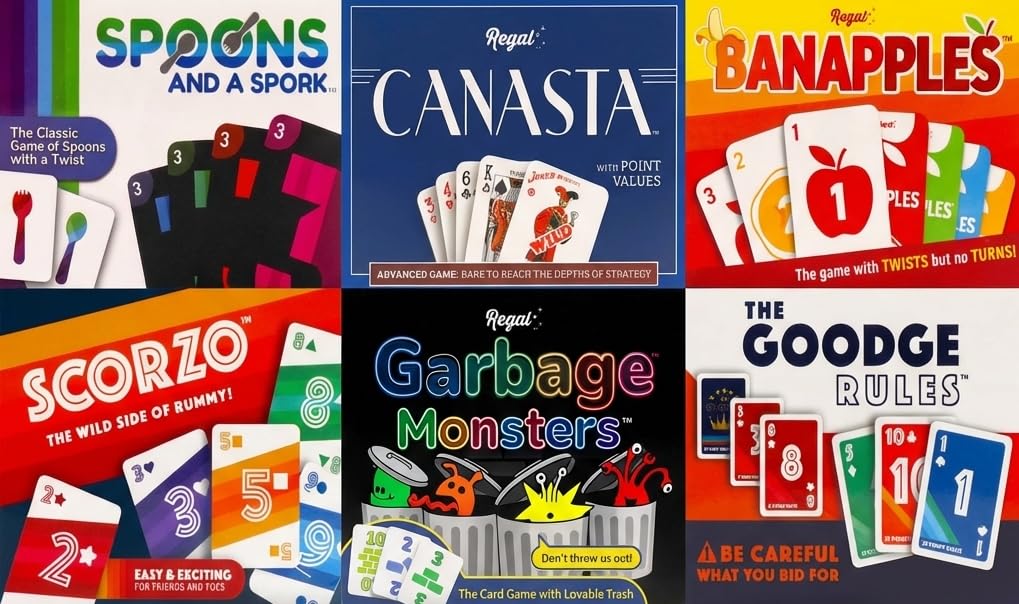
The 13-and-up label is the first thing to check, because it decides who this set is for. Canasta, Spoons and a Spork, Garbage Monsters, ScorZo, The Goodge Rules and Banapples are six games most families do not already own, pitched at a table that can hold a rule in their head for an evening.

The spread is wider than the usual bundle. Canasta is the old rummy standby, Spoons is loud and fast, Garbage Monsters is the easiest way in, and Banapples is the one that takes a full round to click. Numbers and suits are big enough to read across a table, which matters more than it sounds once four people are squinting at score sheets.

Our verdict is that this is the set for a table of teenagers and adults who are tired of the classics, since it is the one here with games nobody grew up with. Families with younger children should look at the six-deck classic set instead; this one earns its place once the youngest player is old enough to lose a hand of Canasta gracefully.

Bottom line: For a table of teenagers and adults, this is the more interesting Regal set: six games nobody owns, though the rule cards take patience.

#6

Juegoal 7-in-1 Wooden Board Game Set

Juegoal 7-in-1 Wooden Board Game Set

Board game basics

Doodle Score 9.2/10
Check Price

Worth Noting

  • Small pieces are easy to knock or lose
Storage
Sliding wooden case
Material
Wood
Board Size
11.5 x 11.5 inches
Games Included
7
Read the full review

Three wooden boards slide out of the case, and between them you get chess, checkers, Chinese checkers, backgammon, Parcheesi, snakes and ladders and tic tac toe. Changing games means sliding a board rather than hunting through a cupboard for a box, which is the whole reason a set like this gets played more than the games it replaces.

The case does the rest. Thirty-two chess pieces, the checker and backgammon pieces, forty Chinese checkers and ludo pieces, four dice and a doubling cube all pack back inside, which is what separates a set that gets used from a drawer full of loose parts. On a shelf it looks like furniture rather than a toy.

At 11.5 inches square the boards are compact, and that is the trade: comfortable for two on a coffee table, tight once four people crowd around the Chinese checkers board. Anyone shopping for a serious chess board should look elsewhere; this is a family set that happens to include chess.

Where it earns its place is as the one set here with actual boards and pieces that still fits on a shelf. The wood looks better than a stack of cardboard boxes, the slide-out boards make a quick game genuinely quick, and everything goes back together without a fight. For a family that wants variety without a cupboard full of boxes, that is the recommendation.

Bottom line: The set to buy if you want boards and pieces rather than cards: seven classics in a wooden case that swallows every piece when you are done.

#7

Merchant Ambassador 100 Classic Games

Merchant Ambassador 100 Classic Games

Trying many classics

Doodle Score 9.0/10
Check Price

Worth Noting

  • Small, thin pieces on cardstock boards
  • Game count is mostly rule variations
Boards
5 double-sided
Age Range
6 years and up
Games Included
100
Read the full review

A hundred games sounds like a cupboard full. What arrives is five double-sided boards and the pieces to play them; the hundred is a hundred sets of rules, with chess, checkers, Parcheesi and Ludo sharing surfaces and swapping the rules between games.

Used as a sampler, it earns its place. A family can try Parcheesi, Ludo, backgammon or one of the dice and matchstick games without buying four separate sets, the rules for each are printed and included, and there is enough variety here to fill a rainy fortnight of trying something new.

The pieces are where the budget shows. Boards are cardstock, the playing pieces are small, and a game played on a rug shifts under a bumped knee. The same smallness that keeps the box compact makes it fiddly for the youngest players in the house, so this suits a table of eights and up better than the printed age suggests.

We treat this as a starter collection: a cheap way to find out which classics your family actually likes before spending real money on a good version of one. Count the pieces against the contents list when it arrives, because an incomplete set is the one problem that turns a bargain into a frustration.

Bottom line: A sampler rather than a cupboard: five double-sided boards and a hundred rule sets, best bought as a cheap way to find out which classics your family likes.

#8

Games on the Go

Games on the Go

Car trips

Doodle Score 9.0/10
Check Price

Worth Noting

  • Ring clip is the weak point
Size
5 x 1 x 6 inches
Players
2 and up
Age Range
4-15 years
Games Included
50
Read the full review

Fifty games on a stack of cards held by a clip, small enough to hang off a bag. There is no board, no dice and nothing to pick up off a car floor; the cards prompt games you play out loud, which is why this one works in a moving vehicle where a board would slide off a knee.

That is what makes it work on a long drive. Guessing games, word games, memory challenges, trivia and search games all play from a seat, and the listing runs from four to fifteen, a wider age spread than most things here manage. The trade is that a card prompt is all you get: someone at the table has to run the game, and the shyest passenger usually is not volunteering.

It is not a game-night set and we will not pretend otherwise. Put this on a dining table and the evening falls flat after a couple of rounds. As the thing that lives in the glovebox and rescues a wait for food, it is the best value here, and the one we reach for before a trip.

Bottom line: Fifty games on a clip with nothing to lose: our pick for the car and the restaurant wait, not for the dining table.

How We Tested Family Game Collections

We started by pulling together every family game collection we could find from established board-game publishers and mass-market toy brands, then narrowed the list by age range, player count, price, and shelf footprint. We ruled out sets that were mostly party prompts or single-game reissues in a bigger box, and we favored collections that included at least four distinct games with clear rules. That left 12 collections, which we bought ourselves and put into rotation with real families.

Over six months, those 12 sets bounced between my kitchen table, a rainy-day playroom, a long car ride to my in-laws', and a birthday party where four kids and three adults opened the box cold. We played every game in every collection at least twice, and we kept a running tally of which ones got requested again. We timed setup and cleanup, read the instructions aloud before the first play, and counted pieces before and after each session to see what went missing.

Durability got checked the unglamorous way: sticky hands, dropped boxes, shuffled decks, and one set that lived in a car trunk for a week. We noted whether cards softened, boards warped, or inserts fell apart. For small pieces, we watched toddlers and dogs and vacuum cleaners, and we flagged collections with tiny tokens that were hard to see on a dark table. Instructions were judged by whether a 9-year-old could explain the rules to a grandparent, and compactness by whether the box slid onto a crowded shelf or turned into a permanent coffee-table resident. We also asked whether the mix justified the price — how many games actually got played versus how many were filler — and whether we'd hand the set to another family as a gift without adding a disclaimer.

How to Choose Family Game Collections for Game Night

Start with the youngest player, not the game list

Age ranges on these boxes carry more information than the game count. A set built for four-year-olds lives or dies on card size and picture reading, which is why the classic six-deck set uses oversized cards and simple symbols; a set aimed at eight and up assumes readers who can hold a plan across several turns.

Work backwards from the youngest person who will actually sit down, then check that the older players get something to think about. The gap between those two is where a collection succeeds or ends up back in the closet.

A hundred games is rarely a hundred games

Big numbers on the box usually describe rule sets, not components. The Merchant Ambassador collection counts a hundred games across five double-sided boards, with several titles sharing a surface and swapping the rules. That is honest value if you want to sample the classics, and a disappointment if you pictured a hundred boxes.

Before buying, count boards and pieces rather than games. Two games per board is a very different purchase from two games per box, and the shelf space and setup time follow the boards, not the number on the lid.

Cards, boards and the size of small hands

Two physical details decide whether a set gets played: whether a young child can hold and read the cards, and whether the board fits your table. Oversized cards let a four-year-old take a real turn instead of watching; an 11.5-inch board suits two on a coffee table and gets crowded with four.

Small pieces are the other half of the decision. Anything carrying a small-parts warning is not for a household with a child who still mouths toys, whatever the printed age range says, so check the pieces before you check the box.

Storage decides whether it survives the year

A collection that lives in six cardboard boxes gets played less than one that lives in a tin or a case. The linen book cases, the metal tin and the wooden box with slide-out boards all solve the same problem: everything back inside, nothing lost behind a drawer.

Where the storage is a thin paper pack, budget for a zip bag or a small tin of your own. It is the cheapest upgrade you can make to a card set, and it is the difference between a game you can play in two years and a pile of loose decks.

Rules you can teach standing up

The best collection for a family is the one an adult can explain without reading aloud. Games everyone half-remembers, like Go Fish, UNO or checkers, cost nothing to teach; games nobody grew up with cost a sitting each, and a set of six unfamiliar titles takes a few evenings to work through.

If your game nights are short and spontaneous, weight the collection toward familiar rules. If your table enjoys learning a new game together, the unfamiliar set is the more interesting buy, and the unfamiliarity is the point rather than a problem to solve.

Frequently Asked Questions

Final Verdict

For most families the six-deck Regal set is the one to buy: it is the least expensive collection here, the oversized cards let the youngest player take a real turn, and the rules are already in the room. Move to the Mattel Skip-Bo, UNO and Phase 10 set once the youngest is around seven and wants a game that lasts past bedtime.

And if the box is a gift rather than something for your own shelf, the vintage bookshelf trio is the one that gets kept.