Games & Puzzles

Best Dice Games of 2026

Game night has a predictable failure mode: someone opens the box, unfolds a rulebook the size of a menu, and the rest of the table starts reaching for their phones. Dice games sidestep that. A pouch of dice and a one-page rules sheet can have everyone rolling within five minutes, and a round is usually short enough that whoever is losing wants another go rather than a graceful exit.

That said, cheap dice games carry their own risk. I've punched out tokens that felt like cardboard confetti, and I've opened boxes that were missing a die before the first roll. Over four months, my team and I played through 17 dice games at kitchen tables, on a cabin porch, and on a hotel desk during a rainy weekend, hunting for ones you can teach while you shuffle, that finish before attention wanders, and that hold up with a 7-year-old as well as a table of adults. The keepers below all earned a permanent spot in the bag by the door.

#1

Qwixx

Qwixx

Mixed-age game night

Doodle Score 9.6/10
Check Price

Worth Noting

  • Score sheets are consumable, not permanent
Players
2 to 5
Box Size
5.25 x 3.75 x 1.2 inches
Age Range
8 years and up
Play Time
15 minutes
Read the full review

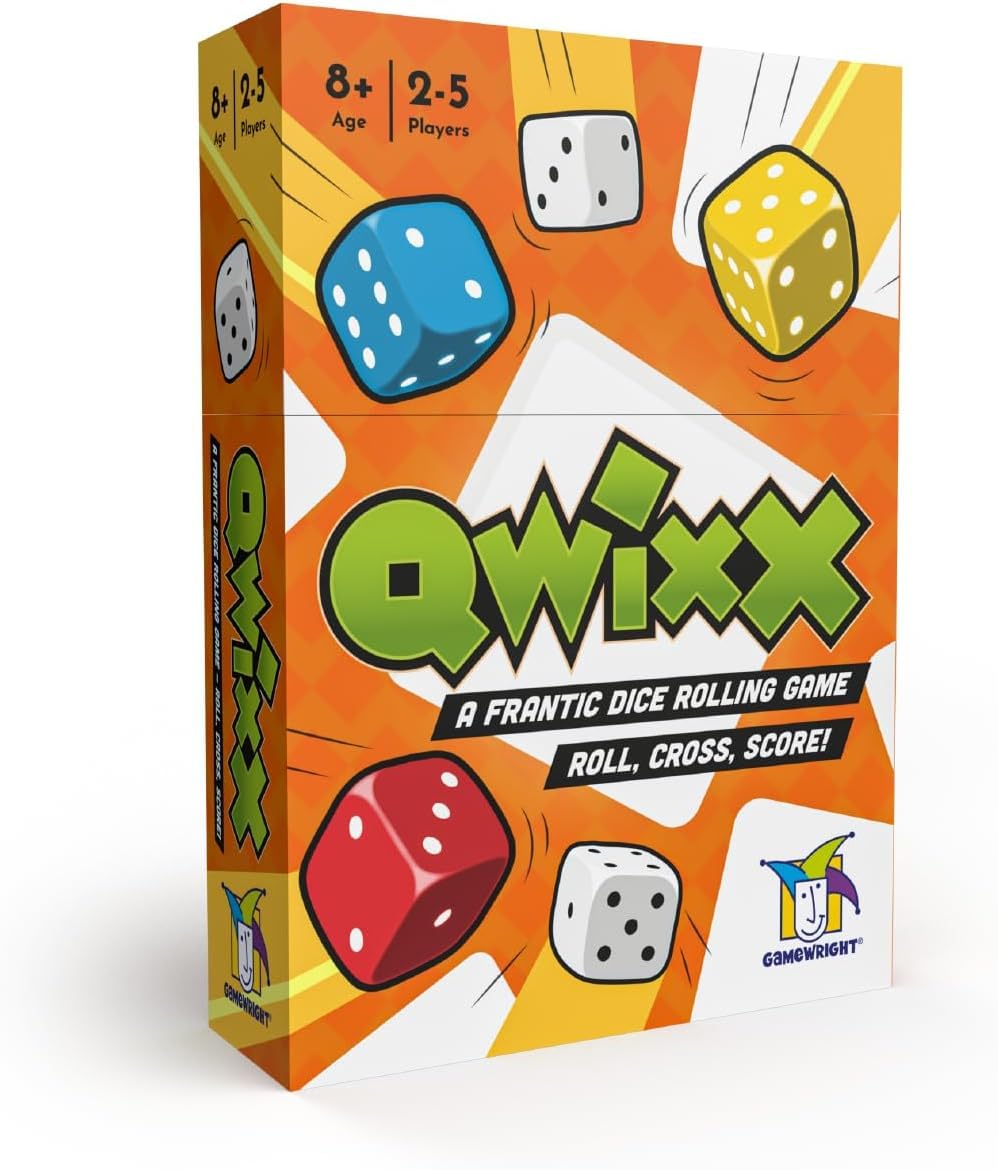
What separates Qwixx from almost everything else in this roundup is what happens between turns: nothing. One player rolls all six dice, everyone at the table crosses numbers off their own sheet at the same time, and a five-player game moves at exactly the pace of a two-player one. In a category where four people usually watch one person shake a cup, that is the detail that made us keep reaching for it.

The rules take about two minutes. The two white dice are added together and anybody can use that total; the colored dice belong to the roller, and each color maps to a row on the sheet. Numbers only climb within a row, so every roll asks a small question — take the seven now or hold out for the eight — and closing a row shortens the game for everyone. That balance is why we rate it above the pure-luck games here: a nine-year-old can beat an adult, and the adult still wants the rematch.

It seats two to five and finishes in about fifteen minutes, which makes it the easiest of these to fit into a school night. It is also the quietest game here — everyone is head-down on their own sheet — so it is the wrong pick if you want a table full of conversation. We have never minded that trade, because nobody at the table is ever waiting for anybody.

Bottom line: Our default pick: fifteen minutes, two to five players, and a real decision on every roll — buy it if your table mixes ages and attention spans.

#2

LCR Dice Game

LCR Dice Game

Big party groups

Doodle Score 9.6/10
Check Price

Worth Noting

Weight
3.2 oz
Players
3 or more
Tin Size
4.75 x 3.25 x 1.25 inches
Age Range
5 years and up
Read the full review

The tin is about the size of a deck of cards and weighs a hair over three ounces, so LCR is the game that actually leaves the house with us. It is rated for three players and up, and it improves with every person you add — eight or ten around a table turns a ten-minute luckfest into the loudest thing in the room.

There is no decision in it, which is normally the thing that kills a game for us. You roll three dice marked with L, C, R and dots; each roll pushes a chip left, right, or into the pot, or does nothing at all. What earns LCR its place is the shrinking circle: players drop out as their chips run low, the pot builds, and the winner is decided in front of everyone. By the third round nobody is complaining about the missing strategy.

Two practical notes. The tin has no molded insert, so the dice and pieces rattle around loose — a small zip bag fixes that. And the stakes are whatever you bring, coins, chips, or candy, which is the part that turns it into a party rather than a game with rules to follow.

Bottom line: We recommend it for a crowd of any age that needs one shared activity and no rulebook; it is the smallest and most reliable group game here.

#3

Yahtzee Classic

Yahtzee Classic

Family game night

Doodle Score 9.6/10
Check Price

Worth Noting

  • Shaker will not stand upright between turns
Players
2 or more
Contents
Shaker and 5 dice
Age Range
8 years and up
Read the full review

Nobody needs the rules read to them. That is the whole case for Yahtzee at a table with grandparents, cousins, and a kid who has never played: the shake-and-score ritual is already in everyone's head, and the box still holds a shaker and five dice and nothing else.

What the scorecard does quietly is arithmetic. Choosing between a full house and three of a kind in the upper section is a real decision, and the running total gives kids a reason to add in their heads. Two players is plenty; with six at the table there is a lot of watching, so it is the wrong choice for a big party and the right one for a family of four.

We keep it for the nights when nobody wants to learn anything, and at this price it is the easiest game here to leave on a shelf for a decade. Two small things: the shaker will not stand upright between turns, so it rolls onto the table, and boxes occasionally arrive short a die — count the contents before you wrap one as a gift.

Bottom line: We keep it for the nights when nobody wants a rules lesson: familiar, inexpensive, and quietly good for mental arithmetic with three generations at the table.

#4

TENZI Party Game

TENZI Party Game

Young kids

Doodle Score 9.6/10
Check Price

Worth Noting

  • Colors may vary and repeat between sets
Players
2 to 4
Age Range
7 years and up
Ways To Play
9
Dice Included
4 sets of 10
Read the full review

Emptying a tube of forty dice onto a table gets a reaction before anyone has read a rule. TENZI is four sets of ten colored dice; each player races to get all ten of theirs showing the same number, rerolling everything that does not match. There are no turns, everybody rolls at once, and a round can be over in a couple of minutes.

That is exactly why we hand it to the youngest players first. There is nothing to read and nothing to add, and fast hands beat careful thinking, so a small kid can genuinely beat an adult. It seats two to four, which leaves a fifth person watching, and colors may vary between sets, so if two sets turn up looking alike, telling players' dice apart gets confusing. Neither has kept it far from the kitchen table.

Bottom line: We hand this to the youngest players first — no turns, no reading, and a round over before anyone has time to lose interest.

#5

Zombie Dice

Zombie Dice

Teens and adults

Doodle Score 9.6/10
Check Price

Worth Noting

  • Zombie theme will not suit every family
Players
2 or more
Age Range
10 years and up
Play Time
10 to 20 minutes
Read the full review

The theme does a lot of the work. A kid who will not sit through a rules explanation will pick up a cup of zombie dice because the dice are the joke — brains are good, shotgun blasts end your turn, and the whole table can see how badly it is going.

Each roll adds brains to your haul or shotguns to your tally, and you choose when to stop and bank what you have. Push too long and the third shotgun wipes the turn. It is the cleanest press-your-luck game in this group: the tension sits in the decision to stop rather than in the arithmetic, and a round runs ten to twenty minutes with two or more players.

The box says ten and up, and that rating is about the theme rather than the rules — there is nothing here a younger player cannot follow, so the zombie idea is the thing to check before handing it to a nervous kid.

It is the priciest game in this roundup, which we minded less than we expected once it became the one that comes out at parties where half the table has never met. If your group is younger, or firmly anti-zombie, Qwixx delivers the same turn-by-turn decisions without the theme.

Bottom line: Our pick for teens and mixed adult parties: fast, funny, and built on the best stop-or-roll decision in this set.

#6

Farkle

Farkle

Casual game night

Doodle Score 9.6/10
Check Price

Worth Noting

  • Rule sheet sometimes ships Spanish-only
Players
2 or more
Age Range
8 years and up
In The Box
Cup, score pad, 6 dice
Read the full review

Farkle is six dice, a plastic cup, and a pad. That is the whole kit, and if it sounds thin, remember that the entire game lives in the decision to roll again.

You roll, set aside scoring dice, and then choose whether to bank the points or push for more; roll a hand with nothing scoring in it and the turn, and everything on it, is gone. It seats two or more, works with eight-year-olds, and the running total is arithmetic practice nobody notices they are getting.

Where it beats the fancier sets is packing. The box is small, the cup is all you need to keep dice on the table, and it survives being thrown in a bag for a weekend. Nothing in it is precious enough to worry about losing.

We reach for it when the table wants to talk while playing. There is no board to look at and no cards to hold, so conversation keeps going, and a game can stop whenever dinner is ready. Of everything here, it is the one that disappears into a bag and comes out most often.

Bottom line: We reach for it when the table wants to talk while playing: six dice, a cup, and a stop-or-roll decision that lasts as long as you let it.

#7

Pass the Pigs

Pass the Pigs

Mixed-age gatherings

Doodle Score 9.6/10
Check Price

Worth Noting

  • Small pigs and small score sheets
Weight
4 oz
Players
2 or more
Age Range
7 years and up
In The Box
Pig sty cup, two pigs, pencil, score pad
Read the full review

Two small pigs, a cup, and a scoring chart full of nonsense words: siders, trotters, razorbacks, snouters. The joke lands within a round — the pigs come to rest in some position, everyone leans in to see whether it counts, and the scorekeeper reads out something ridiculous. It is the game we hand to people who insist they do not like games.

Mechanically it is the simplest thing here. Roll the pigs, score what they land on, and decide whether to throw again; an oinker or a pig out wipes the turn, and the first to 100 wins. There is no strategy to learn and no reading beyond the chart, so a seven-year-old and a grandparent are on exactly the same footing.

Two things to know. The pigs and score sheets are smaller than the photos suggest, which is fine for travel and less fine for older eyes across a table. The case is also fussy to repack, since the pencil has to go back in at the right angle. Neither has stopped us from keeping it in the car.

Bottom line: Our funniest pick and the easiest to teach — buy it for mixed-age gatherings where the point is laughing, not winning.

#8

Shut the Box

Shut the Box

One or two players

Doodle Score 9.6/10
Check Price

Worth Noting

  • Waiting grows past three players
Players
2 or more
Material
Solid wood with felt
Age Range
8 years and up
Numbered Tiles
12
Read the full review

A wooden box with twelve numbered tiles and a strip of green felt, Shut the Box looks like something that belongs in a pub. It is the only game here with any furniture quality to it — it sits on a coffee table and gets picked up without anyone announcing a game night.

The rules are one sentence: roll two dice, flip down any tiles that add up to the roll, and keep going until nothing fits. The lowest remaining total wins, and one person can play the whole thing alone. Because every choice is arithmetic, it is the quietest educational game here — kids work out combinations out loud without it feeling like a worksheet.

We rate it the best of these for one or two players, and the one we leave out on the table. The catch is that there is nowhere built in to keep the two dice, so they will get separated from the board eventually — park a spare pair in the same drawer and it stops mattering.

Bottom line: We rate it the best here for one or two players and the one that stays out on the table; buy it if you want a game that looks like furniture.

How We Picked and Played Our Way Through 17 Dice Games

We started with a list of roughly 40 dice games on shelves right now, then narrowed it by player count (anything that couldn't seat two players and a crowd was out), age range, box size, and whether the rules fit on a single sheet. That left 17 games, which we bought ourselves so nobody's review copy was on the line.

Each one got at least three sessions over four months: one at a kitchen table with two adults and two kids, one with four adults after dinner, and one wherever the box happened to travel — a cabin porch, a hotel desk, the floor of a rental. Before the first roll we timed the teach, meaning how long it took a single reader to get everyone else playing, and whether anyone had to go back to the rules mid-game. We clocked individual rounds and full sessions, and watched for the moment a runaway leader turned the last ten minutes into a formality.

Components were counted against the box list before play and again after five sessions, which is where we saw card edges furrow and where one game turned out to be short a die. We checked that dice and card colors actually matched what the rules sheet showed, rolled each set on bare wood and on a tablecloth to see whether they tumbled true or skidded, and packed every game into a canvas tote to see whether the insert held together in transit. The kids' verdict was its own measure: we noted which games they asked for again and which ones the adults quietly steered away from.

How to Choose Dice Games

Start with the number of people at your table

Every box here names a player count, and the minimum matters more than the maximum. LCR needs three, so a two-person household cannot play it at all; TENZI tops out at four, so a fifth player sits out and watches. Qwixx covers two to five and Farkle covers two and up, which makes both of them safer buys for an unknown group.

Buy for the group you have on a Tuesday night, not the party you host twice a year. The bigger number on the box is almost always the more generous claim.

Decide how much luck you can stand

LCR and Pass the Pigs hand every decision to the dice. Others ask you to weigh a risk: Qwixx's rows, Farkle's bank-or-roll, Zombie Dice's stop-or-keep-going. Pure-luck games are the ones that work when ages are mixed and nobody wants to lose gracefully; decision games are the ones adults ask to play again.

If someone at your table plays to win, start with a decision game. If the youngest player is five, start with luck — a game a child can win on the dice is a game they will keep asking for.

Check who waits while everybody else plays

Turn order is the quiet killer of family game night. Yahtzee, Farkle, and Shut the Box run one player at a time, so with six at the table five people are watching. Qwixx and TENZI are simultaneous, which means the round takes the same time with five players as with two.

Above four regular players, buy a simultaneous game first and treat the turn-based ones as small-group games. It matters more than the theme or the components.

Count what the box does not include

Almost every game here needs something the box does not supply. LCR plays best with stakes to pass around — coins, chips, or candy — and its tin has no molded insert to keep pieces tidy. Qwixx, Yahtzee, and Farkle all score on paper, and those pads run out; check that refills are sold before a favorite becomes unusable.

A zip bag for loose dice and a pencil per player covers most of it. None of these costs much, but the night it stops play is the night you notice.

Dice size, cups, and table survival

Dice are not all the same in the hand. The pigs in Pass the Pigs and the sheets that come with it are small, which is convenient in a bag and awkward for older eyes across a table. A cup earns its place: Farkle ships with one, and it is the difference between a game on a coffee table and a hunt under the sofa.

If anyone at the table has trouble pinching small objects, roll a few turns before you commit. A game nobody can pick up is a game that stays in the box.

Frequently Asked Questions

Final Verdict

Qwixx is the one we recommend to almost anyone: fifteen minutes, two to five players, and a genuine decision on every roll. Nothing else here balances a mixed table that well.

If your group regularly runs six or more, buy LCR instead — it handles a crowd better than anything else on this list. If the players are mostly under ten, TENZI is the one that keeps them moving. The rest of these are variations on those three jobs, and worth buying only when one of them fits you better.