Games & Puzzles

Best Kaleidoscopes for Kids

A kaleidoscope is a simple toy until you put it in a kid’s hands. The good ones turn a patch of sunlight into a few quiet minutes, then end up at the bottom of a backpack. The trouble is that many kids’ kaleidoscopes are prettier on the shelf than in use: the turning ring sticks, the colors go muddy, or the end cap pops off after one enthusiastic shake. What you want is a sturdy tube that looks bright enough to leave out, survives a drop, and is worth the money after the novelty wears off.

Over the past three months, my team and I tested 16 kaleidoscopes with kids ages 4 to 9, and the pattern was clear. The ones that held attention weren’t always the flashiest; they had smooth turning, saturated color, and bodies that didn’t rattle after a week. A quick note for first-time buyers: the magic lives in the lens and the turning mechanism, not the length of the tube or the paint job. The picks below survived real play and kept earning a second look.

#1

iKeelo Classic Tin Kaleidoscopes 2 Pack

iKeelo Classic Tin Kaleidoscopes 2 Pack

First kaleidoscope

Doodle Score 9.2/10
Check Price

Worth Noting

  • Hidden animals are lost on preschoolers
Body
Metal tin with ABS lenses
Pack
2 (dinosaur + ocean)
Size
2 x 2 x 7 inches
Recommended Age
3 years and up
Read the full review

Two metal-tin scopes for barely more than one of the single tubes here, and what tipped it for us is the boring part: this is the only pick that names the standards it is built to — ASTM, EN71, CCPSA and AS/NZS — and it carries a one-year warranty against manufacturing defects. A toy that gets held against a three-year-old's eye should come with that paperwork.

In the hand it is the shape most kids expect: seven inches long, two across, light enough to wave about, with a barrel that turns cleanly. We spent a while working both barrels looking for the grinding, gritty feel cheap scopes get, and did not find it. The tin shell takes knocks that would split a paper tube, and there are no sharp edges on either end, which is the first thing we check.

The extra layer is the good bit. One scope hides dinosaurs, the other sea creatures, and they surface in the pattern as you turn. They are subtle, and a preschooler will not see them at all — that layer starts paying off around five or six, so treat it as a bonus rather than the reason to buy.

You get those two themes and no choice, and the ABS lens wants a dry cloth rather than a sleeve. Neither changes how a two-pack gets used in practice: one for the birthday child, one for the sibling who wants exactly the same thing.

Bottom line: Our default for most families: two certified metal scopes with clean-turning barrels, for barely more than one single anywhere on this list.
#2

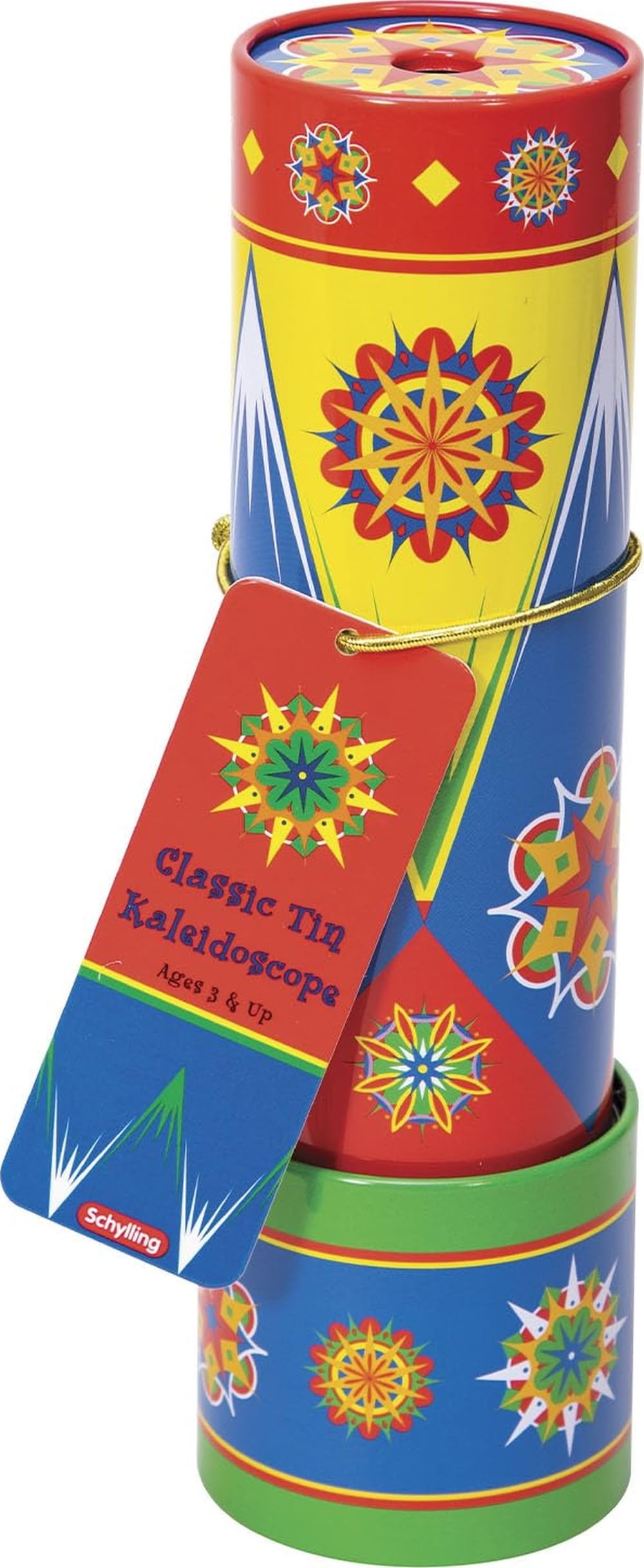
Schylling Classic Tin Kaleidoscope

Schylling Classic Tin Kaleidoscope

Cheap classic gift

Doodle Score 9.2/10
Check Price

Worth Noting

  • Tin body dents if it is dropped
  • No manufacturer warranty listed
Body
Painted metal tin
Pack
1
Size
7 x 2 x 2 inches
Recommended Age
3 years and up
Read the full review

Painted tin, a turning barrel and a chamber of multicolored beads: nothing to assemble, no batteries, nothing to lose. At seven inches by two it has a bit of weight in the hand, and the metal is the point — it looks like the toy a grandparent remembers rather than a plastic impression of one.

It is the least expensive single scope here, and the view holds up. The bead chamber is full, so a quarter turn gives a whole new flower, and there is no adjustment to get wrong, which is exactly what you want for a three- or four-year-old. Handling it beside the two-pack above, we noticed the simpler tube is the one a child picks up and puts down without asking how it works.

Compared with the iKeelo pair you are trading a spare scope and a certification list for the lower price and the object people recognize. Both are reasonable trades, and which one is right depends on how many children are in the room.

If two children are watching you unwrap it, buy the pair instead. If one is, this is the least complicated purchase on the page.

Bottom line: The one to grab for a single small gift: a familiar tin scope with a bright bead chamber, priced below every pair here and simple enough for a three-year-old.

#3

iKeelo 24-Piece Kaleidoscope Party Pack

iKeelo 24-Piece Kaleidoscope Party Pack

Party bags

Doodle Score 9.2/10
Check Price

Worth Noting

  • Ends can split within a week of hard play
  • Cartoon prints skew to the under-sevens
Pack
24
Size
1.4 x 1.4 x 5.8 inches
Designs
6 cartoon styles
Recommended Age
3 to 8 years
Read the full review

Twenty-four tubes in one box, nothing to assemble, which is the entire reason this pack wins the party-bag job. Each is 1.4 by 1.4 by 5.8 inches — small enough for a four-year-old's fist — and light enough that a bag of them does not become a brick.

The prints are the weak spot in a mild way: six cartoon designs, giraffes and dolphins and astronauts, aimed squarely at the under-seven. A nine-year-old will clock them as babyish; a four-year-old will not care, because the view inside is what the toy is for and it is bright.

As favors these are close to ideal. They are cheap enough to hand out two dozen times, sturdy enough for the walk home and sized for small hands. They are not the toy that survives a year in a toy box — the ends can split within a week of hard play — but a favor is not asked to do that.

If the guest list is mostly eight and up, the print will undersell them, and a plain tin scope makes the better favor even at one apiece.

Bottom line: The pack we buy when the job is 24 party bags: light, bright, sized for small hands, and cheap enough to give away without wincing.

#4

Chivao 30-Piece Kaleidoscope Set

Chivao 30-Piece Kaleidoscope Set

Classroom rewards

Doodle Score 9.2/10
Check Price

Worth Noting

  • Paper body scuffs and crushes
  • Same pattern family across the batch
Body
Craft paper
Pack
30
Designs
At least 6 styles
Recommended Age
6 to 12 years
Read the full review

Thirty tubes in one box is the largest count here, and for a teacher or a room parent that is the whole argument. They are craft paper over a core, light as a straw, with at least six printed designs across the batch.

We rate these for the job they are sold for — a class set, a prize table, a shoebox packing session — rather than as a toy a child keeps. Paper scuffs and crushes in a bag in a way tin does not, and it is the print, not the body, that makes them look like a present.

The thing to know before you order 30: the pattern repeats across the batch. One tube shows the same family of shapes as the next, so there is no trading for a better one, and a child who ends up with two will notice within a minute.

The age guidance is six to twelve, and that fits — the print is aimed older than the toddler-favor packs. Thirty is a lot of kaleidoscope. For one child, this is four times the toy you need.

Bottom line: A class-sized box of 30 paper scopes: the efficient way to give a whole room something, with repeat patterns accepted as part of the deal.

#5

Schylling Marble Kaleidoscope

Schylling Marble Kaleidoscope

Outdoor exploring

Doodle Score 8.8/10
Check Price

Worth Noting

  • Shows the scene's colors, not bright beads
  • Can arrive dented with a rattling marble
Pack
1
Size
1.5 x 1.5 x 7.28 inches
Design
Marble-tip teleidoscope
Recommended Age
3 to 10 years
Read the full review

There are no beads inside this one. A marble sits at the tip, mirrors run the length of the housing, and whatever you point it at comes back as a faceted, shifting pattern. Aim it at a hedge and the hedge breaks into green geometry; aim it at a friend and you get a strange, symmetrical face. That is the whole toy, and it is the one we take outside.

It is a different kind of play from a bead scope. A kaleidoscope gives a child the same reliable show every time; this gives them a reason to go and find something worth pointing at. For a six- to ten-year-old who has already had a bead tube, that is the more interesting gift.

The catch is color. Held up indoors with nothing in front of it, it shows brown and not much else, which is where the disappointment about this scope comes from. It needs daylight and a subject — outdoors in sun it is the brightest thing in this roundup, on a sofa it is dull.

At 7.28 inches it is long enough for two hands and short enough for a coat pocket, and the plain brown housing looks more like an instrument than a toy, which older kids tend to like.

Bottom line: Choose it for a child who is past beads: it turns the garden, the street or a face into the pattern, and it needs daylight to do it.

#6

Xeehwb 16-Piece Kaleidoscope Set

Xeehwb 16-Piece Kaleidoscope Set

One-off events

Doodle Score 8.8/10
Check Price

Worth Noting

  • ⚠️ End caps work loose and release the beads
  • Flimsy next to the tin scopes
Pack
16
Length
5.8 in / 14.7 cm
Designs
Random cute-style prints
Read the full review

Sixteen tubes in a box, 5.8 inches each, in cheerful cartoon prints. This is the box bought the night before a party, and for that it does the job.

The pattern changes when you turn the barrel, the colors are bright, and the length suits a five-year-old's grip. On the tubes that stayed whole, the view was as good as anything in the bulk group.

Where it falls down is the ends. They work loose, and when they do the beads end up on the floor; a tube that has lost its beads is a printed cardboard tube. We checked the caps on all sixteen before handing any out, and that is the habit to copy.

Buy it for kids past the mouthing stage, for one event rather than a toy box, and do not expect to see the tubes again after the cake.

Bottom line: A budget box for a one-off event: sixteen bright scopes with turning barrels, best kept for kids old enough to leave the end caps alone.

#7

Anyumocz 2-Piece Magic Kaleidoscope

Anyumocz 2-Piece Magic Kaleidoscope

Pockets and travel

Doodle Score 8.6/10
Check Price

Worth Noting

  • Colors read paler than the photos
Body
Plastic
Pack
2
Size
30 cm
Colors
Yellow and blue
Read the full review

This is the only telescoping scope in the group: pull it out to about 30 cm, push it down to roughly 20, and at the short end it disappears into a coat pocket.

The plastic body is light, the old-fashioned print reads as charming rather than cheap, and the barrel turns easily. The joints are where this one asks for care: it is not the scope to hand a child who yanks a telescope open, and keeping it for six-and-up is the simplest insurance.

Two colors, yellow and blue, so two children get one each without a negotiation. Extended it is about 30 cm, collapsed about 20 — fine for a coat pocket, a car door bin or a school bag.

As a spare that lives in the car, these earn their place. As the main present for a child who has been asking for a kaleidoscope, they do not — the tin scopes above simply feel like more.

Bottom line: The pocket pair: it collapses small enough to live in a coat or a car door, and two colors settle the sibling argument cheaply.

How We Chose and Tested Kids’ Kaleidoscopes

We started by pulling together every kids’ kaleidoscope we could find from major retailers and specialty toy shops, then narrowed the list by age recommendations, materials, tube length, and turning mechanism. We filtered out models with sealed ends that couldn’t be inspected, loose glitter that shed immediately, and anything that felt too light or too brittle in hand. That left 16 kaleidoscopes, which we tested over three months with kids ages 4 to 9 in our homes, back seats, and backyards.

Each tube went through the same rounds. Kids used them in the playroom, on car rides, in the backyard sun, and under a bedside lamp at bedtime. We watched whether the image stayed crisp and saturated or turned muddy as the tube rotated, and whether the turning ring moved smoothly or caught. We also noted which ones kids picked up again without prompting, because a kaleidoscope that only gets one look isn’t much of a toy.

Then we got less gentle. Each kaleidoscope was dropped from waist height onto hardwood, shaken for 30 seconds straight, and tossed into a backpack with a water bottle and a stack of books. We checked for cracks, loose caps, rattling beads, and any change in the pattern after impact. We also twisted the turning mechanism repeatedly to see if it stayed smooth, and compared what you get for the money—materials, finish, and visual payoff—against the rest of the lineup. The ones that held up still looked good on a shelf and still got picked up weeks later.

How to Choose Kaleidoscopes for Kids

Make sure the pattern really moves

A kaleidoscope is a chamber of loose colored pieces behind a triangle of mirrors; tilt it and gravity rearranges the view. The cheap shortcut is a printed film inside the tube, which looks convincing in the pack and then shows the same picture forever.

Twist it once before you wrap it. If the image is identical after a quarter turn, it is a decorative tube rather than a kaleidoscope, and no amount of bright printing fixes that.

Tin, paper or plastic

Tin is the material that survives childhood: it dents rather than shatters, and a dented tube usually still turns. Paper tubes are light and cheap, which makes them right for a party table and wrong for a toy box, because they crush and a crushed tube jams. Plastic sits between the two, with the joints and the lens as the parts that fail first.

Match the material to the job. A tin scope is for the toy that lives in a backpack; paper is for the twenty-four bags you are filling tonight.

One good scope or a whole pack

For one child, buy one scope properly. The iKeelo pair costs barely more than a single and leaves you a spare, which matters the first time two children want the same tube.

Packs make sense when the count is the point: a class of thirty, a party bag for every guest, a shoebox appeal. The cost per tube falls fast with count, and so does individual quality. That is a trade worth making deliberately rather than discovering at the party.

Age, grip and sealed parts

Most scopes here carry a 3+ label, and that assumes a child who no longer mouths toys, because the pieces inside become small parts the moment a tube opens. Length matters as much as the label: 5.8 to 7 inches suits a preschooler's hands, while anything longer gets carried rather than looked through.

Check the far end and the eyepiece before you hand one over. A loose cap or a cracked lens is the moment to retire a scope, not to reach for the glue.

Frequently Asked Questions

Final Verdict

The iKeelo two-pack is what we point most families to: two metal scopes, a safety certification list worth checking, barrels that turn without grinding, and a spare for the sibling, all for barely more than a single elsewhere on this list. It is the one purchase here that is hard to get wrong.

If the child has already worn out a bead scope, buy the Schylling Marble instead and send them outside with it — the beads-in-a-tube pleasure is one they have already had, and a teleidoscope gives them a reason to go looking.