Games & Puzzles

Best Sudoku Puzzles for Kids of 2026

Hand a kid a sudoku grid that's one notch too hard and the interest drains out of them in about ninety seconds — usually right around the moment they realize they've written the same number three times in a row. A good kids' sudoku removes that failure: the grid matches their number fluency, the rules make sense without a lecture, and a wrong pencil mark can be fixed. The right one turns a puzzle into a habit.

Kid sudoku comes in more formats than parents expect — slim workbooks, chunky magnetic boards, wooden tile sets that swap digits for pictures — and they aren't interchangeable. My team and I spent three months putting 14 of them in front of kids ages 4 to 10, from total beginners to second-graders who plow through grids for fun. Check the grid size before anything else, because a 4x4 picture puzzle, a 6x6 grid, and a full 9x9 of digits are three different games. Below are the ones that survived the back seat, the diner wait, and the bedtime plea for one more.

#1

The Super Sudoku Book For Smart Kids
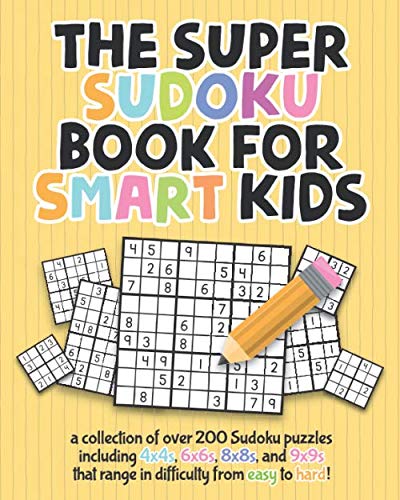
The Super Sudoku Book For Smart Kids

Ages 6-10 beginners

Doodle Score 9.6/10
Check Price

Worth Noting

Pages
135
Puzzles
Over 200
Grid Sizes
4x4, 6x6, 8x8, 9x9
Reading Age
6-10 years
Read the full review

Four grid sizes in one book is what put this at the top of our list. The sequence runs 4x4, 6x6, 8x8, then 9x9, and that third step is the one most kids' sudoku books skip. A six-year-old who has just cracked a four-by-four grid is not ready for nine symbols a row, and the usual result is a book abandoned around page thirty. Here there are 8x8 pages to live on for a while first, so by the time the full grid arrives it reads as the same puzzle with more work rather than a different game.

The other thing we appreciated is the front of the book: a step-by-step guide and a full page explaining how sudoku actually works. That's the difference between a parent re-explaining the box rule every ten minutes and a child who can go back and check. More than 200 puzzles fill 135 pages, easy through hard, and the reading age is listed at 6 to 10 — wide enough that siblings can share one copy without either feeling talked down to.

We found little to complain about. At 8 by 10 inches the pages give the grids room, and the difficulty climbs at a pace that kept us moving forward instead of hunting for an easier page. The caveat is a child already solving full 9x9 grids at speed — for them this is revision. The value here is the climb, and a first-time solver gets the longest one in this guide.

Bottom line: This is the one we hand to a family starting out: an 8x8 stepping stone most books skip, a genuine how-to page, and more than 200 puzzles to grow into.

#2

Sudoku for Kids Ages 6-8 (LogicKids)

Sudoku for Kids Ages 6-8 (LogicKids)

Ages 5-8 practice

Doodle Score 9.6/10
Check Price

Worth Noting

  • Skips the 8x8 step between 6x6 and 9x9
Pages
108
Puzzles
Over 300
Grid Sizes
4x4, 6x6, 9x9
Reading Age
5-8 years
Read the full review

More than 300 puzzles in 108 pages is the headline, and for a child who has caught the bug it's the biggest stack of grid time in this guide. The grids run 4x4, 6x6, and 9x9 in large print, on a 6 by 9 inch trim that slips into a backpack, and the levels climb from easy through medium to hard.

Where it parts company with our top pick is the middle of that sequence. There's no 8x8 section, so a child goes from six symbols a row to nine, which is a bigger ask than it sounds. The six-by-six pages go quickly; the nine-by-nine pages are where a young solver will want company for the first few.

We think the page count is this book's real argument — a child who does three puzzles a day will still have pages left months from now, and large print is a genuine kindness to a kid still forming their numbers. The answers sit in the back where they're easy to flip to, so if you have a peeker in the house, tear those pages out before you hand it over. For volume and big squares, this is the pick.

Bottom line: Our pick when volume matters most: more than 300 large-print puzzles across three grid sizes, though the six-to-nine jump skips a step.

#3

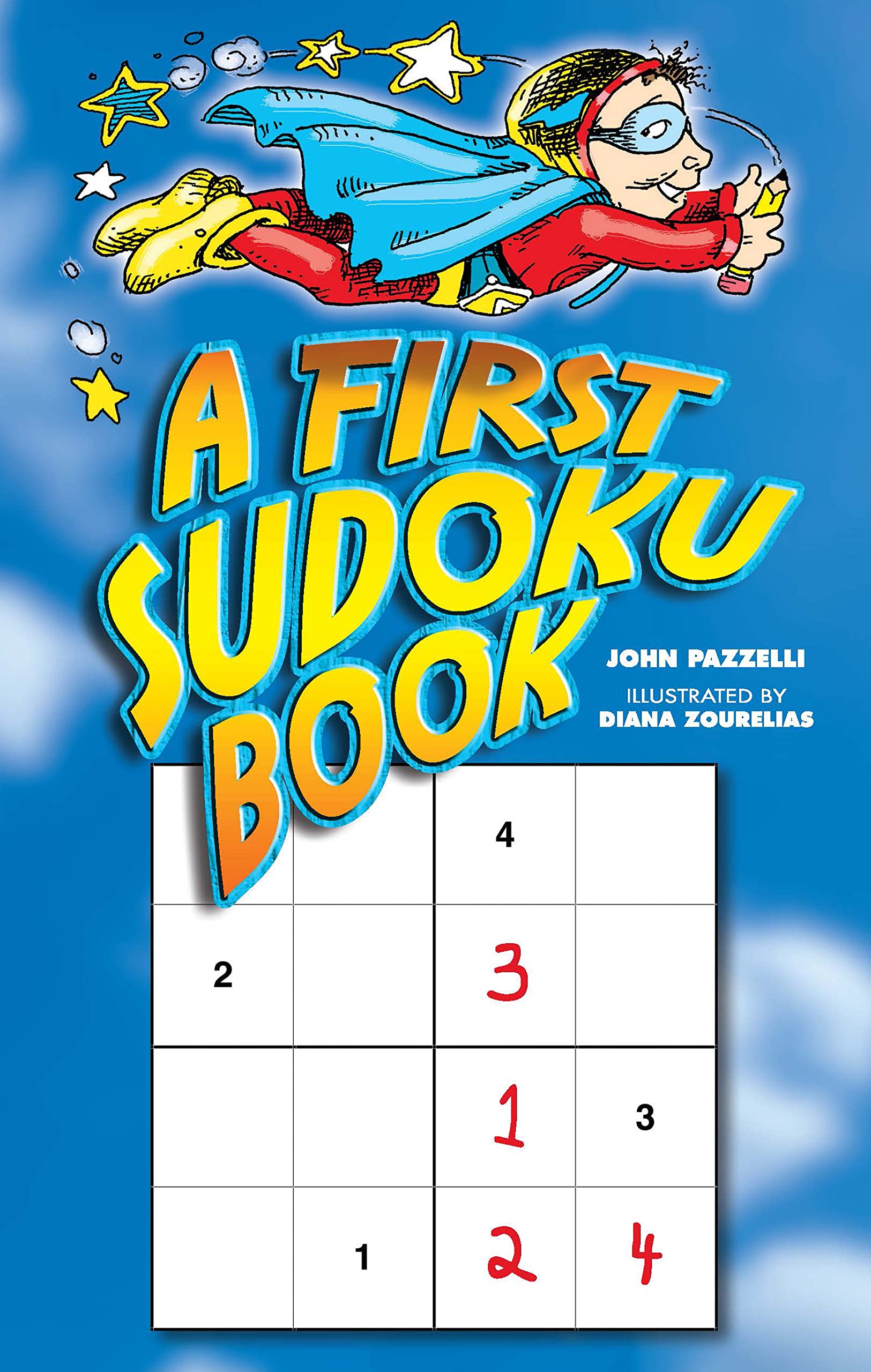
A First Sudoku Book (Dover)

A First Sudoku Book (Dover)

Youngest starters, 5-7

Doodle Score 9.4/10
Check Price

Worth Noting

  • Jumps from 4x4 grids straight to 9x9
  • Short at 64 pages for a hooked solver
Pages
64
Trim Size
5.5 x 8.5 inches
Reading Age
5-7 years
Read the full review

The puzzles here use X's and O's instead of digits, and that one decision tells you who the book is for. A five-year-old who can tell two shapes apart can start solving before they can reliably read a number or write one small enough for a nine-by-nine grid. It opens with 4x4 squares and works up through three levels in 64 pages, at a trim of 5.5 by 8.5 inches that fits a small pair of hands.

We liked it most for the very first week of sudoku, before a child has any stake in being good at it. The four-by-four pages are an unusually gentle introduction, and the size means it goes into a bag without a second thought. The symbols also do their job quickly: once the row-and-box rule clicks, moving to digits is a small step rather than a new skill.

The gap is in the middle. Between the four-by-four warm-ups and the nine-by-nine grids there's no six-by-six section, and the climb is steep enough that plenty of kids finish the easy pages and stall there. If your child is seven or eight and already comfortable with numbers, start them elsewhere and come back to this one for a younger sibling.

Bottom line: The best first grid we found for a five-year-old: X's and O's instead of digits, four-by-four puzzles to start, and three levels to climb.

#4

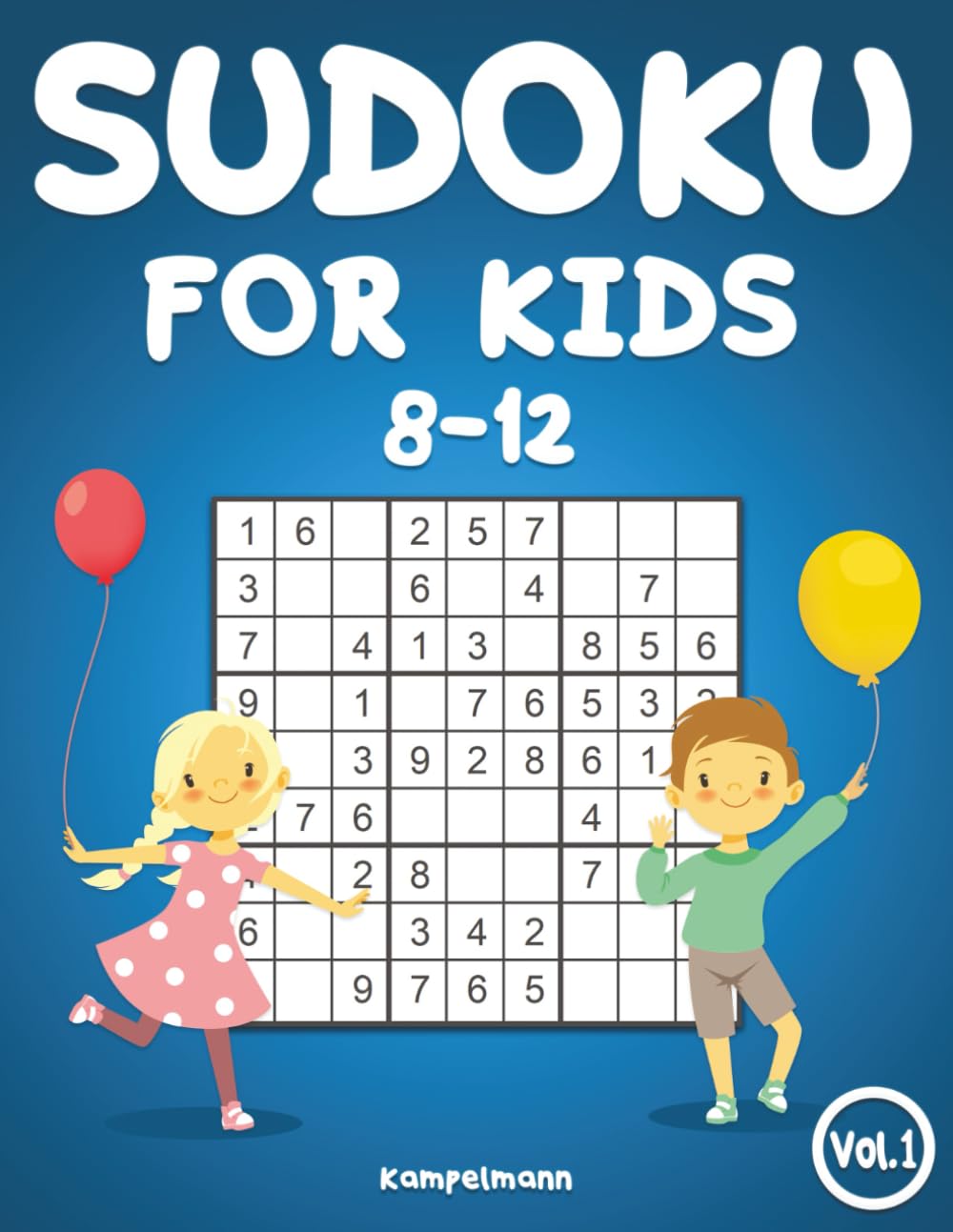
Sudoku for Kids 8-12 (Kampelmann)

Sudoku for Kids 8-12 (Kampelmann)

Ages 8-12

Doodle Score 9.4/10
Check Price

Worth Noting

  • Deep and heavy enough to be awkward in a backpack
Pages
122
Puzzles
200
Trim Size
8.5 x 11 inches
Reading Age
8-12 years
Read the full review

At 8.5 by 11 inches this is a full sheet of paper, and that's the detail that sells it to us. Kids in the eight-to-twelve range are still writing numbers big, and a letter-size page with large print gives them grids they can fill without crowding the margins or erasing half a row to fix one digit. Two hundred puzzles, 122 pages, and the solutions are included at the back.

The scope is deliberately plain: 200 puzzles, no gimmicks between the covers, and enough range to keep an eight-year-old and a twelve-year-old both busy. We read that as a feature. A child who already knows how sudoku works doesn't want another explanation of rows and boxes; they want a stack of grids and somewhere flat to put the book. Our top pick covers roughly six to ten, so this is the one that starts where that leaves off.

Bottom line: For an eight- to twelve-year-old who already plays, this is the sensible buy: a full letter-size page, large print, and 200 puzzles with the answers in the back.

#5

Sudoku for Kids Ages 10-12

Sudoku for Kids Ages 10-12

Ages 10-12

Doodle Score 9.2/10
Check Price

Worth Noting

Pages
108
Levels
Easy, medium, hard
Puzzles
Over 200
Age Range
10-12 years
Read the full review

Ten is about the age where a kids' sudoku book stops being a gift. This one is labelled 10 to 12 rather than 6 to 10, and that labelling does more work than it sounds like it should — it puts a book in a ten-year-old's hands that isn't a hand-me-down from a younger sibling.

The contents back it up. More than 200 puzzles in named easy, medium, and hard bands, across 108 pages, so a child can start where they're comfortable and drop back a band without feeling like they've been sent to the baby section.

The trim is 8.5 by 11 inches, the same full-sheet size as our 8-12 pick, which means the grids aren't squeezed and a pre-teen's handwriting has somewhere to go. If your child has already worked through one of the younger books here, this is the natural next one.

What we like most is how little ceremony there is: named levels, a lot of grids, and a page size that takes a ten-year-old seriously. If your child has never done a sudoku at all, start on one of the beginner picks here and come back to this in a year.

Bottom line: Our pick for the ten-to-twelve crowd: named difficulty bands, more than 200 puzzles, and a full-size page that doesn't feel like a kids' book.

#6

Magnetic Space Sudoku

Magnetic Space Sudoku

Hands-on, ages 4+

Doodle Score 9.0/10
Check Price

Worth Noting

  • Only 72 challenges, with nothing to add after
Size
7.1 x 9.1 x 1.7 inches
Board
Magnetic
Age Range
4-10 years
Challenges
72
Read the full review

The board is magnetic, the pieces stay where a small hand puts them, and nothing gets used up. The set starts with 4x4 grids made of space creatures, which teaches the one-of-each rule before a single number appears, then moves to 6x6 number grids across 72 challenges. When the last one is solved, the whole thing is still intact for a younger sibling.

For the four-to-six bracket, where a paper book is a race against a short attention span, that's the format that works. The pieces don't slide, a bumped table doesn't end the session, and a child can set it up and put it away without supervision. It's also genuinely repeatable: solve the set, tip the pieces out, start again.

Two things to weigh. At 72 challenges it's a starter rather than a library — a sharp seven-year-old will work through the set faster than through a two-hundred-puzzle book, and there's nothing to add afterwards. And the 4-to-10 age range on the packaging is wider than the sweet spot: this is at its best before the six-by-six number grids stop being interesting, somewhere around seven.

Bottom line: Our pick for a four- to seven-year-old: a magnetic board, picture grids that teach the rule first, and 72 challenges that don't get used up.

#7

Kanoodle SudoQube

Kanoodle SudoQube

Tactile color puzzles

Doodle Score 9.0/10
Check Price

Worth Noting

  • Solutions reached by QR code, not a printed page
  • Cubes can be stiff for smaller hands
Size
5.9 x 5.7 inches
Cubes
25 in five colors
Age Range
7 and up
Challenges
100
Read the full review

Colors replace digits entirely here: 25 cubes in five colors, 100 challenges, and sudoku's rule — nothing repeated in a row or column — played out on a double-sided board. That's either the cleverest thing in this guide or the reason to skip it, depending on the child.

For a puzzle-resistant kid who has bounced off pencil grids, the tactile version has real appeal. You snap the cubes into pieces, then arrange them, and the whole thing packs down into a 5.9-inch square that goes in a bag. The early challenges are quick wins, which is fine at six or seven and thin for anyone older.

We found the difficulty curve the weak point. It starts very easy and climbs slowly, so a bright nine-year-old will solve the whole set in a couple of sittings. Below that age, a color rule is genuinely easier to see than a nine-by-nine number grid, and that's where it earns its place.

Two practical notes before you buy. The cubes can be stiff to snap together, so smaller hands will need help the first few times. And solution checks go through a QR code rather than a printed answer key, which is worth knowing if the screen is the thing you're trying to get away from.

Bottom line: A tactile detour for a kid who won't sit with a pencil: five colors instead of nine digits, 100 challenges, and difficulty that starts very easy.

How We Tested Kids' Sudoku, Grid by Grid

We started with a long list of kids' sudoku titles and formats — workbooks, spiral-bound books, magnetic travel boards, and wooden tile sets — then trimmed it by the age band printed on the cover, the grid size, the puzzle count, and whether a child could start one without an adult setting it up first. Fourteen made the cut, ranging from picture-grid books for preschoolers to full 9x9 digit books for third and fourth graders.

Testing ran for three months, mostly in the places where sudoku actually happens: the kitchen table after school, the back seat on a 40-minute drive, a booth at a diner waiting for pancakes, and the last twenty minutes before lights out. We watched whether kids could work out the rules from the page itself, whether a book lay flat or fought back, whether a wrong answer erased cleanly, and whether magnetic tiles held when the car turned a corner. Then we noted who asked for another puzzle and who quietly closed the book.

Difficulty got its own pass — we tracked whether each book or board ramped up gradually or jumped from easy to discouraging, and whether the answer key sat far enough back that a kid wouldn't stumble onto it. For the tile sets, we timed how long a reset took and whether small hands could snap pieces back into place without help. We also kept an eye on wear: bent corners, chipped wooden tiles, and pages that tore under an enthusiastic eraser.

How to Choose Sudoku Puzzles for Kids

Read the grid sizes, not the age band

A child's sudoku ladder has four rungs: 4x4 grids with four symbols, then 6x6, then 8x8, then the standard 9x9. A book that lists three or four of those on the cover is showing you its ladder, and you can decide whether your child is being handed the right rung or dropped in halfway up.

The common gap in this set is the missing middle step, which turns a gentle ramp into a wall at exactly the age enthusiasm is fragile. Pay for the rung your child needs next rather than the highest one advertised, and check the sample pages for what the first puzzle actually looks like.

Find a page that teaches the rule

Sudoku is three rules stacked: one of each symbol per row, per column, and per box. You can explain that in a minute; a six-year-old needs it written down and available to reread on the third puzzle. A step-by-step page and an example grid at the front are worth more than another fifty puzzles at the back.

If the preview shows no explanation, assume the book expects a child who already plays, and save it for an older solver who wants volume rather than tuition.

Decide between a book and a reusable set

A paper book is consumable. A couple of hundred puzzles is a few months at two or three a day, and then you buy another one. A magnetic or cube set costs more once and can be solved again, handed down to a younger sibling, and tipped back into its box — which is why our list includes both formats.

Watch the travel claim. Loose pieces in a car seat end up under the seat, so if the plan is journeys, choose the magnetic board over the tub of cubes. And check the challenge count: a set with 72 challenges is a starter, not a library.

Check where the answers live

Solutions at the back are standard and fine; what matters is whether your child will flip to them. If you have a peeker, tear the answer pages out on day one and keep them in a drawer — the book still works and the temptation disappears.

Layout is the other half of it. Large print and one puzzle per page suit a beginner, and the physical trim tells you how much room there is: an 8.5 by 11 inch book gives noticeably more writing space than a 5.5 by 8.5 inch one.

Frequently Asked Questions

Final Verdict

If you're buying one sudoku book and you're not sure where your child sits on the ladder, get The Super Sudoku Book For Smart Kids. The 4x4-to-9x9 sequence keeps the 8x8 rung in the middle, so the book grows with the solver instead of running out at page ten, and the how-to page at the front lets a child start without you narrating every move.

Two exceptions worth knowing. For a five-year-old, A First Sudoku Book and its X's and O's are the gentler first grid. And for a child who won't sit with a pencil, the Magnetic Space Sudoku teaches the same rule with pieces that stay where they're put.