Games & Puzzles

Best Floor Puzzles for Kids of 2026

A rainy Saturday with a floor puzzle is a good way to spend an afternoon—until a piece bends, the border won’t lie flat, or a 4-year-old loses interest before the sky is done. A good one has to do a lot: pieces big enough for small hands, a difficulty curve that doesn’t end in tears, and a picture that sneaks in color matching or animal names without feeling like a lesson. It also has to survive being rebuilt, stepped over, and wiped down after snack time. The right puzzle turns the floor into a shared project, not a cleanup job.

We spent four months with 12 floor puzzles, handing them to families with kids from preschool through elementary and watching which ones got pulled out without a prompt. The keepers had thick pieces that stayed flat after repeated assembly, age recommendations that matched the challenge, and enough visual detail to spark conversation. “Educational” turned out to mean different things—some taught patience and spatial reasoning, others sneaked in counting, habitats, or storytelling. The picks below earned their floor space.

#1

Ravensburger Disney Pretty Princesses Puzzle
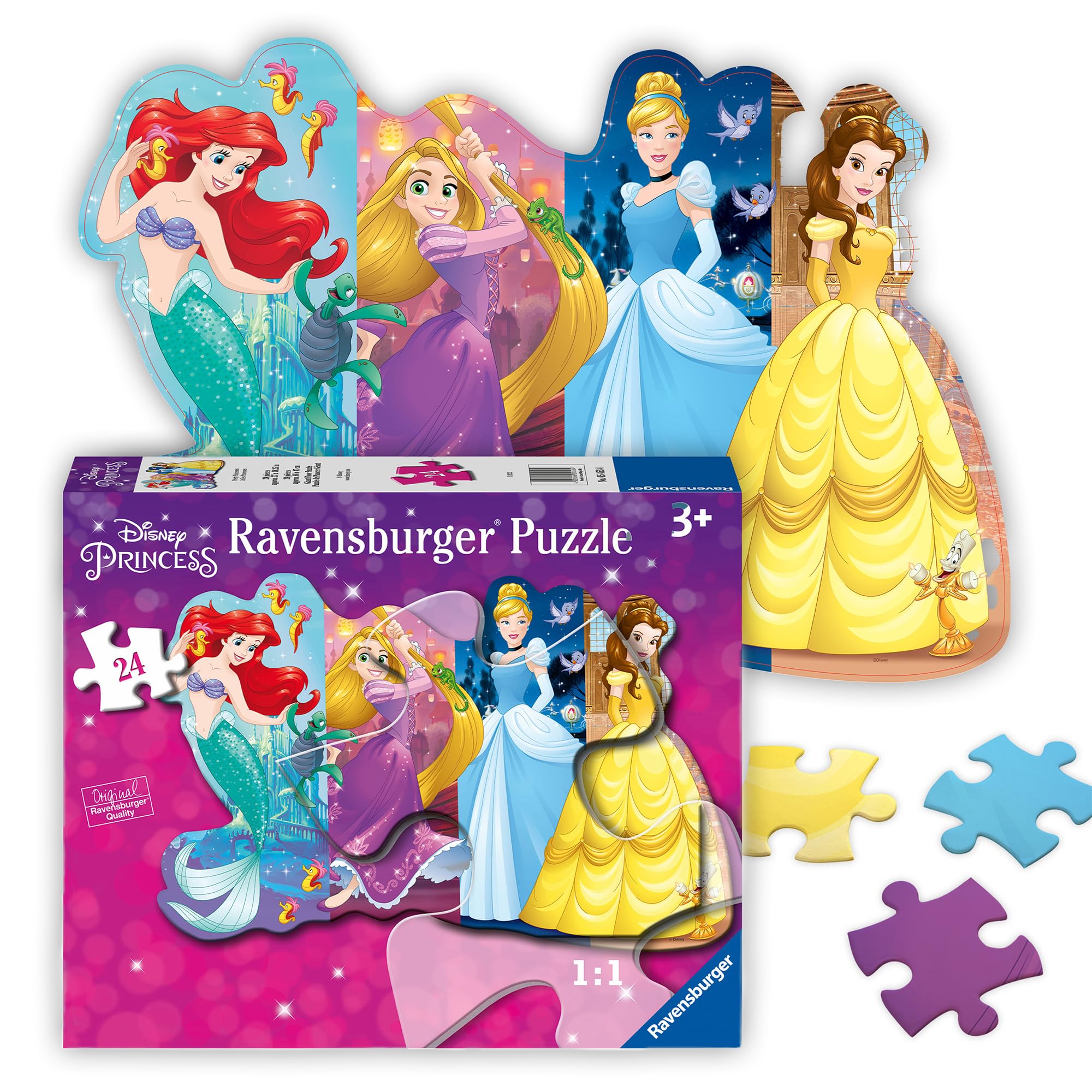
Ravensburger Disney Pretty Princesses Puzzle

Youngest puzzlers

Doodle Score 9.8/10
Check Price

Worth Noting

  • Costliest per piece in this group
Pieces
24
Warranty
Lifetime against manufacturing defects
Age Range
3 to 6 years
Finished Size
19.25 x 27 inches
Read the full review

Twenty-four pieces doesn't sound like much beside a 70-piece solar system, and that's exactly the point. This is the only puzzle here a three-year-old can finish start to finish without an adult handing them pieces, and finishing alone is what turns a puzzle from a supervised activity into something a child asks for.

The pieces are large and thick, and the finished puzzle runs 19.25 by 27 inches — big enough to feel like a proper floor build, small enough to do in a hallway. The artwork helps more than you'd expect: Cinderella's blue and Ariel's red are easy to sort by, and there's no murky background for a piece to disappear into. Ravensburger also backs it with a lifetime warranty against manufacturing defects, which is more than any other puzzle here offers.

The caveat is that it's a princess puzzle and nothing else. A child who doesn't care about Belle and Ariel gets no extra pull from it, and there's no activity layer once it's built. What you're buying is the gentlest on-ramp in this roundup, and for the right kid it's worth every bit of the premium.

Bottom line: The best first floor puzzle in this group — 24 big pieces a three-year-old can finish alone, and sturdy enough to be rebuilt all afternoon.

#2

Melissa & Doug Solar System Floor Puzzle

Melissa & Doug Solar System Floor Puzzle

First big build

Doodle Score 9.6/10
Check Price

Worth Noting

  • Corners can dent with rough handling
Pieces
48
Age Range
3 to 6 years
Finished Size
2 x 3 feet
Piece Construction
Extra-thick, wipe-clean
Read the full review

On the floor it takes up roughly the space of a bath mat, and that turns out to be the right amount of room: a 2 x 3 foot solar system is wide enough for two children to work opposite edges and small enough that you can leave it down between sessions. The 48 pieces are genuinely thick — thick enough to pick up by a corner without the piece folding — and the printed surface wipes clean of the crumbs and the sticky patch that always seem to land on it.

What lifts it above the other big puzzles here is the printing. The planet names are on the pieces, so assembly turns into a naming quiz, and the colors are distinct enough across the scene that matching works as a strategy rather than a guess. It's also the most forgiving build in this group: a three-year-old can hunt for the sun and the bright planets while an adult handles the starry outer areas.

If your child has never finished a jigsaw, this isn't the starting point — the jump from 24 pieces to 48 is bigger than the numbers suggest, and the Ravensburger below is where that job belongs. For everyone else, this is the puzzle that gets built, pulled apart, and built again on a random Tuesday, which is the only test that really counts.

Bottom line: Our top pick: 48 chunky pieces, a 2 x 3 foot space scene that fills the floor, and a price that makes it an easy yes for a first big build.

#3

Melissa & Doug Busy Barn Floor Puzzle

Melissa & Doug Busy Barn Floor Puzzle

Farm-loving toddlers

Doodle Score 9.6/10
Check Price

Worth Noting

  • Outgrown once the picture is memorized
Pieces
32
Outline
Barn-shaped
Age Range
3 to 5 years
Finished Size
2 x 3 feet
Read the full review

The outline is what makes this one: the 32 pieces don't build a rectangle, they build a barn, complete with a peaked roof and a wide door. That matters more than it sounds. A rectangle asks a child to find four corners and grind out a border; a barn hands them a roof line, a door frame, and animal shapes to aim at, so a three-year-old can see progress on the very first pass instead of hunting for edges.

Inside, it's a proper farmyard — a horse, cows, ducks, pigs, and enough small detail to build a story around once the last piece is in. The pieces are extra-thick with the same wipe-clean finish as the solar system, and ours kept their shape through weeks of being assembled on carpet and taken apart by a two-year-old who had opinions. Expect to spend as long naming the animals afterward as you did building the barn.

Bottom line: For farm-loving threes stepping up from a 24-piece, this is the one: the barn outline gives them something to aim at and 32 pieces is a finishable challenge.

#4

Peaceable Kingdom Jumbo Mermaid Floor Puzzle

Peaceable Kingdom Jumbo Mermaid Floor Puzzle

Mermaid fans

Doodle Score 9.6/10
Check Price

Worth Noting

  • Harder than its 3-and-up rating suggests
Finish
Shimmer foil accents
Pieces
41
Age Range
3 years and up
Finished Size
Nearly 3 x 2.5 feet
Read the full review

The shimmer is the reason we keep this one in the stack. Patches of the mermaid's tail and several of the sea creatures are foil, and it isn't purely decoration — it gives a child a second cue to sort by when color alone isn't enough, so the pieces that catch the light become a group worth gathering before the flat ones.

The shape is what separates it from the rectangles: a mermaid silhouette rather than a border, nearly 3 feet by 2.5 feet once finished, with 41 large pieces. In practice it suits a child who likes to study the picture before matching, because the fins, the hair, and the small fish scattered around the edge all give somewhere to start. The box has a corded handle, which sounds like a small thing until you're carrying it to a grandma's house.

Bottom line: Pick this one for the child who wants the mermaid more than the challenge; it's the prettiest shaped build here, and the shimmer is the reason.

#5

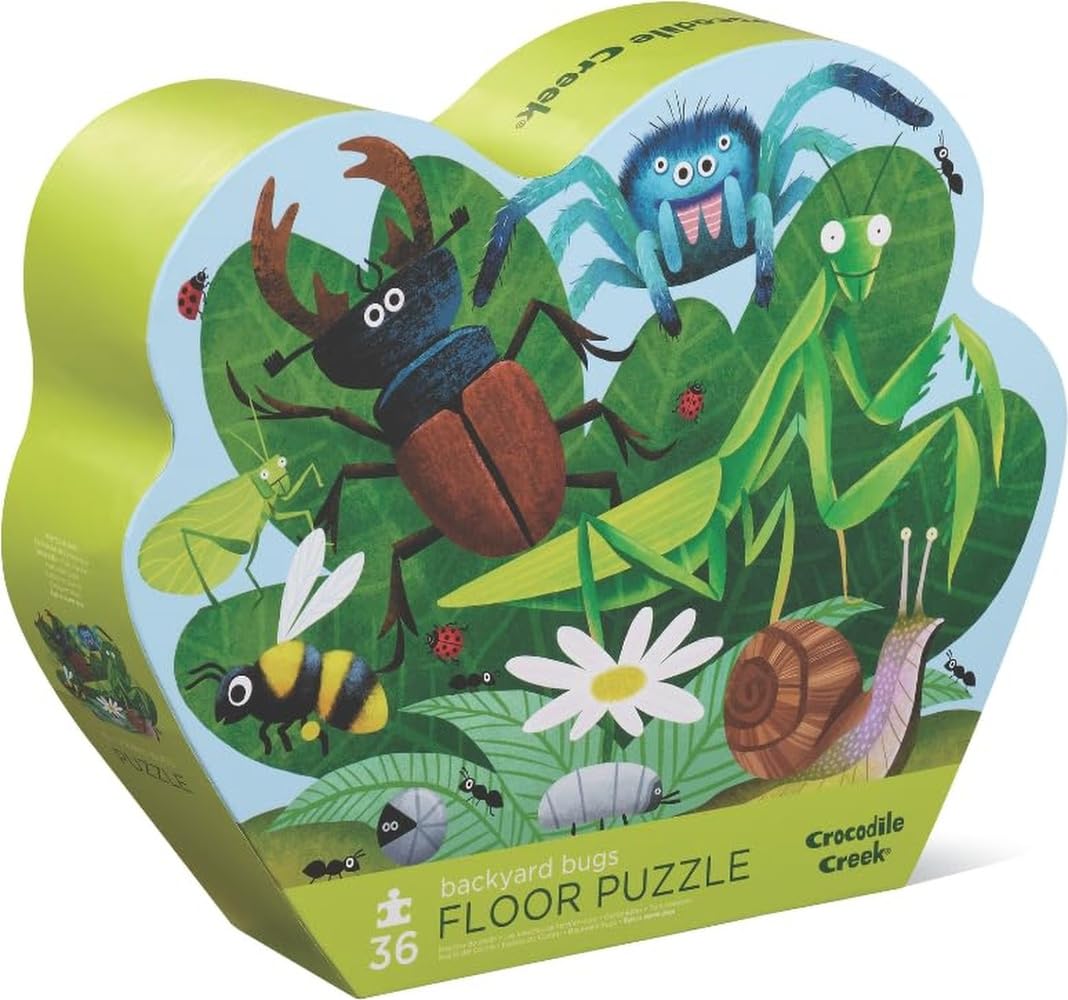
Crocodile Creek Backyard Bugs Floor Puzzle

Crocodile Creek Backyard Bugs Floor Puzzle

Small rooms

Doodle Score 9.6/10
Check Price

Worth Noting

  • Smaller pieces than the other 3-and-up puzzles
Pieces
36
Age Range
3 years and up
Materials
FSC-certified board, soy-based inks
Finished Size
24 x 18 inches
Read the full review

This is the one where the money goes to the artist. The finished puzzle is the smallest in this group at 24 by 18 inches, the piece count sits mid-pack at 36, and it costs more than the 48-piece solar system — so the case has to be made on something other than volume.

The something is the picture. Crocodile Creek commissions artists rather than reaching for stock illustration, and it shows: Backyard Bugs is a dense, hand-drawn scene of beetles, butterflies, and snails packed tightly enough that there's always another creature to find. The board uses soy-based inks and FSC-certified materials with no interior plastic, which is the sort of thing you appreciate when you're the one opening the box at a birthday party.

We reach for it when floor space is tight and the child is past 24 pieces but not ready for 48 — the compact finished size makes it a bedroom-rug puzzle rather than a living-room one. The trade is piece size: 36 pieces inside 24 by 18 inches means each piece is smaller than the chunky ones on the Melissa & Doug puzzles, so it suits a careful four-year-old better than a grabby three.

Bottom line: We keep coming back to this one for small rooms and design-minded parents: 36 pieces, a compact 24 x 18 inch finish, and the best artwork in the set.

#6

TALGIC Jumbo Solar System Floor Puzzle

TALGIC Jumbo Solar System Floor Puzzle

Space fans, 7+

Doodle Score 9.6/10
Check Price

Worth Noting

  • No corners or straight border to start from
Pieces
70
Outline
Round
Material
Extra-thick cardboard
Age Range
3 years and up
Read the full review

A circle is a different puzzle. With 70 pieces arranged in rings, there are no corners to anchor and no long border to build first — you work outward from the middle or inward from the rim, and the last few pieces have to close the ring properly or the center sits wrong. That single change makes it feel unlike anything else in this roundup.

The theme is the draw: a full solar system with planets big enough to point at and name, and enough detail to keep a space-mad seven-year-old talking while they build. The cardboard is thick with clean-cut edges, and the pieces have held their shape well enough that we've rebuilt it more than once without a corner fraying or a layer splitting.

The one thing to settle before you order is the footprint. The finished diameter isn't stated, and a round 70-piece build lands somewhere between a table puzzle and the 2 x 3 foot mats here. If you're planning a specific spot on the floor, confirm that measurement rather than assuming it will match the Melissa & Doug footprint.

As a step up it earns its place: a child who has finished the 48-piece puzzles here and wants more will find 70 pieces genuinely harder without being a different kind of toy. It costs more than the Melissa & Doug builds, and the round format is the reason to pay the difference.

Bottom line: A good step up for a space-obsessed seven-year-old: 70 pieces and a round format that behaves nothing like the rectangles here.

#7

Dr Livingston Jr Human Anatomy Floor Puzzle

Dr Livingston Jr Human Anatomy Floor Puzzle

Science-minded kids

Doodle Score 9.6/10
Check Price

Worth Noting

  • Rated 6 and up, not a preschool puzzle
Pieces
100
Age Range
6 years and up
Guarantee
Missing-piece replacement
Assembled Length
4 feet
Read the full review

Four feet of human body on the living-room floor is a sight. The 100 pieces build a full cross-section from skull to toes, roughly the height of the children assembling it, and that's the detail that sells the whole thing: it's their own body, laid out and labeled, in a size they can walk around.

The anatomy is real rather than decorative — heart, lungs, liver, intestines, bones, each in its own layer with the parts named. Building it is slow in a good way, because every few pieces someone asks what something is, and you end up explaining what an organ does to a seven-year-old who suddenly cares.

The puzzle's shape follows the body rather than a rectangle, so the pieces jump between systems — a rib beside a shoulder beside a stretch of intestine — and that's what makes 100 pieces take a real afternoon rather than an hour. A six-year-old can do it with help; a nine-year-old can manage most of it alone.

What makes it worth the premium is what happens afterward: the finished body is worth leaving out for a while, because the questions keep coming once the last piece is in. Genius Games also replaces a missing or damaged piece at no cost, which matters a lot more on a 100-piece puzzle than on a 24-piece one.

Bottom line: A hundred pieces and four feet of labeled anatomy make this the science-minded six-to-ten pick, and it works best with an adult on the floor nearby.

#8

Spin Master Spidey Foam Floor Puzzle

Spin Master Spidey Foam Floor Puzzle

Rough handling

Doodle Score 9.4/10
Check Price

Worth Noting

  • Small finished size for a floor puzzle
Pieces
25
Material
Foam
Age Range
4 years and up
Finished Size
13 x 24 inches
Read the full review

Foam is a different proposition from cardboard. These 25 pieces are thick, squishy to the touch, and they bend where a cardboard piece would crease, so a toddler who sits down mid-build or drags the finished puzzle across the rug by one end doesn't end the puzzle. The picture runs 13 by 24 inches, which makes it a coffee-table build more than a floor-spanning one.

What we appreciate is the length: 25 pieces takes a few minutes, which is exactly right for a first success and short enough that it gets built twice before attention runs out. It's a starter, a travel-along, and the thing a younger sibling can do while an older one works the anatomy puzzle. The box says 4 and up, and the chunky foam doesn't change that.

Bottom line: Our pick for a kid who is hard on things — foam pieces that bend instead of crease, and a 25-piece build that takes minutes.

How We Tested the Best Floor Puzzles for Kids

To build the shortlist, I started with floor puzzles that kept surfacing in parent recommendations and retail best-seller lists, then narrowed by completed size, piece count, recommended age, material thickness, and price. I ruled out anything with vague age ranges, pieces smaller than a toddler’s palm, or artwork that would be impossible to distinguish once the border was done. That left 12 puzzles, which we tested over four months.

The testing happened where the puzzles actually live: on living room rugs, playroom floors, and a grandparents’ coffee table during a long weekend. I assembled each one first to check piece fit, edge alignment, and whether the image was clear enough to work from. Then kids ages 3 to 7 took over—some with a parent nearby, some alone—while we watched for the moments that separate a good puzzle from a frustrating one: whether a 4-year-old could grip and place a piece without crushing it, whether the border went together in a logical order, and whether anyone asked to do it again.

For quality, we rebuilt each puzzle at least three times, wiped pieces with a damp cloth, and checked corners for peeling or bending after normal floor use. Difficulty got judged by first-assembly time and how much help was needed; age-appropriateness was whether the recommended age matched the actual challenge, not just the piece count. To gauge educational value, we noted what kids talked about while building—colors, animals, counting, where a river or road belonged—and for enjoyment, we tracked which puzzles came back out without an adult suggesting them. The picks below are the ones that stayed in rotation.

How to Choose Floor Puzzles for Kids

Piece count is a ladder, not a score

Twenty-four pieces is a different toy from a hundred. The number matters less than the step it represents: a child who has never finished a jigsaw does best with 24 to 36 pieces and a picture they can hold in their head, 48 to 70 is the next rung, and 100 pieces of anatomy is a project you plan an afternoon around. Climbing one rung at a time is what keeps a puzzle a pleasure instead of a defeat.

That ladder runs right through this group — the 24-piece Ravensburger at the bottom, the 48-piece solar system in the middle, and the 70- and 100-piece puzzles at the top. Buying two rungs up because the picture is nicer is the most common way a floor puzzle ends up back in the box.

Finished size, not box size, tells you where it fits

A 2 x 3 foot build is a living-room puzzle that two children can work on at once, and it needs that much clear floor. A 24 x 18 inch rectangle fits a bedroom rug, and the 13 x 24 inch foam puzzle is really a coffee-table build that gets moved. Measure the spot first and pick the size to match, because a puzzle with nowhere to sit stays in its box.

The trap is the phrase "large pieces." It describes each piece, not the finished puzzle, and a big box can hold a fairly modest build. Read the assembled dimensions.

Rectangles, shapes, and circles

A rectangle hands a child a starting point: find the corners, build the border, fill the middle. Shaped puzzles don't offer that. The barn and the mermaid here have no straight edge to work from, so a younger builder often needs an adult to lay the outline before the middle clicks. What you get in exchange is a puzzle that holds attention longer and gives you something to talk about.

Start rectangular for a child still learning to scan for matching colors. Move to shaped or round once borders have become the boring part — the round 70-piece solar system is the most different build in this set for exactly that reason.

Cardboard, foam, and the life of the pieces

Thick cardboard with a wipe-clean surface is the standard, and it's the right choice for a puzzle that lives on a shelf for years; most picks here use exactly that construction. Foam is the exception worth making for a child who sits on things — it bends instead of creasing and shrugs off the kind of handling that dents a board, though it doesn't hold the crisp interlock of a die-cut cardboard piece.

Choose foam for a first puzzle, a travel puzzle, or a child who is rough with toys. Choose cardboard when fit, flatness, and a picture worth looking at matter more than surviving the afternoon.

What happens after the last piece

Some puzzles end when the last piece goes in; others start there. The solar system prints planet names on the pieces, so the finished puzzle becomes a naming quiz. The anatomy puzzle labels organs and answers questions while you build. The barn's animals invite a story. That extra layer is usually worth more than four extra pieces.

The trade-off is pace: labeled, detailed artwork gives a child more to look at and can slow the build down. That's a gift for a patient kid and a frustration for one who just wants to be finished.

Frequently Asked Questions

Final Verdict

The Melissa & Doug solar system puzzle is the one we point most families to first. Forty-eight pieces is enough to count as a real project, 2 x 3 feet fills a living-room floor without taking it over, and it costs less than nearly everything else here — which makes the step up from a first puzzle an easy one to take.

If your child is three and has never finished a jigsaw, start at the 24-piece Ravensburger and come back to this one in six months. If the goal is a build that eats an afternoon and starts a dozen questions, go straight to the four-foot anatomy puzzle. The rest of the list is mostly a question of which picture your kid will still want to look at on the tenth build.