Games & Puzzles

Best Spy Gadgets for Kids of 2026

A spy kit can be the best gift all year, or the worst — flimsy binoculars that crack before the first backyard stakeout, a night vision scope that needs a flashlight, or a listening device that picks up static. The difference is rarely the gimmick. It's whether the optics line up, the buttons survive a pocket, and the thing feels convincing to a seven-year-old. Good spy gadgets turn the couch and garden into a mission zone without frustrating the kid holding them.

Over four months, my team and I tested 12 spy gadgets — periscopes, night-vision goggles, motion alarms, walkie-talkies — with kid testers and a few adults who took it seriously. We looked at whether each one is fun enough to keep a kid off a screen, how it holds up after a driveway drop, whether the night vision is real or a red LED, and whether it's worth the money. One thing first-time buyers should know: most kids' night-vision gear works only a few feet in near-darkness. The picks below survived our stakeouts and kept getting played with.

#1

UNGLINGA Spy Kit

UNGLINGA Spy Kit

Costume spy play

Doodle Score 9.2/10
Check Price

Worth Noting

  • Black light and flashlight can fail early
Material
Foam, felt
Included Gear
Spy glasses, hat, jacket, magnifier, fingerprint kit
Item Dimensions
10.23 x 7.49 x 4.73 inches
Recommended Age
3 years and up
Read the full review

A trench coat, hat, and spy glasses do more for spy play than another plastic decoder, because they let a kid become someone before the investigation starts. That is the strength of the UNGLINGA kit: it is a costume and an activity in one box, and it earns our top spot because it gives both a character and a job. The fingerprint station turns the outfit into a scene—dust, brush, lift, examine—and the included booklet gives a parent or kid a sequence to follow instead of a pile of loose parts.

We appreciate that the kit does not stop at dress-up. The magnifying glass, spy glasses, and fingerprint tools all point toward the same detective fantasy, and the jacket and hat are the parts that make a six- or seven-year-old want to put it on in the first place. It is not a one-afternoon novelty if an adult is willing to set up the first fingerprint card; after that, the play tends to run on its own.

Compared with the BLOONSY kit, this one leans harder into costume and a little less into forensic procedure. That makes it the better default for a broad gift, especially when you are not sure whether the child wants to be a detective, a secret agent, or simply the kid in charge of the case.

Bottom line: We recommend the UNGLINGA kit as the best all-round spy set for kids who want to dress the part and then run a fingerprint investigation.

#2

BLOONSY Spy Kit

BLOONSY Spy Kit

Forensic detective play

Doodle Score 9.2/10
Check Price

Worth Noting

Included Gear
Fingerprint lab and detective outfit
Item Dimensions
10.43 x 7.87 x 4.72 inches
Recommended Age
8 to 12 years
Educational Focus
Creative thinking
Read the full review

There is a lot in the BLOONSY box: an invisible pen, crime-scene tape, a rear-view spy glass, a magnifier, fingerprint powder and pad, a brush, tweezers, and a detective hat and badge. The first impression is less toy aisle and more junior evidence lab, and that is exactly the lane it fills.

We rank it as the best forensic kit here because the tools support a sequence a kid can repeat: dust a print, lift it with tape, examine it, and add it to a case file. The hat and badge are the hook, but the fingerprint work is the reason the kit holds attention after the costume novelty wears off. It suits an eight- to twelve-year-old who likes procedure and a bit of mess; younger kids will need an adult to run the powder station.

The trade-off is supervision. Fingerprint powder travels, ink can mark a table, and the small tools need a tray and a wipe-down plan. Set up a tray before the first case; the kit is far more pleasant when the mess has a boundary. Compared with the UNGLINGA kit, this one gives up some dress-up glamour and gains a more satisfying investigation.

Bottom line: We recommend the BLOONSY kit for older kids who want a proper fingerprint-and-evidence detective set rather than another costume.

#3

Little Experimenter Night Vision Binoculars

Little Experimenter Night Vision Binoculars

Younger spies

Doodle Score 9.2/10
Check Price

Worth Noting

  • Not water resistant
Weight
8.82 oz
Batteries
3 LR44H required
Magnification
2x
Objective Lens
36 millimeters
Read the full review

The night-vision mode on these binoculars is a green LED wash, not the image-intensified view a military pair would give you. For a three- to six-year-old, that distinction hardly matters: the green glow makes the backyard feel like a stakeout, and the focus-free 2x view keeps the binoculars usable without a focusing lesson. That combination is why we rate them as the best first pair here for younger spies.

At 0.25 kg, they are light enough for small hands, and the rubber eye cups are shaped to sit against a child's face rather than float around. The built-in flashlight adds a second kind of play after dusk, and the fixed focus means a kid can sweep the yard without stopping to fiddle with a wheel. The 36mm objective lens and 2x magnification are modest, which is appropriate: this is a toy for spotting the dog and the neighbor's fence, not for reading a license plate across the street.

Plan for 3 LR44H batteries, and check that the power button shuts off cleanly before you hand them over; a pair that stays on will drain quickly. The green light can also be bright enough to dazzle at close range, so a quick reminder about not shining it in faces is worth giving.

Bottom line: We recommend these binoculars for younger spies who want a sturdy, easy-to-hold first pair, as long as parents know the night vision is a green-light effect.

#4

EODVICS Invisible Ink Pens

EODVICS Invisible Ink Pens

Party favors

Doodle Score 9.2/10
Check Price

Worth Noting

  • All pens write the same invisible color
Ink Type
Water-based, non-toxic
Pack Size
7 pens
Recommended Age
3 years and up
Safety Standard
ASTM toy safety
Read the full review

A seven-pack is a party-favor strategy, not a single toy. Each pen has its own UV light and batteries, and all seven write in the same invisible ink; the barrels are colorful, but the secret marks are not color-coded. That is fine for the way these get used—one per guest, a quick demonstration, then a hunt for hidden messages around the room.

We rate the EODVICS set as the best party-favor pen here because the slide switch is easier for small hands to work than a tiny press button, and the water-based ink is listed as non-toxic and compliant with ASTM toy safety standards. The pack is also ready to hand out: batteries are included, so you are not opening a drawer for coin cells the night before a birthday.

Test each pen on paper before the party, and keep a couple back as spares; that is the practical way to avoid handing out a dud. The set is at its best when it is treated as a sharing pack, not as one child's long-term pen collection.

Bottom line: We recommend the EODVICS set when you need a whole party's worth of spy pens, with a slide switch that's easier for young kids than a tiny button.

#5

National Geographic Spy Science Kit

National Geographic Spy Science Kit

Guided missions

Doodle Score 8.8/10
Check Price

Worth Noting

  • Periscope can be blurry or hard to focus
Missions
10
Batteries
3 LR41 included
Included Gear
Periscope, spy glasses, decoder wheels, invisible pen
Recommended Age
8 years and up
Read the full review

The ten-mission booklet is the engine of this kit. Without it, the periscope, decoder wheels, spy glasses, and invisible-ink pen are a bag of parts; with it, a kid has a sequence of clues to work through and a reason to keep the notebook open. That structure is what separates a spy science kit from a box of gadgets.

The set is aimed at eight-year-olds and up, and that fits. The missions ask for reading, note-taking, and a little patience with codes, so this is the pick for a child who likes a guided challenge rather than pure dress-up. The history-of-spycraft pages are a nice bonus: they give the play a bit of context and make the decoder wheel feel like a tool rather than a trinket. The decoder wheels and invisible ink are the parts we expect to get the most repeat use.

We rate it as the best structured-mission kit here for a child who will actually follow the booklet. The decoder wheels, spy glasses, and invisible ink give the missions enough variety, and the history pages add a little depth without turning the play into homework. Compared with the UNGLINGA kit, it is less about becoming a character and more about solving a case step by step.

Bottom line: We recommend the National Geographic kit for kids who like a guided mission, not just a costume, and who are ready to read instructions and work through clues.

#6

Bedwina Spy Sunglasses

Bedwina Spy Sunglasses

Disguise play

Doodle Score 8.8/10
Check Price

Worth Noting

  • Narrow mirror strip can be distracting
  • Frames not as sturdy as regular sunglasses
Lens
UV filter
Pack Size
3 pairs
Item Shape
Rectangular
Frame Material
Flexible plastic
Read the full review

The trick with the Bedwina glasses is simple: mirrored strips on the outer edges let a kid see behind without turning around. That is the whole fantasy, and it works well enough to make the glasses feel like a real piece of spy gear rather than a plain pair of party sunglasses.

The three-pack is the practical part. Each pair has UV-filter lenses and flexible frames, so they can be worn outdoors as actual sunglasses, and there are enough pairs for siblings or a small crew. For a kid who has seen spy movies, the rear-view effect is the hook; for a parent, the UV lenses make them useful beyond the costume.

We rate them as the best disguise gadget here because they are easy to hand out and immediately understandable—no instructions, no batteries, no setup. They are a stocking-stuffer sort of gift: inexpensive, instant, and more likely to be worn for a bike ride than a plastic badge. For a party, three pairs also solve the problem of one child getting the cool item and everyone else asking where theirs is.

Bottom line: We recommend the Bedwina glasses for a quick disguise fix, especially as a stocking stuffer or party prize, not as a serious pair of sunglasses.

#7

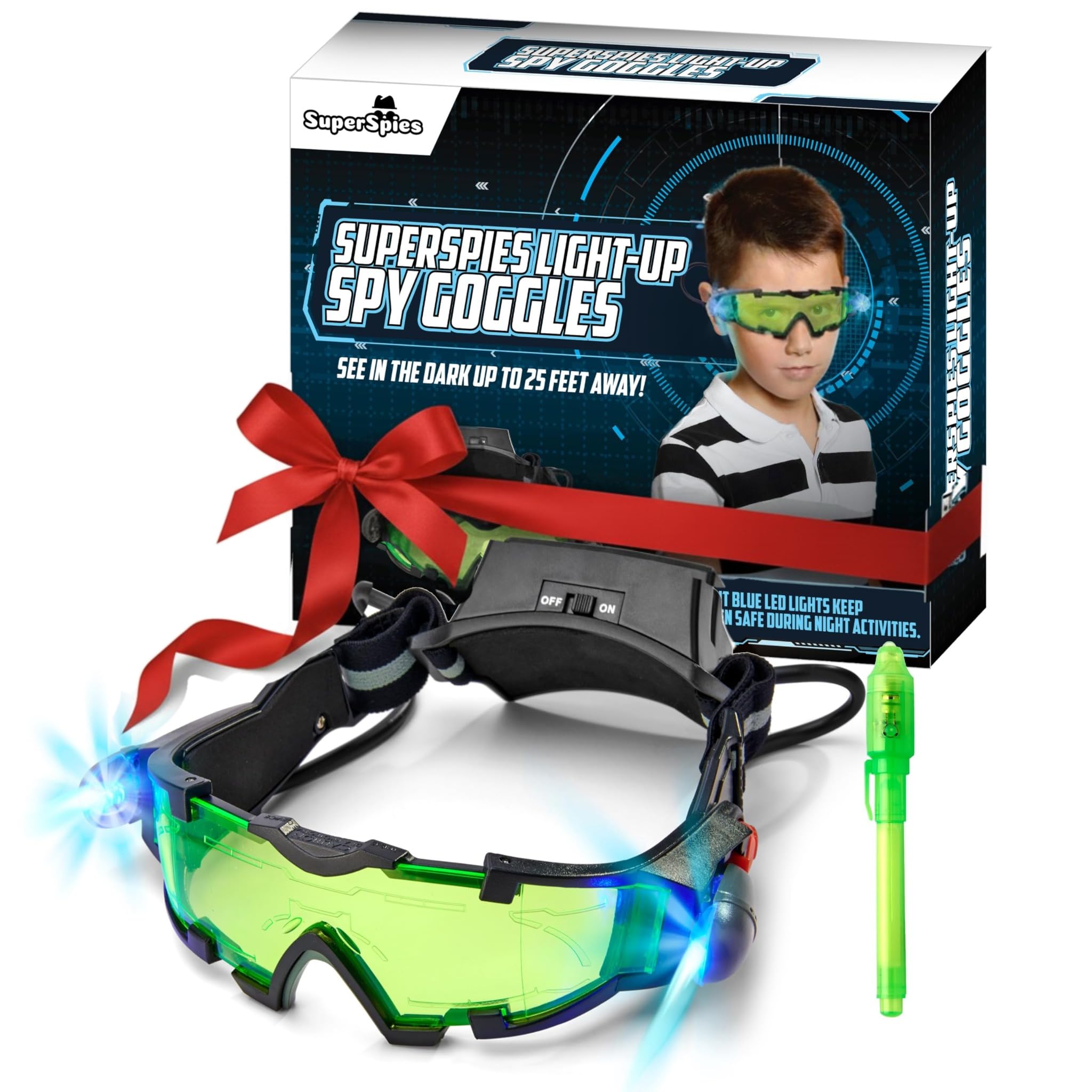
SLF Night Vision Goggles

SLF Night Vision Goggles

Night-vision dress-up

Doodle Score 8.6/10
Check Price

Worth Noting

  • Lights can stop working
  • Batteries not included
Lens
Green-tinted PC
Strap
Adjustable elastic
Included
Bonus invisible-ink pen
Power Source
Battery powered
Read the full review

A night-vision toy has to stay on a kid's head, and the SLF goggles' battery pack is the first thing we noticed. The box sits at the back of the strap, and the weight pulls the lenses forward when a child looks down; a snug strap helps, but the fit is not as carefree as a pair of binoculars.

The look is the selling point. Pop-out blue LEDs, green-tinted lenses, and an adjustable elastic band make the goggles feel like a prop from a spy movie, and the bonus invisible-ink pen gives a kid a second secret-agent tool right out of the package. This is dress-up gear with a light show, not a real night-vision device; the LEDs help you see close objects in a dark room, but they do not brighten the whole yard.

Plan to supply batteries, and keep the first mission short while you check the fit. The blue glow also creates glare for anyone standing nearby, so these are best for short missions in a dim room or a controlled backyard game rather than a whole evening outdoors.

The SLF goggles earn their place as a dress-up prop for short spy missions, not as a real night-vision tool or comfortable all-evening wear. If the child wants to scan the dark, the Little Experimenter binoculars are easier to hold and more reliable as a first pair; if the goal is the look of night-vision goggles, this is the pair that delivers it.

Bottom line: We recommend the SLF goggles as a dress-up prop for short spy missions, not as a real night-vision tool or a comfortable all-evening wear.

How We Tested These Spy Gadgets

We started by pulling together a shortlist of 30 spy gadgets, then cut it to 12 after filtering for age recommendations, battery type, and replacement parts. Over four months, a group of kid testers (ages six to 10) and two adults ran each gadget through a backyard stakeout, a living-room headquarters setup, a sleepover, and after-school sibling reconnaissance. We watched for enjoyment first — did they reach for it again without prompting? — but also noted how visible the device was to the 'target' when tucked behind a bush, whether a periscope's mirror gave a clear view or a warped one, and if a tripod stayed upright when a kid bumped the table.

Night vision got its own test: we took each scope into a closet, a dim hallway, and a moonlit backyard, then checked how far we could see and whether the image was sharp or just a red glow. Realism mattered too — a gadget that looked convincing in the box but felt like a cereal prize in hand lost points. For quality and durability, we dropped each one from waist height onto grass and pavement, stuffed it into a backpack, and checked for cracks, loose battery doors, and stuck buttons. Suitability for children was non-negotiable: we checked small parts, sharp edges, volume limits, and whether the controls made sense without an adult reading the manual.

At the end, we compared what each gadget actually did against what it cost relative to similar toys, and asked the kid testers which ones they'd spend their own allowance on. The highest scorers still got pulled out after the novelty wore off, with mirrors that lined up, night vision that worked within its limits, and stands that didn't tip over mid-mission. We'll keep using them on weekend stakeouts and update if anything changes.

How to Choose Spy Gadgets for Kids

Match the Gadget to the Fantasy

Some kids want to become a character, some want to run a lab, and some want to pace the backyard with binoculars. A costume-led kit such as the UNGLINGA set gives the first child a hat, jacket, and a reason to stay in role. A forensic kit such as BLOONSY suits the child who likes powder, tape, and evidence bags. The National Geographic kit is for the child who wants a booklet and a sequence of missions, while the Little Experimenter binoculars are for the kid who would rather watch the world than dress up for it.

Choose a Kit or a Single Gadget

A kit gives a bigger first reveal, but it also puts more pieces in the box and more chances for one accessory to be the weak link. If you know the child's fascination is secret messages, a pen set such as EODVICS is a cleaner buy than a full detective kit. If the hook is disguise, the Bedwina glasses do one job without asking for storage space or setup. Kits are best when the child wants a whole afternoon of directed play; single gadgets are better for a small gift, a party favor, or a child who already has the costume.

Check the Working Parts Before the Big Reveal

Battery-powered accessories are where spy kits most often disappoint, so check what is included and what you need to supply. The National Geographic kit lists its LR41 batteries as included; the Little Experimenter binoculars need LR44H cells. Test lights, switches, and sound before wrapping anything, and keep a small screwdriver handy if a compartment is secured. A gadget that works on day one is a toy; one that dies before the first mission is a chore.

Plan for Consumables and Cleanup

Invisible ink and fingerprint powder are part of the fun, but they are not set-and-forget supplies. A fingerprint kit needs a tray, a small amount of powder, and a wipe-down plan, especially if the child is working at the kitchen table. Invisible-ink pens are better tested on scrap paper before they go into a goodie bag or a hiding game. Factor in whether you are buying a reusable tool or a consumable that will run out, because that changes what the gift costs in time and refills.

Buy for the Group, Not Just the Child

If the gadget is headed to a party or classroom, the multi-packs earn their place. Seven pens or three pairs of sunglasses let every guest take part without turning one child into the keeper of the cool item. Group-friendly gadgets also tend to be the simplest: no instructions, no batteries, and no adult needed to referee a turn. For a single child, one well-chosen kit is usually better than a bulk pack that leaves most of the pieces in a drawer.

Frequently Asked Questions

Final Verdict

Start with the UNGLINGA kit if you want the safest all-round gift: it gives a kid a costume, a fingerprint activity, and a booklet that turns the pieces into a case. For an older child who wants more procedure, the BLOONSY kit is the better forensic set; for a younger child who would rather be outside, the Little Experimenter binoculars are the easier first gadget.

The common thread is fit. Buy the spy role the child already wants to play, not the biggest box in the aisle.