Games & Puzzles

Best Board Games for Toddlers of 2026

The box says ages 2 and up, but the real test arrives about four minutes into the first round — when a piece goes in a mouth or the rules turn out to assume a kid can read. Toddler board games live or die in the gap between what the packaging promises and what a two-year-old can actually do. The right one turns a rainy afternoon into twenty minutes of real turn-taking; the wrong one has you playing both sides while your kid stacks the box.

I'm picky about this shelf, and my team and I spent the past four months playing 16 of these with kids from 18 months to 4 years. One thing to know before you shop: the age on the box is a safety minimum, not a promise of fun — a 3+ game can still be a year away, and a 2+ game may bore a four-year-old by round two. What separates the keepers is whether a toddler can mostly set it up, whether it survives being sat on, and whether anyone asks for it again. The picks below passed all three.

#1

First Orchard

First Orchard

First cooperative game

Doodle Score 9.8/10
Check Price

Worth Noting

  • Too simple once the routine is mastered
Players
2 to 4
Material
PEFC-certified wood
Game Style
Cooperative fruit picking
Recommended Age
24 months - 3 years
Read the full review

The first thing to notice about First Orchard is what it does not have: a single winner. Players work together toward a shared goal, rolling a die and gathering wooden fruit. The wooden fruit is sized for small hands, and the path gives a two-year-old a clear place to move pieces. It is a real game with turns, a die, and a shared goal, not a toy dressed up as one.

That cooperative structure is why it earns our top pick for toddlers. A two-year-old can roll, match a color, and pick fruit without needing to manage a hand of cards or follow a long rulebook, and the shared win removes the sting of losing. We also like that the pieces are PEFC-certified wood; they feel more like play food than game tokens, which invites a toddler to handle them.

The trade-off is simplicity. Once a child has mastered the routine, the decisions are thin, and the game is more about repetition than strategy. For the two- and three-year-olds it is built for, that is not a flaw; it is the reason the game gets played. The wooden fruit is also likely to end up in pretend play, which is a nice second job for a first game.

Bottom line: For a two-year-old, First Orchard is the gentlest real game here: cooperative play, chunky wooden fruit, and simple rules make it easy to start.
#2

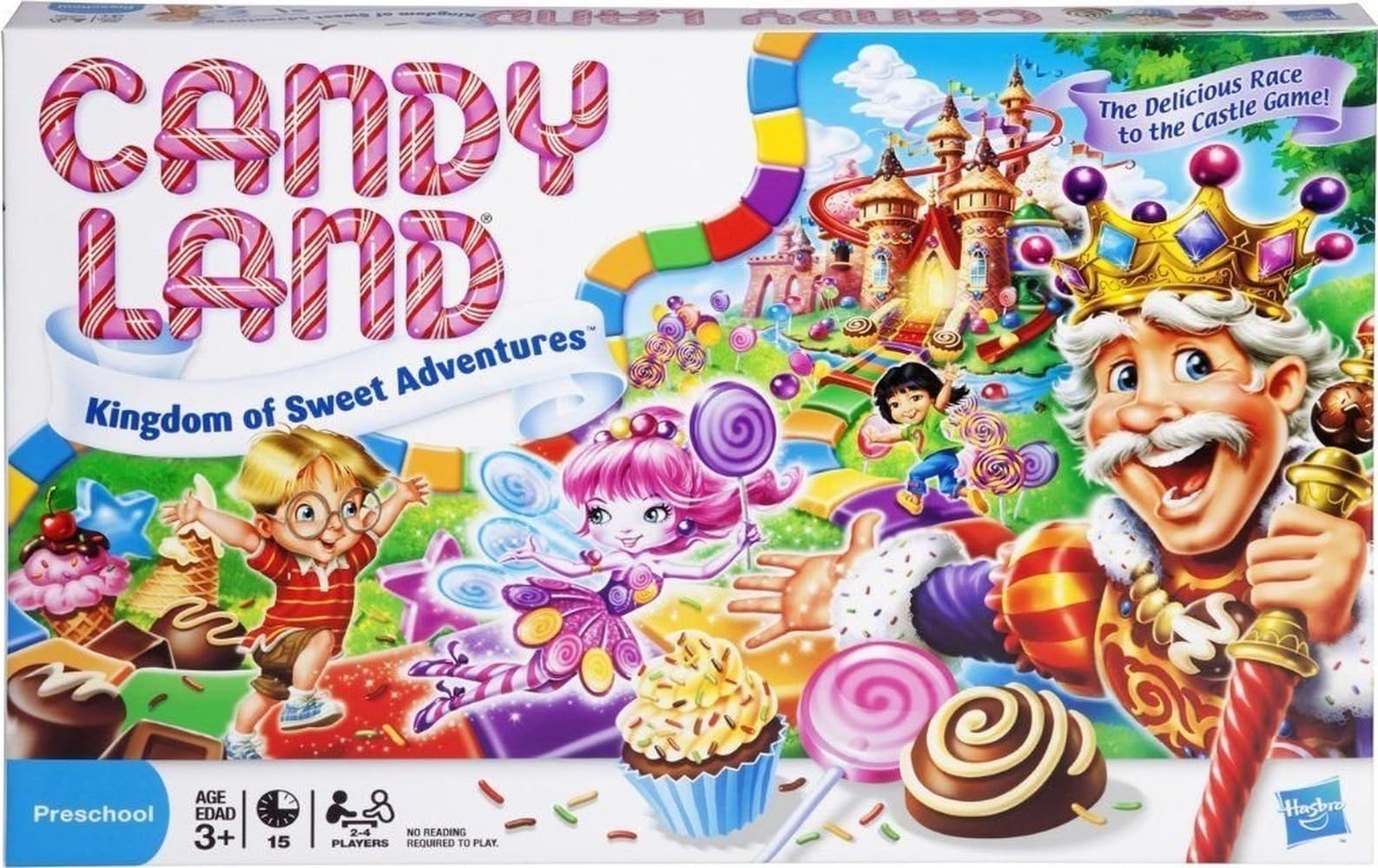
Candy Land

Candy Land

Classic color race

Doodle Score 9.6/10
Check Price

Worth Noting

  • Not a first game for a two-year-old
Players
2 to 4
Play Time
15 minutes
Game Style
Color-card race
Recommended Age
3 to 6 years
Read the full review

Candy Land hands a pre-reader the whole turn: draw a card, match the color, move the gingerbread pawn. There is no reading and no hidden rule to remember, which is why a three-year-old can play it with a four-year-old and a grown-up without a helper hovering over every move.

The board is bright and the path is easy to scan, and the gingerbread pawns give a child something concrete to move. The cards are stiff enough that an adult will do the shuffling, but a child can still handle the draw. What we appreciate is that the game does not ask a child to count spaces or strategize; the color match is the whole decision.

The luck is the point: a child who draws the right card can leap ahead, and the child who does not gets a low-stakes lesson in handling a bad break. For a three-year-old, that is enough. For a four-year-old who wants to make a decision, the game will feel thin.

Bottom line: For a three-year-old ready for a first race, Candy Land is the easiest yes: no reading, fast turns, and a color deck a child can follow alone.

#3

Sneaky, Snacky Squirrel

Sneaky, Snacky Squirrel

Fine motor practice

Doodle Score 9.6/10
Check Price

Worth Noting

  • Not for children under three
Acorns
20 in five colors
Players
2 to 4
Fine Motor Tool
Squirrel squeezer
Recommended Age
3 to 7 years
Read the full review

The squirrel-shaped squeezer is not a gimmick; it is the game. Players spin, then use the tool to pick up matching acorns and fill their logs, which turns a simple color match into a pincer-grip workout. We rank it as the best fine-motor choice here because the challenge is built into the doing, not added as a worksheet.

The acorns have a slightly rubbery grip, which makes the squeezer feel possible rather than fiddly, and the turns are short enough for a three-year-old's attention span. The tree-shaped box doubles as the board, so setup is mostly opening the lid. The squeezer does take hand strength; a child who is still learning tongs may need hand-over-hand help at first. That is a temporary hurdle, not a reason to skip the game.

What we appreciate most is that the game gives a child a reason to repeat the same small motion without it feeling like practice. The windstorm and snatch cards add just enough surprise to keep a preschooler engaged, and the four logs mean siblings can play together. It is a more active kind of first game than a race around a board, and that is exactly why it earns a place.

Bottom line: For a three-year-old who needs to do something with their hands, Sneaky, Snacky Squirrel is our pick: the squeezer builds a real pincer grip while the color match keeps turns quick.

#4

Monkey Around

Monkey Around

Active toddlers

Doodle Score 9.6/10
Check Price

Worth Noting

  • Two-person activity, not a group game
  • Needs open floor space
Players
2
Game Style
Parent-child movement
Activity Cards
40
Recommended Age
2 years and up
Read the full review

Monkey Around is the one in this group that does not ask a toddler to sit still. The deck of 40 cards prompts balancing, hopping, marching, and other small physical challenges, and the game is built around one adult and one child doing them together. There is no board to circle and no pile of tokens to keep straight.

We put it at the top of the active category because it uses the energy a two-year-old already has instead of fighting it. The adult reads the card and models the move, which keeps the rules invisible; the child's job is simply to try. That makes it a better fit for a wiggly toddler than a race game, even though it is less of a tabletop board game.

The cards move quickly enough that a toddler can do one action, reset, and ask for another. That is the real test of a first game, and Monkey Around passes it.

Bottom line: For a two-year-old who will not sit still, Monkey Around is the best active first game here: one adult, one child, and a deck of movements instead of a board.

#5

Don't Break the Ice

Don't Break the Ice

Dexterity challenge

Doodle Score 9.6/10
Check Price

Worth Noting

  • ⚠️ Small parts need supervision around younger siblings
Players
2 to 4
Game Style
Dexterity block tapping
Ice Blocks
32 small
Recommended Age
3 years and up
Read the full review

Don't Break the Ice turns the tabletop into a demolition site. Players take turns tapping out small ice blocks with one of the two mallets, trying to keep Phillip the Penguin on top of the tray. There are no cards to manage; the whole game is aim, tap, and wait for the wobble.

The physicality is the draw. A child has to judge which block is loose, control the mallet, and accept that a careful tap can still bring the whole thing down. That is a useful lesson in cause and effect, and it is more engaging for a hands-on three-year-old than another color-matching race. The two mallets also make it easy for a parent and child to play head-to-head.

We rank it as an also-consider because it asks more of the grown-up than the other games here. The snap-together tray takes patience to assemble, and the legs can pop off during play. Neither ruins a round, but they make this a game you set up and supervise rather than one you hand over and walk away from. For a child who loves the anticipation of a collapse, the trade-off is worth it.

Bottom line: Don't Break the Ice is the suspense pick for a three-year-old who likes to tinker: tap out blocks, keep the penguin up, and laugh when it falls.

How We Tested Toddler Board Games With Real Toddlers

We started with more than 50 games sold as toddler-friendly — classic first roll-and-move titles alongside newer cooperative and matching games — and narrowed the list using specs you can check before anything leaves the box: the manufacturer's age range, whether play requires reading or a screen, how many pieces one round scatters across the floor, whether anything is small enough to be a choking hazard, and price. That left 16, which we played with kids from 18 months to 4 years over four months — at home on slow afternoons, at a playgroup table, and in the back seat on longer drives.

Every game got the same treatment. We timed setup straight out of the box, punching out cardboard and assembling any inserts, then timed it again on the fifth play to see whether it stayed fiddly. Each one had to be teachable in a sentence, so we counted the prompts an adult needed before a toddler took a turn unprompted and clocked how long a round held attention before someone wandered off. We also watched whether the lid picture alone was enough for a three-year-old to set up, and whether everything went back in the box without a fight.

Then came the abuse. Pieces hit hardwood, boards were flexed and sat on, cards were shuffled by hands still learning to shuffle, and everything was wiped down after sticky snacks; four months in, we looked for peeling laminate, split cardboard, and corners that no longer lay flat. We tracked the quieter wins too — a kid counting or matching colors without being asked, waiting a turn by the third round — and noted which boxes the kids reached for on their own. The keepers had to be cute enough to be chosen and tough enough that we weren't fishing pieces out from under the fridge.

How to Choose Board Games for Toddlers

Start with age and attention span

A two-year-old and a three-year-old are not shopping for the same game. For a new two, look for a 2+ label, a turn that takes seconds, and simple rules; First Orchard is the clearest example here. A three-year-old can usually handle a color card, a spinner, or a simple rule that repeats, which is where Candy Land and Sneaky, Snacky Squirrel come in. Do not buy a 3+ game for a two-year-old and expect the age label to bend. The practical test is whether the child can take a turn after one demonstration.

Choose cooperative or competitive

Cooperative games remove the single loser, which can be a mercy at two or three. In First Orchard, everyone works toward the same goal, so a child practices taking turns without practicing disappointment. Competitive games are not the enemy; a simple race teaches a child to wait, win, and lose with a little drama. The choice is really about temperament. A child who melts down at the end of a race does better with a shared goal first. A child who is ready for a race can start with Candy Land, where the cards decide most of the outcome.

Check the pieces and the fine-motor demand

Toddler games split into two physical types: pieces a child picks up with fingers, and pieces a child has to manipulate with a tool. Large wooden fruit is the easier start; it is satisfying to hold and hard to fumble. A squirrel squeezer is a bigger ask, because it requires a pincer grip and enough hand strength to open and close the tool. Neither is better in the abstract, but they suit different children. The trap is assuming a toddler game has toddler-proof pieces. Check the age label and the choking-hazard warning, especially if a younger sibling is in the house.

Plan for setup, cleanup, and storage

The game that gets played is the one you can get out and put away without dread. A snap-together ice tray or a pile of loose acorns adds a job for the adult; a tree-shaped box that doubles as the board removes one. Before you buy, picture the pieces on your floor and in your cupboard. If you will not bag them, choose a game with fewer loose parts. If you have a child who likes to sort, the setup can become part of the play rather than a chore.

Frequently Asked Questions

Final Verdict

Our recommendation for a two-year-old is First Orchard. The cooperative goal, large wooden fruit, and simple rules make it the easiest game here to hand to a very young child without a referee.

If your child is already three and wants a familiar race, Candy Land is the classic next step. For a three-year-old who likes to work with their hands, Sneaky, Snacky Squirrel is the more engaging challenge; if the appeal is pure suspense, Don't Break the Ice delivers it with more setup.