Building & Blocks

Best Stacking Blocks of 2026

A good set of stacking blocks looks like the simplest toy in the room, which is exactly why the bad ones are so disappointing. You buy a tub of bright wooden cubes, and within a week corners are chipped, the smallest piece has vanished under the couch, and the lid no longer snaps shut. I've spent enough afternoons building towers with a toddler to know the right set earns its keep differently: it survives being knocked down, stacked again, and dragged across the rug without turning into splinters. The best sets give little hands a satisfying mix of sizes and colors, with pieces big enough to be safe and light enough to balance, which is what turns a pile of blocks into open-ended play.

We've spent the past four months testing 14 sets with toddlers, from morning tower sessions to the after-dinner cleanup that reveals a lot about a storage lid. The keepers had smooth, sturdy pieces, toddler-friendly sizes, and containers that survived being filled and dropped; some suit first-time builders, others older kids ready for castles.

#1

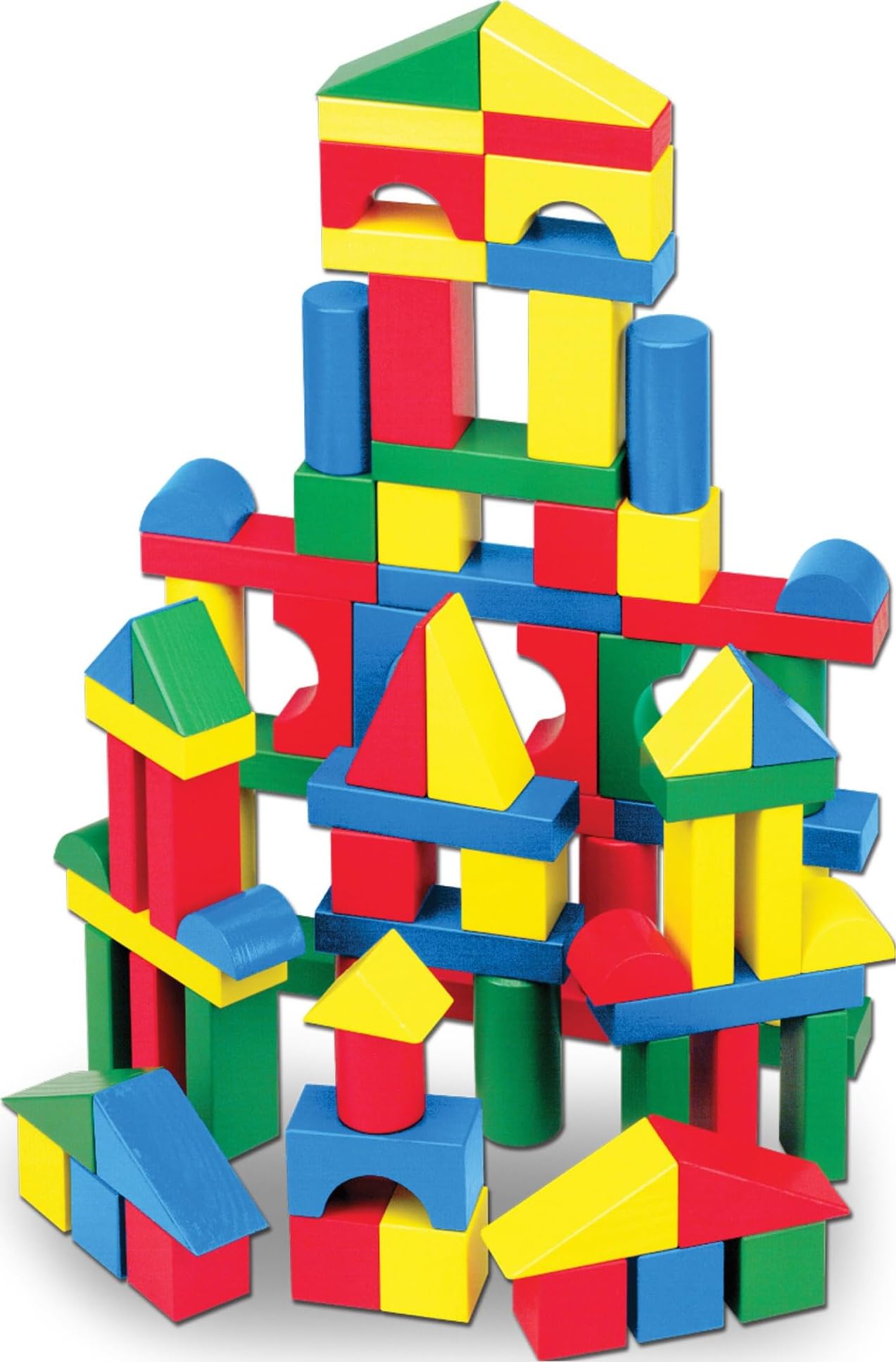
Melissa & Doug 100 Wooden Blocks
Melissa & Doug 100 Wooden Blocks

Open-ended building

Doodle Score 9.6/10
Check Price

Worth Noting

  • Cardboard box is not built for travel
  • Graded 2 and up, so not a first-birthday buy
Pieces
100
Shapes
9 classic shapes
Material
Solid wood
Recommended Age
2+ years
Read the full review

A hundred blocks makes a different toy, and that is the whole case for this set. Nine shapes in four colors means a tower can have a wide base, an arch for a door, and a ramp on the side instead of being a stack of identical cubes that topples at the third level. We built alongside the smaller letter set below, and what the extra pieces buy isn't more wood — it's that two children can build at the same time without arguing over the one arch.

Pick a block up and the difference registers before you stack it: dense, smooth-sanded, edges eased enough that a hard tumble doesn't throw splinters, and a flat, weighted feel in the hand that plastic never quite matches. The classic shapes resist tipping because the faces meet squarely, which is why a four-year-old who has never balanced anything can still get a tower to shoulder height and then keep going.

Storage is the quiet win. All hundred pieces go back in the box they came in, and the box sits flat on a shelf instead of bulging at the seams. The one thing worth knowing is the paint: colored faces can pick up chips once blocks start getting thrown rather than stacked, so a set headed for a child who still mouths everything is better served by one of the big plastic or soft options here.

Bottom line: We recommend it first because a hundred pieces in nine shapes is simply more building than anything else here, and any family past the mouthing stage will get years out of it.
#2

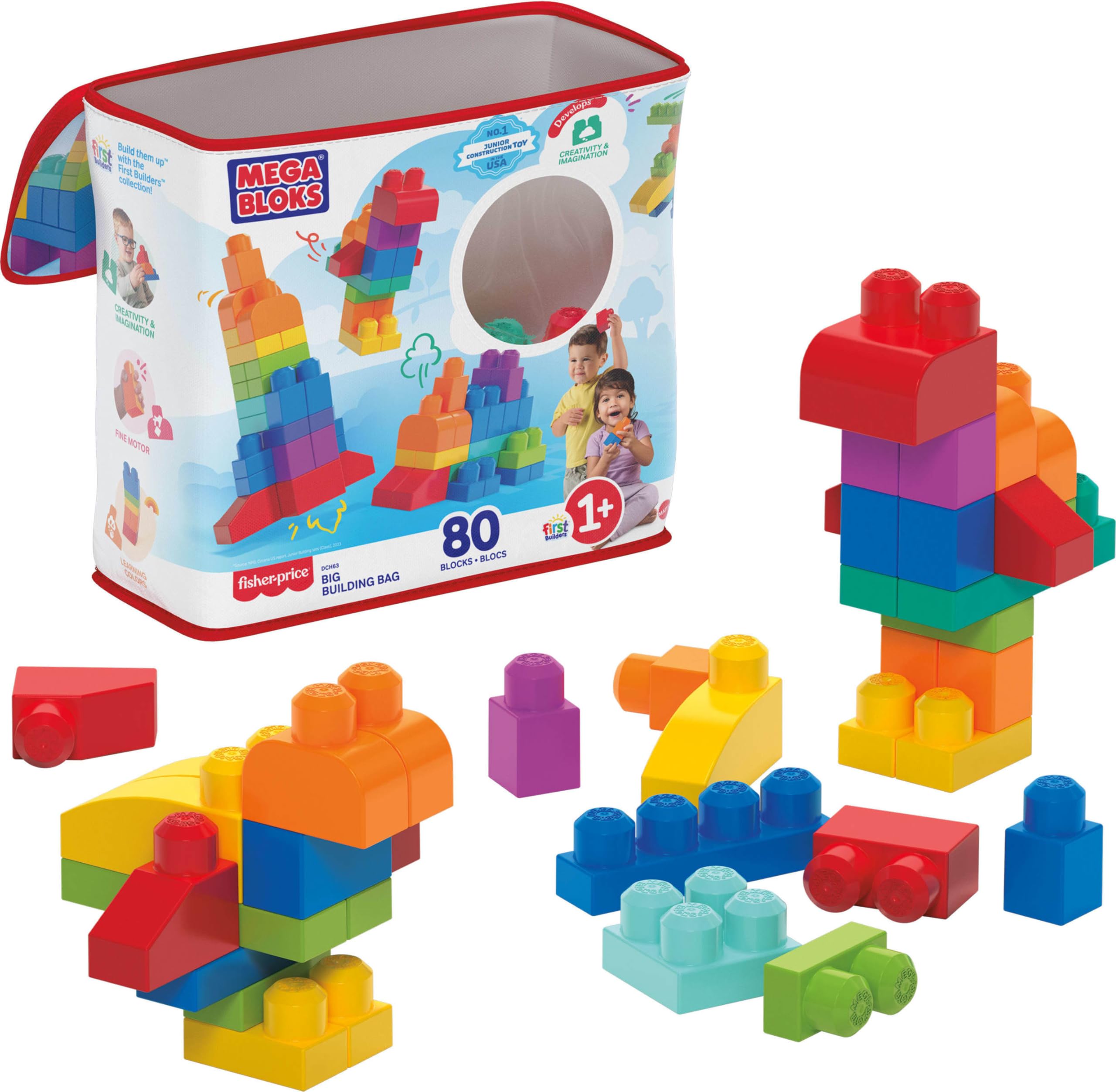
MEGA BLOKS First Builders Bag

MEGA BLOKS First Builders Bag

Ages 1-3

Doodle Score 9.6/10
Check Price

Worth Noting

  • Chunky scale caps how detailed a build gets
Pieces
80
Shapes
10 shapes, 9 colors
Storage
Storage bag
Recommended Age
1 to 5 years
Read the full review

Each block is big enough for a one-year-old to palm, corners rounded, with a top a small hand can find without looking. Eighty pieces in ten shapes and nine colors arrive in a blue bag with handles wide enough to carry at your side, which sounds like a minor detail until you're the one picking up.

We keep coming back to this set for the one-to-three window, and the reason is that the pieces hold together. A toddler presses two blocks into one, carries the pair across the room, and adds a third — the build survives being picked up, which is not true of loose wooden blocks. That changes the play. Instead of knocking a tower down and starting over, they start adding to it.

Past four, the scale starts to work against it. There's a ceiling on what you can build with blocks this chunky, and a five-year-old will want windows and smaller pieces. Up to that point it gets more repeat play than anything else in this roundup, and the bag turns cleanup into a two-minute job rather than a search under the couch.

Bottom line: Our pick for one- and two-year-olds: the big blocks press together, so a toddler can carry a build across the room instead of watching it collapse.

#3

B. toys One Two Squeeze

B. toys One Two Squeeze

Babies under 1

Doodle Score 9.6/10
Check Price

Worth Noting

  • Soft faces make tall towers wobbly
Pieces
10
Storage
Recycled-fabric bag
Material
Soft, squeezable plastic
Recommended Age
6 months+
Read the full review

Squeeze one and it answers with a squeak, then a soft thump when it hits the floor. Ten cubes, each with an animal, a number, a shape, or a color pressed into a textured face, and the softest edges in this roundup — a baby can fall on one and carry on. In the months when blocks are mostly for chewing and dropping, that's worth more than stackability.

They do stack, three or four high before the pile leans, and that's the honest limit. Squishy cubes can't do what wood does and a tall tower isn't what this set is for. Where they earn their keep is texture: a baby runs a thumb over the embossed animals, and a two-year-old comes back to them to name the numbers and colors.

One practical note. A squeaker needs a hole, and the hole takes in water, so wipe these with a damp cloth rather than washing them, and if one gets soaked, squeeze it out and dry it hole-down overnight. The recycled-fabric bag is the other thing we didn't expect to like as much as we do — it's light enough for a toddler to drag around themselves.

Bottom line: We reach for these first for a baby under a year — soft, squeaky, and gentle enough that nobody minds when they're thrown.

#4

Ms. Rachel Learning Blocks

Ms. Rachel Learning Blocks

Letter learning

Doodle Score 9.6/10
Check Price

Worth Noting

  • Graded 18 months and up, so not first blocks
  • Paint can chip with heavy play
Pieces
30 blocks and 14 activity cards
Material
FSC-certified wood
Block Size
1.5 inches
Recommended Age
18 months+
Read the full review

The cards are what separate this from every other pile of letter blocks. Fourteen double-sided cards, each one handing a grown-up a game to play with thirty wooden blocks: find the letter, match the picture, roll a block and name what comes up. On a rainy afternoon when you have run out of ideas, that is the part you're paying for.

The blocks are 1.5 inches, a size a two-year-old can pick up and turn over in their hands, and each face carries a letter, a number, a picture, or a color. The embossing is deep enough to read by touch, which matters more than it sounds when a child is still learning to recognize shapes with their fingers as well as their eyes.

This isn't a first block set. It's the one after that — for a child who is naming letters, sitting still for a game, and ready to be told what to do next. The wood is FSC-certified, the box holds everything, and the cards quietly turn a parent into the playmate a toddler actually wants, which is not something we expected to say about blocks.

Bottom line: The set we hand to a family whose two-year-old is starting to name letters, because the activity cards give a grown-up a game to lead.

#5

Fisher-Price Baby's First Blocks

Fisher-Price Baby's First Blocks

First blocks

Doodle Score 9.6/10
Check Price

Worth Noting

  • Lid rests on the bucket instead of snapping shut
Pieces
10 blocks and a bucket
Shape Sorter
Lid with cut-out holes
Recommended Age
6 months+
Read the full review

The lid is the shape sorter, and that's the idea: a baby drops a block through the matching hole and the bucket answers with a clunk. Ten chunky blocks, bright colors, and a handle small enough for a baby to hold while they carry the whole thing to you.

For a six- to nine-month-old, though, the fun is the dump. Tip the bucket, watch ten blocks hit the floor, do it again. Sorting arrives later — closer to eighteen months, when the shape actually means something — so the first year of this toy is really about carrying, emptying, and filling, with the blocks stacked in a wobbly three-high pile between rounds.

That's not a criticism. As a first block set it's the most sensible purchase here: chunky enough for a baby who still mouths everything, inexpensive enough that a lost block isn't a tragedy, and a bucket that doubles as the storage. Just don't buy it expecting the shape sorter to be the main event before your child's second year.

Bottom line: A sensible first block purchase for a baby around six months, as long as you're buying it for the blocks and the bucket rather than the sorting.

#6

Pidoko Kids 100 Wooden Blocks

Pidoko Kids 100 Wooden Blocks

Natural wood look

Doodle Score 9.6/10
Check Price

Worth Noting

  • The priciest set in this roundup
  • Graded 3 and up, with small shapes in the mix
Pieces
100
Storage
Bucket with shape-sorter lid
Material
Solid beech wood
Recommended Age
3 years and up
Read the full review

This is the most expensive set here, and the first thing to understand is what the money buys: a hundred blocks of solid beech, natural finish with no paint, packed in a bucket with a shape-sorter lid. No theme, no branding on the blocks, just shapes in wood tones.

The finish is the appeal. Every piece we picked up was smooth, with eased edges and nothing that felt like a splinter waiting to happen, and the blocks look like something you leave out in a living room rather than hide in a toy bin. Wood this dense stacks with a satisfying settle; a tower built from these feels more solid than one built from the painted set we recommend.

Two things worth knowing. The pieces run smaller in the hand than the bucket photo suggests — fine for a three-year-old's grip, less so if you pictured big toddler blocks — and the shape-sorter lid on the bucket is a nice extra rather than a feature anyone will use daily, since a hundred loose blocks go back in faster than they go through the holes.

If you want wood that looks like wood and don't mind paying for the finish, this is the one that ends up on the shelf instead of in the bin. If you just want a hundred blocks to build with, the painted set below does the same job for less and shrugs off being thrown across the room.

Bottom line: The choice for a family that wants natural wood on the shelf and will pay for the finish, not for anyone still putting blocks in their mouth.

#7

Infantino Squeeze and Stack

Infantino Squeeze and Stack

Budget soft set

Doodle Score 9.6/10
Check Price

Worth Noting

  • Squeaker needs a hard squeeze
  • Eight blocks limit how much can be built
Pieces
8
Material
Soft BPA-free plastic
Recommended Age
6 months to 2 years
Read the full review

The squeak takes work. Squeeze one of these and the sound arrives late and quiet, which is either a relief or a letdown depending on the baby — a five-month-old who startles easily won't mind, and a one-year-old who has worked out that squeezing makes noise will keep trying anyway.

Eight blocks, soft BPA-free plastic, rounded on every edge, graded from six months to two years. They're rubbery rather than slick, so they stack a little more willingly than the fabric-covered cubes here, and they're light enough that a thrown block is a non-event for whoever's in the way. In the car or the diaper bag, that's the whole point.

Where it lands is as a second set. Eight blocks won't build much, and the squeeze-to-squeak trick stops being interesting, but you're getting something a baby can mouth, throw, and stack without anyone wincing. A set this small tends to end up in the car, which is the highest compliment a toy like this gets.

Bottom line: A good second soft set for the diaper bag — eight blocks, no sharp edges, and a squeak that takes some effort to get.

How We Tested the Best Stacking Blocks

We began by scanning specs, age recommendations, piece counts, and parent reviews, then narrowed the field to 14 sets that represented a range of sizes, finishes, and storage styles. We skipped anything with pieces too small for the toddler age range and focused on sets that claimed to be solid wood, sealed, or otherwise built to survive real play.

Testing happened where blocks actually live: the living-room rug, the kitchen floor, and a hardwood hallway, with toddlers ages 1 to 3 and a few older siblings. We built towers, knocked them down, sorted by color, and packed everything away after each session. We ran a thumb along every edge and corner before the first play session and again after four months, looking for splinters, dents, and paint wear. We measured the smallest block in each set against a choke-test cylinder and watched whether a 2-year-old could grip and stack the pieces without frustration. Towers went up on carpet and hard floor so we could see which shapes held and which slid. We also watched whether the colors and shapes invited open-ended play—pretend roads, color sorting, tall castles—or just one obvious tower.

Storage got equal attention. After each cleanup, we filled the container to the brim, latched or screwed the lid on, and dropped it from counter height onto tile to see whether hinges cracked, latches popped, or the lid stopped fitting. We noted which sets still looked presentable after four months of being dragged, dumped, and refilled.

How to Choose Stacking Blocks

Match the blocks to the mouth first

Before about a year, blocks are for mouthing, banging, and dumping, and a soft set is the honest choice: nothing sharp, nothing heavy, and nothing that hurts when it lands on someone. From roughly twelve months, chunky plastic blocks let a toddler stack and press pieces together, and the sets graded 1+ are built around that grip. Wooden blocks come into their own around two, when balance and precision start to matter.

The usual mistake is buying a hundred-piece wooden set for a first birthday. The pieces are small, the towers fall down before they're finished, and the box sits in a closet until the child is old enough to want it.

Piece count is not the same as building range

A hundred small blocks and sixty big ones are different toys. What turns a stack into a building is shape variety: arches, cylinders, wedges, and long rectangles let a child make doors, ramps, and bridges, while a bin of identical cubes only makes towers. Read the shape list before the piece count.

The other half of the equation is how many children will be building at once. Two children sharing one set need enough pieces that neither has to negotiate for the only arch.

What actually holds a tower up

Flat faces and square edges stack. Rounded, embossed, or slightly domed faces rock, which is why soft blocks top out three or four high and why a heavily textured block frustrates a builder who is nearly tall enough to be proud of the tower. Plastic blocks that press together trade balance practice for sturdiness: a toddler can carry the build instead of watching it collapse.

Neither approach is better, but decide which you want practiced. Wooden blocks teach a child to place a piece carefully. Connecting blocks teach them that a structure can be picked up, moved, and added to.

Storage that survives the first week

Blocks get put away in whatever they arrived in, so the container matters more than it looks on the listing. A bag with handles is the easiest thing to carry between rooms and the easiest for a child to dump out. A lidded bucket doubles as a seat and sometimes a shape sorter. A cardboard box is fine on a shelf and hopeless in a car.

If the blocks will travel at all, buy a set that comes with a bag or plan to add one. Loose blocks in a tote get scattered, and a scattered set is the one that stops being played with.

Frequently Asked Questions

Final Verdict

The Melissa & Doug 100 Wooden Blocks earns the top spot on the plainest grounds: a hundred pieces in nine shapes, in real wood, so two children can build at once and the towers hold. Most families should start there and stay there for years.

If there's a one-year-old in the house, buy the MEGA BLOKS instead — the big blocks press together, which means a toddler can carry a build rather than watch it fall. And if the blocks are headed for a baby who still mouths everything, skip wood entirely and get the soft set.