Building & Blocks

Best Building Toys of 2026

A good building set buys you something rare: quiet on a rainy Saturday while a five-year-old works out how a wall stays up. The trouble is the shelf is crowded with sets that look generous in the box and disappoint on the floor — magnets too weak to hold a doorway, corners that crack on the third rebuild, pieces the vacuum finds before the toddler does. What you want is a set that survives being built, knocked down, and built again.

Over the past four months my team and I have put 14 building sets through the version of use that actually happens at home — towers built and toppled, tiles swept into a bin, a toddler working a corner loose with her teeth. I watched which ones came back out the next day without anyone suggesting it. Quality shows up fast here, and so does the fuzzier stuff: a set with animal faces or printed windows becomes a story, while a plain one gets abandoned as a pile of parts. The picks below earned their floor space.

#1

MAGNA-TILES Classic 32-Piece

MAGNA-TILES Classic 32-Piece

Growing a collection

Doodle Score 9.8/10
Check Price

Worth Noting

  • Premium price for only 32 pieces
Colors
6 colors
Pieces
32
Build Type
Magnetic tiles
Recommended Age
3 years and up
Read the full review

The tower we built on the kitchen floor took a direct hit from a toddler and stayed standing, which is the short version of why these tiles have the reputation they do. Thirty-two pieces, six translucent colors, squares and triangles, and a magnetic hold that doesn't let go halfway up a wall.

Thirty-two pieces builds a small house, a garage for a couple of toy cars, or a corner of something bigger; it doesn't build the castle in the photos on its own. What we noticed is the fit. Tiles meet squarely and stay met, so a child can add a roof without the walls folding, and the color is clear enough to build against a window on a sunny day.

Where this earns its place is the long run. It's the set we recommend when tiles will be added to at birthdays rather than bought in one go, because the pieces are consistent enough to mix with a second and third set and the finish holds up to being dropped, stacked, and sat on. If you want one box and done, the PicassoTiles set gets you three times the tiles for less; if you're starting a collection, start here.

Bottom line: Fewer tiles, better tiles: we recommend this one when the set will be handed down and added to rather than opened once.

#2

LEGO Classic Medium Creative Brick Box

LEGO Classic Medium Creative Brick Box

Open-ended building

Doodle Score 9.6/10
Check Price

Worth Noting

  • Small baseplate limits bigger builds
Pieces
484
Storage
Storage bin included
Build Type
Interlocking bricks
Recommended Age
4 to 99 years
Read the full review

There's no single model on the front of this box, and that's exactly why it's the set we recommend first. LEGO Classic gives you 484 bricks across a wide spread of colors and shapes, plus windows, toy eyes, 18 tires with wheel rims, and a green baseplate. That's enough raw material for a car, a house, and a wobbly giraffe in the same afternoon without running out of anything that matters — for anyone from a 4-year-old to the adult who helps.

What surprised us is how much of the box is vehicle hardware. Eighteen tires and a set of rims do more for a young builder than another fifty basic bricks, because they turn a stack into something with wheels and a face. And because these are standard LEGO bricks, every piece clicks into the sets a child already owns and into whatever arrives next.

The catch is the size of the pieces themselves. Most of the 484 are small, and the 4-and-up rating is a real boundary — if there's a one-year-old in the house who still tests everything in their mouth, start with the MEGA BLOKS bag and come back to this when the youngest is three or four.

Two details we noticed after a few weeks. The bin is bigger than the pile of bricks, so there's headroom for the next set and the lid closes on the mess in one motion — that sounds trivial until you've stepped on a brick at nine at night. And the instructions show a handful of builds that most kids follow once before going their own way, which is the point of a box like this rather than a fault in it.

Bottom line: This is the building toy we point most families to: 484 bricks, no fixed model, and a bin with room for whatever comes next.

#3

MEGA BLOKS Big Building Bag

MEGA BLOKS Big Building Bag

First blocks

Doodle Score 9.6/10
Check Price

Worth Noting

  • Big blocks stop at towers and walls
Pieces
80
Storage
Blue storage bag
Build Type
Large stacking blocks
Recommended Age
12 months to 5 years
Read the full review

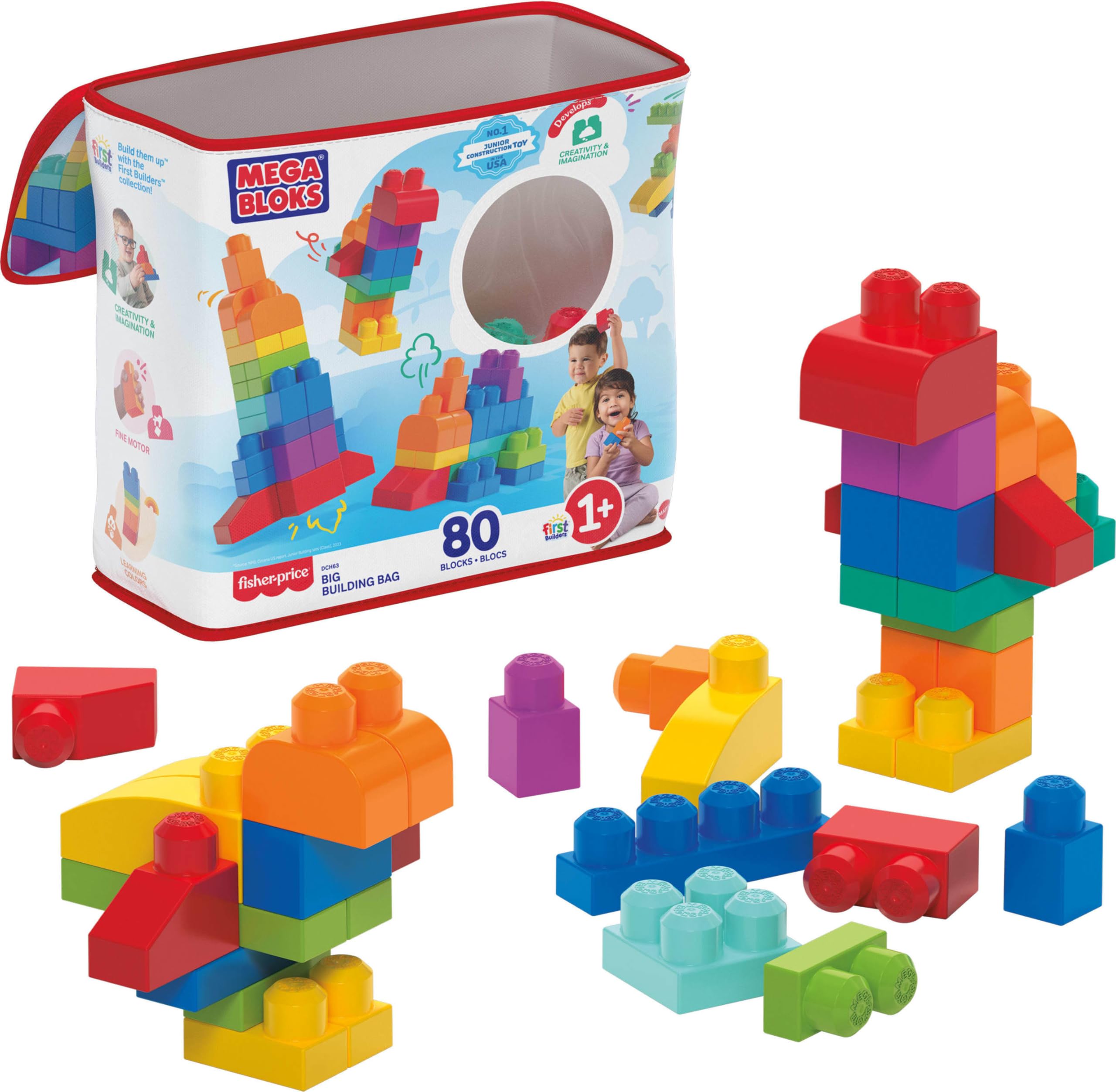
A one-year-old's hand is a specific size, and the whole point of this bag is that the blocks fit it. They're chunky enough to grab with a fist, they pull apart with a fraction of the force a standard brick needs, and there are 80 of them — enough to build a wall across the living room floor and still have spares.

That combination makes this the toddler set we hand over without hovering. The listed range is 12 months to 5 years, and it tracks: a 1-year-old can stack two blocks and knock down ten, and a 4-year-old can still get a house out of the bigger pieces. The bag earns its place too — blocks go back in with one sweep of an arm, and of everything here it's the easiest to carry to a restaurant or a grandparent's house.

The bag is also the first step in a longer chain. Once a child starts asking for doors, wheels, and a truck that looks like a truck, big blocks have done their job and the brick box takes over, with the MEGA BLOKS passed down to a younger cousin. Buying both at once is wasted money; buying them two years apart is how the handoff usually works.

Bottom line: For a one-year-old, this is the set we hand over without hovering: big blocks, easy to pull apart, and a bag to keep them in.

#4

PicassoTiles 100-Piece Magnetic Tiles

PicassoTiles 100-Piece Magnetic Tiles

Big tile builds

Doodle Score 9.6/10
Check Price

Worth Noting

  • Magnets in some tiles grip weaker than others
  • No storage bin or bag included
Pieces
100
Build Type
Magnetic tiles
Recommended Age
3 years and up
Read the full review

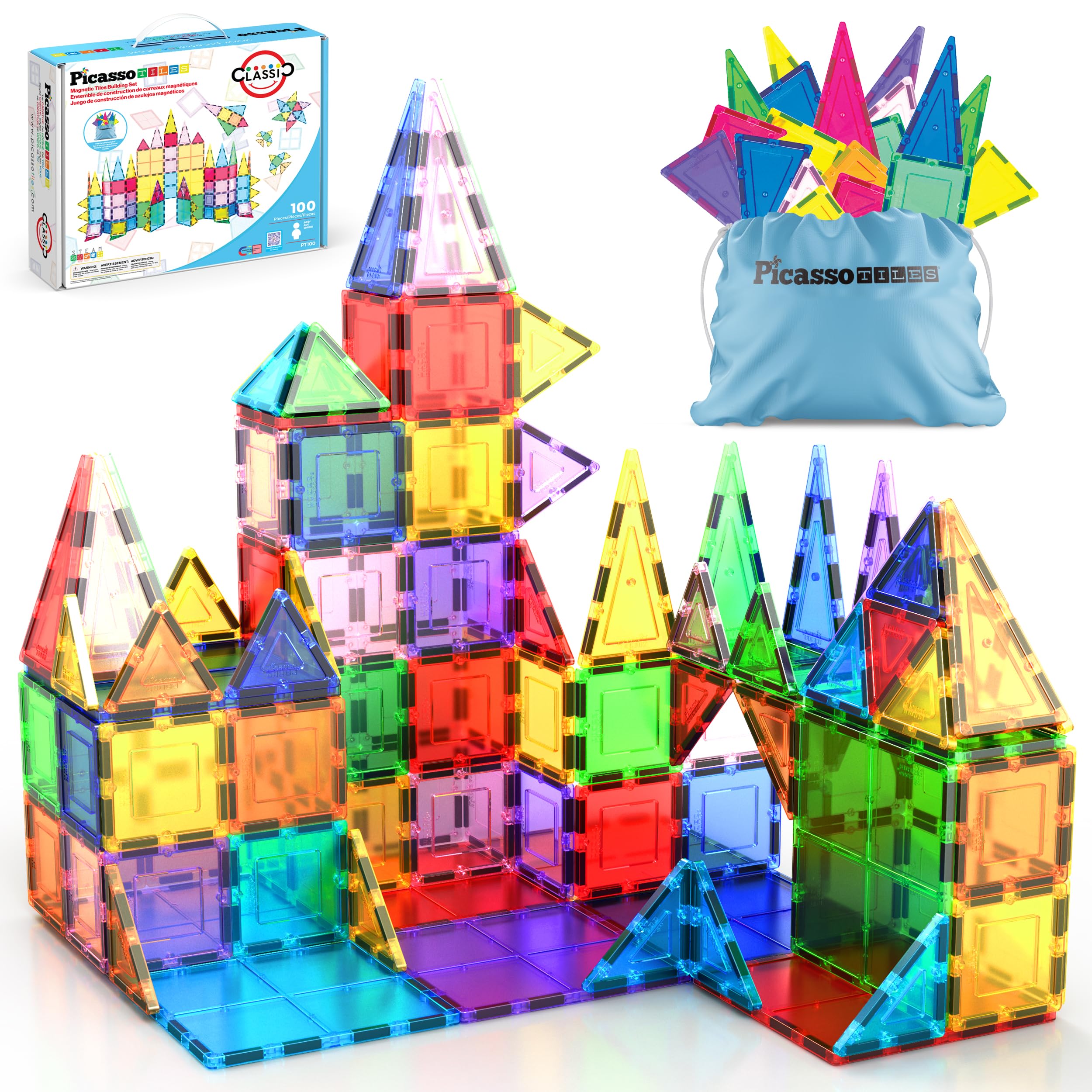
A hundred tiles against the premium set's thirty-two is the whole argument. If what you want is volume — enough pieces that a toy car can park inside the finished build — this is the set we hand over, and the one we recommend to a family buying magnetic tiles for the first time.

Tiles build differently from bricks, and it's worth understanding before you buy. There's no click: two edges either pull together or push apart, so a tile has to be turned the right way before it joins a wall. Kids work that out faster than adults do. Once they have it, a 3-year-old can put up a four-walled house in a couple of minutes, and flat panels make windows and roofs obvious in a way bricks never quite do.

Flat is also how they store. The whole set stacks into a couple of inches, so a hundred tiles take less shelf space than a hundred bricks, and tidying up is a two-minute job with a tub rather than a sorting exercise. The colors are the draw for younger children, and a set this size is the one the adults end up building with after dinner. Ours has been a castle, a garage, and a very unstable chair.

Bottom line: A hundred magnetic tiles is the number that makes big builds possible, and this is the set we recommend when you want volume.

#5

Melissa & Doug 100 Wooden Blocks

Melissa & Doug 100 Wooden Blocks

Quiet toddler play

Doodle Score 9.6/10
Check Price

Worth Noting

Pieces
100
Shapes
9 shapes in 4 colors
Material
Solid wood
Recommended Age
2 to 8 years
Read the full review

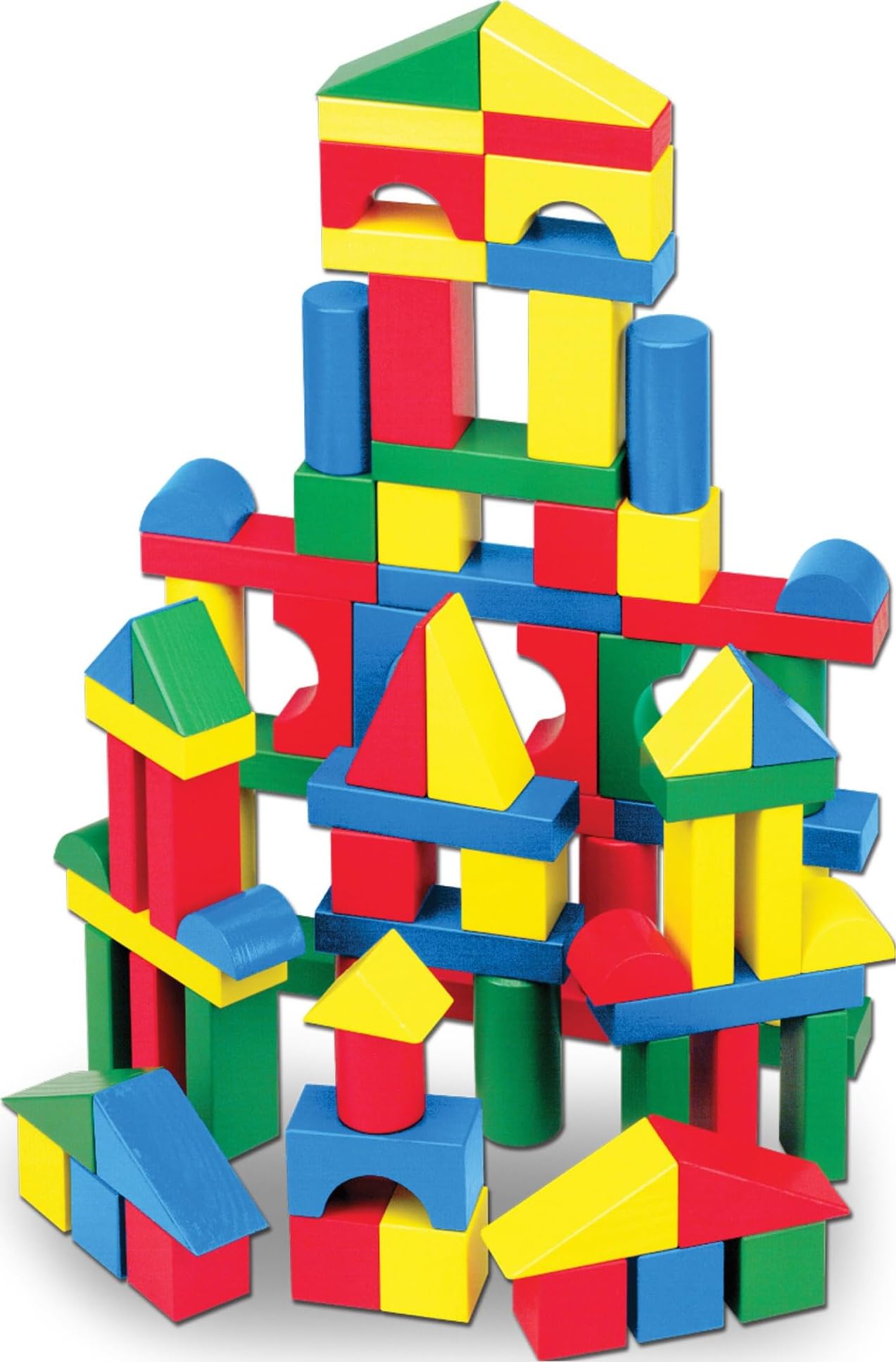
Nothing clicks, and that's the appeal. These are 100 solid wood blocks in four colors and nine shapes, and they stack on balance alone — which is why a 2-year-old can play with them and a 5-year-old can still find something to do, building taller, wider, and more precarious until the whole thing comes down.

The variety of shapes matters more than the count. A bag of identical cubes gets old in a week; with nine shapes to work from, a stack turns into a bridge or a garage, and there are enough pieces that two children can build at once. Edges are rounded and the finish is smooth, so there's nothing sharp to catch a finger, and each block is light enough for a toddler to carry two at a time. This is the set we reach for when a younger child wants to build next to an older sibling working on something delicate, because it makes almost no noise.

For the money it's the best-value box here: a hundred solid wood pieces for about what a bag of big plastic blocks costs, and nothing in it to break or lose. The cardboard box is the surprise. It's sturdier than it looks, it has held up as the storage, and it's still what the blocks get swept back into.

Bottom line: We reach for these when a two-year-old wants to build beside an older sibling — no clicking, no instructions, and nothing to charge.

#6

LEGO Creator 3-in-1 Flatbed Truck

LEGO Creator 3-in-1 Flatbed Truck

Guided model builds

Doodle Score 9.6/10
Check Price

Worth Noting

  • Finished models are smaller than the photos suggest
Pieces
270
Moving Parts
Wheels, propellers, rotors
Build Options
3 models in one box
Recommended Age
7 years and up
Read the full review

Three complete builds come out of this box, and each one uses the whole 270-piece kit: a flatbed truck with a helicopter, a plane with a fuel truck, and a hot rod with an SUV. Wheels turn, propellers spin, and the models hold together well enough to be flown around the living room before they go back in the box.

The rebuilding is what keeps it out of the drawer. A single-model kit gets built once and then sits on a shelf; this one gets taken apart and made into something else, which is a different kind of afternoon. The instructions are clear enough that a 7-year-old can work through a model alone, and the three builds are genuinely different constructions rather than a recolored version of the same chassis.

It's the pick for the child who follows instructions and wants a result, and the one we choose over a free-building box for a 7-year-old who asks for a set with a picture on the front. The limitation worth knowing is that only one of the three models can exist at a time. For most kids that's the game — the truck becomes the plane — but a child who wants a fleet on the shelf needs more than one box.

Bottom line: The best rebuildable set here for a child who follows instructions: three complete vehicles from one box, and a real afternoon of building each time.

#7

Brain Flakes 500-Piece Set

Brain Flakes 500-Piece Set

Older, patient builders

Doodle Score 9.6/10
Check Price

Worth Noting

  • Stiff to snap for younger children
  • One identical shape, so no wheels or figures
Pieces
500
Storage
Yellow-cap storage jar
Build Type
Interlocking discs
Recommended Age
3 years and up
Read the full review

The first thing you notice is the resistance. Brain Flakes are a single disc shape with slots around the rim, and pressing two together takes a firmer push than clicking a brick. A 3-year-old can do it, but for the first week they'll hand you the stiff ones.

Five hundred discs in twelve colors sounds like an odd way to build until you see what one shape can do. Because every piece is identical, the set never suggests a model: children make spheres, flowers, hats, and stands for other toys, and the results hold their shape in three dimensions in a way a brick wall can't. An idea booklet covers a flower, a rainbow ball, and a tree to copy before they take off on their own.

It's also the easiest of these to live with. The whole set lives in a yellow-capped jar, a spilled pile sweeps back in a minute, and there are no small special pieces to lose under the sofa. After a few months of use, that containment is the part we appreciate most.

The box says 3 and up; we think 5 is closer to the mark for independent play, with 4-year-olds managing fine if an adult is nearby for the first few sessions. Younger children can sort and count the colors, which is a legitimate use of the set but not really building. As a gift for a child who has already worn out a brick box, it's the one that gets remade into something new every week.

Bottom line: If your kid has outgrown bricks, these 500 discs build shapes bricks can't — just expect to help younger children snap them.

How We Tested (and Rebuilt) 14 Building Sets

We started with roughly 60 sets sold at major retailers and cut the list using the things that actually decide whether a set gets played with: the age grading on the box, how big the individual pieces are, what kind of magnets or connectors hold them together, and whether the brand sells replacement pieces. Price mattered only as a filter — a set that costs twice as much has to hold up twice as long. That left 14 sets, from chunky toddler blocks to magnetic tile kits to classic interlocking bricks.

Testing ran for four months in houses with a 2-year-old, a 5-year-old, and a 7-year-old, which meant sets were built on the living room rug before breakfast, at the coffee table after school, and once, memorably, on the floor of a pediatrician's waiting room. To judge magnetic strength, we built a four-walled box and a three-story tower, then lifted the top piece to see how much of the structure came with it, and carried finished builds across the room by the roof. Every piece got measured against a choke-test tube, and we noted whether a toddler could connect and pull pieces apart without an adult.

Durability was mostly a matter of repetition: each set was rebuilt at least 20 times, dropped from coffee-table height onto hardwood, and tossed back into its bin at cleanup. We watched for corners that cracked, seams that felt sharp, paint that chipped, and magnets that worked loose of their housing. Cuteness and quality showed up in smaller ways too — whether printed faces lined up, whether the pieces went back in the box without a fight. And because fun is the whole point, we kept track of which sets got pulled back out over the following weeks with nobody prompting.

How to Choose Building Toys

Match the pieces to the hands, not the age on the box

An age rating is a floor, not a skill ceiling. The 4+ on a brick box means the pieces are small enough to matter if a child still mouths things; it doesn't mean every 4-year-old is ready, and it doesn't mean a 5-year-old who builds carefully should wait. Big blocks suit a one-year-old, wooden blocks start around two, and standard bricks and interlocking discs are a three-to-four-and-up purchase.

Here's the test we use: if a piece would disappear inside a toilet-paper tube, it isn't for a child who still puts things in their mouth. If there's a younger sibling crawling around, buy for the youngest and let the older child build up — that's how a house ends up with both a bag of big blocks and a brick bin.

Decide how the pieces should connect

Every building toy here asks something different of small hands. Standard bricks click firmly and need real fingernail pressure to separate. Magnetic tiles need no strength but must be turned the right way before they hold. Interlocking discs are the stiffest of the lot, and plain wooden blocks don't connect at all — which is either the whole appeal or the whole frustration, depending on the child.

Watch what a child does with a stack of anything before you spend. The one who rebuilds after every collapse will take to a stiff set; the one who gets angry at fiddly pieces builds more with tiles.

Free building or a set that makes one thing

A brick box with no fixed model is the most forgiving purchase you can make: it doesn't run out, it absorbs new pieces, and it spans the widest age range. A three-in-one kit trades that openness for direction — three complete models and instructions, which is exactly what some kids want and exactly what others ignore.

The trap is buying a guided model kit for a child who has never followed a booklet. They build it once, with help, and then the pieces sit. If you don't know which kind of builder you're buying for, the open-ended box is the safer guess.

Check what it comes in, and whether it grows

Piece count is the number everyone compares and the least useful on its own. Thirty-two premium tiles and a hundred budget tiles do different jobs, and a set with windows and wheels beats a bigger pile of identical cubes. Shape variety is what lets a build turn into something, so look at the mix before the total.

Then look at the container. A bag, a lidded bin, a jar, or a cardboard box decides whether the set gets tidied or abandoned on the floor. Finally, check the system: bricks from the same maker combine with the sets a child already owns, and big-block ranges are a different scale from standard bricks, so the first purchase sets the direction of every birthday after it.

Frequently Asked Questions

Final Verdict

If you're buying one building toy and you don't know where to start, buy the LEGO Classic Medium Creative Brick Box. It has 484 pieces, no fixed model, and a bin that swallows the next set too — the set that stays in use from about four to ten.

If there's a one-year-old in the house, start with the MEGA BLOKS bag and keep the small bricks for later. And if the child in question would rather stick flat panels together than click bricks, PicassoTiles gives you the most to build with.