Building & Blocks

Best Building Toy Storage for Bricks and Tiles of 2026

Every parent knows the sound of a barefoot meeting a stray brick at 6 a.m. The bigger annoyance comes later: the floor is finally clear, and nobody can find the one gray hinge piece that finishes the roof. Most storage solves one problem and quietly creates the other — sweep everything into one deep tub and cleanup takes ninety seconds, but the next build starts with twenty minutes of digging. What you actually want is a setup that keeps pieces findable and still gets the floor cleared before bedtime.

Over the past eight months, my team and I lived with 12 different storage solutions — sorting trays, rolling carts, stackable drawers, and a couple of heavy-duty tubs — across playrooms, bedroom closets, and one very cluttered car trunk. The surprise was how little the advertised capacity told us: a container can be enormous and still useless if small pieces sink to a bottom nobody wants to reach into. The picks below were judged on how fast cleanup actually goes, how easily a specific piece turns up again, whether the whole thing survives being sat on, and what each one holds for the money.

#1

MAGNA-TILES Storage Bin

MAGNA-TILES Storage Bin

Magnetic tiles

Doodle Score 9.6/10
Check Price

Worth Noting

  • 300-tile capacity tops out fast
Bin Size
12.5 x 11 x 8 in
Play Mat
28 x 25 in
Age Range
3 years and up
Tile Capacity
Up to 300 tiles
Read the full review

Three hundred tiles is the number this bin is built around, and it is a real one: 12.5 by 11 by 8 inches of interior holds a substantial tile collection, plus the loose pieces that never made it back into a set.

The zip is the clever part. Each corner opens and the bin's own panels flatten into a 28-by-25-inch play surface, so there is no separate mat to roll up, store, or lose behind the sofa.

That surface is padded. The panels have some give and the folds leave creases, so a tall tower built on the mat wobbles in a way it does not on a table. For flat work — patterns, roads, a house with a wide base — it is perfectly usable, and the trade is a mat you never have to put away.

What we think: this is the storage object that makes most sense for a tile household, because it is shaped around tiles rather than bricks, and a tile collection is exactly the kind that gets scattered and abandoned. It folds flat when empty, which is more than the rigid bins here can say, and it is simple enough for a three-year-old to open unaided.

Bottom line: The tile-specific pick: 300 tiles go in, and the bin unzips into a 28-by-25-inch mat that folds flat afterward.

#2

TrueLux 10-Pack Mesh Pouches

TrueLux 10-Pack Mesh Pouches

Slim shelf storage

Doodle Score 9.6/10
Check Price

Worth Noting

  • Not sized for loose bulk collections
Material
Nylon mesh
Set Size
10 pouches
Pouch Size
13.8 x 9.8 x 1.5 in
Stated Load
6.61 lb
Read the full review

Thirteen point eight by nine point eight by one and a half inches is the number that matters, and it is why we rate these above the boxier bags for shelf storage: the footprint is A4 with room to spare, so ten pouches file flat like folders instead of piling up like luggage.

The two-layer build is the useful detail. A transparent outer pocket holds the instruction book, the mesh pouch behind it holds the pieces, and a handle on the end lets a child pull one out of a stack without emptying the shelf. Nylon mesh is lighter and less springy than clear PVC, so an empty pouch folds down to nothing.

Where they stop is bulk. This is a system for sets, not for a sea of loose bricks — ten pouches hold ten sets, and a thousand random pieces want a bin with an open mouth and a scoop. Mesh is also less forthcoming about contents than clear plastic, a fair trade for something that breathes and folds.

Bottom line: Best when sets and manuals need to file flat on a shelf — ten slim pouches that take less room than one rigid bin.

#3

Mecozone 4-Pack Bags

Mecozone 4-Pack Bags

Built models

Doodle Score 9.4/10
Check Price

Worth Noting

  • Only four bags per set
  • Clear panel on the front only
Extras
Mesh manual pocket
Closure
Double zippers
Bag Size
12.5 x 3.9 x 8.5 in
Set Size
4 bags
Read the full review

Twelve and a half inches long and nearly four inches deep is what separates these from the flat pouches: a built vehicle or a half-finished castle goes in without being taken apart first, and the bag stands up on a shelf instead of folding over on itself.

Four colors — orange, red, blue, and green — with a clear PVC front and a mesh pocket across the back for the manual. The colors do the sorting for you: one theme per bag, and a child who cannot read yet can still find the right one by color.

What we think: the double zipper is the detail that makes these pleasant rather than merely adequate. It opens from either end and runs far enough around that the bag lies flat on the table, which turns loading and unloading into a two-second job instead of a wrestling match.

This is the set to buy when the collection is big and few rather than small and many. If your shelf is a dozen little sets, the six-bag and ten-pouch options here give you more addresses for the same space; if it is three huge builds, these are the bags that fit them.

Bottom line: Four deep, color-coded bags for builders who keep models built — big enough for a vehicle, bright enough for a pre-reader.

#4

Creative QT SlideAway

Creative QT SlideAway

Whole collections

Doodle Score 9.2/10
Check Price

Worth Noting

  • Wire rim can bend out of shape
Closure
Drawstring
Bin Size
15 x 12 in (dia x h)
Capacity
9 lb of toys
Play Mat
52 in diameter
Read the full review

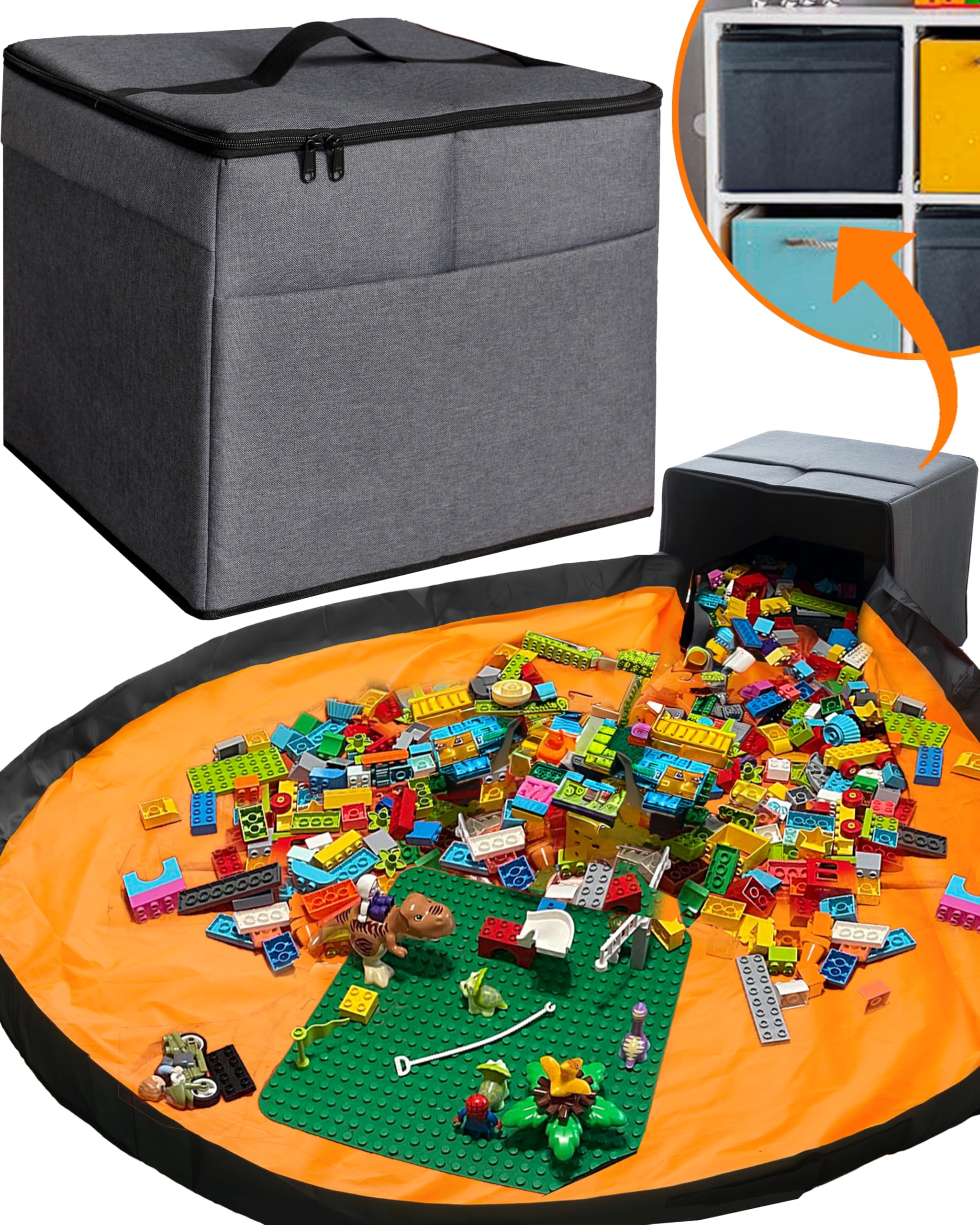
The drawstring is the whole idea, and it is why we send most families here first. Spread the 52-inch mat, tip the bricks out, build, then pull the cord: the mat gathers itself into a bag with everything inside. Cleanup becomes one motion instead of an afternoon of sorting, and it is a motion a young child can manage without an adult hovering.

The bin that results is 15 inches across and 12 inches tall, rated for 9 pounds of toys, with a wire hoop in the rim that keeps the mouth open while you shovel pieces in. Nine pounds is a genuine collection for most households, a deep layer of bricks with room left over for the loose bits that never made it back into a set. The nylon shell is the reason it survives being dragged between rooms.

What we did not expect to care about is how little it looks like toy storage. Round and fabric-covered, it reads as a laundry hamper or a beanbag, which is the difference between a bin that lives in the playroom and one that has to be hidden. If yours sits in a corner nobody sees, that matters less; if it sits where you sit, it matters a lot.

One practical note before you commit: a 52-inch circle needs a 52-inch circle of floor every time it is open, and it is round because a drawstring needs a circle. In a narrow room, measure first. In a playroom corner, it is the least fussy thing here to put away.

Bottom line: We point most families here: spread the 52-inch mat, build, then pull the drawstring and the whole pile is a bin again.

#5

SAM AND MABEL XXL Organizer

SAM AND MABEL XXL Organizer

Multiple builders

Doodle Score 9.2/10
Check Price

Worth Noting

  • Velcro mat attachment can pull loose
  • Tall 16-inch sides put pieces out of reach
Bin Size
15 x 15 x 16 in
Play Mat
60 x 45 in
Stated Load
12 lb
Empty Weight
1.8 lb
Read the full review

Fifty-two inches of mat sounds generous until two children want the same corner of it. The mat here is 60 by 45 inches, boat-shaped with a lip running right around, and in our experience that is enough edge for three or four children to work at without bricks migrating onto the rug.

What wins us over is how little the bin asks of a child. Empty, it weighs 1.8 pounds and has handles on the sides, so it gets hauled from room to room by the person who made the mess. The stated load is 12 pounds of toys, the largest of the mat bins here — though a full one is a two-handed carry even for us.

The mat lifts off rather than being sewn in, which is genuinely convenient: shake it out over the garden, wipe it, put it back. It is a polyester bin built without cords to thread or loop when it is time to close up, and 15 by 15 by 16 inches is a lot of interior for the width it takes against a wall.

Bottom line: For siblings who build at the same table, the 60-by-45-inch mat and a bin a child can drag alone make this the better buy.

#6

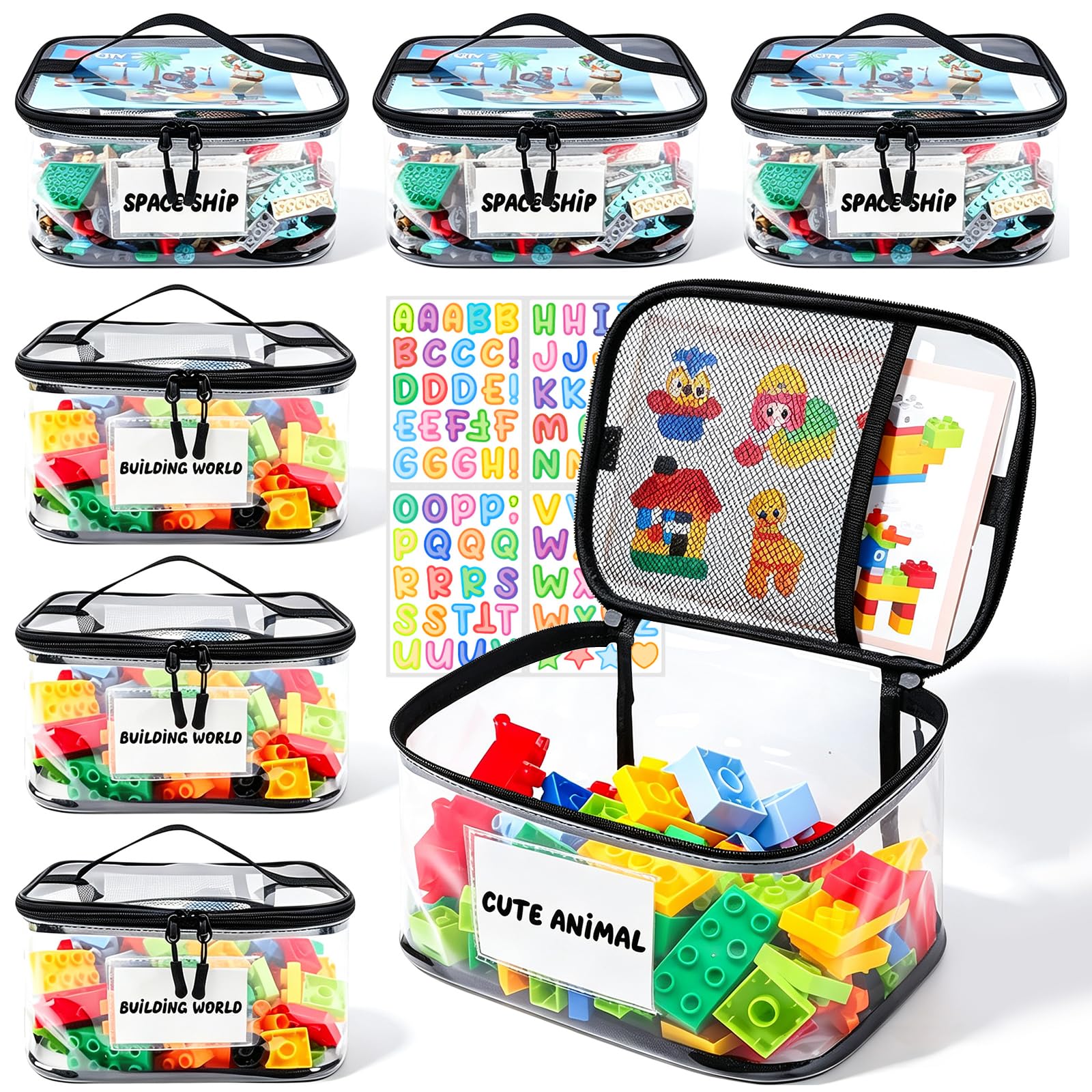
Tesuko 6-Pack Clear Bags

Tesuko 6-Pack Clear Bags

Sorting by set

Doodle Score 9.2/10
Check Price

Worth Noting

  • Too small for a flagship set
Extras
Name tag and manual pocket
Closure
Double zippers
Bag Size
9.45 x 6.7 x 5.12 in
Set Size
6 bags
Read the full review

If your building table looks less like a pile and more like a shelf of sets waiting their turn, this is the shape of storage that holds. Each bag is 9.45 by 6.7 by 5.12 inches, about a shoebox, and there are six of them, which covers six mid-size sets or a dozen small ones.

The details are what earn it a place. There is a clear window across the front, a mesh pocket on the outside for the instruction booklet, and a name tag so two children's sets do not end up in the same bag. The PVC is stiff enough that a bag stands open on the floor while you load it, which is not true of the softer fabric bags here.

Our reservation is the stiffness itself. A rigid bag has no give, so one packed past its depth strains the zip rather than bulging, and the corners are where that shows first. Fill them to the seam and stop. Treat the six-pack as a system for the sets you actually rebuild, and it does its job without ceremony.

Bottom line: If your sets live in separate piles, these six clear bags give each one an address, a name tag, and a pocket for the manual.

#7

STARSIKO XL Organizer

STARSIKO XL Organizer

Square shelf fit

Doodle Score 9.2/10
Check Price

Worth Noting

  • Zip-on mat is not permanently attached
Closure
Zipper
Bin Size
15 x 13 x 13 in
Capacity
10 gal
Shelf Fit
Standard 13 x 13 in
Read the full review

Rectangles are underrated in toy storage. This bin is 15 by 13 by 13 inches, so it sits square against a wall and slides onto a standard 13-inch shelf, and the reinforced walls mean it does not collapse into itself when it is half empty.

Ten gallons is the stated capacity, a serious pile of bricks or magnetic tiles, and the zip-on mat turns the whole thing into a play surface without a separate mat to store. What we like most is that it stays a box: you can carry it by the sides, put it on a shelf, and it holds its lines instead of sagging into a sack.

The sewing is where it is thinner. The fabric is soft-walled with reinforcement, and the seams are the part to watch; a stitch that lets go at the base takes the mat with it. A bin that lives in one room will likely never test that. A bin that travels weekly will.

Bottom line: The mat-bin idea in a rectangular shape: it fits a 13-inch shelf, holds 10 gallons, and the walls hold their shape.

#8

Gowee Toy Storage Box

Gowee Toy Storage Box

Bulky toy overflow

Doodle Score 9.0/10
Check Price

Worth Noting

  • Soft sides bow once it is full
  • Fabric is not water resistant
Lid
Flip top
Box Size
25 x 13 x 16 in
Capacity
83 L
Compartments
2 with removable divider
Read the full review

Eighty-three liters is the number to start with: 25 by 13 by 16 inches, which is a laundry basket's worth of soft toys, dress-up clothes, or the unsorted remainder of a brick collection. The flip lid opens the whole top, so you are dropping things in rather than posting them through a slot.

The divider is the useful bit. It secures with velcro to split the box in two, and it comes out entirely when you want one big cavity, which is the difference between a chest you fill once and one you can reorganize as the collection changes.

It also looks better than a fabric box has any right to. The linen-look fabric and the beige-and-white finish mean it can sit in a living room, and the lid closes it off so a corner of clutter reads as furniture.

What it is, honestly, is a finishing container. Bricks go in as a mass — no sorting, no scoop, no clear panel — so it works behind a bag or mat system rather than instead of one, and it is the only thing here with a lid you can shut on a mess you do not want to look at.

Bottom line: A big lidded chest for everything that never had a home, best used behind a sorting system rather than instead of one.

How We Tested Building Toy Storage

Building a shortlist here is mostly a filtering job. We started with roughly 40 storage options — open bins, lidded tubs, drawer towers, rolling carts, fabric cubes, and wooden cubbies — and cut anything that wouldn't slide under a play table or sit on a standard closet shelf, anything with a lid a young child couldn't open alone, and anything whose sides flexed when we pressed on them in the aisle. Price came next: we kept a spread from budget to investment so we could judge value rather than assume it. That left 12 units, which went into real homes for eight months.

Testing happened wherever the bricks land: living room rugs, playroom corners, bedroom closets, and a car trunk for the set that travels. At bedtime we timed cleanup with a six-year-old doing the sweeping and counted how many pieces ended up in the right compartment instead of the nearest one. Mid-build, we sent a kid to fetch a specific 2x4 and noted whether it took seconds or a full minute of rummaging — the clearest measure of whether a sorting system is worth the extra steps at pickup. We also loaded each container with 20 pounds of mixed bricks, carried it up a flight of stairs, then dragged it across carpet by its handle or wheels to see whether the base stayed square.

Construction got its own round of abuse. We sat on the lids (so did the kids), dropped loaded bins from counter height, and worked every latch and hinge 50 times looking for cracking or a lid that stopped sealing. At the eight-month mark we checked for warped sides, split seams, handles pulling out of fabric, and wheels that no longer rolled straight, and we compared how much usable space each one held against what it cost. Several bins that felt solid on day one had developed a sag by spring.

How to Choose the Right Building Toy Storage for Bricks and Tiles

Decide between scooping and sorting

Building toy storage splits into two jobs, and most of the mess comes from asking one product to do both. A mat-and-bin system — a wide mat that gathers into a bag on a drawstring or a zip — is for the pile: the bricks that live on the floor at the end of the day. A set of clear zip bags is for the collection: one bag per set, so pieces stay with their instructions and a half-built model survives the week.

The trap is buying one and expecting the other. A 52-inch mat will not tell you which bag the gray hinge ended up in, and a shelf of labeled pouches will not make a floor sweep any faster. Households that stay on top of it usually run both: a mat bin for the loose mass, pouches for the sets in rotation.

Match capacity to the collection, not to the word large

Capacity figures in this category are not comparable. One bin is rated by weight (9 to 12 pounds), another by volume (10 gallons, or 83 liters), another by tile count (300). What they all really describe is how much comes off the floor in one go.

So count in sets instead. A bag of about 9.5 by 6.7 by 5 inches holds one mid-size build; a 10-gallon bin holds a family pile or the unsorted remainder. Buy addresses for the sets that matter, then size the bin for everything else.

Measure the spot where it will live

Two footprints matter, not one: the space it takes closed and the floor it needs open. A 52-inch round mat wants a clear circle every time it is used, and a round bin will not tuck into a corner the way a rectangular one does. If storage is a shelf, check the fit — several bins here are built around a standard 13-inch cube, and flat A4 pouches are the only ones that slide into a magazine file.

Where a soft bin sits matters too. A fabric chest with cardboard panels bows once it is full, so give it a wall and keep weight off the lid.

Check the closure, the seams, and who lifts it

Zips and seams fail before anything else does. Look for a zip that runs around three sides so the bag opens flat, and do not judge it empty — the zip that glides on an empty bag can fight you when the corners are tight. Overstuffing is what kills them, because a stiff PVC bag strains at the seam instead of bulging.

Then think about the person tidying. An empty bin at 1.8 pounds is a child's job; the same bin holding twelve pounds of bricks is an adult's. Handles on the ends and a mouth that stays open matter more than capacity for the small person doing the picking up.

Frequently Asked Questions

Final Verdict

The Creative QT SlideAway is where we point most families, because it solves the problem that actually creates the mess: bricks on the floor and nobody willing to pick them up one at a time. One pull, and it is a bin.

Add a set of clear bags once the collection starts organizing itself into sets, and if two children build side by side, the wider mat on the SAM AND MABEL is worth the extra floor space.