Building & Blocks

Best Foam Building Blocks for Toddlers

I traded our wooden blocks for foam after one too many barefoot encounters with a sharp corner, and I haven't looked back since. Foam blocks solve a very specific set of problems: they're quiet on hardwood, they don't leave bruises, and they're light enough for a toddler to stack without help. But the wrong set creates new ones — pieces small enough to worry a parent, foam that tears the first time it's chewed, or a set that feels too babyish for a 4-year-old by lunchtime.

Over the past eight months, my team and I have tested a dozen sets, from basic blocks to magnetic versions, and the differences come down to density, size range, value, and how well they hold up to real play. One thing I wish every shopper knew: the age on the box is a starting point, not a guarantee — check the actual block size against the age label. The picks below are the ones that earned a spot in the playroom, organized by what they do best.

#1

CRAFTY HAPPITOYS Foam Blocks
CRAFTY HAPPITOYS Foam Blocks

Shape variety

Doodle Score 9.6/10
Check Price

Worth Noting

  • 34 pieces runs short with two kids building
Pieces
34
Shapes
Mixed shapes and sizes
Storage
Clear storage bag
Material
Foam
Read the full review

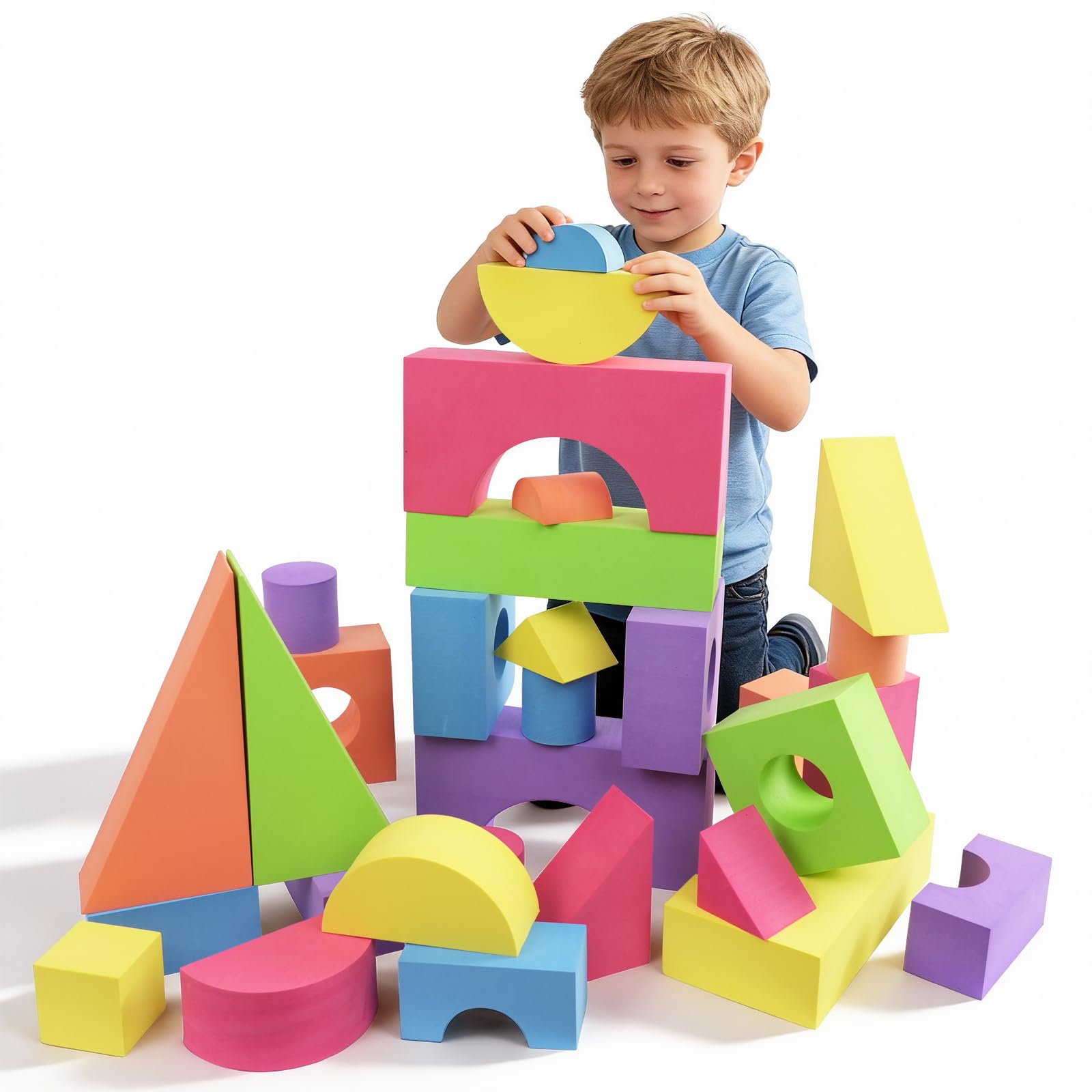
Arches, cylinders, half-rounds and cubes: the CRAFTY HAPPITOYS set is the one that stops a block collection from being all towers. Thirty-four pieces in mixed shapes and sizes, plus a clear bag, in the sort of primary colors that look right in a playroom and loud in a living room.

The foam has a slightly toothy, fine-grain surface, and that texture does more work than the shapes do. A cylinder set on top of a cube stays there instead of rolling off, so a three-year-old can get three pieces high before physics intervenes. We spent less time rebalancing and more time watching a kid work out that an arch needs two supports underneath it. The pieces are firm enough to hold a wall and light enough that a collapse lands with a thump and nothing else.

This is our pick for the child who has stopped knocking things over and started planning them. The shape mix pushes play toward bridges, garages and doorways, and after months of use the blocks have picked up bite marks without splitting. It is the set we hand over when a four-year-old asks for a garage.

Bottom line: If your kid has moved past towers and started building ramps and doorways, these 34 mixed shapes grip each other and stay put.

#2

Deekin Foam Brick Blocks

Deekin Foam Brick Blocks

Older builders

Doodle Score 9.6/10
Check Price

Worth Noting

  • Stated for ages 6 and up
  • Thirty bricks runs out fast on a long wall
Color
Gray
Pieces
30
Material
EVA foam
Block Size
8 x 4 x 2.4 inches
Read the full review

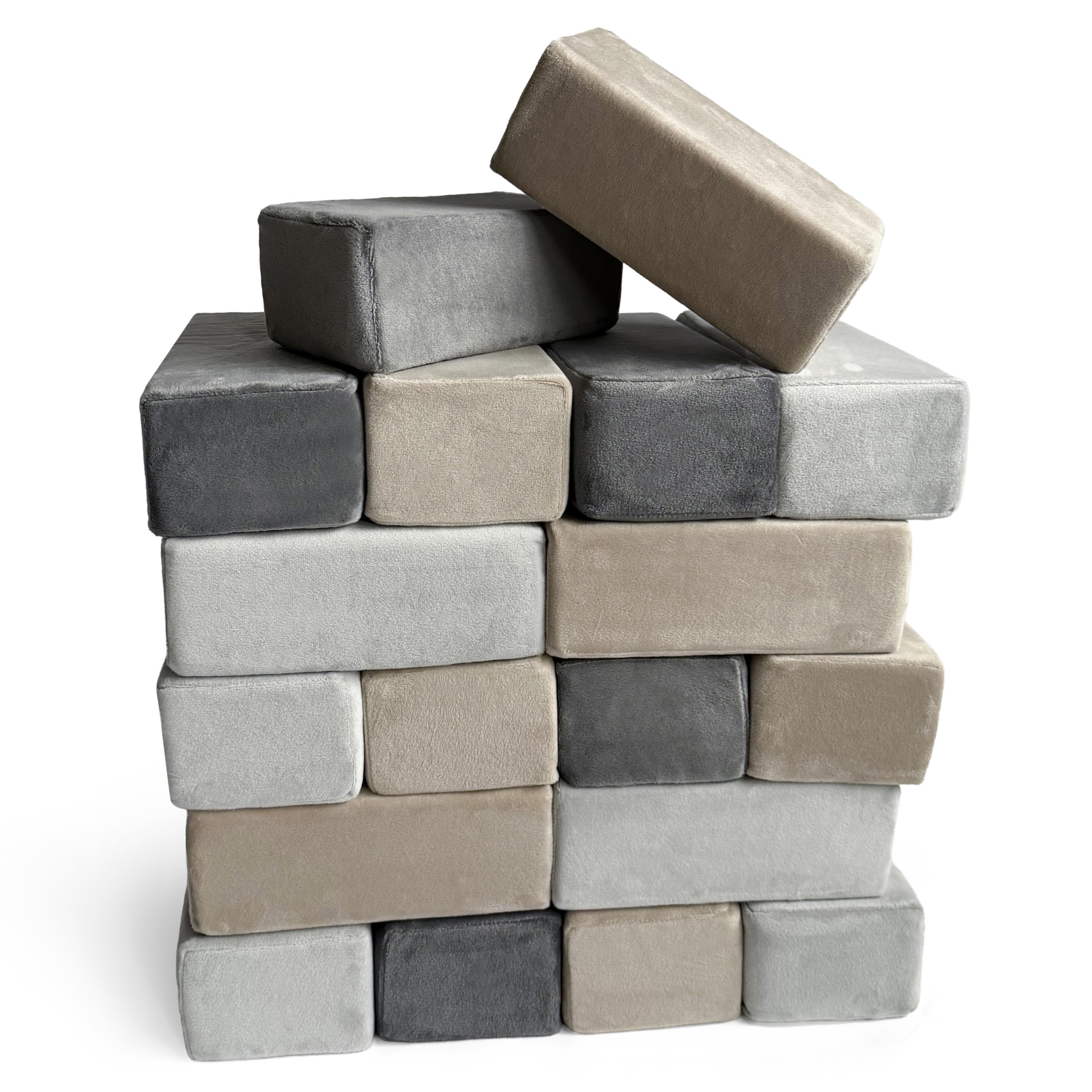
Gray. Not rainbow, not pastel, not even a primary color — 30 gray EVA bricks moulded to look like real cinder blocks. The Deekin set is the odd one out in this guide, and that is exactly why we kept it.

It is the most literal set here: about 8 by 4 by 2.4 inches per brick, the size and shape of the real thing, for building a wall, laying courses, and knocking the whole lot down to start again. The gray does the work — a stack of these reads as construction rather than as a toy — and the size gives a finished wall real presence in a room.

EVA makes the idea practical. Each brick is light enough that a collapse is funny rather than painful, and firm enough that a course stays where it is laid, even when the builder is in a hurry.

Where it fits: a seven- or eight-year-old with a construction streak, a bedroom with floor space, and a parent who does not mind blocks that look like they came off a building site. It is a narrow set, and it does its narrow thing better than anything else here.

Bottom line: A narrow pick we are glad exists: 30 realistic cinder blocks for the kid who wants to build a wall, not a castle.

#3

LOLO TOYS Large Foam Blocks

LOLO TOYS Large Foam Blocks

First block set

Doodle Score 9.4/10
Check Price

Worth Noting

  • Minimum age of 3 rules out younger toddlers
Colors
6
Pieces
30
Storage
Clear storage bag
Material
High-density EVA foam
Read the full review

A toddler's tower is only as good as the block they can get a hand around. The LOLO set solves that with size: 30 jumbo blocks in six colors, made from high-density EVA foam, big enough that a small hand wraps around one and carries it across the room without dropping it.

This is the set we put in front of the youngest builders, and it earns the spot on the first collapse. When a tower goes over — and it will, several times an hour — nothing hurts, nothing breaks, and nothing lands with a clatter. The knock-down turns out to be as much of the game as the build, which is how toddlers actually play.

The practical details are where it quietly wins. The foam wipes clean with a damp cloth, so jam and dust do not become a scrubbing job, and the blocks float, which makes them bath toys as well as floor toys. Six bright colors are enough for sorting games without turning the living room into a paint chart.

Thirty jumbo blocks will not build the sprawling castle a 138-piece set manages; they build the tower a toddler can finish before losing interest. That trade — fewer, bigger pieces — is the whole reason this set works, and ours gets pulled out far more often than the denser sets in this guide.

Bottom line: We hand these to toddlers first: the blocks are big enough to stack on the first try, and soft enough that knocking the tower down is part of the game.

#4

Plush Blocks Premium Set

Plush Blocks Premium Set

Softest premium set

Doodle Score 9.4/10
Check Price

Worth Noting

  • Blocks run smaller than the photos suggest
Cover
Plush fabric over foam
Edges
No zippers or sharp corners
Colors
Rainbow
Pieces
24
Read the full review

Plush Blocks is the set you raise an eyebrow at before you touch it. Twenty-four foam blocks wrapped in soft fabric, in colorways chosen by someone who owns a living room — it is the priciest set in this guide by a wide margin, and five minutes with the pieces explains where the money went.

What the money buys is the finish. Fabric over foam means no seams splitting at the corners, no zippers to catch a finger, and a surface with just enough nap to grip the block above it. A tower of these is quieter, softer and steadier than a tower of bare EVA, and a child who flops into it meets fabric rather than an edge.

They are also the easiest here to live with. The covers are washable, the colors are muted enough for a shared room, and the blocks moonlight as cushions and doll beds when a fort needs them. We have watched a fifteen-month-old and a seven-year-old use the same 24 pieces in completely different ways, which is the argument for the price.

None of that makes them a value pick. If you want maximum stacking for the least money, the EVA sets here do the same job in sizes that suit bigger builds, and nobody will cry if they get left outside. Plush Blocks is for the household where the blocks live in the living room rather than the playroom.

Bottom line: Spend the money if you want blocks that feel like a stuffed animal, look good in the living room, and go through the wash.

#5

Bingyouth Large Foam Blocks

Bingyouth Large Foam Blocks

Big builds

Doodle Score 9.4/10
Check Price

Worth Noting

  • Stated age range stops at 5 years
Colors
6
Pieces
60
Material
EVA foam
Stated Age
36 months to 5 years
Read the full review

Sixty large blocks sounds like a lot until the box arrives and it turns out to be exactly right for two children building at once. This is our pick for big builds: enough pieces, in six colors, for a tower taller than the kid stacking it and enough left over for the wall around it.

The foam is firm. Firm enough that a block stays upright when a child sets it down slightly off-centre, which is the difference between a three-year-old staying interested and walking away. It is also dense enough to survive being stood on, thrown and used as a step — soft enough to fall onto, without being the spongy sort of soft that sags in the middle of a wall.

Two things we learned living with them. The foam picks up pet hair and lint, so a lint roller by the toy bin earns its keep. And the pieces are big enough that the set wants a dedicated bin rather than a shelf, which is worth deciding before it comes inside.

Bottom line: Buy these when one tower is not enough: sixty chunky blocks let two kids build side by side without running out of pieces.

#6

Blockaroo Magnetic Foam Set

Blockaroo Magnetic Foam Set

Magnetic building

Doodle Score 9.2/10
Check Price

Worth Noting

  • Premium price for a 35-piece set
Pieces
35
Cleaning
Dishwasher safe
Connection
Magnets, 360-degree rotation
Water Play
Floats
Read the full review

The click is the whole idea. Each Blockaroo piece carries magnets in its edges, so two blocks snap together and rotate into position — which means a two-year-old gets a connection without lining anything up. If you have watched a toddler give up on a tower because the third block kept sliding, you know what that is worth.

The rest of the set is aimed at the same age. Thirty-five pieces arrive as a castle kit, the foam is soft enough to sit on, the blocks float, and the whole thing is dishwasher safe, which is the cleaning answer nobody argues with. Colors are bright without being neon, and the pieces are light enough for a small hand to carry three at once.

Magnets are also where the set asks something of you. A wide, low build holds; a narrow tower that leans puts load on the joints and the pieces let go, so the play that works here is castles and walls rather than skyscrapers. That is a fair trade for a set that takes the frustration out of connecting two blocks, and it remains the only magnetic option in this guide.

Bottom line: The magnets do the aligning for small hands, which makes this the set we reach for with a toddler who gets frustrated by balancing.

#7

UHAPPYEE Fabric Foam Cubes

UHAPPYEE Fabric Foam Cubes

Quiet indoor play

Doodle Score 9.2/10
Check Price

Worth Noting

  • Only 12 cubes for the money
Cover
Removable, washable fabric
Colors
6
Pieces
12
Block Size
5.5-inch cubes
Read the full review

Picture the half hour before dinner, a waiting room, a church nursery: places where a toy has to be quiet, soft and easy to wipe. The UHAPPYEE set is built for them — 12 cubes, 5.5 inches on a side, foam inside a fabric cover that unzips and goes in the wash. These are the blocks we pack when the setting matters as much as the play.

The covers are the reason to choose these over bare foam. Jam, marker and whatever else lands on them comes off in the machine, and the zips tuck away so there is nothing scratchy on the outside. They arrive compressed, which is worth knowing before you panic: give them a day or two, or squeeze and slap them back into shape, and the cubes fill out to full size.

What they ask in return is patience at the sink — covers dry overnight, and a child who wants to build right now has to wait. As a quiet-room set, the one that lives in the car or by the front door, nothing else in this group does the job as well.

Bottom line: These are the blocks we take where noise is unwelcome: soft cubes with covers that unzip and go in the wash.

#8

Pairez Toys Foam Blocks

Pairez Toys Foam Blocks

Piece count

Doodle Score 9.2/10
Check Price

Worth Noting

  • Colors arrive as a random mix
  • 138 pieces is a long cleanup
Colors
5 random colors plus 2 accent pieces
Pieces
138
Shapes
19+ shapes and sizes
Water Play
Floats
Read the full review

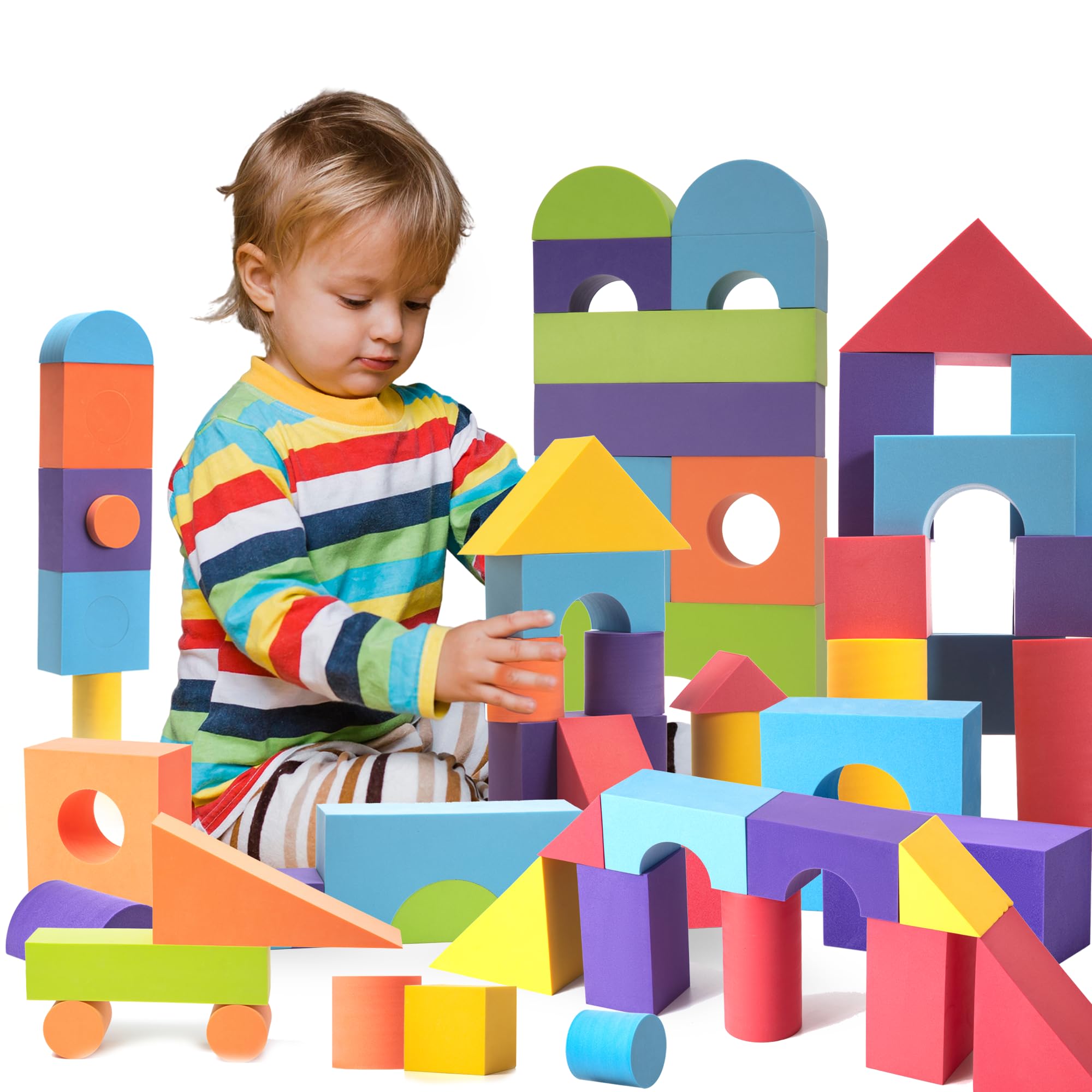
The Pairez set is the volume play: 138 pieces across 19-plus shapes, in five bright colors with a couple of pink and light-blue accent pieces thrown in. Nothing else here comes close on count, and nothing comes close on cost per block either.

What that buys is a different kind of play. These are bricks rather than jumbo blocks — the set is built for arranging numbers and letters on the floor, making tangram animals, and sorting into piles by shape. A four-year-old who likes patterns and look-what-I-made gets more from this than from 30 giant squares.

They are waterproof and they float, so the bath is fair game, and every piece is light enough that a thrown block is a nuisance rather than a hazard. Sorting by shape is half the play here, which is why the instruction manual earns its place in the bag rather than the bin.

As a value pick it is hard to argue with: the most building material per dollar in this guide, and the best of these sets for pattern play. It will not replace our top pick as a toddler's first set; it is what you add when your kid starts building with intent.

Bottom line: The best value here if your child likes puzzles and letters as much as towers: 138 pieces that float, sort and build.

How We Tested Foam Building Blocks

We started by pulling together more than 40 sets from major retailers and specialty toy brands, then narrowed the list by reading specs, checking age recommendations, and comparing the price per block. We eliminated sets with vague foam descriptions or blocks smaller than a golf ball, and we made sure to include both magnetic and non-magnetic options. That left us with 12 sets, which we tested over eight months.

Testing happened on our living room rug, in a shallow bathtub, and on a concrete patio. We handed each set to toddlers, preschoolers, and a few adults who couldn't resist, then watched what happened: which blocks got stacked into towers, which were ignored, and which got thrown across the room. We measured every block, noted whether edges were rounded or sharp, and checked whether printed patterns peeled after a rinse. To test durability, we stepped on blocks, dropped them from counter height, and let a 2-year-old gnaw on a corner.

We also tracked how long each set held attention during free play — the best ones got picked up again the next morning without prompting. For magnetic sets, we checked whether the magnets aligned correctly and whether the blocks stuck firmly enough to build a wall without collapsing. And after each session, we cleaned up: some foam sets left crumbs or held onto stains, while others wiped clean. Value came down to how many blocks we actually used, not how many came in the box.

How to Choose Foam Building Blocks for Toddlers

Put block size ahead of piece count

A 138-piece set and a 30-piece set can sit on the same shelf and suit completely different children. A two-year-old needs blocks big enough to grab with one hand and set down without toppling; a five-year-old building patterns wants lots of small, varied shapes. Before you compare counts, find the listed size of the blocks themselves. If a listing gives only a piece count and a glamour shot, treat that as a question to ask rather than a bargain.

The trap is assuming more pieces means more play. For a child under three, a heap of small bricks is a frustration exercise: they slide, they scatter, and the tower falls before it is finished. Buy jumbo for the first set and add a high-count set later, when play shifts from stacking to arranging.

Bare foam, fabric covers and magnetic pieces

The finish decides how the set cleans and how it feels. Bare EVA is the default — wipeable, light and happy outdoors. Fabric and leather-look covers feel nicer, grip a little better and can be zipped off for the wash, but they need drying time and they cost more. Magnetic blocks trade some stability for speed: they connect without lining anything up, though a tall, narrow build loads the joints.

Choose by where the blocks will live. A playroom that gets hosed down wants EVA. A living room where blocks double as cushions wants fabric. A set that has to work in the bath and on the floor wants magnetic foam.

Firm blocks stack; soft blocks sag

Soft covers an enormous range. The foam in a good building set is dense enough that a cube holds its shape under another cube and a wall stays upright when a child nudges it. Cheaper sets can be spongy enough that everything slumps and nothing builds. The tell is in how the set is described in use: sets where a block stays put on a slightly off-centre stack, or where a tower does not crash easily, are the firmer ones.

Firm is not the same as hard. Every set here is soft enough that a falling tower is funny rather than painful — that is the whole point of foam. What you are buying is the density that keeps a build standing long enough for a child to feel proud of it.

Check the stated age, and plan for teeth

Stated minimum ages across these sets run from six months to six years, and the gap is about piece size, not quality. Follow it. Foam is also the one toy material a teething toddler will happily test: bite marks are the normal wear pattern on a foam block, and a piece that has been chewed down is a piece to throw away. If your child still mouths toys, buy fewer, larger blocks and inspect them regularly.

Frequently Asked Questions

Final Verdict

The LOLO TOYS 30-piece set is the one we point a toddler's parent toward: jumbo EVA blocks that stack on the first try, wipe clean, float in the bath and go back into one bag. If the blocks will live in a shared room and the budget stretches, Plush Blocks is the upgrade — softer, quieter and washable. For a child who has started building with intent rather than knocking things down, CRAFTY HAPPITOYS and its shape mix is the better spend.