STEM & Learning

Best Magnetic Letters of 2026

A fridge covered in bright letters looks like preschool joy until you step on a plastic W in bare feet. The best magnetic letters are cute enough to leave out, tough enough to survive a toddler’s grip, and magnetic enough that the whole word stays put when the door swings shut. They should be easy to read, fun to handle, and worth the money even if half the alphabet migrates under the sofa.

I’ve spent the last three months with 16 sets on my fridge, a whiteboard, and the playroom floor. The differences come down to whether an M slides when the door swings shut, whether the plastic chips at the corner, and whether my kid comes back after ten minutes. I counted usable letters—duplicates matter if you want to spell more than “cat”—and checked letter shapes against the simple forms kids see in early readers. A tip: a few sets include audio features, and the good ones sound clear instead of like a robot underwater. The sets that earned a permanent spot on my door are below.

#1

Gamenote 234-Piece Magnetic Letters Kit

Gamenote 234-Piece Magnetic Letters Kit

Family and classroom

Doodle Score 9.6/10
Check Price

Worth Noting

  • ⚠️ Small pieces require supervision under age 3
  • Foam and storage box feel utilitarian
Board
Double-sided 11.3 x 7.9 in
Magnets
Full-cover magnet backing
Storage
Compartment storage box
Letter Mix
182 lowercase, 52 uppercase
Read the full review

The double-sided board is what makes the Gamenote kit feel less like a bag of magnets and more like a portable lesson. Open the sturdy storage box and you get 234 foam letters—182 lowercase, 52 uppercase—plus a board that works for both magnetic letters and dry-erase practice. It earns the top spot here because it covers the two jobs most families actually need: a fridge toy for a younger child and a tabletop spelling station for an older one.

The letter mix is the practical win. With far more lowercase than uppercase, the kit can handle names, CVC words, and early sentences without the usual scramble for a second 'a' or 'e'. The full-cover magnets also mean there are no loose magnet bits to worry about, which is the detail we care about most with a set this size. We used the board on a kitchen counter and liked that it gave the letters a defined workspace; on the fridge, the pieces held without sliding, though the smaller letters still demand supervision around a child who mouths things.

Nothing about the kit feels premium—the foam is soft and light, and the box is utilitarian rather than beautiful—but that is the right trade for a set meant to be dumped out, sorted, and packed away. The age rating is 3 and up, and the 1.2-inch letters are small enough that we kept them away from a child who still mouths toys. If you want one set that can move from preschool letter recognition to early spelling, this is the one we reach for first.

Bottom line: Our top pick is the Gamenote kit: enough upper- and lowercase letters for real spelling, a useful double-sided board, and a storage box that keeps the set manageable.

#2

LeapFrog Fridge Phonics Magnetic Letter Set

LeapFrog Fridge Phonics Magnetic Letter Set

Electronic letter play

Doodle Score 9.6/10
Check Price

Worth Noting

  • Some tiles are not recognized accurately
  • No volume boost for noisy kitchens
Tiles
26 interactive letter tiles
Reader
Magnetic tile reader
Learning
Phonics, alphabet, vocabulary
Material
Plastic
Read the full review

The Fridge Phonics set is the one that talks back. It pairs a yellow magnetic bus reader with 26 interactive letter tiles; press a tile into the reader and it sings the letter's name, its sound, or a word that starts with it. For a toddler who is already grabbing at fridge magnets, that cause-and-effect loop is the hook.

The songs are the part we remember. The set includes familiar tunes, including the alphabet song and Wheels on the Bus, and the letter tiles trigger short phrases rather than a long loop. We liked that the play is contained: a child can press one letter, hear the sound, and move on without needing a screen. The reader also has a word mode, so the set can grow from letter names to vocabulary.

Accuracy is where we hesitate. Some tiles can be hard for the reader to recognize, and the sound is not always clear enough to tell similar letters apart. That matters because the whole point is hearing the correct sound; a child who presses L and hears something else is not getting the lesson the set promises. Stay nearby and press the tile again, or use the set as a conversation starter rather than a solo teacher. There is no volume boost for a noisy kitchen, so it works best in a quiet room.

We still think it has a place, just not as the main alphabet set. The 26 uppercase tiles are a narrow collection, and the accuracy issue keeps it from replacing a foam kit. What it does better than anything else here is make a fridge feel interactive enough that a young child wants to press, listen, and repeat.

Bottom line: We keep Fridge Phonics in the mix for toddlers who respond to songs and cause-and-effect play, not for families who want a complete, accurate alphabet set.

#3

KOKO AROMA 291-Piece Magnetic Letters Kit

KOKO AROMA 291-Piece Magnetic Letters Kit

Creative all-in-one

Doodle Score 9.4/10
Check Price

Worth Noting

  • Premium price for extras many families skip
  • ⚠️ Many small pieces need supervision
Board
Double-sided 13.7 x 8.5 in
Extras
30 numbers and math symbols, 53 geometric shapes
Material
EVA foam
Letter Mix
156 lowercase, 52 uppercase
Read the full review

If the Gamenote kit is the sensible family default, the KOKO AROMA set is the one for a household that wants more creative play from the same shelf space. The box holds 291 pieces—156 lowercase letters, 52 uppercase, 30 numbers and math symbols, and 53 geometric shapes—along with a double-sided aluminum magnetic board. The foam letters are familiar; the board is the part that feels more permanent.

We like the shapes more than we expected to. They turn letter practice into picture-building, and the larger board gives a child room to spread out a word and a drawing without running out of surface. The storage box is the other detail that earns its place: every shape and letter has a home, so cleanup is a sorting game rather than a shoebox free-for-all. For a family with two children close in age, that extra surface area is the difference between sharing and squabbling.

The trade-off is cost and quantity. This is the premium set in our group, and 291 pieces is a lot to keep track of; if you mainly need letters for the fridge, the extra shapes and numbers are nice rather than necessary. The small pieces also put it firmly in supervised-play territory for a toddler. For a family that wants one kit to grow into spelling, counting, and shape play, though, the breadth is the point.

Bottom line: We keep the KOKO AROMA kit in the premium slot for families who want an all-in-one learning set, with a large magnetic board, shapes, and enough letters for two children to share.

#4

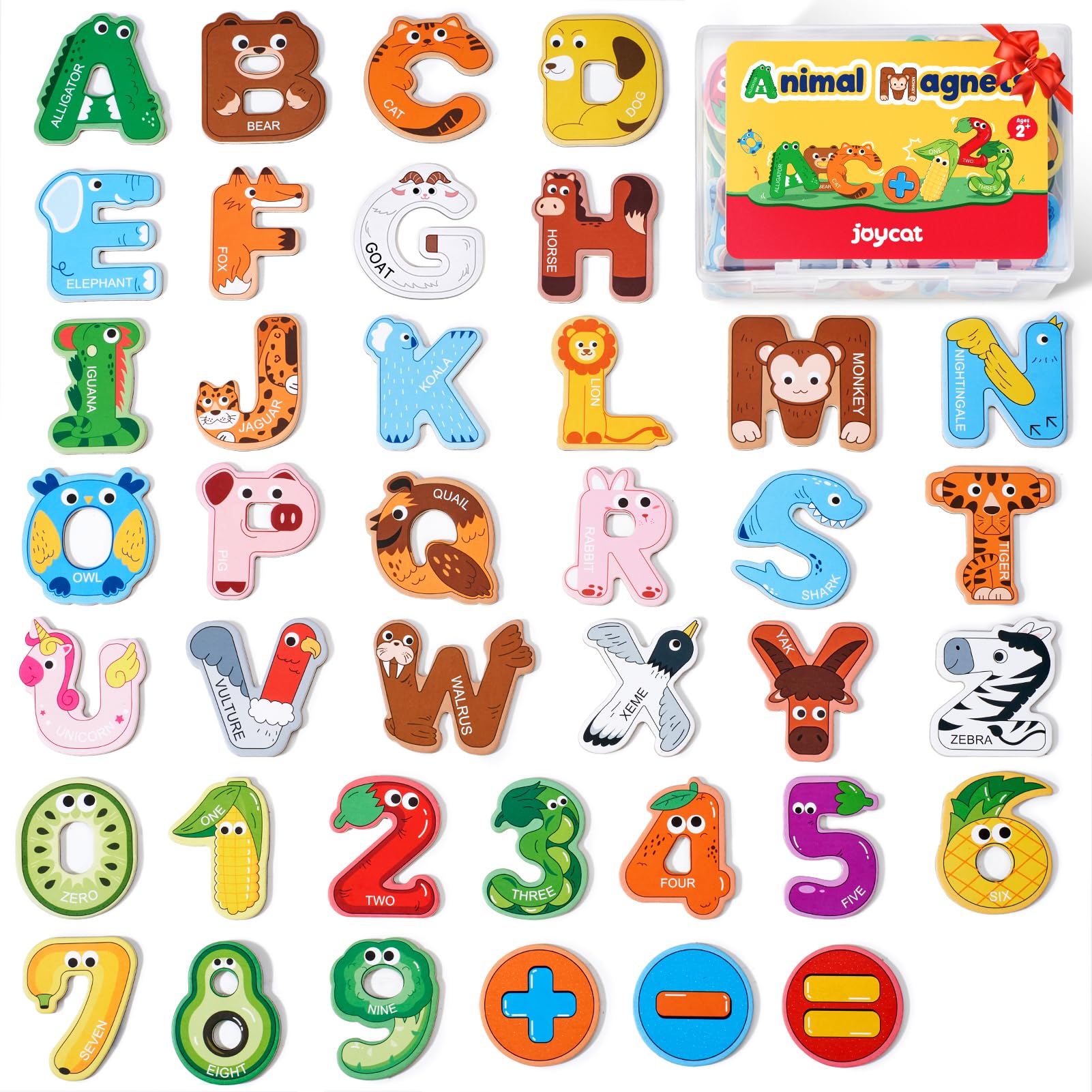
JoyCat Wooden Alphabet Magnets

JoyCat Wooden Alphabet Magnets

Toddlers and preschoolers

Doodle Score 9.2/10
Check Price

Worth Noting

  • Front print can peel with heavy use
Pieces
26 uppercase letters, 10 numbers, 3 math symbols
Storage
Storage box
Material
Basswood
Letter Size
2.36 x 2.5 x 0.14 in
Read the full review

For a toddler who still puts everything in their mouth, the big wooden pieces here are the point. This is the toddler-first choice in our group because it gives you 26 uppercase letters, 10 numbers, and 3 math symbols in thick basswood, with letters about 2.36 by 2.5 inches. The full magnetic back gives little fingers less to pick at than a sticker-covered card, and the size makes the pieces easy to slide from fridge to table.

The animal characters do more work than decoration. Each letter carries a cute illustration, which gives a child something to name and talk about before letter names stick, and the numbers use the same visual language. We liked that the set stays with uppercase letters, the form most toddlers meet first, and the storage box makes it easy to carry a small set from kitchen to car. The pieces are thick enough to feel substantial without being heavy.

The front print can peel after repeated use, so we treat these as a supervised kitchen toy rather than a hand-me-down. The full-back magnet is the bigger win for us: there is no tiny magnet to work loose, and the pieces are easy to grab. The numbers extend the useful life past the alphabet stage, which is more than most toddler sets manage.

Bottom line: We hand the JoyCat wooden set to toddlers first: large, easy-to-grab uppercase letters, plus numbers and a storage box that extend its usefulness.

#5

Laxdacee 192-Piece Magnetic Letters Set

Laxdacee 192-Piece Magnetic Letters Set

Classroom value

Doodle Score 9.2/10
Check Price

Worth Noting

  • Small foam letters can rip when bent
  • ⚠️ Small size needs supervision with toddlers
Extras
30 numbers, 10 math signs, 10 pattern blocks
Pieces
192 pieces
Material
EVA foam
Letter Mix
52 uppercase, 90 lowercase
Read the full review

Laxdacee's set is the one we reach for when a classroom or a big family needs volume without a premium spend. The 192 pieces break down into 52 uppercase letters, 90 lowercase letters, 30 numbers, 10 math signs, and 10 pattern blocks, all in nine bright colors. That is a lot of lowercase letters, which matters more than the headline piece count: you can build several words at once without stopping to hunt for another 'e'.

The full magnetic backing is the feature we appreciate most at this price. It makes the letters feel more secure on a fridge or board than the small button magnets found on cheaper foam sets, and the soft pieces are easy for a child to slide around. The pattern blocks and math signs are a bonus rather than the main event, but they give the set a second life when a child moves from letters to counting and shapes.

We see this as the best value in the group if you want a large shared set. The trade-offs are real: the letters are small, the foam can rip when bent, and the finish is plain compared with the wooden sets. For a classroom, a homeschool shelf, or a family with two children close in age, those compromises are easier to accept than paying premium prices for the same basic function.

Bottom line: We see the Laxdacee set as the value pick for classrooms and busy families: a big foam alphabet with full magnetic backs, plenty of lowercase letters, and useful extras.

#6

Melissa & Doug 52 Wooden Alphabet Magnets

Melissa & Doug 52 Wooden Alphabet Magnets

Classic wooden play

Doodle Score 9.2/10
Check Price

Worth Noting

  • Weak magnets let letters slide
  • ⚠️ Small lowercase pieces need supervision
  • Paint can chip with heavy chewing
Pieces
52 letters
Storage
Storage box
Material
Wood
Letter Mix
26 uppercase, 26 lowercase
Read the full review

Wooden letters sound like the premium choice until a toddler tries to pull one off the fridge and the paint comes with it. The Melissa & Doug set is the classic version of that promise: 52 wooden letters, one uppercase and one lowercase for each letter, in a sturdy box. The pieces are smooth and pleasant to handle, and the color matching between cases gives a child a visual cue for pairing A with a.

We like it most as a first spelling set for a child who is past mouthing everything. The wooden pieces have a satisfying weight, and the two cases make it easy to introduce the idea that letters have big and small forms. It is also the set that looks best left out on a fridge—more like a toy than a classroom supply. For quiet table play, it is the set we keep coming back to.

The magnets are not the strongest here, and the surface can chip or peel if a child chews or drops the letters repeatedly. We noticed that the lowercase pieces are especially small, so this is not the set we hand to a child still exploring with their mouth. For a 3- or 4-year-old learning names and simple words, the size and feel are right; for a rough-and-tumble toddler, foam or thick wood is safer. The box is simple but sturdy, and it keeps the two cases together between spelling sessions.

Bottom line: We choose the Melissa & Doug set for a first wooden alphabet: matched upper- and lowercase letters, a tidy box, and a pleasant feel for a preschooler who no longer mouths pieces.

#7

Educational Insights Lowercase AlphaMagnets

Educational Insights Lowercase AlphaMagnets

Phonics practice

Doodle Score 9.2/10
Check Price

Worth Noting

  • ⚠️ Weak magnets and small pieces
  • Check for missing letters on arrival
Material
Foam
Color Coding
Color-coded vowels
Letter Count
42 lowercase letters
Recommended Ages
3-5 years
Read the full review

Color-coded vowels are the quiet feature that makes the Educational Insights set feel like a teaching tool rather than a toy. The set is 42 lowercase letters, with the vowels picked out in a different color so a child can see the pattern in words like cat, bed, and pig. That is a small thing that pays off during phonics practice: you can ask a child to find the vowel without breaking the flow of the word.

It is also one of the few sets here built around lowercase from the start. Since most of the text a child meets in books is lowercase, that focus makes sense for a 4- or 5-year-old who is beginning to blend sounds. The letters are correctly formed, and the storage case keeps the set contained. We liked that the set does not pretend to be a full alphabet for a toddler; it has a narrower job and does it.

The magnets are not the strongest, and the pieces are small enough to disappear under the fridge or into a toy bin. Check the alphabet against the box when it arrives; a missing letter is easier to resolve at the start. The set is also lowercase only, which means you need another source for capitals if your child is learning names.

We reach for these when the goal is phonics practice, not when we need a first magnet set for a toddler. If your child is already working on vowel sounds and lowercase word building, the color coding earns its place; if you need a big, durable set for a fridge and a 2-year-old, the foam kits are the better fit.

Bottom line: We reach for the Educational Insights AlphaMagnets for phonics-focused practice with lowercase letters, especially when color-coded vowels help a child spot patterns.

#8

MAGTiMES 112-Piece Magnetic Letters

MAGTiMES 112-Piece Magnetic Letters

Budget starter

Doodle Score 9.0/10
Check Price

Worth Noting

  • ⚠️ Small pieces suit older preschoolers
  • Foam can bend and crease
Extras
20 numbers, 6 symbols
Pieces
112 pieces
Material
EVA foam
Letter Mix
26 uppercase, 60 lowercase
Read the full review

How many letters does a first set actually need? MAGTiMES answers with a small, bright pile that covers the alphabet without asking for much space. The 112 pieces include 26 uppercase letters, 60 lowercase letters, 20 numbers, and 6 symbols in five colors. The 60 lowercase letters are the useful part; they let a child build a few short words without running out of vowels.

The foam is light and soft, and the pieces stick to a fridge or magnetic board without much fuss. This is a budget set, and it feels like one: the letters are smaller than the chunky toddler magnets, and the foam can bend or crease. We think that is acceptable if you want a low-cost alphabet to leave on the fridge and do not need the extras that come with the bigger kits.

We treat it as a starter set for a preschooler who is gentle with pieces, or as a second set for a grandparents' kitchen. The size is the main caveat—these are not the letters we choose for a child who still mouths things—but the lowercase coverage and bright colors make it a useful, low-commitment addition. It will not replace a full classroom kit, and it is not trying to.

Bottom line: We treat the MAGTiMES set as a low-cost starter alphabet with a strong lowercase mix, best for a preschooler who handles small pieces carefully.

How We Tested 16 Sets of Magnetic Letters

We built a shortlist from the magnetic letter sets sold at major retailers and specialty toy shops, filtering for age recommendations, magnet construction, and enough duplicate letters to spell simple words. Price mattered, but we also looked at how many pieces were actually usable—not just how big the box was.

We tested 16 sets over three months, living with them on a kitchen fridge, a magnetic whiteboard, and the playroom floor. Each morning I stuck up a few words and names, then let my toddler and a preschooler take over; we noted which letters slid down or spun when the fridge door closed, which ones held a sheet of artwork without creeping, and which got ignored after five minutes.

Durability got its own round of abuse: we dropped letters from counter height onto tile, stepped on a few in bare feet, wiped them with a damp cloth after jam-handled play, and checked whether the magnets stayed seated inside the plastic. We measured the height of every letter and used a toilet-paper tube as a rough small-parts check for younger siblings, then counted how many duplicates and vowels each set included.

For sets with audio readers, we listened to each letter sound at arm’s length and across a noisy kitchen, flagging garbled pronunciations and volume that jumped around. We also compared letterforms—the lowercase a, g, and l especially—against the shapes kids see in early reading materials, because a cute font that confuses b and d is not cute anymore. At the end, we tallied the pieces still on the fridge and still being played with—our version of value.

How to Choose Magnetic Letters

Start with the letter mix, not the piece count

An alphabet of 26 letters is enough for display and letter naming, but it stalls the moment a child wants to spell a name with two A's or a word with three E's. We look for a set with at least two of each lowercase letter and several vowels. For a toddler, uppercase pieces are easier to recognize and grab; for a preschooler, lowercase is the form that appears in books. The Gamenote kit's 182 lowercase letters are more useful for spelling than a 26-piece display set, even though both contain the same alphabet.

Check the magnet backing before anything else

A full-cover magnet is the safer choice for young children because there is no small button magnet to work loose, and it usually holds better on a fridge or board. Run a fingernail along the edge of a letter; if the backing lifts, the piece will not survive a toddler's grip. Small magnets that detach are a choking hazard, so remove any damaged letter from use. We prefer full-back foam for toddlers and reserve small, flat classroom magnets for older children who no longer mouth pieces.

Decide whether a board belongs in the purchase

A fridge is enough if you have a magnetic door and want the letters within reach while you cook. A magnetic board adds a portable workspace and a place for dry-erase practice, which is why the Gamenote and KOKO AROMA kits feel more complete. Board quality matters: an aluminum board feels more permanent than a cardboard one, and a double-sided surface gives two children room to work. If your fridge is stainless and not magnetic, a board solves the problem before you buy.

Match the material to the child's habits

Foam is light, quiet, and easy to slide, which makes it the best choice for a large shared set. Wood feels nicer in the hand but can chip or peel when chewed or dropped, so it suits a preschooler who has stopped mouthing pieces. Plastic wipes clean and holds up to rough handling, while thick cardboard gives you large, cute letters at the cost of durability. We choose foam for classrooms, wood for quiet table play, and plastic for a set that needs to be wiped down often.

Plan for size, storage, and supervision

Most magnetic letters are rated for ages 3 and up, and that rating exists for a reason: small pieces are choking hazards. For a toddler, look for large pieces with full-back magnets and keep the set in supervised play. A compartment box saves cleanup time and makes missing letters easier to spot; a plain bin works if you are willing to sort. After play, check the letters for peeling edges or loose magnets and remove any piece that is starting to come apart.

Frequently Asked Questions

Final Verdict

We keep coming back to the Gamenote kit because it handles the most buying situations: enough upper- and lowercase letters for real word building, a double-sided board that gives the letters a place to live, and a storage box that makes cleanup realistic. It is not the budget pick or the most polished set here, but it is the one that turns a pile of magnets into a usable learning routine.

If a toddler is still putting pieces in their mouth, change the requirement and start with the JoyCat wooden letters instead; the larger pieces and full-back magnets are worth the smaller alphabet. For a phonics-first classroom, the Educational Insights lowercase set is the specialist alternative.