RC & Vehicles

Best Toy Airplanes of 2026

Every toy airplane has one perfect throw in it — the one where it catches the air and sails clear across the yard. Then it lands nose-first in the dirt, and you find out what you actually bought. The good ones shake it off, fly straight on the next throw, and keep a kid outside long enough to wear out a pair of sneakers; the bad ones shed a wing, peel their decals, or dive so reliably they're forgotten by Tuesday.

I've thrown plenty of the bad ones. Over the past four months, my team and I flew, launched, and crashed 14 toy airplanes — foam gliders, die-cast models, motorized fliers, and a couple of float planes — and the pattern held: the ones kids return to are the ones that survive the tenth throw, not just the first. Value matters more here than in almost any toy category, because a cheap plane that lasts all summer beats a spendy showpiece that loses its propeller in a week. Here's what earned a second throw.

#1

Green Toys Airplane

Green Toys Airplane

Everyday toddler play

Doodle Score 9.6/10
Check Price

Worth Noting

  • No figures included, and the cockpit is tiny
Size
9 x 9 x 4 inches
Weight
5.6 oz
Cleaning
Dishwasher safe
Recommended Age
12 months to 10 years
Read the full review

No batteries, no assembly, no small parts to lose: the Green Toys Airplane comes out of the box as one molded body with a propeller and two wheels, and that absence of features is exactly why we make it our top pick. It is the plane we hand to a one-year-old without hovering. The body is recycled milk-jug plastic, the edges are rounded, and at 9 by 9 by 4 inches it is light enough for a toddler to carry one-handed and drop without consequence.

On the floor it rolls on its wheels and the propeller spins, which is the entire trick and enough for the age group. It also goes in the bathtub and, more usefully, in the dishwasher, so sand, yogurt, and whatever else a plane picks up comes off without a toothbrush. Nothing about it is going to break in a way that matters.

The trade is that there is nothing else here. No lights, no launcher, no passengers, and no speed. A seven-year-old who wants a plane that does something will be bored inside an afternoon, which is what the foam gliders and the LEGO kit are for. But for the first four years of plane play, this is the one we buy.

Bottom line: Our default first plane: tough, battery-free, dishwasher-safe, and simple enough that a one-year-old and a five-year-old both find something to do with it.

#2

Barbie Dreamplane

Barbie Dreamplane

Doll and role play

Doodle Score 9.6/10
Check Price

Worth Noting

  • Barbie doll sold separately
  • Needs real floor space when opened out
Seats
Pilot plus 2 reclining passengers
Pieces
25
Accessories
15+ including snack cart and puppy
Recommended Age
3 years and up
Read the full review

Closed, the Dreamplane is roughly the length of a one-year-old. Open the top and one side and it unfolds into a cabin that takes up a small rug: a pilot's seat, two passenger seats that really recline, a snack cart, and a puppy riding along. Closed again, it rolls on its wheels like any other plane.

What earns it the pick for doll play is the accessory loop rather than the flying. There are more than fifteen pieces, from meals and trays to a water bottle, a blanket, an eye mask, headphones, and luggage that actually works, and in our experience the packing, unpacking, and seat-shuffling holds attention far longer than the takeoff does. A five- to eight-year-old with a Barbie habit will get everything the set is worth.

Setup is minimal: it comes out of the box ready to open and play, and the work is in keeping track of the small parts, which a zip bag solves. The 3-plus age on the box is honest for the plane itself, but the accessories suit the older end of that range better, and the whole thing stores better on a shelf than on the floor between sessions.

Bottom line: The pick for Barbie kids: a plane that unfolds into a cabin full of accessories, and the only playset here built around doll role play.

#3

LEGO Technic Bush Plane

LEGO Technic Bush Plane

Building and display

Doodle Score 9.6/10
Check Price

Worth Noting

  • No play until 333 pieces are together
Size
10.32 x 5.55 x 3.58 inches
Pieces
333
Recommended Age
8 years and up
Working Features
Spinning propeller, adjustable ailerons, 4-cylinder piston engine
Read the full review

Turn the propeller and four pistons rise and fall in the engine block you assembled yourself, which is the moment this set earns its place. We rate it the best buildable plane here because the reward for 333 pieces is a mechanism you can watch work, not a model that only sits there.

The rest of the kit supports it. The ailerons on the wings move by hand, the propeller spins from a control you build into the cockpit, and the zebra-stripe livery ties into the bush-plane conservation idea rather than just looking cool. It is the most interesting build in this roundup for a kid who takes things apart to see how they work.

Two things to know. Nothing happens until the build is finished, so this is a gift for a child who enjoys the assembly as much as the result, and younger siblings will need help with the engine. And it does not fly, launch, or float: swooping it around the room by hand is the play, and the model is solid enough for that once the pieces are pressed home.

Bottom line: The buildable pick for ages eight and up: a working engine and propeller make the assembly the reward, not a chore before the play.

#4

Melissa & Doug Wooden Airplane Set

Melissa & Doug Wooden Airplane Set

Preschool pretend play

Doodle Score 9.6/10
Check Price

Worth Noting

  • Made for ages 3 to 6, so it is outgrown early
Size
10.0 x 5.5 x 4.1 inches
Pieces
9
Material
Wood
Recommended Age
3 to 6 years
Read the full review

Four wooden passengers, four suitcases, and a plane with wings that fold down: that is the whole set, and the luggage is what turns it from a shelf object into a toy. A three-year-old packs and unpacks, decides who sits where, and narrates a trip, and the plane is the prop rather than the point.

We like the folding wings for a practical reason. The set stores in a fraction of the space, which matters in a cupboard already full of bigger plastic, and the nine pieces go back together in under a minute. The wood is solid, there are no batteries or screens, and it happens to be the set that starts the airport conversation before a real flight.

Bottom line: The preschool pick: four passengers, four suitcases, and a wooden plane that turns packing and unpacking into the whole game.

#5

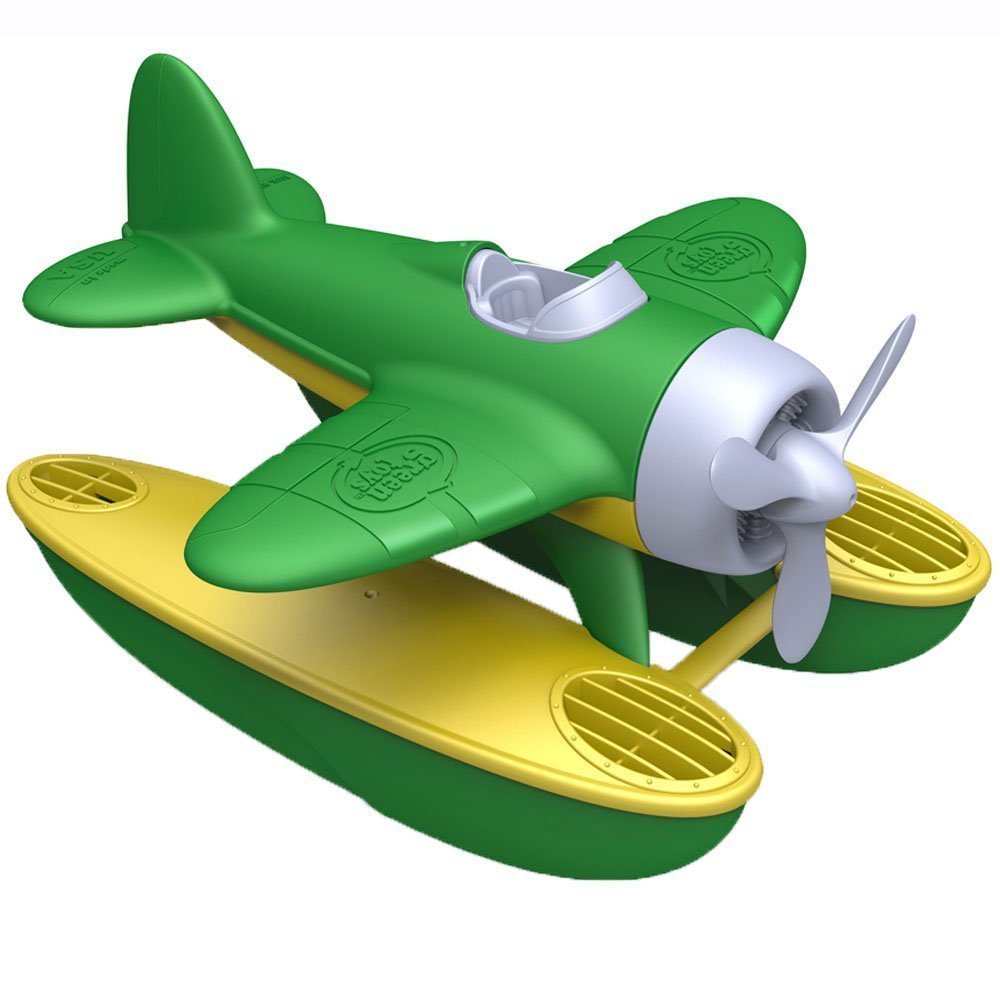
Green Toys Seaplane

Green Toys Seaplane

Bath and pool

Doodle Score 9.6/10
Check Price

Worth Noting

  • Not every one floats level
Size
9 x 9 x 5 inches
Cleaning
Dishwasher safe
Material
Recycled plastic milk jugs
Recommended Age
3 months to 10 years
Read the full review

Drop the Seaplane in the bath and it does the one thing a bath toy has to do: it floats. Two chunky pontoons hold it up, the propeller spins when a small hand pushes it, and it moves between the tub, the paddling pool, and the beach bag without complaint.

The body is recycled plastic like its sibling, and the whole plane is dishwasher safe, which is the answer to the question every bath toy eventually raises. Water that gets inside takes a shake and a night on the drying rack to leave, and ours needed both. That is a small chore next to scrubbing a hollow toy with a bottle brush.

Its role is narrow by design. On carpet it slides rather than rolls, so it is not the plane a kid pushes around the living room; it is the one that lives in the bathroom caddy and comes out at the end of the day. For a one- to three-year-old who already loves the water, that is a very good use of a small toy.

Bottom line: The bath-time pick: a dishwasher-safe floatplane with chunky pontoons that earns its place in the tub rather than the toy bin.

#6

Daron Southwest Die-Cast Plane

Daron Southwest Die-Cast Plane

Realistic airline model

Doodle Score 9.2/10
Check Price

Worth Noting

  • Plastic wings are the fragile part
  • Stickers peel at the edges
Length
5.75 inches
Assembly
None required
Wingspan
5 inches
Materials
Die-cast metal with plastic parts
Read the full review

Five and three-quarter inches long with a five-inch wingspan, the Daron Southwest plane is small enough for a coat pocket and detailed enough that the livery is the real thing: licensed markings, a metal body, rolling wheels, and no assembly.

It does exactly one thing, and that is roll. No propeller, no lights, no doors. For a kid in the middle of an airline phase that is plenty, because it is the plane they actually flew on, at a size they can hold through a boarding wait and push along a tray table.

Scale is the other thing to weigh. This is the smallest plane in the roundup by a wide margin, roughly half the length of the LEGO Technic model, which is either the whole appeal or a disappointment depending on whether the child wants a fleet to line up or a plane to carry everywhere.

We treat it as two toys in one: a desk object for the adult who flies a lot and a pocket companion for the kid who does. It is the pick when the point is a particular airline rather than aviation in general.

Bottom line: The realistic-model pick: licensed Southwest livery on a pocket-sized die-cast body that rolls, for the kid obsessed with the actual airline.

#7

BooTaa Foam Glider 4-Pack

BooTaa Foam Glider 4-Pack

Outdoor throwing

Doodle Score 9.0/10
Check Price

Worth Noting

  • Tail fin is the first part to crack
Material
EPP foam
Pack Size
4 planes
Plane Length
17.5 inches
Recommended Age
3 to 12 years
Read the full review

A small wing fits into one of two slots cut in the tail, and that single choice decides whether the plane sails straight ahead or loops back over your head. Switching takes seconds and needs no tools, which is the best thing about these gliders: a kid can experiment without waiting for an adult.

The pack holds four planes, each 17.5 inches nose to tail and made of EPP foam, soft enough to catch bare-handed and light enough that a nose-first landing on grass is a non-event. Four of them changes the game. Two kids can throw at once, a parent can join, and a plane that lands badly does not end the afternoon. They pack flat enough to live in the car.

As with any foam glider, they are at the mercy of the wind, and a calm evening is worth more than a strong arm. Where this set beats the alternatives is the spares built in: you get a squadron rather than a single plane you are afraid to throw. This is the one we take outside.

Bottom line: The best outdoor pick here: four foam gliders, two flight settings, and enough spare planes that a hard landing does not end the game.

#8

Wesfuner Launcher 3-Pack

Wesfuner Launcher 3-Pack

Backyard launching

Doodle Score 8.8/10
Check Price

Worth Noting

  • Launcher pull is stiff for small children
  • Foam cracks where the launcher grips
Range
33 to 49 ft
Includes
Launcher, 3 planes, stickers
Material
Foam
Recommended Age
3 to 12 years
Read the full review

The launcher is the toy here, not the plane. A plastic handle with an elastic band pulls back, grips a foam plane, and throws it 33 to 49 feet according to the listing; the three planes are, in effect, ammunition.

The lights are the sleeper feature. The planes glow, so the last half hour of daylight becomes the best half hour, and the included stickers let a kid claim one as theirs. Assembly takes a minute and the foam is soft enough that a bad throw is funny rather than painful.

It is an outdoor toy in the way a kite is. A backyard or a park with room behind the target is the right setting, and a word about not aiming at faces covers the rest. Indoors we found the planes bounce off furniture within a throw or two, and the launcher ends up by the back door until the weather turns.

Set against the hand-thrown BooTaa gliders, this one adds distance and lights and asks you to keep track of a launcher. For a family with a yard and more than one kid, that is a fair trade.

Bottom line: The most active outdoor option: a launcher that sends glowing foam planes across a yard, for families with space and more than one thrower.

How We Tested (and Crashed) the Best Toy Airplanes

We started by rounding up every toy airplane a kid could actually get their hands on — balsa and foam gliders, die-cast models, motorized prop planes, and water-ready float planes — then narrowed the list by price, recommended age, wingspan, and whether replacement parts existed. That left 14. Each one was unpacked and assembled the way a family would at the kitchen table, with a timer running and no help from us.

Then they went outside. Every plane flew in a backyard on a calm evening and again on a breezy Saturday, and we counted throws until the first real damage — a cracked nose, a bent tail, a wing that wouldn't stay clipped on. We noted whether it flew straight or hooked left, roughly how far it carried, and whether a 7-year-old could relaunch it without an adult crouching down to help.

Durability got its own round of abuse: we threw each plane into a fence, dropped it from shoulder height onto pavement, and let the stickers sit through a week of sweaty-handed play to see whether the edges curled. Paint got checked after every crash session, and the float planes went into a bathtub and a shallow pool to see whether they landed upright or flipped and took on water. Looks counted too, since a plane that doesn't look like a plane doesn't get picked up, and we kept a running note of which ones were still being flown voluntarily two weeks in. Last, we divided price by the number of afternoons each one survived, which is the only value math that matters.

How to Choose Toy Airplanes

Start With How It Gets Played

Four kinds of airplane toy turn up in this search, and they are not interchangeable. There is the floor plane a small child pushes around and narrates over, the foam glider that exists to be thrown, the buildable model that is really about the mechanism, and the water toy that lives in the bath. A four-year-old who wants to fly to Grandma's house and a seven-year-old who wants to see how far something goes need different objects.

We match the toy to the action rather than to the box art. If you are not sure, buy the simple one: it is the version that gets played with by the widest age range, and it tells you which kind of plane kid you have before you spend more.

Age Grading Is a Real Limit

Every listing here carries a recommended age, and the spread is wider than it looks: a molded one-piece plane can start at twelve months, a building set waits until eight, and trays, figures, or stickers push a playset to three and up. Buy for the youngest child who will get their hands on it, not just the birthday kid. That is the trap in a house with a toddler and a second-grader.

Anything with small accessories should clear age three, and a launcher with an elastic band needs an adult nearby regardless of what the box says.

Check Which Parts Are Actually Metal

Die-cast is the most misleading word in this category. It often describes a metal fuselage with plastic wings, and the wings are exactly what snaps when a plane is dropped. Foam has the same weak point in a different place: the tail fin takes the hits, not the fuselage.

Before you pay for toughness, look at what carries the livery. Painted-on markings last; stickers peel at the edges, especially on a metal body. We treat a plane with plastic wings as a display-and-pocket toy and a molded one-piece as the one that goes in the toy bin.

Give Some Thought to Size and Storage

Size decides where a plane can be used as much as who can use it. A 17.5-inch glider needs a yard or a park, a big transforming playset needs floor space the whole time it is open, and a five-inch model lives in a pocket or on a desk. None of those is better than the others; they belong in different rooms.

Fold-down wings and a playset that closes back into a plane make the difference between a toy that gets put away and one that stays on the floor. Measure the space you actually have before you fall for the biggest thing on the page.

Plan for Water, Sand, and Cleaning

Plastic planes sold for the bath are dishwasher safe here, and that is the single most useful line on a listing once a toy starts commuting between the tub and the playroom. Wood should be wiped rather than soaked, and metal bodies with stickers do not enjoy water at all.

If a plane is going to get wet, check the cleaning instructions before the first bath. A toy that cannot be properly dried is a toy that starts to smell, and hollow bodies hold water longer than you expect.

Frequently Asked Questions

Final Verdict

The Green Toys Airplane is the one we point to first, and the reason is boring in the best way: it is molded in one piece, needs no batteries, survives the bathtub and the dishwasher, and works for a one-year-old and a five-year-old alike. Buy it as the default and let the child's play tell you where to branch next.

If the child wants to know how a plane works, the LEGO Technic Bush Plane is the better gift. If the energy is outdoors, the BooTaa four-pack turns plane play into a game with a running start.