RC & Vehicles

Best RC Drones for Kids of 2026

A kids' drone has one job before anything else: survive the first afternoon. Cheap ones tend to split into two camps — featherweight toys that drift off on the slightest breeze, and sturdy little tanks that hover about as gracefully as a brick. What you actually want is something that flies smoothly enough to be genuinely fun, holds its position when your kid takes their hands off the sticks, and shrugs off the inevitable crash into the hydrangeas. Get that balance right and a drone stops being a fragile gadget your kid is afraid to break and becomes the thing they beg to take to the park.

I spent three months handing 14 drones to kids between six and eleven, in backyards, at a park down the street, and in a basement on rainy days, and the pattern was hard to miss: the drones that got played with were the easy ones, not the fancy ones. One-touch takeoff and a real altitude-hold button do more for a first-time pilot than any camera claim, and a second battery in the box beats an extra hundred feet of range every time. The picks below are the ones my testers kept asking to fly again.

#1

SYMA X100

SYMA X100

Young indoor pilots

Doodle Score 8.6/10
Check Price

Worth Noting

  • Indoor focus limits outdoor flying
Safety
Full guard and sensors
Batteries
2 included
Flight Time
Up to 20 minutes total
Obstacle Range
About 12 inches
Read the full review

The X100's first trick is not a flip; it is the ring of four infrared sensors that watch for walls and furniture within about a foot. Add the fully enclosed propeller guard and this is the drone we feel most comfortable handing to a younger pilot indoors. The two batteries are rated for up to 20 minutes total, which is enough for a couple of practice sessions.

What earns it a place is how directly it addresses the two things that make a first flight go wrong: hitting something and panicking. The obstacle avoidance actually nudges the drone away, and altitude hold keeps it from climbing into the ceiling while small hands learn the sticks. One-key takeoff and landing and headless mode are there too, so the learning curve stays shallow.

It is an indoor specialist. At 58 grams with sensors tuned for close obstacles, it is happiest in a room rather than over a park. For a first solo hover in a living room, the X100 is the one we reach for first. The sensor ring is the part that changes the experience: the drone backs away from the sofa instead of testing it.

Bottom line: We recommend the X100 for younger kids flying indoors: obstacle sensors and a full cage turn a living room into a safer practice space.

#2

HASAKEE Q9s

HASAKEE Q9s

Nighttime light shows

Doodle Score 8.6/10
Check Price

Worth Noting

  • Short per-battery runtime
Size
6.9 x 6.9 x 2 in
Camera
720p
Safety
Four propeller guards
Batteries
Two 500mAh packs
Read the full review

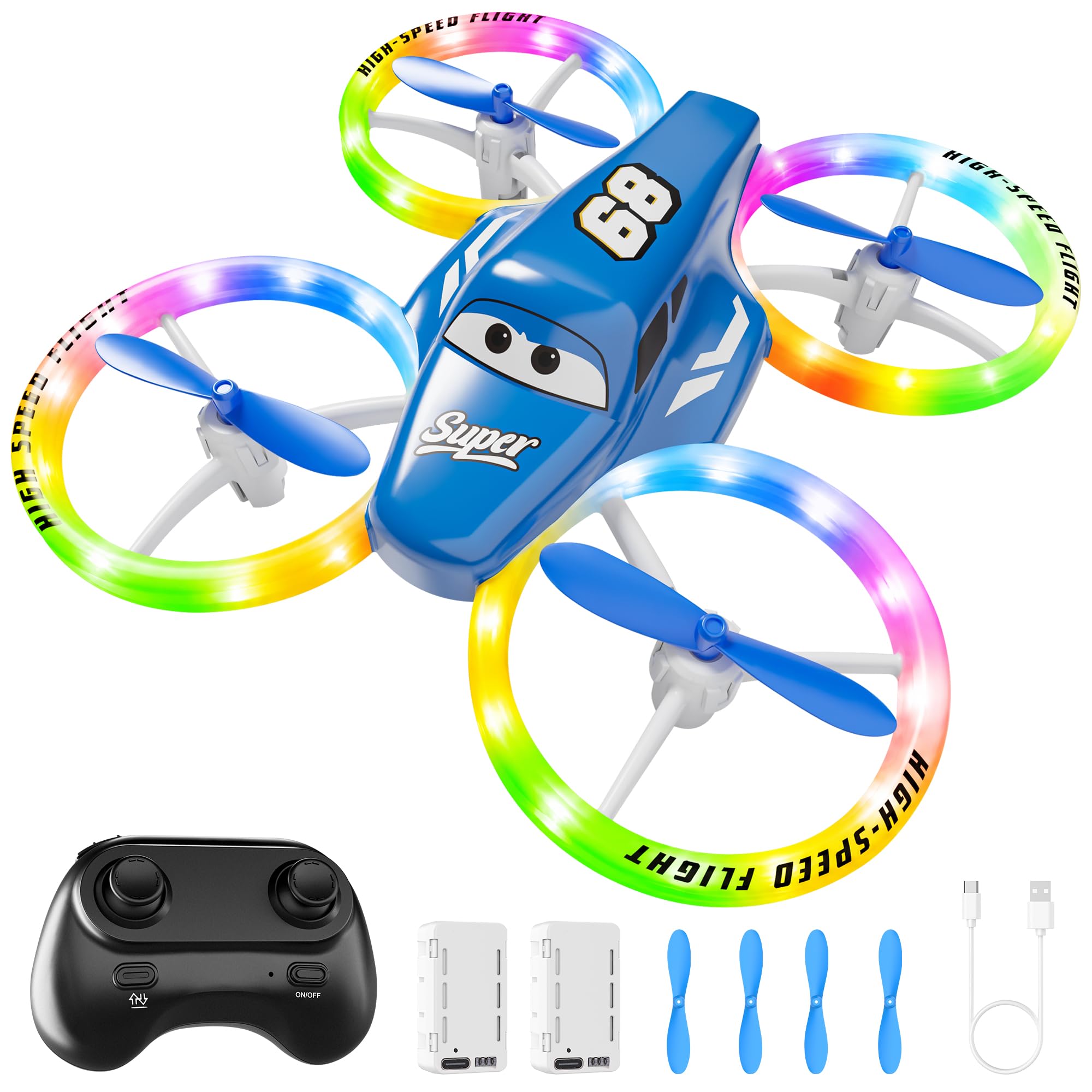
The Q9s is the one that looks like an event. Neon green and blue LEDs run through the frame, and the glow modes make a dim room feel like a night flight. That is the reason to choose it over the more sober mini drones here; in daylight it is a small toy quadcopter with the usual flips and headless controls.

We also like that the fun is not fragile on paper: four propeller guards surround the blades, two 500mAh batteries are included, and the controller has three speed levels. The 720p camera is a bonus for snapshots, not the main event; do not expect stabilized video. For a kid who wants a drone that announces itself, this is the most entertaining pick in the group.

The catch is the session length. Each battery delivers only a short flight, so the two-pack is less generous than it sounds, and hard crashes can take a toll. Keep it indoors or in very calm air, and treat it as a visual toy rather than a long-range flyer. The glow modes do make the drone easier to track against a wall, which matters when the room lights are low.

Bottom line: We recommend the Q9s for the kid who wants a night-flight spectacle: the LEDs are the attraction, and the guarded body keeps indoor fun manageable.

#3

RELIDOL X62

RELIDOL X62

Aerial photos

Doodle Score 8.6/10
Check Price

Worth Noting

  • Drifts in even light wind
  • Hard crashes can damage it
Range
30 meters
Camera
1080p
Batteries
2 included
Flight Time
Up to 25 minutes total
Read the full review

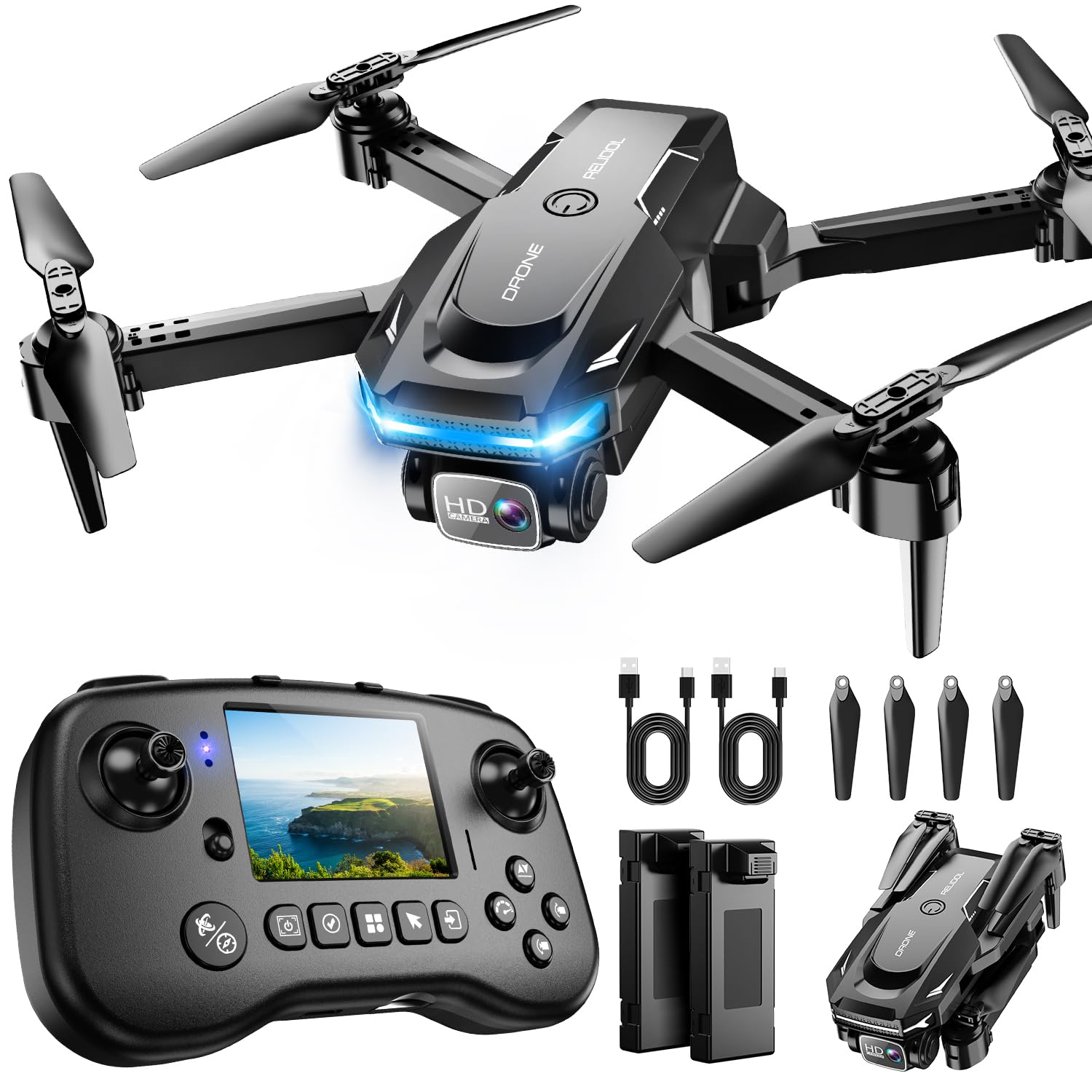
A 1080p camera, two batteries, and a foldable body at the value end of this group: the X62 is the obvious first stop if photos matter. The camera sits on an 80-degree adjustable mount, and the drone can be flown from the remote or through the phone app. For a kid who wants to see the yard from above, that is a lot of toy for the money.

The flight experience is beginner-friendly on paper: one-key start, altitude hold, optical flow, and an emergency stop. The two batteries are rated for up to 25 minutes total, so there is enough time to learn the controls and still grab a few clips. The app adds waypoint flying and gesture controls, which are fun to try and not the reason to buy.

Our reservation is that the camera is a toy camera: footage is good enough for sharing, not for stable aerial video, and the app's gesture tricks are more novelty than production tool. That is fine for a kid's first aerial snaps. If the camera is the hook that gets a kid outside and flying, the X62 earns its spot. The 80-degree mount is enough to aim at the yard without landing, and that is the detail that makes the camera useful rather than decorative.

Bottom line: We recommend the X62 as the camera-first kids' drone: it puts 1080p video and two batteries within reach without pretending to be a serious aerial camera.

#4

RELIDOL PK01

RELIDOL PK01

Phone-free camera flights

Doodle Score 8.6/10
Check Price

Worth Noting

  • MicroSD card required for recording
  • Premium price
Camera
1080p
Batteries
2 included
Flight Time
Up to 25 minutes total
Controller Screen
Built-in
Read the full review

The PK01's built-in screen is the feature that changes the experience. Instead of clipping a phone into a controller and hoping the app behaves, a kid gets a live view and flight readouts right on the remote. For parents who do not want to hand over a phone, that alone is worth the step up.

The rest is a familiar foldable camera drone: 1080p video, two batteries, one-key start, altitude hold, and an emergency stop. The camera is clear enough for casual clips, and the controller feels more substantial than the phone-app setups here. It is a simple package to hand to an older child who wants to shoot video rather than just hover.

The app is still there if you want waypoint flying or gesture tricks, but the screen is the reason to choose this model. It is also the most expensive pick in this group, which makes it a harder sell for a child who may lose interest after a month.

Our call: the PK01 is the premium choice for a family that wants camera flights without phone drama. The screen also means no notifications, no incoming calls, and no app updates between flights; that quiet is part of what you are paying for.

Bottom line: We recommend the PK01 for families who want camera flights without a phone: the built-in screen makes it the most self-contained pick here.

#5

Helatt 807

Helatt 807

Low-cost starter

Doodle Score 8.6/10
Check Price

Worth Noting

  • Controls can feel vague
  • Stability is not always steady
Range
133 feet
Batteries
2 included
Flight Time
Up to 16 minutes total
Light Modes
5 LED modes
Read the full review

The Helatt 807 is the lowest-priced drone we kept in the roundup, and the light package is the reason. Five LED modes cycle from the remote, and the full propeller guard wraps the blades. For a first taste of flying, that combination is more appealing than a plain black mini drone.

The basics are covered: one-key takeoff and landing, altitude hold, two speed levels, and two 500mAh batteries rated for up to 16 minutes total. The 133-foot range is fine for a yard or a large room. It is an eight-ounce toy, so it is not going to cut through wind, but it is also not going to terrify a beginner.

The ready-to-fly package is simple: two batteries, a full guard, and a controller that runs the light modes. It is not trying to be a camera drone or a long-range flyer.

For a low-cost gift that lights up and flies without a phone, the 807 makes sense. We recommend it as a starter toy, not as the one drone a family grows into. The controller's light button is the first one kids find, and that tells you who this drone is for.

Bottom line: We recommend the Helatt 807 as a low-cost starter: it lights up, flies simply, and asks for no phone, though it is not the most precise flyer.

#6

Holy Stone HS210

Holy Stone HS210

First family drone

Doodle Score 8.4/10
Check Price

Worth Noting

  • Short run time from each battery
  • Light enough to drift in a breeze
Range
160 feet
Safety
Full propeller guards
Batteries
3 included
Flight Time
Up to 21 minutes total
Read the full review

Three batteries are the practical heart of the HS210. The kit claims up to 21 minutes total, and because each pack swaps in a few seconds, a kid gets several short turns without waiting on a charger. At 3.15 inches across and 50 grams, it is small enough for a living room, and the full propeller guards make the inevitable bumps less dramatic.

That combination is why it is our top pick for most families. Altitude hold keeps it at a steady height while a beginner learns the sticks, headless mode means the controls stay relative to the pilot, and one-key takeoff and landing removes the scariest part of the first flight. The 160-foot range is generous for a backyard or school gym, and three speeds let the drone grow with the child.

Tricks are here, including 3D flips and auto rotation, but they are a bonus rather than the sell. The controller is a real remote rather than a phone app, so setup stays simple. The spare props in the box acknowledge that new pilots crash, which is the right attitude for this category.

Bottom line: We recommend the HS210 as the default kids' drone: three batteries, full guards, and simple controls make it the easiest all-around first quadcopter for most families.

#7

Holy Stone HS190

Holy Stone HS190

Travel and apartments

Doodle Score 8.4/10
Check Price

Worth Noting

  • One battery limits sessions
  • Too light for breezy outdoor flying
Range
96 feet
Weight
1.23 oz
Batteries
One 220mAh pack
Folded Size
2.44 x 2.44 x 0.94 in
Read the full review

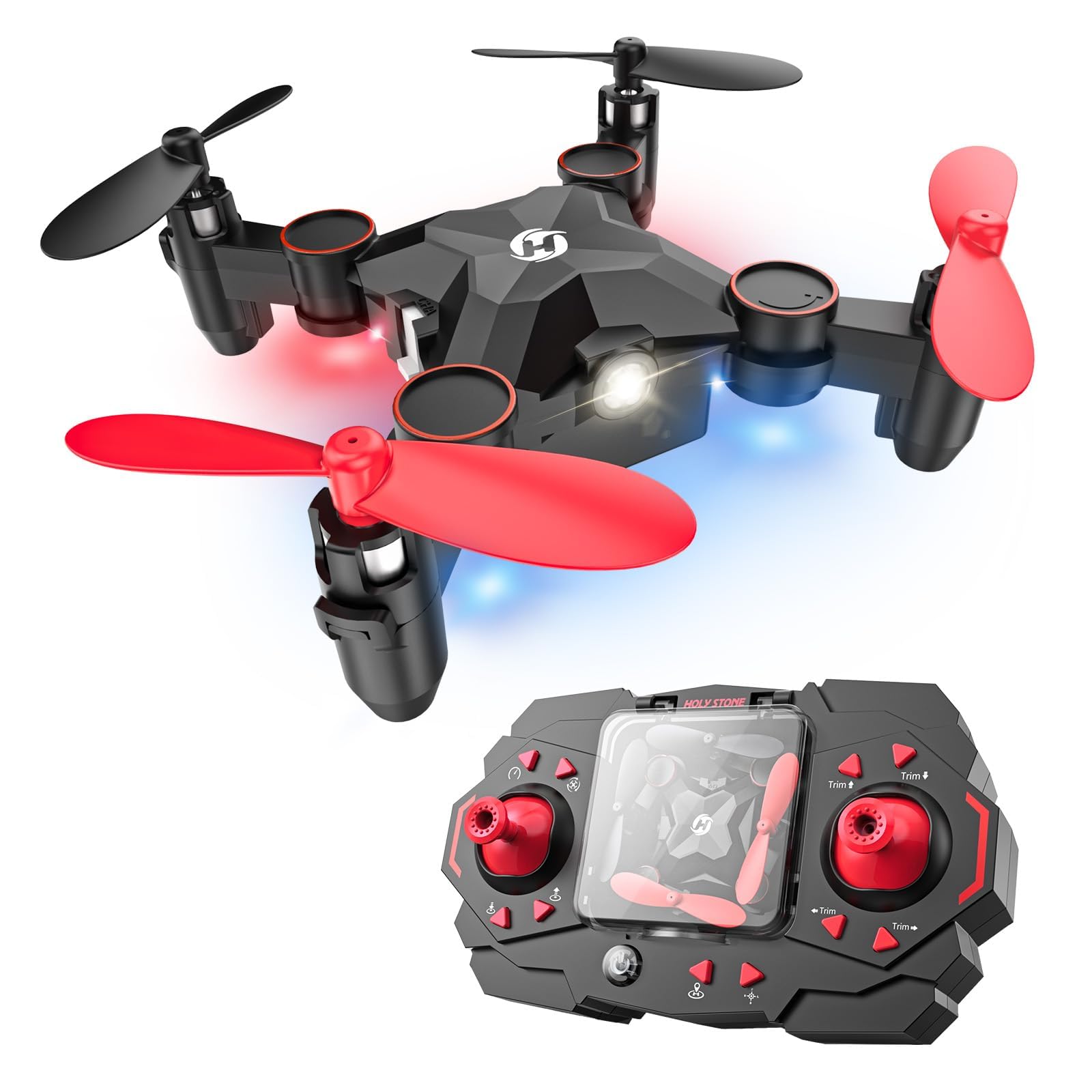
The HS190 folds into its own controller, which is the whole pitch. At 35 grams and roughly 2.4 inches square when folded, it disappears into a glovebox, a jacket pocket, or a backpack. No camera, no phone, no bag of accessories.

For that tiny size, it is surprisingly complete: three speed modes, altitude hold, headless mode, one-key takeoff and landing, and an emergency stop. The 96-foot range is enough for a living room or hotel room, and the propeller guards are already fitted. It is the drone we leave in the car for spontaneous sessions.

As a travel drone or a first indoor hover, that is a fair bargain. It will not replace a camera drone or a longer-flying backyard model, but the controller itself becomes the case, so there is nothing extra to remember.

Bottom line: We recommend the HS190 as the take-anywhere first drone: it folds into its controller and turns a spare moment into flight time.

#8

Veeniix V995

Veeniix V995

Budget battery bundle

Doodle Score 8.4/10
Check Price

Worth Noting

  • Hovering can drift
  • No camera
Safety
Propeller cage
Weight
0.79 oz
Batteries
3 included
Flight Time
21+ minutes total
Read the full review

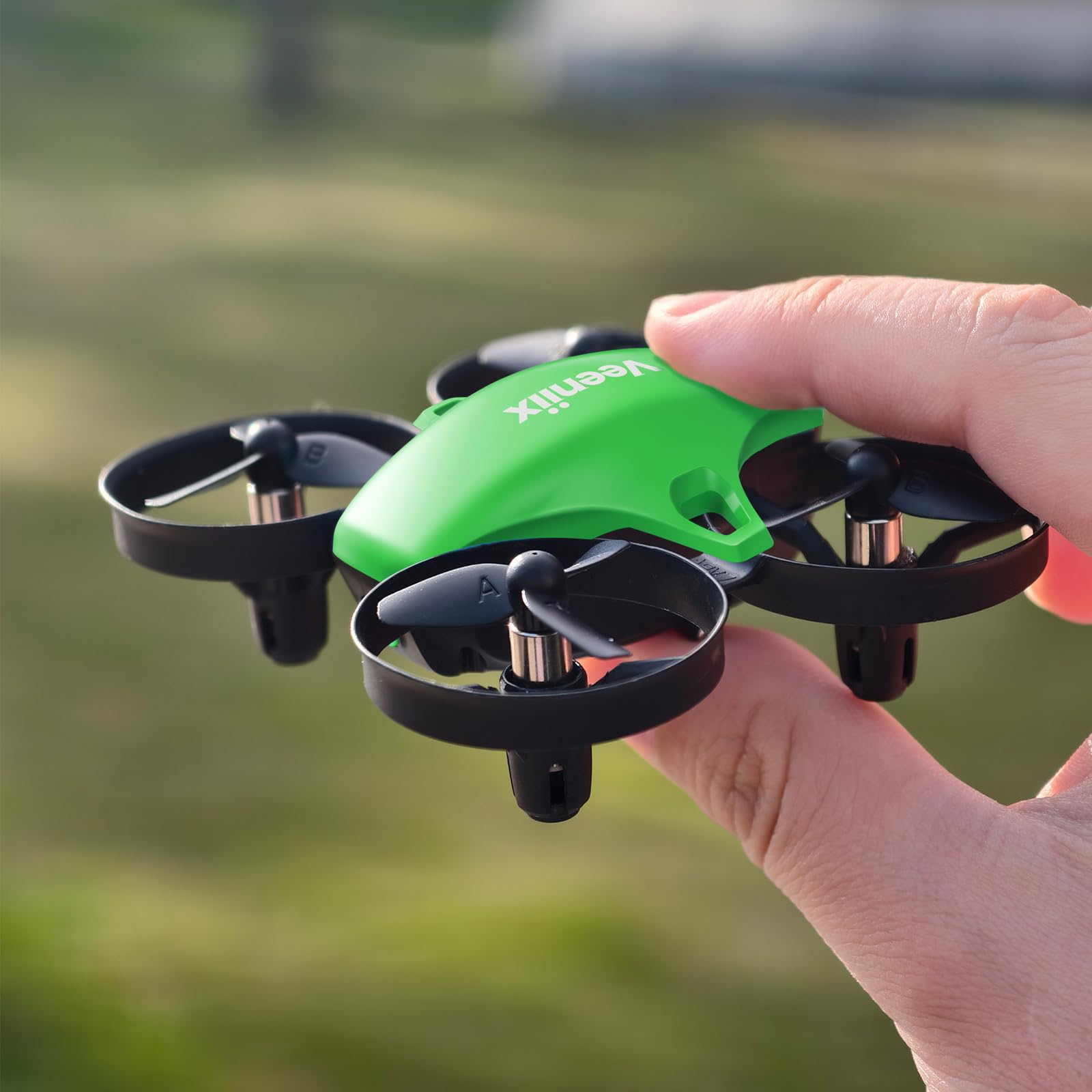
At 22 grams, the V995 is the drone we worry about least when it clips a chair leg. The cage surrounds the blades, the body is light enough to bounce rather than bite, and the package includes three batteries. That is the value case: more spare packs and less anxiety than most of its budget rivals.

Flight aids are all here, including altitude hold, headless mode, one-key takeoff and landing, and one-button flips. The controls respond quickly, and the three batteries are the reason it can stay in the air across a whole play session rather than one short hop. The 21-plus-minute total is spread across three packs, which is the honest way to buy flight time. For a family that wants a low-stress indoor or calm-air toy, that combination is genuinely useful.

It is not the most precise hover in this group, and the very light weight means any breeze has an outsized effect. The upside is that it survives the bumps those mistakes produce; for a first drone that will be handed between kids, that is the part we trust.

Bottom line: We recommend the V995 for families who want the most airtime for the least anxiety: three batteries, a caged body, and simple controls at the value end.

How We Tested the Best RC Drones for Kids

To build the shortlist, I read spec sheets and parent reviews for more than 40 drones, then cut anything that required a smartphone to fly, weighed more than a pound, or arrived without propeller guards. That left 14 models, which my team and I flew for three months in backyards, at a neighborhood park, and in a basement on rainy weekends, with kids from six to eleven on the sticks first and adults stepping in only for retrievals.

Ease of use got measured first: I handed each drone to a kid with nothing but the controller and started a timer, noting how long it took to get airborne and how often they had to ask for help. Every model ran at least a dozen full battery cycles so I could clock real flight time from takeoff to the low-battery warning and time the recharge afterward, because a drone that flies for six minutes and charges for an hour is a fight waiting to happen.

Durability testing was mostly crashing. Each drone was dropped from waist height onto grass and pavement, steered into a fence post on purpose, and checked afterward for cracked arms, popped-off props, and motors that had picked up a rattle. I flew them in whatever breeze the park offered, noting which held their altitude hands-off and which slid sideways the moment the wind picked up, and I checked whether each one fit in a kid's backpack with the controller and spare props.

Reliability surfaced later, in months two and three: a couple of drones that flew fine in week one started dropping connection at 50 feet or needed their trim reset every flight, and those got cut. Value came down to what's in the box — a spare battery, an extra set of props, and a controller that doesn't eat AA batteries are worth more than a flashy camera.

How to Choose RC Drones for Kids

Protection comes before performance

For a child, the propeller guard is not an accessory; it is the feature that decides whether the drone can be flown indoors without an adult lunging at it. A full cage is better than four small clips for young pilots, and obstacle sensors add another layer in a furnished room. Weight matters too: a 30- to 60-gram toy is safer around furniture but will not fight a breeze. Plan the first flights for a calm room or a still evening, and treat the backyard as a later step. If you want the strongest indoor-safety package here, the SYMA X100's sensors and full guard are the benchmark.

Buy batteries, not a flight-time headline

Toy-drone flight-time claims usually add up across the packs in the box, not one long flight. That is why battery count matters more than a single big number. Three packs, as on the Holy Stone HS210 and Veeniix V995, let one child fly while another battery charges, and they shorten the wait between turns. Two packs are workable for a single pilot; one pack means the session ends when the battery does. Check that the packs are modular and easy for a child to swap, and keep charging in an adult's hands.

Look for controls that prevent panic

Altitude hold, headless mode, one-key takeoff and landing, and an emergency stop do more for a beginner than any stunt button. Altitude hold keeps the drone at a steady height while small hands learn the sticks; headless mode keeps forward relative to the pilot when the drone is turned around. Speed switches let you start slow and add pace later. We rank those aids ahead of flips and app tricks, because a child who feels in control flies longer. The Holy Stone HS190 packs all of them into a pocket-size body.

Decide whether the camera needs a phone

A toy camera is fun for snapshots and short clips, but it will not match a phone or an adult drone for stability. The practical question is how the live view reaches the pilot. A phone-app drone such as the RELIDOL X62 is cheaper and adds waypoint tricks, but it ties the flight to a handset, an app, and a mount. A controller with a built-in screen, as on the RELIDOL PK01, removes that friction and is easier for a child to handle alone. If photos are a bonus rather than the reason to buy, spend the money on batteries and guards instead.

Assume a crash and check the spares

Every one of these drones is light enough to survive many bumps, but props, guards, and motors are the parts that take the punishment. Before you buy, look for spare propellers, a supplied screwdriver, and a battery that clicks in without a cable dangling from the body. A modular battery is easier for a child to change and less likely to be yanked loose. Keep flights low while the pilot learns, and inspect the blades after a hard landing; a bent prop turns a stable drone into a drifty one.

Frequently Asked Questions

Final Verdict

For most families, the Holy Stone HS210 is the straightforward buy: three batteries, full guards, and controls that let a child fly rather than fight the transmitter. If the flying happens mostly in a living room with a younger pilot, choose the SYMA X100 for its obstacle sensors and full cage. Camera-first families can step to the RELIDOL X62, while the RELIDOL PK01 is the upgrade when you want the live view without handing over a phone. Start with the HS210 unless one of those specific needs changes the plan.