RC & Vehicles

Best RC Helicopters of 2026

A good RC helicopter shouldn’t feel like a dare. The fun starts when the model holds a steady hover, the controls respond without lag, and the battery lasts long enough to fly a few patterns before you’re chasing it out of a hedge. I’ve watched first-timers grin through a landing—and I’ve watched cheap-feeling models turn a backyard session into a parts hunt. The difference usually isn’t top speed; it’s stability, sensible controls, and a setup that lets you learn without punishing every mistake.

Over the past four months, my team and I have flown 14 helicopters in calm parks, breezy cul-de-sacs, and one patient living room. We tracked battery life, how quickly the controls became second nature, and whether each model still felt reliable after repeated charges and hard landings. Value mattered too: spare blades and a second battery can matter more than a flashy extra flight mode. A first-time buyer should know that a stable low-rate mode teaches more than a high-speed setting ever will. The picks below are the ones we kept reaching for.

#1

SYMA S107H-E

SYMA S107H-E

First-time pilots

Doodle Score 8.6/10
Check Price

Worth Noting

  • Short flights between long charges
  • Only one battery in the box
Size
7.4 x 1.5 x 4.13 inches
Frame
Alloy steel and metal
Speed Modes
High and low
Recommended Age
8 years and up
Read the full review

A one-key takeoff button and an alloy frame are the two things that make the S107H-E the helicopter we hand to someone who has never flown one. Press the button, the rotors spool up, and it climbs to a hover without any help from the sticks; from there the low rate is slow enough to steer around a sofa rather than into it. That first clean flight, about a minute in, does more for a new pilot than any figure on this page.

The detail that won us over arrived with the first wall. The blades fold back on impact instead of snapping, and the metal frame takes a bump without a crack, so the standard beginner's crash costs nothing but a walk to pick it up. High rate is there when the room stops being big enough: noticeably quicker, and it wants a still evening in the yard rather than a hallway. The LED headlight doubles as a low-battery warning, which you only learn to value once the helicopter is up at ceiling height.

Where it gives ground is time. A charge buys a short hop and the box holds one battery, so sessions end earlier than anyone wants; a spare pack is the first thing to add to the order. If a longer session matters more than a metal airframe, the BUSSGO X11C carries two packs and flies each one for longer stretches.

Bottom line: The best first helicopter in this group: the alloy S107H-E takes the crashes that come with learning and its takeoff button delivers a clean first flight. Buy it for any beginner aged eight or over.

#2

TERRAMUS XK913

TERRAMUS XK913

Young beginners

Doodle Score 8.6/10
Check Price

Worth Noting

  • Transmitter needs three AAA batteries, not included
  • Indoor flying only
Size
5.5 x 3.9 x 10.2 inches
Flight Time
About 15 minutes
Recommended Age
6 years and up
Transmitter Batteries
3 AAA, not included
Read the full review

Six is young for a helicopter, and the XK913 is one of the few here rated for it. The trim buttons are why that rating isn't wishful thinking: drift is what makes a small helicopter feel broken to a child, and being able to correct it from the transmitter, a click at a time, is what keeps a young pilot flying instead of handing the controller back. One-key lift and land plus altitude hold cover the other two moments where beginners lose it.

The rest of the package is sensible rather than exciting: about 15 minutes a charge, two spare blades and a screwdriver in the box, and a body small enough to fly in a bedroom. Two practical notes before you wrap it up — the transmitter takes three AAA batteries and they aren't included, and this is an indoor helicopter. The trim controls sit on the radio rather than buried in a menu, and a kid learns them in a minute.

Bottom line: The youngest-friendly pick here: the XK913 is rated from six, and its trim buttons let a small pilot fix drift instead of giving up. Indoors only.

#3

BUSSGO X11C

BUSSGO X11C

Long indoor sessions

Doodle Score 8.4/10
Check Price

Worth Noting

  • Rear motor or forward control can fail
  • Indoor flying only
Size
8.5 x 4.8 x 7.5 inches
Flight Time
15–17 minutes per battery
Recommended Age
8 years and up
Batteries Included
2 modular
Read the full review

Two batteries at 15 to 17 minutes each is the arithmetic behind the X11C: you fly one pack while the other charges, and the session doesn't end when the first one sags. The gyro does the rest. Let go of the sticks and it holds its height instead of sinking to the carpet, which is the difference between a helicopter you can pass to someone mid-flight and one you have to chase.

What we kept noticing is how much of the beginner experience comes down to that hold. Set it hovering at shoulder height, hand the transmitter over, and the new pilot gets a few seconds to think before touching anything — that pause is worth more than a faster top speed. The seven light modes and the demo mode are for the kids, and they land well; the alloy and plastic build has taken the indoor knocks this kind of flying guarantees without any drama.

The thing to watch is the rear motor and the forward and reverse channel, which on some units give out. Fly it properly in the first week rather than saving it for a birthday, so a dud surfaces while you can still swap it. It is strictly an indoor helicopter, and a gusty afternoon is a no-fly day — indoors, at this size, that's no great loss.

Bottom line: Two packs and a hands-off hover make the X11C the one to buy when sessions have to outlast a single battery. It suits indoor beginners from about eight up.

#4

RC ERA C032 UH-1

RC ERA C032 UH-1

Adult hobbyists

Doodle Score 8.4/10
Check Price

Worth Noting

  • Rated 15 and up, and it needs open space
  • Durability is uneven
Scale
1/48
Channels
6-channel, 2.4 GHz
Stabilization
Gyro, barometer, optical flow, TOF lidar
Recommended Age
15 years and up
Read the full review

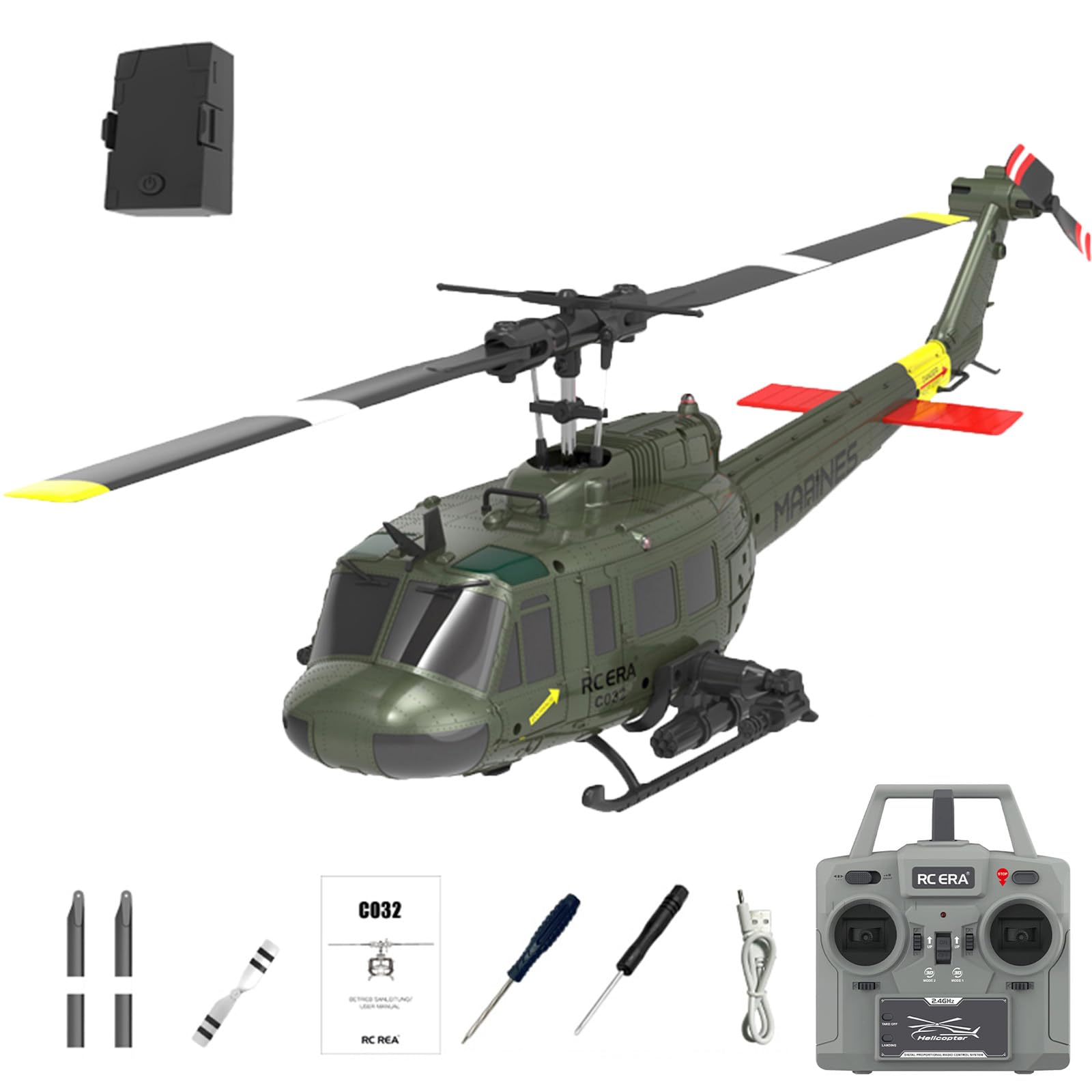
The C032 is the most expensive helicopter here by a wide margin, and it is aimed at a different pilot: an adult who wants a scale model that flies like a model, not a toy that has to survive a seven-year-old. It's a 1/48 UH-1 Huey with a six-channel radio, rated 15 and up, and the detailing is the sort you notice before it ever leaves the ground.

The sensors do the invisible work. A six-axis gyro, a barometer, optical flow and TOF lidar hold a steady hover indoors, where GPS can't reach, so the helicopter sits where you left it while you get your thumbs organized. Three speed settings take it from a cautious circuit of the room to something that wants a hall or a calm field.

It will also roll inverted, which is a neat trick and a clear dividing line: that isn't a living-room maneuver, and it isn't a beginner's one. The little coaxials in this group forgive a lot of sloppy input; this one asks for a decision and gives back exactly what you put in.

We think it earns its price for the right buyer — an adult who already flies, or wants to learn properly, with a big room or a field to do it in. The 15+ rating is doing real work here, and so is the space requirement: a hallway is a no. As a first helicopter for a child, it's the wrong tool entirely.

Bottom line: For adults and experienced hobbyists only: the C032 holds a hands-off hover on lidar and optical flow and will roll inverted, at a price and skill level that rule out a child's first helicopter.

#5

DEERC Apache

DEERC Apache

Military-model fans

Doodle Score 8.2/10
Check Price

Worth Noting

  • Some units stop working after a few flights
  • Landing gear and rotor fittings damage first
Size
9.84 x 3.74 x 4.33 inches
Charging
USB-C
Flight Time
Up to 26 minutes with two batteries
Spare Parts
4 main blades, 2 tail rotors
Read the full review

Four spare main blades, two tail rotors and a USB-C cable: the DEERC is sold as an Apache, but it's packed like something meant to stay in service. The scale work is what you notice before it ever flies — rotor head, cockpit contours, that green military finish on a 9.84-inch body — and it's why this one gets displayed between flights rather than buried in a toy box.

In the air it's a beginner machine with a bit of weight behind it: one-key takeoff and landing, altitude hold, and a speed setting that keeps it manageable in a living room. Two batteries give up to 26 minutes in total, which is generous at this size, and USB-C means one cable covers the helicopter and everything else on the kitchen counter.

Consistency is where it slips. Some units stop working after a flight or two, and the landing gear and rotor fittings are what a hard arrival damages first. We think the kit is the reason to buy this one and also the reason to fly it properly on day one rather than at a party. It suits the kid who wants a military helicopter to look at as much as to fly, and the spare blades mean a bad landing doesn't end the ownership.

Bottom line: Buy the DEERC for the silhouette and the kit: an Apache model with two USB-C batteries and six spare rotor blades. Test it thoroughly the week it arrives.

#6

SYMA S100

SYMA S100

Tiny spaces

Doodle Score 8.2/10
Check Price

Worth Noting

  • Only 5 to 7 minutes per charge
Size
4.1 x 2.36 x 1 inches
Channels
3.5-channel
Flight Time
5–7 minutes
Recommended Age
8–10 years
Read the full review

A coffee table is enough room for the S100. At 4.1 inches long it will fly along a hallway, over a desk or around a bedroom without touching anything, and it disappears into a coat pocket between flights. That's the whole idea: a helicopter small enough that the room you're already in is big enough, which is not true of anything else in this group.

We found it works better as a desk toy than as a trainer. Five to seven minutes a charge is a short hop even by the standards here, and the 3.5-channel controls are simple enough that there isn't much to grow into. What it does have is 2.4GHz, so two or three can fly at once without interference — a kitchen-table dogfight is genuinely good fun, and it's why we keep one charged and within reach.

Bottom line: The one to buy when space is the constraint: the S100 flies in a bedroom and stows in a pocket, as long as five-minute flights don't put you off.

#7

XIKOTEC RC Helicopter

XIKOTEC RC Helicopter

Budget indoor flying

Doodle Score 8.0/10
Check Price

Worth Noting

  • Forward control can be stubborn
  • Rotor screws can work loose
Size
21 cm (W) x 30 cm (L) x 14 cm (H)
Control Range
About 50 meters
Recommended Age
8–12 years
Batteries Included
2, USB-C charging
Read the full review

Forward is the direction that asks the most of the XIKOTEC. It pivots and reverses happily, but pushing it into forward travel takes a firm, steady stick, and where that never quite settles the helicopter ends up circling instead of going anywhere. Everything else about the way it flies is friendly: it holds altitude, it hovers without shaking, and the silver body looks better in the room than it does in the listing photos.

The quirk to know about is the startup order — helicopter on first, transmitter second, or it won't bind at all, which out of the box looks like a dead helicopter. Two USB-C batteries are the practical upside: the packs swap in seconds and one charges while the other flies, and the radio reaches about 50 meters, far more than any indoor room needs.

We found the build more solid than the price suggests, though the rotor screws can work loose and start a blade flopping if you don't check them now and then. As a budget indoor helicopter with a military look and two batteries, it's a reasonable buy for a patient pilot with some space; as a first helicopter for an impatient kid, the SYMA S107H-E is the easier one to live with.

Bottom line: A decent budget indoor helicopter with two USB-C packs and a steady hover, provided you can live with forward control that takes a firm hand.

How We Tested the Best RC Helicopters

We built the shortlist from owner reviews, hobby-shop recommendations, and a hard look at replacement-part availability, then narrowed it to 14 helicopters that covered different control styles, sizes, and included accessories. Over four months, each one got the same routine: charge, bind, calibrate, and lift off from a marked pad in a park field on calm mornings, then repeat in a breezy cul-de-sac and indoors on low rates. We flew each until the battery hit its cutoff, then timed the recharge.

To judge controls and beginner-friendliness, we handed the transmitter to two first-time flyers and one younger pilot and counted how many trim adjustments and spoken tips they needed before holding a steady hover. We practiced nose-in hovering, figure eights, and spot landings, noting lag, overcorrection, and whether low rates actually calmed the model down. Stability showed up in how much drift we corrected in a light breeze; reliability showed up after repeated charge cycles, minor blade strikes, and checks for loose screws or hot motors.

We also tracked battery life in real terms—hover time versus mixed flying—and noted whether extra flight modes did anything useful or just cluttered the transmitter. Value came down to what was in the box: spare blades, a second battery, and parts we could actually find later. Throughout, we noted which helicopters made us grin and reach for another pack, because fun and enjoyment are part of performance too. The ones that stayed in rotation had steady hovers, predictable controls, and no surprises after a hard landing.

How to Choose RC Helicopters

Where It Will Fly Comes First

Every helicopter here is a coaxial indoor machine, and that single fact decides more than any feature list. They run 4 to 10 inches long, they weigh almost nothing, and a light breeze moves them around like a leaf. Outdoors they need a still evening and short grass; indoors they need a clear run, a ceiling you won't hit, and a ceiling fan that isn't turning.

Walk the room before you buy. A hallway suits the palm-size SYMA S100, a living room suits the 8-inch models, and a big hall or a calm field is where the six-channel RC ERA C032 belongs. The word outdoor on a listing tells you it can be flown outside on a good day, not that it handles wind.

Count Batteries, Not Just Minutes

Flight time in this class runs from about five minutes to about seventeen, and charging always takes longer than flying. That makes a second battery the best money you can spend on any of these: the spare charges while you fly, so a session doesn't end when the first pack sags. The BUSSGO X11C and the DEERC Apache ship with two packs; the SYMA S107H-E and the S100 ship with one.

If the helicopter is going to a child who will ask to fly it every day, buy the version with two batteries or order a spare at the same time. It matters more than the top speed or the paint scheme.

What Altitude Hold and One-Key Takeoff Really Do

Two features carry most of the beginner experience. One-key takeoff and landing handles the launch and the arrival, which is where new pilots usually lose control; altitude hold keeps the helicopter at the height you left it when you release the stick, so you can stop steering without it sinking.

What they don't do is hold position sideways. A coaxial helicopter still drifts, and the trim buttons are what fix a steady slide to one side. For a pilot under ten, or anyone flying for the first time, take both features. Experienced pilots will find them mildly dull, which is rather the point.

Blades, Screws, and the Spare-Parts Question

Damage concentrates in a few places: rotor blades, landing gear, the tail rotor, and the small screws that hold the blade grips. Metal frames and folding blades survive more than thin plastic, which is why the alloy SYMA S107H-E and the BUSSGO X11C come out ahead on toughness within this group.

Check what's in the box before you buy. Spare main blades and a screwdriver — the DEERC and the TERRAMUS include them — turn a grounded helicopter into a ten-minute repair, and a model that ships without spares is one hard arrival away from the shelf.

Age Ratings Are About the Pilot, Not the Toy

The 8+ ratings here assume a child who can work a two-stick control and won't grab a spinning rotor. The 6+ TERRAMUS and the tiny S100 suit younger pilots because the helicopter is small and the controls are few; the 15+ RC ERA C032 is a hobby model and should be treated as one.

Whatever the box says, the first flights belong indoors with an adult in the room, rotors clear of faces, and long hair tied back. A child who can fly one of these unsupervised is a child who has already crashed it a dozen times with someone watching.

Frequently Asked Questions

Final Verdict

The SYMA S107H-E is the one we point people to first. The alloy frame absorbs the crashes that come with learning, the takeoff button means a first flight ends in a landing rather than a repair, and it sits in the middle of this group on price rather than at the top. Add a spare battery when you order it.

If the pilot is an adult with a big room or a field, the RC ERA C032 is the step up worth paying for. If the only space is a bedroom, take the palm-size SYMA S100 and accept that flights are short.