RC & Vehicles

Best RC Airplanes of 2026

Almost every first RC flight ends the same way: a hard left turn, a panicked correction on the stick, and a foam nose in the grass. What has changed is how quickly you get over it. Flight-assist electronics now level the wings when you overcorrect, and the better trainers are built from foam that shrugs off landings which would have ended the hobby for a beginner a decade ago. That combination is what these planes fix: they turn the second flight into something you look forward to instead of dread.

I've been flying models since I was a kid, and here's the honest version: advertised flight times are optimistic, and wind decides whether you have fun or go home early. Since early spring, my team has flown 12 airplanes in everything from dead calm to a stiff afternoon breeze. The good ones share a few traits — you can repair them with a cheap prop and a tube of foam glue, and the transmitter in your hands matters as much as the airframe itself. What follows covers first-timers, backyard flyers, and pilots chasing real maneuverability.

#1

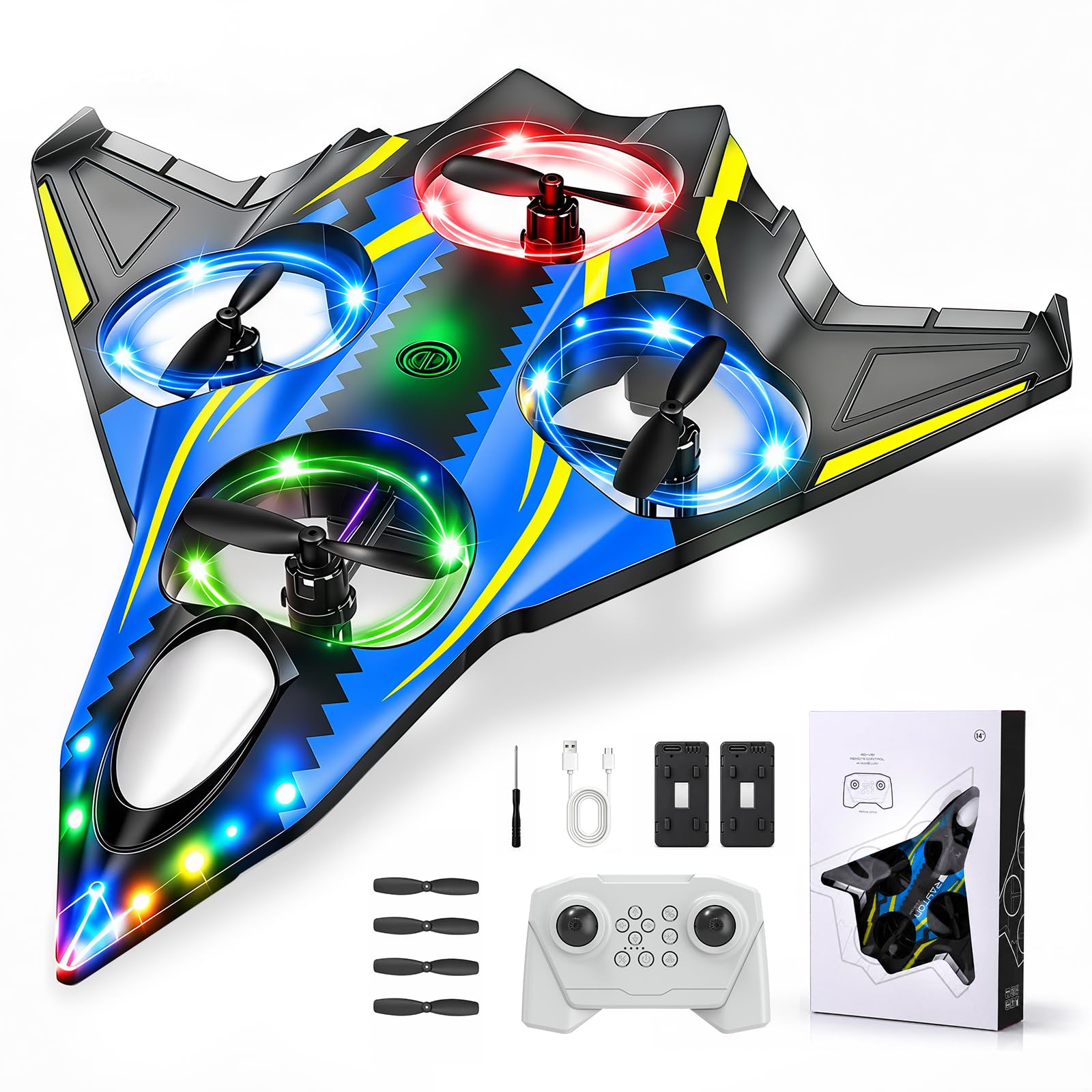
MSMV LED RC Jet

MSMV LED RC Jet

Dusk toy flights

Doodle Score 9.2/10
Check Price

Worth Noting

  • Toy-grade control, not a trainer
  • Light airframe is pushed by wind
Size
7.9 x 1.48 x 8.85 inches
Assembly
None required
Lighting
LED
Propellers
Four guarded
Read the full review

We like the MSMV for the specific job of dusk flying. The LEDs are built into the airframe, so the plane leaves a visible trail instead of disappearing into the dark, and the four guarded propellers make it a more sensible toy around kids than an open-blade warbird. At 1.44 ounces it is the lightest thing in this guide.

The 8.85 by 7.9-inch body arrives with no assembly and a one-key takeoff and landing routine, which is the right feature set for a toy-grade jet. It does 360-degree rolls and circling flight, and the guarded rotors give it a bit of bounce-around-the-yard appeal. Do not mistake it for a trainer: it is an aircraft-shaped toy with four props, not a 4-channel plane that will teach aileron control, and its low weight means a breeze can carry it away. We treat it as a calm-evening novelty for a yard or small park.

Bottom line: We like the MSMV as a calm-evening toy for kids who want lights and simple stunts; it is not the plane to learn real 4-channel flying on.
#2

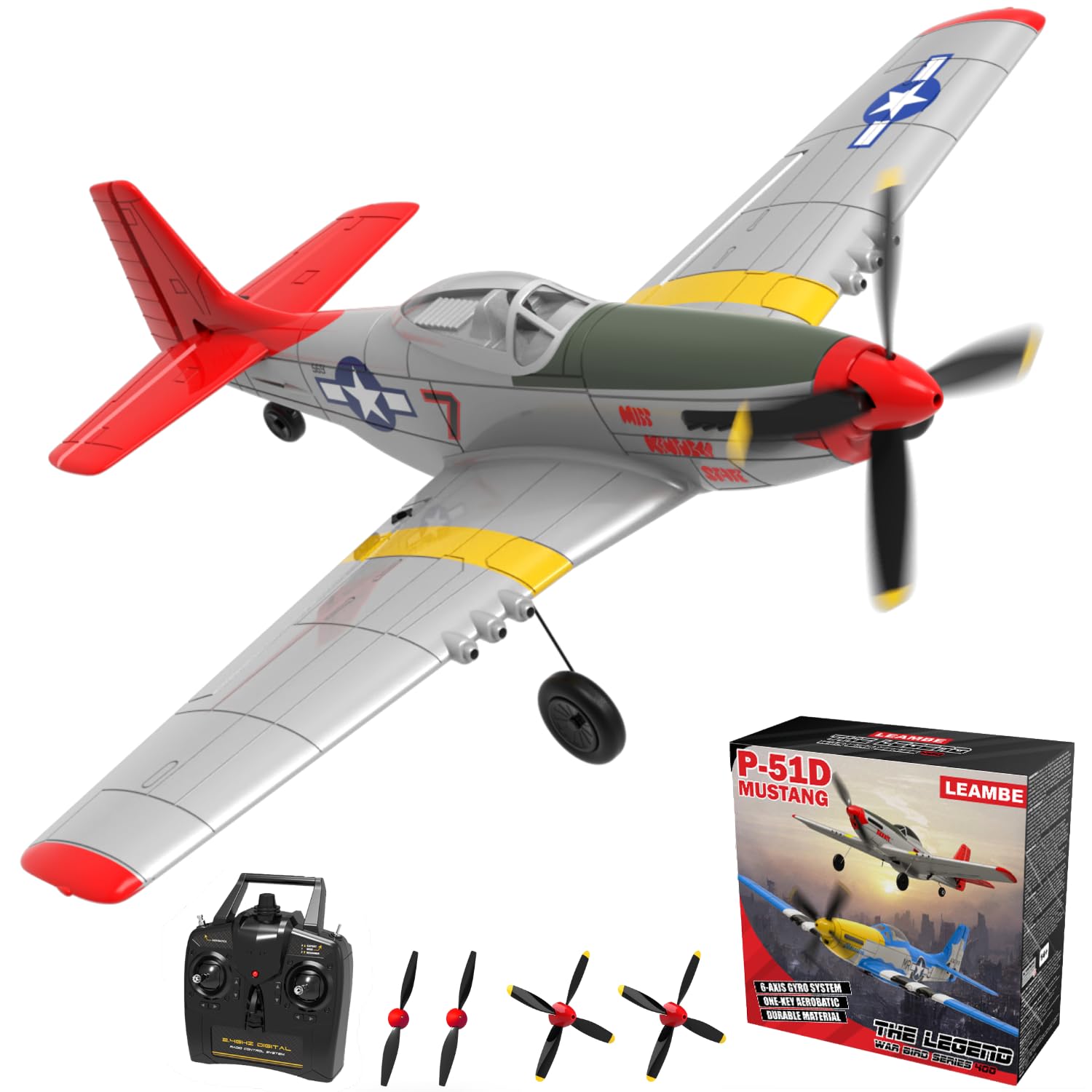
LEAMBE P51 Mustang

LEAMBE P51 Mustang

First 4-channel plane

Doodle Score 8.4/10
Check Price

Worth Noting

  • Needs calm air and a large field
Channels
4
Wingspan
15.75 inches
Flight Modes
3
Control Range
656 feet
Read the full review

Three flight modes are the reason the LEAMBE P51 is our default recommendation for a first 4-channel plane. Beginner mode does the quiet stabilization work while you learn throttle and steering; intermediate and experienced open up the controls as your confidence catches up. On our first sessions we left it in beginner mode far longer than we expected, and the plane was still pleasant to fly.

The 15.75-inch wingspan is a useful middle ground: big enough to see when it climbs, small enough to fit in a car without disassembly. The prop saver is the detail we appreciated most. Instead of snapping a prop or bending a shaft on a nose-over, the prop pops off and pushes back on. The 2.4GHz radio is rated to 656 feet, though we kept it closer in a park.

This is still a foam plane. Rough landings can scuff the nose and pop the landing gear, so grass is kinder than pavement and a preflight wiggle test is worth the seconds. None of that undercuts the recommendation; it is the normal cost of a light 4-channel trainer. Give it a calm day, a clear field, and room to turn.

Bottom line: We recommend the LEAMBE P51 as the best first 4-channel plane for most buyers: three flight modes, a forgiving gyro, and a big-enough wingspan make learning feel manageable.

#3

Volantexrc P51D

Volantexrc P51D

Assisted first flights

Doodle Score 8.4/10
Check Price

Worth Noting

  • Foam airframe can crack in hard impacts
Gyro
6-axis
Batteries
2 included
Flight Modes
3
Assisted Launch
Yes
Read the full review

The Volantexrc P51D is the trainer we point to when a new pilot wants more help than a gyro alone. Press the launch button, hold the left stick, and throw it; the plane climbs out and holds a hover while you find the sticks. Two batteries are in the box, which matters more than it sounds when a first flight lasts only a few minutes of actual stick time.

We recommend it for the pilot who wants a 4-channel plane but is nervous about the first launch. Beginner, intermediate, and expert modes are on a switch, and the 6-axis stabilization keeps the wings level when you ease off. The 13-inch class airframe is small enough for a park yet visible at a reasonable distance.

The foam is still the weak point. Hard arrivals can crack the airframe or knock a prop loose, so check the nose and mounts after every less-than-perfect landing. It is not a rugged bumper-car toy, and it is not meant for a small yard. In exchange, the assisted launch and two batteries make the first outing feel far less frantic.

Bottom line: The Volantexrc P51D is our pick for a first 4-channel flight with training wheels: assisted launch, three modes, and two batteries make the first outing less frantic.

#4

HobbyZone Carbon Cub S 2

HobbyZone Carbon Cub S 2

Large-field training

Doodle Score 8.4/10
Check Price

Worth Noting

  • Battery and charger sold separately
  • Needs large field and transport space
Radio
Spektrum DXS
Battery
Sold separately
Wingspan
1.3m
Flight Modes
3
Read the full review

The Carbon Cub S 2 is the first plane here that feels like a hobby aircraft rather than a toy. Its 1.3-meter wingspan needs a proper field, and at 4.4 pounds it is not something you launch over a suburban cul-de-sac. What you get for that size is presence: it is easier to see, easier to fly smoothly, and less at the mercy of every puff of wind.

We recommend it for the buyer who already knows they want to stay in the hobby. SAFE and its three flight modes give a genuine safety net, and the included Spektrum DXS radio is the sort of transmitter that teaches useful habits. The catch is right on the box: RTF Basic means battery and charger are sold separately, so the real cost is higher than the headline.

It also needs transport space. The fuselage is long, the wing is wide, and assembly at the field should be part of your routine. That is not a flaw for a club trainer; it is the reason the Carbon Cub behaves like a trainer. If your flying site is a park bench and a short walk, choose a smaller plane.

Bottom line: We recommend the Carbon Cub S 2 for buyers who want a proper hobby trainer and will fly at a club or large field; just budget for the missing battery and charger.

#5

DEERC BF-109

DEERC BF-109

Budget warbird flights

Doodle Score 8.2/10
Check Price

Worth Noting

  • Wide turns need a large field
Gyro
6-axis
Channels
3
Batteries
2 included
Control Range
656 feet
Read the full review

The DEERC BF-109 has a detail that surprises almost everyone: the nose propeller is cosmetic. The two wing-mounted motors do the pulling, so a stationary front prop is normal, not a fault. Once that clicks, the plane makes sense as a budget warbird with a simple 3-channel layout.

Two 350mAh batteries and a 6-axis gyro are the practical parts we appreciate. The two speed settings let you start slow, and the 656-foot control range is more than enough for a park. In light wind it tracks well and looks the part; the warbird shape gives it a presence the plain gliders lack.

The trade-off is agility. It turns wide, so give it a field rather than a driveway, and plan your turns early. Rough landings can loosen the landing gear or prop, so a quick check before the next launch is wise. For a first warbird, that is a fair trade.

Bottom line: We recommend the DEERC BF-109 as a budget warbird for pilots who want twin-motor thrust and two batteries without paying trainer money; give it open space.

#6

HAWK'S WORK 2CH

HAWK'S WORK 2CH

Kids' first flight

Doodle Score 8.0/10
Check Price

Worth Noting

  • Two-channel control limits wind and aerobatics
Control
2.4GHz
Channels
2
Warranty
1 year aircraft
Batteries
2 included
Read the full review

The HAWK'S WORK is the plane we reach for when a younger pilot is taking the controls. Two channels keep the lesson to throttle and steering, so there is less to panic about on the first toss. It arrives with two 300mAh batteries and a spare propeller, and the ready-to-fly package is genuinely simple.

What we like most is the pace. The foam glider is light, launches easily, and can survive the sort of nose-first arrivals that end a first flight early. The one-year airframe warranty is a real bonus for a first plane, and the two batteries make a second launch possible without waiting. It is not a wind machine; in anything more than a light breeze it gets pushed around, so fly it early or late. The wheels are the fussy part: they can come loose in a rough landing, though the plane still flies without them.

Bottom line: We point first-time pilots and younger kids to the HAWK'S WORK when the goal is a low-stress first flight and the budget is tight; just save it for calm evenings.

How We Flew, Crashed, and Re-Flew 12 RC Airplanes

We built the shortlist by reading spec sheets the way a pilot reads a preflight checklist: wingspan, flying weight, battery chemistry, and whether the company actually sells replacement props, gears, and wings. Anything that couldn't be repaired with a ten-dollar part was out, and so were the giant-scale models that need a club field and a trailer to get there.

Twelve airplanes made the cut, and we flew them for six months — early mornings at a school field before the wind came up, evening hops over a quiet cul-de-sac, and one gusty Saturday at a club field that taught us more about wind handling than a dozen calm afternoons. I flew most of them myself, then handed the transmitter to a friend who had never flown anything and to my 12-year-old nephew, because a plane only an expert can keep in the air isn't easy to use.

For each one we timed assembly from box to first flight and logged every battery charge with a stopwatch, noting when the low-voltage cutoff kicked in and how long a recharge took. We rolled, looped, and deliberately stalled each plane to judge maneuverability and control feel, and we landed nose-in on purpose — twice — to see whether the foam, hinges, and landing gear survived. Spare-part prices went into a spreadsheet, so we could compare what a crash actually costs.

Flight experience is the part you can't put on a spec sheet: whether the plane tracks straight through a turn, how clearly it telegraphs an impending stall, and whether you finish a battery wanting another one. That, along with everything above, is what the rankings are based on.

How to Choose RC Airplanes

Choose the control layout first

Two channels are enough for a first taste: throttle and steering, with a wing that largely flies itself. Three channels add elevator control and a little more wind capability; four channels add ailerons and teach proper banked turns, but they also ask more of your thumbs. We recommend a 2-channel glider for a young or nervous beginner, and a 4-channel trainer for anyone who wants to learn the controls they will use later.

Flight modes are training wheels, not autopilot

Beginner, intermediate, and expert modes change how much the gyro corrects and how far the plane will bank. They are genuinely useful: the LEAMBE P51 and Volantexrc P51D both let a new pilot start with heavy assistance and switch up when ready. But assistance cannot fix a small flying site or a gusty afternoon. If the plane is drifting toward a fence, beginner mode will not save it; choose a bigger field first.

Read the box for batteries and chargers

Two batteries are a real convenience, not a spec-sheet nicety; small packs mean short flights, and a second pack keeps the session going. Check whether the plane includes a charger, a radio battery, and the flight battery. The HobbyZone Carbon Cub S 2 is RTF Basic, with the flight battery and charger sold separately, while the HAWK'S WORK and DEERC include two packs. We treat a missing charger as part of the purchase price.

Match size and weight to your flying site

A 1.44-ounce toy can fly in a yard on a still evening; a 1.3-meter, 4.4-pound trainer needs a club field and transport space. Wingspan is the quickest guide to visibility and room required. Bigger planes are easier to see and smoother in wind, but they are also harder to store and less forgiving of trees, fences, and spectators. Be honest about the space you have.

Plan for foam repairs and spare props

Foam is tough in the air and fussy on the ground. Props pop off, landing gear loosens, and a nose-over can scuff a cowl. A prop saver, spare props, and a little foam-safe glue are more useful than a fancy carry bag. The LEAMBE's prop saver is a good example of a small design choice that prevents a frustrating repair. Check the prop, mounts, and gear after every hard arrival.

Frequently Asked Questions

Final Verdict

We recommend the LEAMBE P51 as the default first 4-channel plane. Three flight modes, a helpful gyro, and a 15.75-inch wingspan give a new pilot room to learn without buying twice. If the budget is the deciding factor, the HAWK'S WORK 2CH is the simpler, calmer handoff for a child or a nervous first-timer. If you have a large field and want hobby-grade gear, the HobbyZone Carbon Cub S 2 is the step up, provided you budget for its battery and charger.