RC & Vehicles

Best RC Servo for RC Car of 2026

A servo is the part that can turn a good RC afternoon into a walk back to the bench. It's the muscle behind your steering, and when it's slow, jittery, or weak, the whole car feels vague—you correct twice for every turn, the front end wanders over bumps, and a hot run can leave you nursing a dead steering rack. The right one keeps the car tracking straight, centers predictably after a hit, and holds up through dust and heat. I care less about the torque number on the box than how the thing behaves after twenty minutes of real running.

Over five months, we installed 14 servos in our own cars and ran them through backyard laps, dusty parking-lot runs, and repeated steering inputs that expose weak centering. We weighed speed, responsiveness, stability, and power, but also gear play after a few weekends, how easy the endpoints are to set, and whether the included hardware and replacement parts earn their keep. The picks below are the ones that stayed crisp without asking you to baby the car.

#1

Monster 56KG Brushless

Monster 56KG Brushless

Large 1/8 builds

Doodle Score 9.2/10
Check Price

Worth Noting

  • Premium cost versus this group
Motor
Brushless
Torque
56 kg-cm
Voltage
6–8.4V
Waterproof
Yes
Read the full review

The brushless motor is what separates this Monster from the geared servos here. A 56 kg-cm rating is already enormous, but the brushless design is also why it runs smoothly and stays quiet under load instead of feeling like a tiny power tool. Full metal gears, full ball bearings, and a shockproof case are built for a truck that lands hard and keeps going. We also like the black, milled case; it looks purposeful in an open chassis.

The 6–8.4V range gives you headroom if your ESC and receiver can supply it, so check that your BEC can feed the servo at the voltage you plan to run before relying on it. A brownout at full steering lock is a miserable way to find out. It is more servo than a 1/10 trail truck needs, which is exactly the point for a big build.

For heavy 1/8 bashers and loaded crawlers, we choose it because a 25 kg servo can feel like a weak link. The extra muscle and smooth brushless delivery are what the big build is for, and the waterproof case means wet running is not an immediate disqualifier. It is a premium part, and it belongs on a truck where the rest of the steering system is built to the same standard.

Bottom line: The Monster is the servo we choose for heavy 1/8 builds where a standard 25 kg servo feels like a weak link.

#2

ZOSKAY DS3235 35KG

ZOSKAY DS3235 35KG

All-round RC cars

Doodle Score 9.0/10
Check Price

Worth Noting

  • Centering trails premium servos
  • Hard impacts can strip gears
Gears
Stainless steel
Torque
35 kg-cm
Waterproof
Yes
Control Angle
270°
Read the full review

A 35 kg-cm rating is the headline, but the useful part is what it does for a heavy 1/10 crawler: it keeps the front wheels turned when they are wedged against a rock or packed with mud. The coreless motor and stainless-steel gear train are the right ingredients for a truck that sees dirt and water, and the standard case drops into the usual 40 x 20 mm mounts. At 2.89 ounces it adds a little weight up front, though not enough that we minded in a crawler.

We put it at the top because it covers the widest range of RC car jobs here. It has enough torque for a 1/10 crawler or basher, it is quick enough to feel alert on a trail, and the waterproof case means a wet run is not an automatic rebuild. It is the high-torque servo we reach for when a standard 25 kg unit leaves the steering feeling vague.

The 270-degree control angle is the spec to pay attention to. A steering linkage only needs a fraction of that, so set the endpoints in your radio before you drive. Do that and the extra travel is harmless; skip it and the servo can stall against the chassis at full lock, which is hard on gears and the receiver's power supply.

For a basher or crawler where a replacement is easy to fit, the extra torque and sealed case make this the one we reach for first. It is not the servo for a race car chasing tenths, but that is a different brief.

Bottom line: We recommend the DS3235 when you want maximum torque for a 1/10 crawler or basher without paying premium-servo money.

#3

ZOSKAY 25KG 180°

ZOSKAY 25KG 180°

1/10 bashers

Doodle Score 9.0/10
Check Price

Worth Noting

  • Durability under hard impacts varies
Gears
Metal
Speed
0.13 s/60°
Torque
25 kg-cm at 6.8V
Control Angle
180°
Read the full review

180 degrees sounds like a downgrade next to the 270-degree servos here, but for steering it is the cleaner starting point: the travel matches what a car's steering linkage expects, so setup is simpler and there is less excess range to limit in the radio. That simplicity is why we recommend it as the default 1/10 basher servo.

The 25 kg-cm rating at 6.8V and 0.13-second transit are a sensible balance for short-course trucks, buggies, and trail rigs. It has enough muscle for bigger tires without the current draw of a 35 or 40 kg servo, and the standard 40 x 20 x 40.5 mm case fits the usual mounts. At 2.82 ounces it is light enough that we did not notice it changing the truck's balance. The metal gears and CNC aluminum middle shell are the right internals for a truck that sees jumps, and the lower price leaves room for a spare.

This is a steering servo, not a winch or a robot joint. The 180-degree range is the right call for a car, but if you need more sweep for another project, look elsewhere. For a 1/10 basher that spends its life turning tires rather than lifting loads, it is the straightforward choice.

Bottom line: We point 1/10 bashers to this 180-degree ZOSKAY when simple steering setup and a lower spend matter more than ultimate torque.

#4

AGFRC B53DHS 24KG

AGFRC B53DHS 24KG

Precise 1/10 builds

Doodle Score 9.0/10
Check Price

Worth Noting

  • Lower torque than 35–40 kg picks
Gears
Titanium
Speed
0.190 s/60°
Torque
24 kg-cm at 8.4V
Sealing
IP65
Read the full review

The AGFRC's party trick is that you can program it, which matters more on a 1/10 car than the headline numbers suggest: you can tune endpoints and centering at the servo instead of fighting radio menus.

At 24 kg-cm and 0.190 s/60° on 8.4V, it is not the strongest or fastest here, but the titanium gear set, dual ball bearings, and IP65 sealing make it the most polished small servo in this group. The 40 x 20 x 42.3 mm case is compact, and the 2.22-ounce weight keeps the front end light. The CNC aluminum middle shell is a nice touch for heat, and the case is only a little taller than a standard 40 mm servo, so it fits most 1/10 mounts without drama.

We recommend it when steering precision matters more than raw torque: a 1/10 buggy, a scale trail truck, or a car where you are trying to dial out slop. The 24 kg-cm rating is plenty for most 1/10 cars, and the programmable endpoints let you make the most of the travel you have.

Bottom line: Precise centering, programmable endpoints, and IP65 sealing make the AGFRC our pick for a 1/10 build where torque is already sufficient.

#5

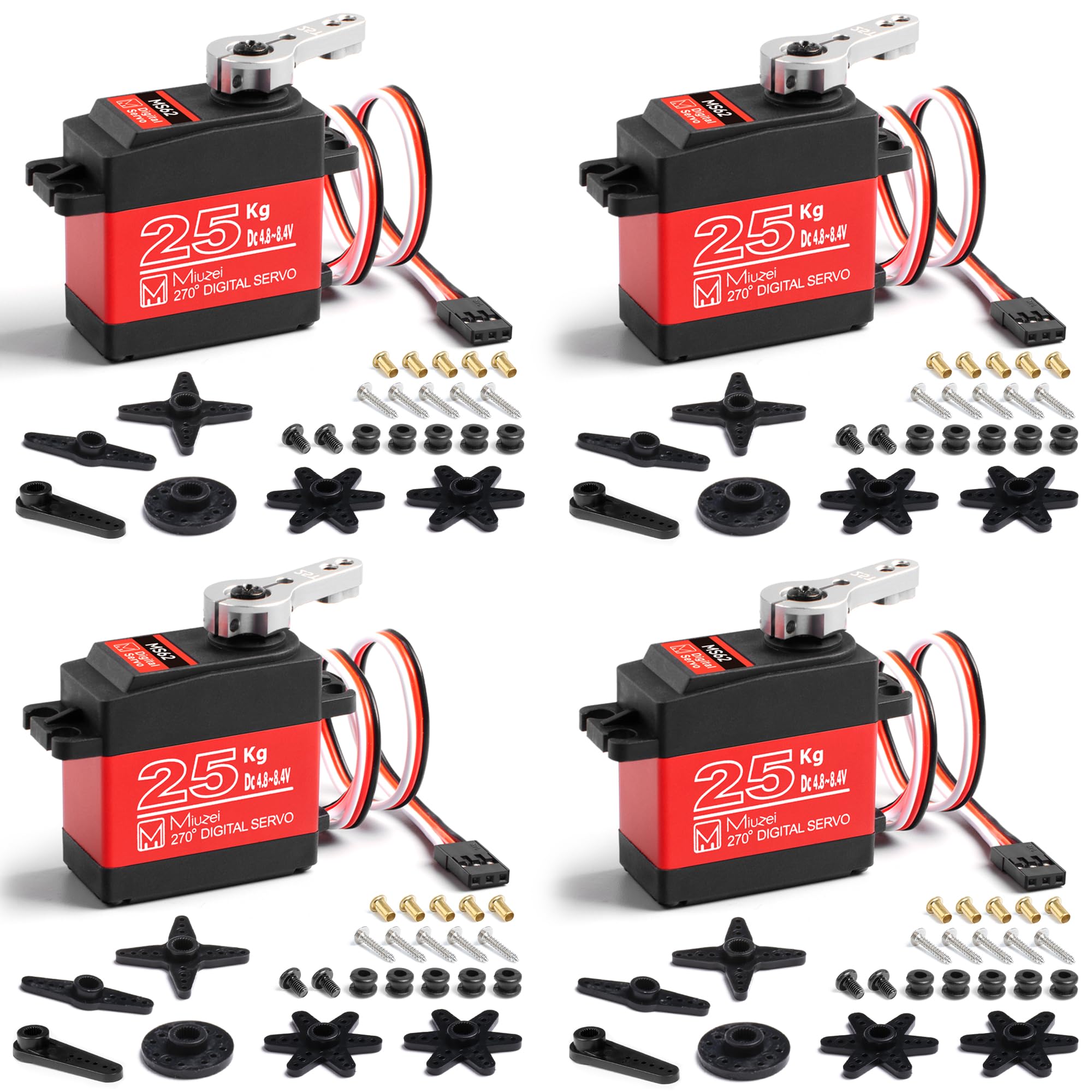
Miuzei 25KG 4-Pack

Miuzei 25KG 4-Pack

Multi-car fleets

Doodle Score 9.0/10
Check Price

Worth Noting

  • Four-pack is more than one car needs
Pack
4 servos
Speed
0.13 s/60°
Torque
27.5 kg-cm at 8.4V
Control Angle
270°
Read the full review

A four-pack of 25 kg-class servos is less about one perfect steering servo and more about keeping a fleet running. If you have several 1/10 trucks, or you go through servos often enough that a spare in the box is worth something, the math here starts to make sense.

Each servo is rated 27.5 kg-cm at 8.4V and 0.13 s/60°, with metal gears, dual ball bearings, and an IP66 splash-resistant case. The four share the same case and 25T horn fit, so a spare drops into any of the usual 1/10 mounts. At 0.13 s/60°, it is quick enough for a basher, and the 27.5 kg-cm rating gives the steering some reserve on bigger tires.

The 270-degree rotation needs a 500–2500 µs PWM signal to reach full travel, so check that your receiver can output that range before you rely on it. For a basher or crawler fleet, the four-pack gives you consistent spares without buying singles one at a time.

We keep this pack on the list for multi-car households that want strong 25 kg-class steering and a spare on the shelf. For a fleet that sees regular trail time, the per-servo value is easier to defend than buying singles.

Bottom line: We keep this four-pack on the list for multi-car households that want strong 25 kg-class steering and a spare on the shelf.

#6

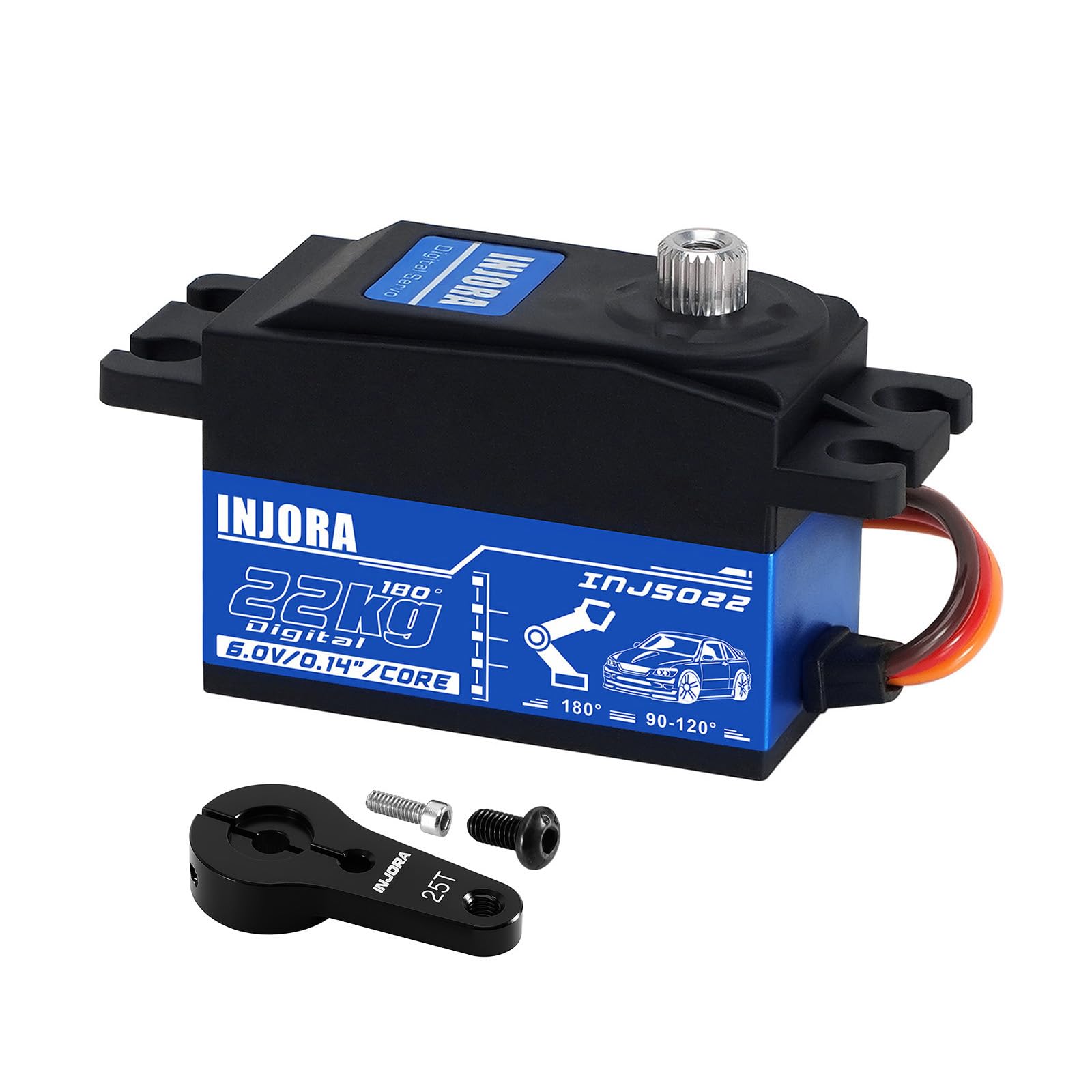
INJORA INJS022 22KG

INJORA INJS022 22KG

Tight chassis

Doodle Score 9.0/10
Check Price

Worth Noting

Gears
Full metal
Speed
0.14 s/60°
Torque
22 kg-cm at 6.0V
Case Size
40 x 20 x 28.8 mm
Read the full review

The low-profile case is the whole reason to notice this INJORA: at 28.8 mm tall it fits where a standard 40 mm servo will not, which is often the difference between a clean chassis mount and a cut-up body. At 50 grams it is light enough that it does not upset a small truck's front end.

The 22 kg-cm rating at 6.0V and 0.14 s/60° transit are well matched to a 1/10 crawler or scale truck, and the full metal gears and dual ball bearings are the right internals for a rig that sees dirt. The 90–120 degree control angle is another steering-friendly detail.

The included 25T aluminum horn is a useful detail, since the plastic horns in a parts bin often do not fit. The shallow case also leaves more room for a front chassis mount or a body with a tight grille.

We choose it when a standard servo will not fit and you still need real steering torque. The plastic case with an aluminum center band is a weight-saving choice, not a bash-proof one, so this is a fit-first servo for a 1/10 crawler rather than a heavy 1/8 truck. If you have room for a full-size case and need maximum torque, the larger servos here are the better call.

Bottom line: The INJS022 earns its place in our list when a standard servo will not fit and a 1/10 crawler still needs low-profile steering torque.

#7

HOOYIJ DS3240MG 40KG

HOOYIJ DS3240MG 40KG

Heavy 1/8 rigs

Doodle Score 8.8/10
Check Price

Worth Noting

  • Only sold as a two-pack
Pack
2 servos
Gears
Stainless steel
Torque
40 kg-cm
Control Angle
180°
Read the full review

Forty kilograms of torque from a stainless-gear servo is the sort of thing you notice when your truck is already stuck: the front wheels keep biting instead of stalling. That is the job this HOOYIJ pair is built for, and the 180-degree control angle makes it a straightforward steering fit rather than a winch or robot servo.

The two-servo pack is the practical reason we keep it on the list. You get a spare for a second truck, or a replacement on the shelf, plus two 25T metal arms and accessory bags. For a heavy 1/8 crawler or monster truck running big tires, the 40 kg-cm rating has the reserve that a 25 kg servo lacks. That makes the pair easier to justify than a single premium servo if you run more than one heavy truck.

This is a torque-first servo, not a razor-sharp race part. The trade-off is that it suits a crawler or basher more than a precise on-road car, and the standard-size case still needs the usual clearance check. We like it most where the steering is doing hard work at low speed.

Bottom line: We like this pair for heavy 1/8 crawlers and monster trucks that need 40 kg-cm and a spare servo in the box.

#8

INJORA INJS035 35KG

INJORA INJS035 35KG

Budget crawlers

Doodle Score 8.6/10
Check Price

Worth Noting

  • Fit and finish trail leading picks
Gears
Reinforced metal
Torque
35 kg-cm at 6V
Waterproof
Yes
Control Angle
90–120°
Read the full review

A budget crawler build is where the INJORA INJS035 makes the most sense, and it is our budget crawler pick: it brings 35 kg-cm of torque at 6V and a waterproof case without pushing the build into premium-servo territory.

The important numbers are right for a trail truck. The 90–120 degree rotation is a steering-friendly range, the reinforced metal gears are the right choice for a rig that binds up on rocks, and the low-noise case is a small civility on a quiet trail. It is not a fast servo, and that is fine for crawling. At 90 grams, it is light enough that it does not change the front-end balance much on a trail truck.

For a weekend crawler, the torque and sealing are the parts that matter most, and the lower price leaves room for a spare. It is the budget pick we reach for when the terrain is slow and technical rather than fast and open. If you need precise centering for a fast car, the AGFRC is worth the step up; for a slow crawler, this one does the job.

Bottom line: The INJS035 is our budget crawler pick when you want 35 kg-cm and waterproofing without paying for a premium gear train.

How We Tested the Best RC Servos

We started with a shortlist of popular servos in the sizes and torque ranges that actually fit 1/10 and 1/8 RC cars, then narrowed it by the specs that matter on the bench: case dimensions, gear material, bearing count, speed and torque ratings, and whether replacement gear sets and horns are easy to find. From that pool, we bought 14 servos and ran them for five months in our own vehicles rather than on a test stand alone.

Each servo went into a steering position and was driven through the same rotation: backyard laps, dusty parking-lot runs, and a few high-traction sessions that put heat into the motor and servo. We timed lock-to-lock travel with a stopwatch, then made quick left-right corrections to see whether the steering answered immediately or lagged behind the wheel. We also held the wheels against a low curb and watched how each servo recovered, which separated smooth power delivery from a unit that stalled and buzzed. After every few weekends, we rechecked gear play, wire chafe, and whether the servo still returned to center after bumps.

Quality and adjustability showed up in the small stuff: case fit, wire gauge, whether endpoints and trim could be set without fighting the radio, how the included horns fit, and whether the mounting tabs lined up without shimming. We judged value by what came in the box and what replacement gears cost, not by the lowest sticker alone. Suitability was the final filter—a fast, low-torque servo that felt sharp in a buggy was the wrong choice for a heavier truck or a crawler, and we noted where each one made sense. The ones that survived the full five months without loose gears or vague centering are the ones we recommend.

How to Choose the Right RC Servo for RC Car

Torque and Speed: Match the Car, Not the Numbers

Torque is what holds the wheels against load, so a 1/10 trail truck or basher usually has enough with 25–28 kg-cm, while a heavy 1/8 truck or a crawler on big tires needs 35–40 kg-cm. Speed is the other half: a 0.13 s/60° servo feels alert in a short-course truck, while a 0.190 s/60° unit is better suited to a trail rig where smoothness matters more than snap. We prioritize torque for a crawler and transit speed for a basher, because the two cars ask different things of the same part. Buying the biggest torque rating you can find can add weight and current draw without making the car easier to drive.

Control Angle and Radio Setup

Steering linkages do not need 270 degrees of sweep. A 180-degree servo like the ZOSKAY 25KG is simpler to set up because there is less excess travel to limit, while a 270-degree servo such as the DS3235 needs endpoints set before the first run. Check the PWM range too: the Miuzei four-pack wants 500–2500 µs for its full 270 degrees. We treat 180 degrees as the default for steering; if your radio cannot limit travel or output the wider range, choose a 180-degree servo instead.

Gears, Bearings, and Sealing

Metal gears are the minimum for a car servo, and stainless or titanium sets resist wear better than basic coated gears. Dual ball bearings support the output shaft and make steering feel smoother; a plastic bushing can develop play. Sealing matters if you run in wet conditions, but IP65 or IP66 means splash and dust protection, not unlimited submersion. Dry the case and check the output seal after a wet run. A waterproof claim is useful, not a licence to leave the truck in a puddle.

Fit: Standard, Low-Profile, and Horn Spline

Most 1/8 and 1/10 cars take a standard 40 x 20 x 40.5 mm case, so start there. A low-profile servo such as the INJORA INJS022 is 28.8 mm tall and solves a tight chassis mount, but it usually trades torque and case strength. Check the servo horn spline as well: 25T is common, and a metal arm included in the box saves a second order. Measure the space between the chassis rail and the body before you buy, not after.

Centering and Replacement Value

A servo that does not return to center makes the car steer differently every time you release the wheel, which is more tiring than a small torque deficit. Programmable servos like the AGFRC let you trim endpoints and centering at the servo, while budget servos ask you to work within their fixed range. For a one-car build, we prefer one good servo to a multipack of unknowns. For a fleet, a four-pack with a spare on the shelf can be the smarter buy.

Frequently Asked Questions

Final Verdict

The ZOSKAY DS3235 35KG is the servo we point most RC car drivers toward: it has the torque for a loaded 1/10 crawler or basher, a waterproof case, and a price that leaves room for a spare. Its 270-degree travel is the one setup detail to manage, so set endpoints before the first run. If you want simpler 180-degree steering and a lighter spend, the ZOSKAY 25KG is the better fit; for a heavy 1/8 build, the Monster or HOOYIJ has the reserve.