Pretend Play

Best Toy Tool Sets of 2026

If you've assembled anything with a small child nearby, you know the routine: you're on the floor with a hex key, and a 3-year-old appears with a plastic drill that whirs for two seconds, drops its bit, and never actually turns a screw. A good toy tool set fixes that specific frustration. The bit stays in the chuck, the screw seats, the latches open without an adult, and the handle fits a hand that's still learning to grip.

Over the past four months, my team and I have had 16 sets spread across living room floors and playroom benches, and the gap between a set that gets played with for a year and one that's abandoned by Tuesday comes down to a few small things — mostly the chuck, and whether the age range printed on the box is honest. Ignore the "3+" if a grown-up has to load the bit; that number is about fine motor skills as much as safety. The sets that held up are below, sorted by the kid they suit.

#1

John Deere Talking Toolbelt

John Deere Talking Toolbelt

Dress-up role-play

Doodle Score 9.6/10
Check Price

Worth Noting

  • Nothing on the belt fastens or builds
Tools
6 plus tool belt
Buckle
3 sounds, 2 phrases
Weight
12.8 oz
Age Range
24 months to 3 years
Read the full review

The belt is the toy. Six plastic tools — hammer, wrench, screwdriver, pliers, ratchet, tape measure — each sit in their own loop, and the electronic buckle chips in with three tool sounds and a couple of phrases when a child presses it. Strap it on a two-year-old and they stop fixing things and start patrolling for something to fix, which is a different game from sitting at a bench.

The plastic is thick, and the tools stay in their loops through climbing, crawling, and running across a kitchen floor. The belt adjusts, though the buckle takes a few tries before you get it small enough that it stops sliding down a slim two-year-old's hips.

The honest boundary is the age window. This is rated from 24 months to three years, and that matches what we saw — a four-year-old works out the buckle in an afternoon and moves on. Buy it for the toddler who follows you around with a real screwdriver, and treat it as a birthday present rather than an heirloom.

Bottom line: We recommend it for a two-year-old who shadows you around the house: the talking belt turns tool play into dress-up that fits a real toddler.

#2

Hape Fix-It Tool Box

Hape Fix-It Tool Box

First wooden set

Doodle Score 9.6/10
Check Price

Worth Noting

  • Fewer tools than the bigger wooden kits
Tools
Hammer, wrench, screwdriver, nuts and bolts
Storage
Wooden tool box
Material
Wood
Age Range
3 years and up
Read the full review

This is the smallest set here, and that's the point. It's a wooden box holding a hammer, wrench, screwdriver, and a handful of nuts and bolts, and it takes up about as much shelf space as a shoebox. Nothing else in this guide is easier to put away.

For a first wooden set, this is the one we hand over first. Everything is sanded smooth with no splinters, the hammer has enough weight in the head to feel real, and the nuts turn easily enough for three-year-old fingers. It's also the set that gets tidied without an argument, because every piece has exactly one place to go.

Where it earns its keep is the playroom shelf: it comes down for twenty minutes and goes back up, and a grandparent can hand it over without clearing the floor first. It's the set we leave out and let a three-year-old come back to on their own.

Bottom line: We recommend it as the first wooden tool set for a three-year-old: small, smooth, and tidy enough to live on a shelf.

#3

Learning Resources New Sprouts Fix It!

Learning Resources New Sprouts Fix It!

Toddlers from two

Doodle Score 9.4/10
Check Price

Worth Noting

  • No screws or bolts to drive at all
Pieces
6
Material
Soft plastic
Age Range
2 years and up
Batteries
None required
Read the full review

Every tool in this set is molded from a soft, rubbery plastic, and that single design decision is why it tops our list. The saw has no teeth that bite, the hammer head gives under a thumb, and the screwdriver has a squeeze trigger that clicks and whirs with no battery involved. It's the only set here we're comfortable putting in front of a two-year-old and then walking away.

Six pieces, and they're chunky: thick handles, oversized heads, nothing small enough to vanish under the couch. The tools are sized so a toddler's whole fist wraps around them, and the rubberized sections are the ones that get chewed, dropped, and used to drum on the coffee table. They've taken all of it and come back for more the next morning.

What you give up is hardware, and that's the honest trade: this is a set for narrating a repair rather than completing one. A two-year-old is practicing the grip, the sound, and the handing-over of a tool, which is the part that comes before assembly anyway. It goes to the youngest child in the house; wood can wait until three.

Bottom line: We recommend it as the first tool set for a two-year-old: soft, battery-free tools that survive being chewed, thrown, and hammered on the coffee table.

#4

Melissa & Doug Take-Along Tool Kit

Melissa & Doug Take-Along Tool Kit

Classic wooden play

Doodle Score 9.4/10
Check Price

Worth Noting

  • Small boards and hardware scatter easily
Pieces
24
Material
Wood
Age Range
3 to 6 years
Case Size
9.84 x 4.72 x 5.51 in
Read the full review

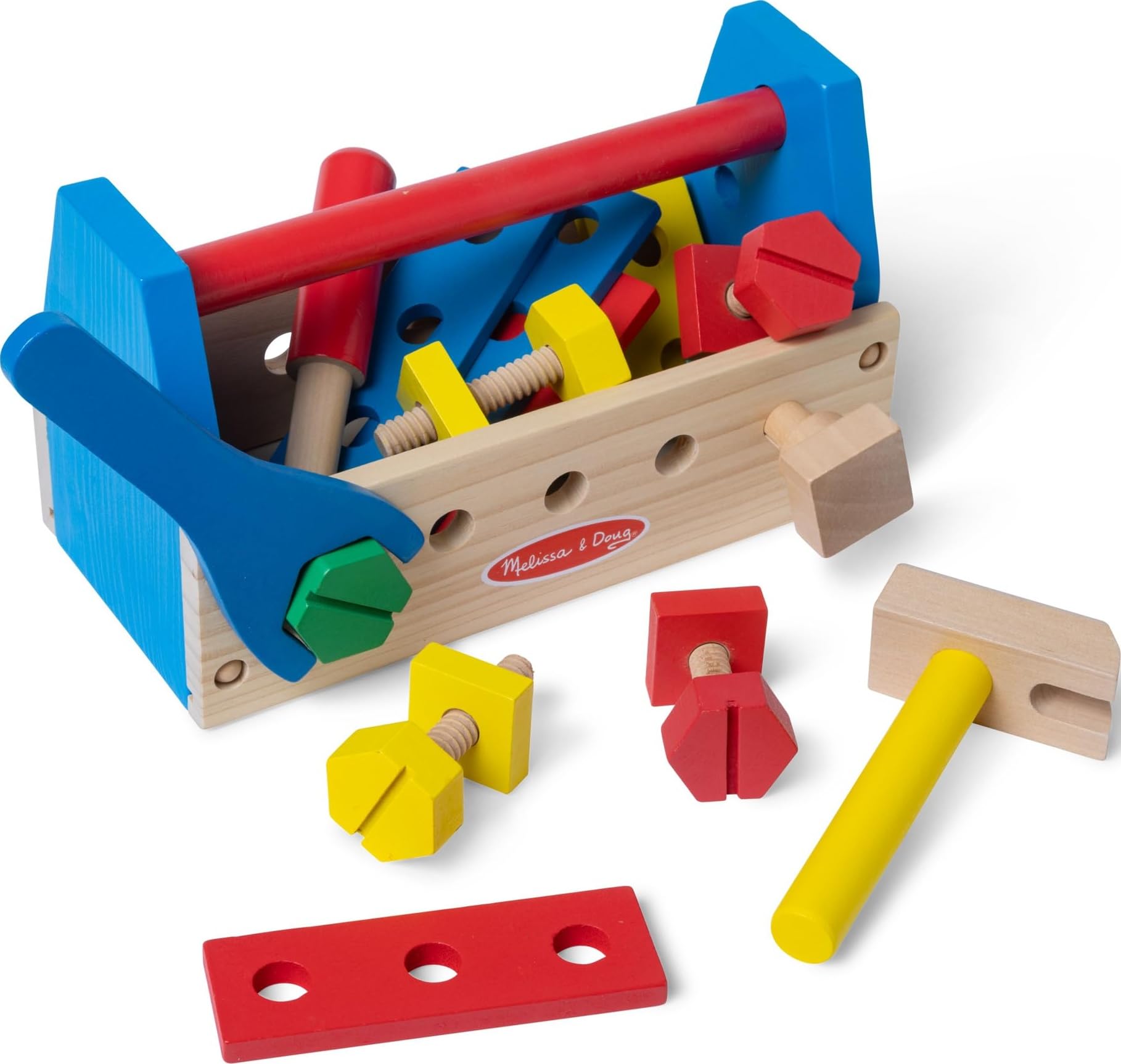
Where our top pick is soft and silent, this is the wooden version of the same idea: 24 pieces, a child-size hammer, wrench, and screwdriver, and boards with holes bored through them. For a three- or four-year-old who wants to actually turn something, it's the wooden set we reach for first.

The threading is the thing to understand before you buy. The screws turn into the bolts and into the holes in the boards, but they don't lock down or let a child build a structure the way a real bolt would; the play is in the twisting, the sorting, and the hammering. Pair each screw with a bolt and it's satisfying work for a four-year-old. Hand it to a three-year-old who expects a tight fit and it will come back to you.

Everything packs into a wooden case about the size of a lunchbox, which is why this is the set that ends up in the car and at Grandma's. The wood is solid, the pieces still seat in their holes after weeks of play, and nothing has chipped at the corners.

Bottom line: We recommend it for a three- or four-year-old who wants wood, a real hammer, and screws that turn, in a case that goes in the car.

#5

VTech Drill and Learn Toolbox

VTech Drill and Learn Toolbox

Songs and lights

Doodle Score 9.4/10
Check Price

Worth Noting

  • Screws only drive into the tray
Size
12.6 x 5.7 x 4.9 in
Age Range
2 to 5 years
Batteries
2 AA required
Play Modes
Songs, lights, instruction cards
Read the full review

The drill doesn't fit back in the toolbox. That's the detail we mention first, because the tray is molded around the hammer, wrench, and nails and there's no slot wide enough for the drill's handle, so the toy's headline tool ends up living on the floor beside the box.

With batteries in, the drill earns its keep: it spins the gears on the tray, drives the chunky screws into the holes, and clicks as it turns. The light-up buttons play songs and name the tools, the double-sided cards give a toddler something to match, and there's a volume control, which we appreciated more with every song.

Songs, colors, and numbers are what you're buying here, and the tray is the whole workshop. The drill is also the part that can let you down — some units whir without turning a screw — so put the batteries in on day one and run it through a few screws while the box is still returnable. Do that, and this is the electronic set we point parents to for a two- or three-year-old who wants buttons.

Bottom line: We recommend it for a two- or three-year-old who wants buttons and songs: the drill really drives, and the cards keep it going.

#6

Step2 Big Builders Pro Workshop

Step2 Big Builders Pro Workshop

Siblings and playrooms

Doodle Score 9.4/10
Check Price

Worth Noting

  • Accessories can arrive missing from the box
Assembly
Required
Age Range
3 years and up
Accessories
45
Assembled Size
27.5"D x 38.5"W x 34"H
Read the full review

This is the commitment in the group: a freestanding workbench a preschooler stands at rather than carries, and the only set here built for two children at once. It's also the one you'll notice in the room, so plan a corner for it rather than a shelf.

Forty-five accessories hang off it, including an electric drill, and the parts that earn their keep are the ones that respond: a working light, tools that make noise, and a birdhouse a child paints with water and watches change color. The birdhouse is the sleeper — it's the station we saw children come back to after the drill had lost its novelty.

Set-up takes a real half hour with the hardware bag, and some holes need persuading before the bolts catch, so build it the night before a birthday rather than the morning of. Once it's up it's stable: 34 inches tall, wide enough for two children without tipping, and smooth enough to wipe down after a session with playdough.

Buy it when the bench is going to be furniture — a playroom centerpiece, a grandparent's house with two grandchildren, a family where the tools get shared. For one child who plays in short bursts, a tabletop set gives you the same idea without giving up the floor.

Bottom line: We recommend it for a playroom with two children in it: a bench they can both stand at, with enough accessories to fill a morning.

#7

ORWINE Musical Tool Bench

ORWINE Musical Tool Bench

One-year-olds

Doodle Score 9.4/10
Check Price

Worth Noting

  • Smaller than the product photos suggest
Power
Battery powered
Age Range
12 months to 5 years
Activities
Ball tube, chainsaw, drill, shape blocks
Dimensions
11.4 x 9.4 x 6.8 in
Read the full review

Twelve months is the number that matters here: this is the only set in the guide rated for a child who is still putting everything in their mouth. The tools are molded plastic with rounded edges, there are no small parts, and the whole bench arrives assembled.

It's a bench-shaped activity center rather than a tool kit. A ball-drop tube, a shape sorter, a drill, a buzzing saw, a clamp, and a number ruler, all with lights and sound effects, and a toddler works around it the way they work around a busy board — a minute here, two minutes there, back to the ball tube.

It's the chattiest toy here: music and effects fire on nearly every activity, and it runs on batteries, so keep spares in the drawer. That's the trade for a toy that will hold a one-year-old at the bench while you get dinner started.

For a first birthday, that's a good deal. The bench does a lot in a small footprint, the edges are genuinely smooth, and the activities are pitched at a child who is still learning to press a button on purpose. It won't last past four — a child who has used the wooden sets will find it babyish — but as a first tool toy it earns its place.

Bottom line: We recommend it for a first birthday: it's the only tool toy here rated from twelve months, and the busiest small bench in the group.

#8

KIDWILL Wooden Tool Kit

KIDWILL Wooden Tool Kit

Building models

Doodle Score 9.2/10
Check Price

Worth Noting

  • Nuts and bolts need gathering up after play
Pieces
36
Material
Wood
Age Range
3 years and up
Case Size
12 x 9 x 3 in
Read the full review

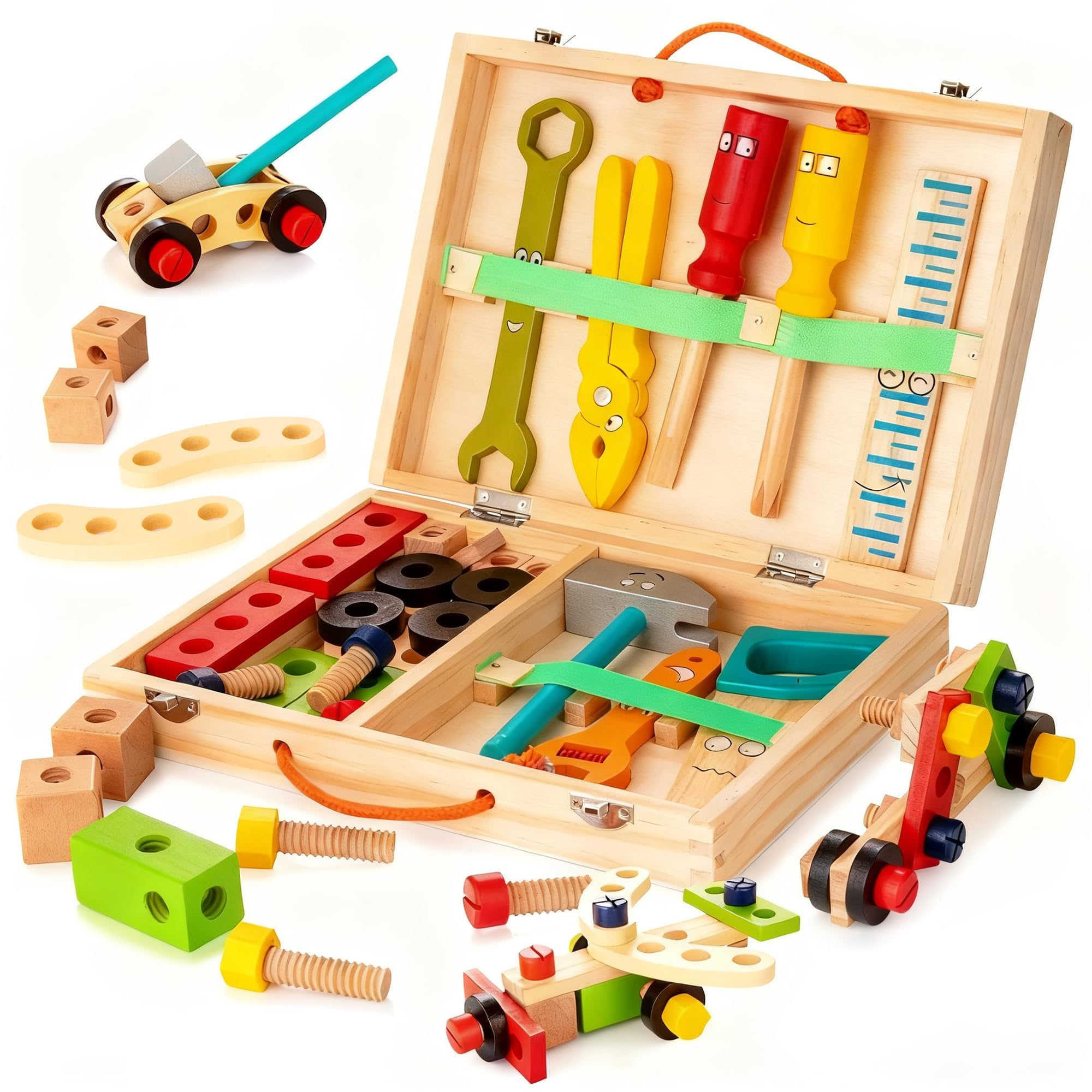
The windmill is what sells this one. Thirty-six wooden pieces include wheels, bolts, and assembly boards, so a child can bolt together a car, a plane, a windmill, or a balance scale and then push the result across the floor. It's the only set here where the play ends with something built rather than a pile of hardware.

Two details landed better than we expected: the tool handles carry little painted faces, which turns a hammer into a character, and the toolbox doubles as storage and a carry case with a latch a four-year-old can work alone. The wood is smooth, the paint has stayed put, and a three-year-old can line up a bolt without help.

The range is what earns it a place. A two-and-a-half-year-old hammers pegs and sorts nuts; a five-year-old follows the assembly pieces into an actual model. That span is wider than most of the wooden sets here, and it's why this sits high among our wooden picks even though it isn't the most polished box in the group.

Bottom line: We recommend it for a three-to-five-year-old who wants to end up with a windmill or a car, not just a full toolbox.

How We Tested the Toy Tool Sets

To build the shortlist, I started with more than 40 sets — house brands, wooden classics, a few battery-powered workbenches — and filtered by what the box actually promised: printed age range, tool count, piece count, and price. Sets that padded their numbers with 40 identical screws, or that needed a screwdriver to open the battery door, got cut. That left 16, which my team and I handed to kids between 2 and 7 in our own homes for four months.

Most of that testing looked like a Saturday morning. We set each kit out beside a real flat-pack project and let the kids "help," then watched what happened when a bit wouldn't seat, a screw stripped, or the drill turned out heavier than a small wrist wanted to hold. We measured handle circumference against a 4-year-old's grip, dropped every toolbox off a coffee table, and stepped on the tools in socks the way it's going to happen anyway. Every few days we dumped the pieces out and had the kids pack them away, which told us whether the case held everything and whether a 3-year-old could work the latches alone.

Age-appropriateness got its own pass: the same set went to a 2-year-old and a 6-year-old, and we noted who was still playing 20 minutes later and who needed an adult to load a bit. We also weighed piece counts against the pieces that actually got used — a 60-piece set where half the screws never leave the bin isn't better value than a 25-piece set that comes out daily. And we judged playfulness by what got picked up unprompted on day four, not by what beeped on day one.

How to Choose Toy Tool Sets

Match the set to the age, not the piece count

A 36-piece wooden kit looks like better value than a six-piece plastic one, and for a two-year-old it isn't. The hardware is a choking size, the threading asks for finer fingers than a two-year-old has, and the whole thing ends up back in the box. Sets rated 3+ carry small screws and bolts for exactly that reason.

If the child is under three, shop the 12-month-and-up and 2-and-up shelf and accept fewer pieces. Our top pick has six pieces and is the only set here we hand to a two-year-old without hovering. The wooden kits with working fasteners start at three, and they are worth waiting for.

Decide how much should actually work

Two kinds of set sit side by side here. In one, screws turn into nuts and boards and the hammer hits pegs; in the other, the tools are for narrating a repair and nothing fastens. Working hardware builds grip and patience, and it also builds frustration when a three-year-old can't seat a bolt.

Battery drills are a third case: they turn, but they drive into the toy's own tray and nothing else. Our rule is simple. Working fasteners for a four-year-old, pretend tools for a two-year-old, and a drill only if the child is the sort who presses every button in the room.

Weigh wood against plastic, and decide how loud you want it

Wood feels better in the hand, survives a drop, and usually costs more; plastic takes more abuse without chipping and is what you want around a one-year-old who throws. Material also predicts noise. Wood and soft plastic sets are close to silent — the Learning Resources drill runs on a squeeze rather than a motor — while the electronic benches bring songs and effects with them.

If you want a toy that can come out while you're on the phone, choose a set with nothing to switch on. If you want a child occupied while you cook, the opposite applies.

Check the storage and the floor space before you commit

Look at whether the case has a molded slot for every tool. When it does, tidy-up is a two-minute job a child can manage alone; when it doesn't, one tool lives on the floor forever. The VTech drill, for instance, doesn't fit back in its own toolbox.

Then check the footprint. A tabletop bench takes a shelf; a full-size workbench is 38.5 inches wide and 34 inches tall and needs a corner of its own. Measure that corner before you fall for the water-reveal birdhouse.

Frequently Asked Questions

Final Verdict

If you're buying for a two-year-old, buy the Learning Resources New Sprouts Fix It! set and stop looking. The soft, battery-free tools are the only ones here that survive a mouthing, a throwing, and a hammering on the coffee table in the same afternoon.

Move to the Melissa & Doug Take-Along Tool Kit when your child turns three and wants screws that turn and boards to work on.