Pretend Play

Best Toy Vacuums of 2026

There's a moment every parent knows: the real vacuum comes out, and your toddler sprints over to grab the handle. Handing over a toy version buys you ten minutes of peace — and, if you're lucky, a kid who stops treating the broom closet as forbidden territory. The catch is that most toy vacuums get abandoned within a week, either because they make one sad beep and nothing happens or because they're so loud the dog leaves the room. The good ones let a kid push, watch something spin, and see the bin fill up with crumbs they made themselves.

I've watched a lot of these get opened at birthday parties, and the box is almost always cuter than what's inside. Over the past three months our team has run 14 toy vacuums through real living rooms, play kitchens, and crumb-covered floors, and the pattern held: the ones kids come back to are the ones that make a satisfying noise without being ear-splitting, and that actually trap a little debris. Here's what survived.

#1

Fisher-Price Laugh & Learn 2-in-1
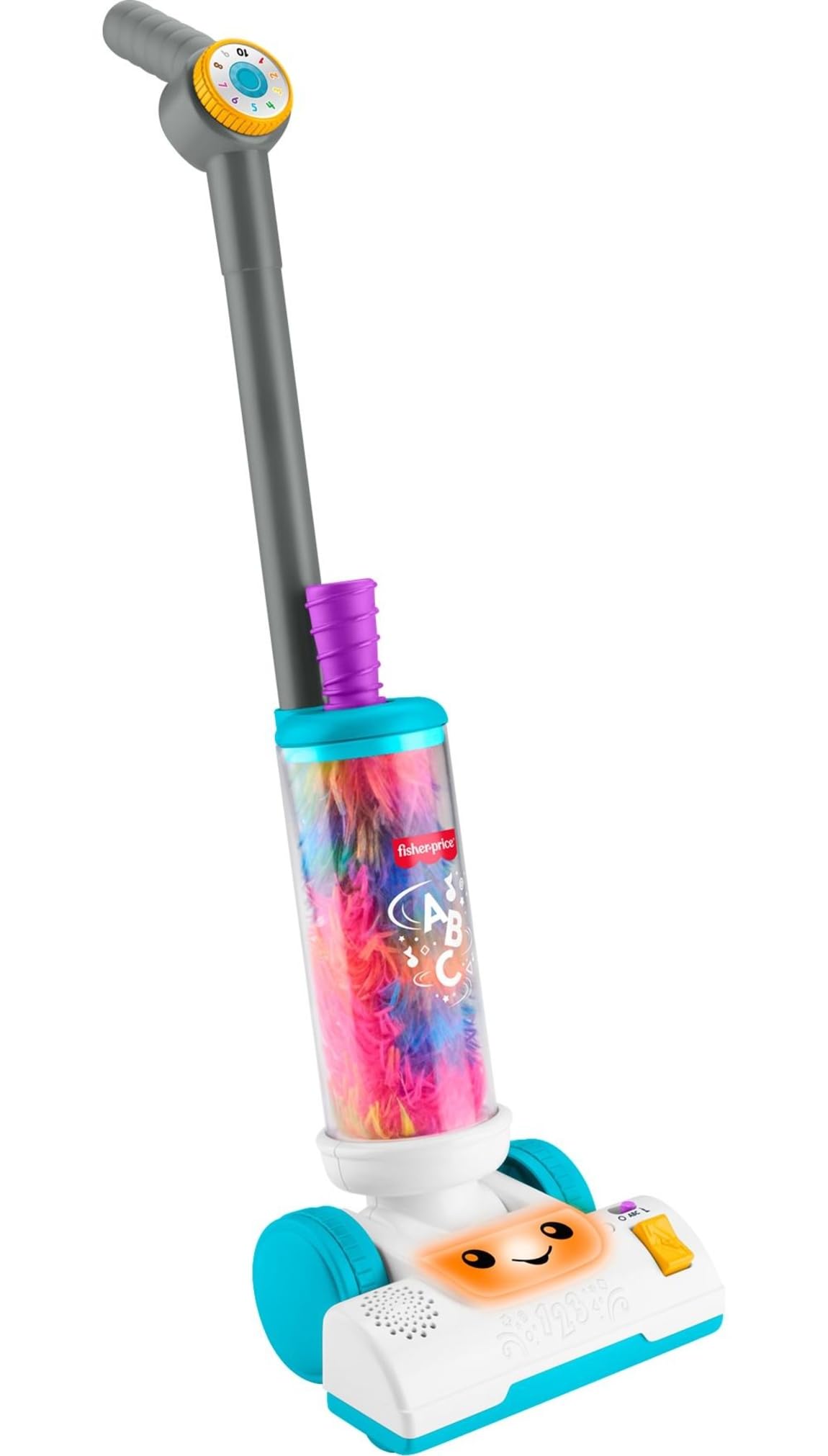
Fisher-Price Laugh & Learn 2-in-1

Two-year-olds

Doodle Score 9.6/10
Check Price

Worth Noting

  • Pretend only, with nothing to pick up
  • 45-plus songs get repetitive for adults
Height
22.3 inches
Sounds
45+ songs, sounds and phrases
Weight
1 lb
Recommended Age
24 months and up
Read the full review

A duster that lifts out of the canister is a small idea that changes how long this toy gets played with. The vacuum is one job; the duster is a second one that works on a bookshelf, a windowsill or the side of a dollhouse. We rate it the best of these for a two-year-old, and that second job is most of the reason.

The rest is Fisher-Price doing what Fisher-Price does. There are 45-plus songs, sounds and phrases across two modes, the duster twirls inside the canister as the toy rolls, and the whole thing weighs a pound. It stands on its own at just over 22 inches, with a chunky toggle a small hand can work, and it is short enough that a two-year-old can push it without stooping.

What you don't get is realism: no whizzing debris, no replica detail, no pickup. What you get instead is a toy a very young child can operate alone on the first afternoon. The honest caveat is that this is one of the newer designs in the roundup, so we are recommending it on the design and a strong start rather than on years of use, and the duster, being removable and carry-sized, is the piece most likely to go missing.

Bottom line: For a two-year-old, this is the toy we hand over: light, free-standing, full of songs, and with a duster that turns one present into two jobs.

#2

Barney's World Clean Up Vacuum

Barney's World Clean Up Vacuum

Songs on a budget

Doodle Score 9.4/10
Check Price

Worth Noting

  • Songs are the play, with nothing to pick up
Height
24.41 inches
Sounds
65+ songs, sounds and phrases
Batteries
3 AAA, included
Recommended Age
24 months and up
Read the full review

Three modes give you three different toys: clean-up mode with vacuum sounds, music time with the sing-along songs, and play time with color games. Roll it and the lights come on, and the song list includes the Clean Up song from the show. For a Barney household, that last part is the entire pitch.

It is a tall, thin push-along, just over 24 inches and 1.7 pounds, with a chunky grip and a light-up top. Nothing about it pretends to be a replica, and there is no pickup of any kind. What it has instead is more than 65 songs, sounds and phrases, a volume that stays at a level you can live with, and a body light enough for a two-year-old to carry one-handed.

Our hesitation is depth. The songs are the whole experience, and a child who does not already know the Clean Up song will find less here than in the Casdon or the LeapFrog, both of which give them something to do with their hands. For a Barney fan, or a grandparent buying for one, it is a good birthday present at the cheaper end of this group. It is just a narrower toy than the rest.

Bottom line: For a Barney household this is the easy buy: 65-plus songs and phrases, three modes, and the Clean Up song on request. For everyone else it's a decent push-along with nothing to pick up.

#3

Fisher-Price Light-Up Learning Vacuum

Fisher-Price Light-Up Learning Vacuum

One-year-olds

Doodle Score 9.2/10
Check Price

Worth Noting

  • Outgrown around age three
Batteries
3 AAA, included
Dimensions
15.83 x 7.44 x 10.27 inches
Learning Themes
Colors and counting
Recommended Age
12–36 months
Read the full review

Twelve months is younger than almost any other toy vacuum goes, and that is the case for this one in a sentence. With the handle tilted down it sits at the height of a child who is still crawling or just cruising, and the light-up canister button is easy to hit from a sitting position. We reach for it when the child is under two and everything else here is a head taller than they are.

It is a learning toy shaped like a vacuum rather than a vacuum that happens to teach. The songs and phrases cover colors and counting, there are two settings, one with vacuum sounds and one with the learning content, and the canister lights when pressed. What you give up is the replica detail: no whizzing balls, no debris drawer, no pickup. At this age that is the right trade, because a one-year-old is copying the push, not the cleaning.

One quirk is worth knowing before you buy. The switch runs backwards from the obvious way round: on gives you vacuum sounds, and off switches over to songs and phrases, so the toy keeps talking after the vacuum noise stops. If you are buying this to get a quiet ten minutes, off isn't off. Three AAA batteries come in the box, so it plays the moment it is unwrapped.

Bottom line: We keep this one for the under-twos, because the tilting handle puts vacuum play at the height of a child who is still crawling — no realism, and none needed at that age.

#4

LeapFrog Pick Up and Count Vacuum

LeapFrog Pick Up and Count Vacuum

Counting practice

Doodle Score 9.2/10
Check Price

Worth Noting

  • Pink is the only listed color
  • Pricier than most picks here
Height
24.3 inches
Batteries
4 AA
Play Pieces
10 color-coded dust pieces
Recommended Age
2–5 years
Read the full review

Ten color-coded dust pieces come in the box, and the vacuum knows which color it has swallowed. Roll over a piece and it disappears into the canister, the panel lights, and a voice counts it. No other toy here has a mechanic like that, and it is what makes this the pick for a child who has already mastered pushing and wants a game on top of it.

The learning layer is properly built: number, color and play modes, six games, and a canister of bouncing balls that keeps the visual interest going while the counting happens. The handle tilts through several heights, which is more adjustment than most of these offer, and the pieces store inside the body. It is pink only in this listing, which is worth knowing before you order for a child with opinions.

The catch is effort. Picking up those discs takes aim, and pushing the thing across carpet takes a real shove, enough that a two-year-old will need help or a hard floor. On a wood floor with a patient three-year-old, we think it is the most rewarding toy in this group, and the only one where the play is a game rather than an impression.

Bottom line: Buy this one if you want a toy vacuum that teaches as it plays: it counts and names every dust piece it swallows, and the counting is the game. Best on a hard floor.

#5

EP Kids Vacuum Cleaner Set

EP Kids Vacuum Cleaner Set

Full cleaning set

Doodle Score 9.0/10
Check Price

Worth Noting

  • Light build that won't take years of play
Modes
Try Me and continuous
Weight
1.9 lb
Accessories
Spray bottle and 2 cloths
Recommended Age
3+ years
Read the full review

The box is the pitch: a vacuum, a spray bottle and two cloths, all sized for a three-year-old. The vacuum is the toy; the bottle and cloths are the job. A child who has been told to help gets to wipe a table while the vacuum waits in the corner, and the accessories turn tidying into a routine rather than a single action.

The vacuum itself has an on/off switch, a realistic sound, lights and whirling stars in the canister. The feature we rate most highly is the try-me setting: about seven seconds of play per press, then it stops, which saves batteries during the phase when a child does nothing but press the button. Switch to continuous when they are actually pushing it around.

Noise is the pleasant surprise. It reads as a vacuum without being one of the louder toys here, which matters in a flat or a house with a baby asleep upstairs. The build is the weak point: the shell is light, the mechanism is not built for years, and the ones that stop working tend to do it after months of play rather than in the first week.

Where it earns its place is the set, not the machine. If you want one box that covers pretend cleaning, spray, wipe and vacuum, this is the only pick here that does the whole routine, and the accessories are the reason to choose it over a better-built single vacuum. If you only want the vacuum, the Casdon is the better toy for the same sort of money.

Bottom line: Buy it for the set rather than the machine: a spray bottle, two cloths and a vacuum that lights up and swirls, sized for a three-year-old who wants the whole cleaning routine.

#6

Battat Play Circle 2-in-1 Vacuum

Battat Play Circle 2-in-1 Vacuum

Handheld conversion

Doodle Score 8.8/10
Check Price

Worth Noting

  • Loud for an indoor toy
  • Takes three C batteries, not included
Height
24.02 inches
Weight
3.4 lb
Batteries
3 C, not included
Recommended Age
3–8 years
Read the full review

The upright splits into a handheld. The duster pulls off the body, the dust cup lifts out, and a child can carry the small piece around a baseboard while the stick stands in the corner. That conversion is why this one earns a place over the cheaper replicas: it is two toys, and the handheld half is the part that gets carried around the house.

We rate it the best of these for a household with two children close in age. The hand vac suits a one-year-old, the full upright with its whirling beads and pop-out dust cup suits a four-year-old, and both can be in play at once. Tipping the beads back out and starting again is a loop that keeps the play going longer than the sound effects do.

It isn't dainty. At 3.4 pounds it is the heaviest toy here, and the upright is top-heavy, so a child who drags it by the handle instead of pushing will tip it over. That same weight is why it feels like it will survive being hauled up the stairs, which is more than we can say for the lighter replicas.

Bottom line: Two toys in one body — the upright converts into a handheld a toddler can carry — which is why we choose it for a house with more than one small child. Heavy and loud, and worth it.

#7

Casdon Dyson Ball

Casdon Dyson Ball

Realistic 3+ role-play

Doodle Score 8.6/10
Check Price

Worth Noting

  • Handle joint can pop apart under hard pushing
  • Requires four C batteries
Height
24.8 inches
Weight
2.25 lb
Batteries
4 C, not included
Recommended Age
3+ years
Read the full review

The first thing a child does with the Dyson Ball is push it forward and turn the handle to see what the body does. It swings around on the ball, pivots, and keeps going, with colored balls spinning in the clear cylinder as it rolls. That steering action is the most satisfying thing in this roundup, and it is why a three-year-old picks it over a plain push-along.

We think it's the best toy vacuum here for the three-to-five set, and the reason isn't cleaning, it's resemblance. This is a licensed Dyson replica down to the pull-out debris drawer and the sound effect, and matching the machine you use is most of what a preschooler wants from pretend play. That isn't a small thing at this age: the toy that looks like yours is the toy that gets used.

What it won't do is pick anything up. The packaging mentions real suction; treat that as decoration and set the expectation before you hand it over. A child who thinks crumbs are going to vanish will lose interest fast, and no amount of whizzing balls makes up for a promise the toy cannot keep.

The stated range runs to age ten, which is generous for a toy this simple. In practice the children who get the most out of it are the ones still young enough to copy you around the house, and for that child nothing else here comes as close to the real thing.

Bottom line: If your child is three or older and wants the vacuum you're using, this is the one we point to: a real-looking replica that steers, spins and sounds the part, as long as you don't expect it to clean.

How We Tested the Best Toy Vacuums

Our shortlist began with roughly 30 toy vacuums — the ones crowding the toy aisle, the ones the big toymakers push every holiday, and a few that parents kept telling me their kids still used months after the box went out. Anything with small detachable parts, anything that needed a screwdriver and four batteries before a kid could touch it, and anything whose handle sat too high for a toddler got cut. That left 14, which we bought ourselves and handed to families with kids from about 18 months to 6 years old.

For three months those 14 vacuums lived in family homes and got used the way these things really get used: pushed across a rug after a bowl of cereal hit the floor, dragged into the play kitchen, yanked by the handle, and dropped down a step or two. To see whether they'd actually do anything, we sprinkled a measured spoonful of cereal crumbs and dry rice on carpet and hardwood, then opened the bin to see what made it in — that number predicted better than anything else whether a kid came back to it on day ten. We also asked the kids which one they wanted, because the cutest vacuum gets grabbed first and the one with a spinning brush and a satisfying rumble gets played with longest.

Sound got its own test, since it's the thing that quietly ruins a toy vacuum. We took a decibel reading at arm's length and again from across the room, and noted which models had a volume switch or a mute — those are the ones that survive quiet hours instead of getting banished to the garage. Durability meant real abuse: handle yanks, tipped-over bins, wheels dragged over shag carpet and hardwood thresholds. And because most of these arrive as gifts, we clocked what it takes to get one running on the morning it's opened, whether the bin comes apart without a fight, and what's actually in the box for the money.

How to Choose Toy Vacuums

Match the height to the child, not the age on the box

A toy vacuum that is too tall gets dragged by the handle or abandoned. The picks here run from a low push-along a crawling child can reach up to 24 inches, which is the difference between a toy for a one-year-old and one for a four-year-old. Two features flatten that curve: a handle that tilts through a few positions, and a body that stands up on its own when a child lets go.

Our rule of thumb is chest height when the child stands beside the toy. Anything that reaches above the shoulder gets tipped over instead of pushed, and a child who has to lift the handle to move it will go back to the real one.

Treat suction claims as decoration

Listings talk about working suction and realistic pickup. In practice most toy vacuums move air and nothing else, and the more prominently a toy advertises suction, the more likely the disappointment when a child tests it on a crumb. If pickup is the point for your child, buy a visible mechanism instead of a suction claim.

The LeapFrog Pick Up and Count is the clearest example: ten dust pieces disappear into the canister and get counted on the way in, which reads as success in a way that a hopeful pass over the rug never does. Otherwise buy the pretence and set the expectation before you hand it over.

The joints are what break

Handles, debris doors, wheels and clip-on dusters fail or vanish before anything else does. Look at how the handle attaches to the body: a click or a screw holds, while a push-fit joint that relies on friction is the one that separates mid-play. The same goes for a dust-cup door and any removable brush.

Keeping the box for the first month is worth the cupboard space, because a joint failure in week two is still returnable. It is also the reason a heavier, plainer toy often outlasts a lighter, prettier one.

Count the batteries before you buy

Cell size is the hidden running cost. AA and AAA cells are cheap and in every drawer; C cells cost several times as much and do not last proportionally longer. Two of the picks here take C cells, so put a spare pack in the same order as the toy rather than discovering it on Christmas morning.

Watch the demo setting too. Several toys ship with cells meant for the shop rather than for a month of play, which is exactly why the try-me modes run for a few seconds per press.

Volume and repetition matter as much as the feature list

Sound is where a toy vacuum goes from charming to unbearable, and the song count is not the measure — the volume and the loop are. The Fisher-Price two-in-one and the EP set both read as a vacuum without dominating a room; the Battat runs closer to a real machine, which is either the point or the problem depending on your house.

Ask whether there is a volume control before ordering, and if the toy will live in a flat with a sleeping baby, let that answer decide more than the number of songs does.

Frequently Asked Questions

Final Verdict

Start with the Casdon Dyson Ball. For a child of three or over it is the toy that most convincingly lets them do what you are doing: it steers, it swings, it sounds right, and the only thing you have to manage is the expectation that it will clean anything.

If your child is younger than that, or the vacuum has to survive being carried around by a one-year-old, the Fisher-Price two-in-one is the better first toy: lighter, free-standing, with a duster that keeps a second job going. Buy the Casdon when they are tall enough to push it, and the Fisher-Price now.