Pretend Play

Best Pretend Phones of 2026

The first time my toddler pried my actual phone out of my hand and started tapping at the lock screen, I understood the appeal of a decoy. A good pretend phone isn't trying to fool anyone for long — it hands over something that lights up, chatters, and survives being dropped, so your real phone stays in your pocket. What separates a great one from a hunk of plastic is mostly in your ears: volume, sound quality, and whether the noises are charming or the kind that make you leave the room.

These past three months, my team and I put 14 pretend phones through their paces on playroom floors, in the back seat of the car, and in one restaurant booth where I was desperate. Cuteness matters more than the packaging admits — kids reach for the ones that look like the phone in your hand. Functionality matters too: does the screen change, do the buttons do different things, does the cord survive a tug-of-war. Playability and value beat gimmicks nearly every time, and the ones worth your money are below.

#1

LeapFrog Chat & Count Emoji Phone

LeapFrog Chat & Count Emoji Phone

Everyday toddler play

Doodle Score 9.4/10
Check Price

Worth Noting

  • Audio gets lost in noisy rooms
Batteries
3 AAA (included)
Dimensions
2.8 x 1.04 x 5.79 inches
Recommended Age
18 months-5 years
Learning Content
Numbers 0-10, counting, manners
Read the full review

What makes the LeapFrog Chat and Count Emoji Phone our default is not one flashy feature; it is the balance. It handles pretend calls with Scout, voicemail, emojis, and a video button, then turns the same number buttons into counting practice from 0 to 10. We liked that a 2-year-old can pound buttons and hear a response, while a 4-year-old can follow the games and songs. It is the one here we can hand to a broad age range without wondering whether the phone will be outgrown in a month.

The shape helps. At 5.79 inches long and 5.6 ounces, it sits in small hands without feeling like a tablet, and the light-up buttons are easy to find. The 3 AAA batteries are included, so it works out of the box. We also appreciate the screen animations and emoji sounds because they make pretend play feel like a real phone call without turning the toy into a miniature tablet.

Our reservation is the audio. The sound is fine in a quiet room, but it gets lost against road noise, and we wished for more headroom when the counting prompts were competing with the car. That is a small trade-off for the mix of learning and pretend play, and it is the reason the eKids Frozen phone is the better travel pick. For everyday play at home, this is the first phone we reach for.

Bottom line: Our default for most families: the LeapFrog mixes pretend calls, counting games, and a durable toddler-friendly shape better than any other phone here.
#2

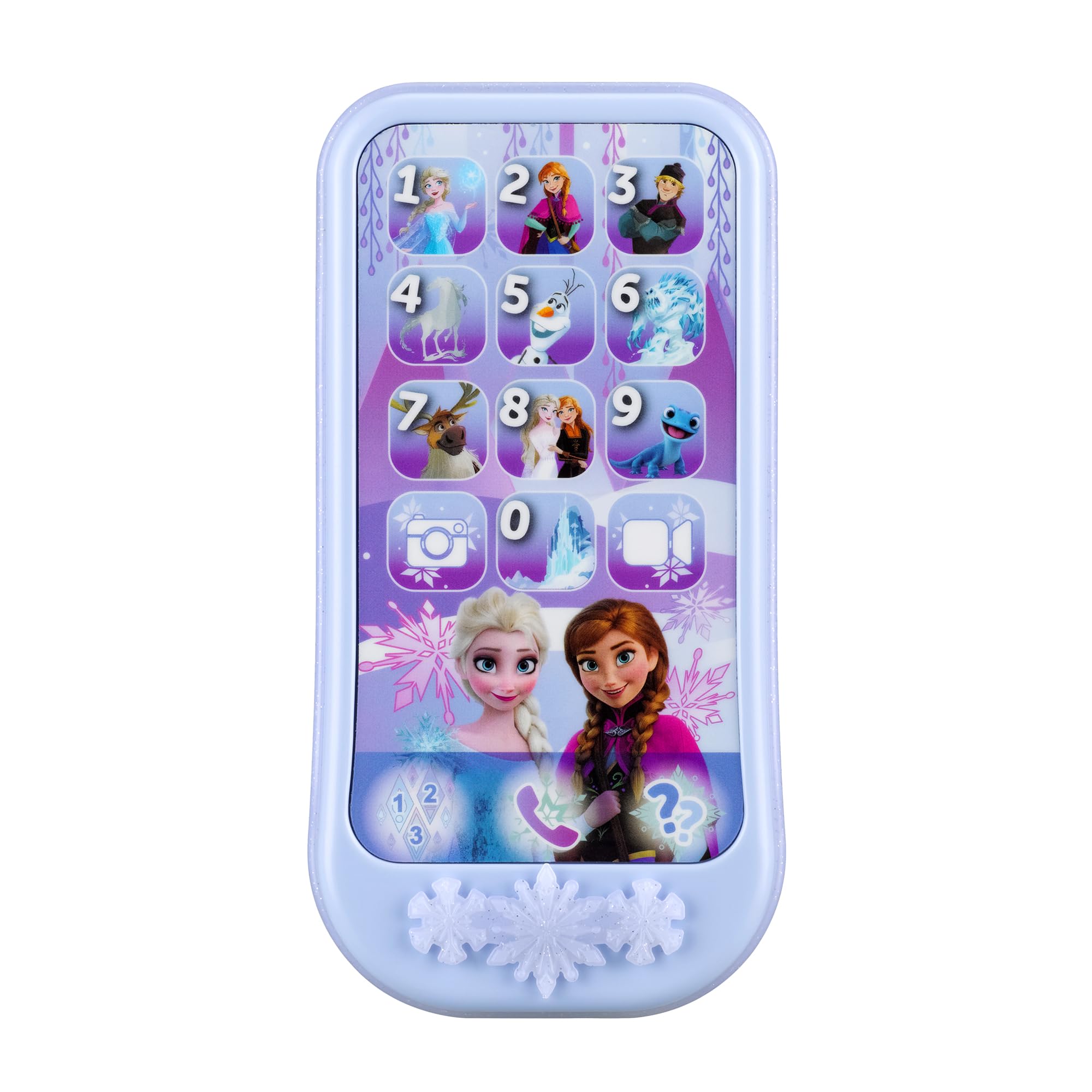
eKids Frozen Toy Phone

eKids Frozen Toy Phone

Travel and volume

Doodle Score 9.4/10
Check Price

Worth Noting

  • Frozen theme limits the audience
Dimensions
3.29 x 1.2 x 6.41 inches
Auto Shut-Off
Yes
Volume Control
Built-in
Recommended Age
3 years and up
Read the full review

Built-in volume control is the detail that makes the eKids Frozen phone the one we pack for a car trip. Plenty of toy phones here have a speaker; this one gives you a volume choice and automatic shut-off, so it is less likely to become the loudest thing in the back seat. The sounds, preschool games, and pretend apps give a Frozen fan plenty to press without turning the phone into a full tablet.

We were also impressed by how well the phone holds up to being carried around. It is 6.41 inches long, light enough for a preschooler, and the buttons are easy to hit. The Elsa theme is not an afterthought: the character phrases and ring sounds carry the play, and the volume controls make the whole thing easier for an adult to live with. We found the sound clear at the lower settings, which is more than we can say for several phones here.

The catch is obvious before you buy: this is an Elsa phone. A child who does not care about Frozen will get more from the LeapFrog or Bluey phone. For the right fan, though, it is the most practical travel choice in the group, and the auto shut-off is the kind of small feature that saves batteries and nerves.

Bottom line: The Frozen phone is our travel pick because the volume control and auto shut-off make it easy to live with, provided your child is an Elsa fan.

#3

Fisher-Price Chatter Telephone

Fisher-Price Chatter Telephone

Classic walk-along play

Doodle Score 9.4/10
Check Price

Worth Noting

  • Short cord limits pulling and ear play
Dial
Numbers 0-9
Weight
14 oz
Play Style
Pull-along or sit-at
Recommended Age
12 months and up
Read the full review

The Chatter Telephone looks like it came from a garage sale in the best way: chunky plastic, a rotary-style dial, and eyes that bob as it rolls. It is the only pick here that works as a pull-along toy, and that gives it a second act after the pretend-call novelty fades. A toddler can sit and dial 0 through 9, then pull it across the floor and watch the eyes move.

The sounds are simple—a ring and a few chatter effects—and that is part of the appeal. There is no screen, no app, and no learning mode to outgrow. At 14 ounces, it is light enough to drag by the cord, and the 12-month-and-up rating makes it one of the earliest phones in this group. We like it as a first phone for a child who is already walking.

The cord is the sticking point. It is short enough that a taller toddler cannot easily hold the receiver to an ear while the body stays on the floor, and it makes the pull-along play less satisfying than the classic look suggests. We still think the Chatter Telephone earns its place for nostalgia and motor play, but if you want a phone for long pretend conversations, the LeapFrog or Bluey models are easier to use. The short cord is a design compromise, not a reason to skip the toy entirely.

Bottom line: A classic pull-along phone with real charm; buy it for nostalgia and motor play, not for long pretend calls, because the cord is short.

#4

Bluey Ring Ring Phone

Bluey Ring Ring Phone

Bluey pretend calls

Doodle Score 9.4/10
Check Price

Worth Noting

  • Quiet speaker with no volume control
Games
Four Bluey and Bingo games
Batteries
2 AAA (demo included)
Dimensions
3.27 x 0.98 x 6.69 inches
Recommended Age
3-6 years
Read the full review

The Bluey Ring Ring Phone earns its spot with the voice-activated chat. A child can talk to Bluey and Bingo and get a reply, which feels more like a real phone call than the one-way buttons on most toys here. There are four games, character animations, two voice messages, and a ringtone to change. For a Bluey fan, that is a lot of familiar play packed into a 6.69-inch phone.

The games are gentle rather than frantic: help Bluey catch fruit, blow bubbles, play music for Bingo, or help her do a handstand. We like that the phone also lets a child change the ringtone and brightness, because those small controls make it feel like a real device. The 3-to-6 age range fits the show's audience, and the 2 AAA demo batteries mean it starts working right away.

Sound is where it gives ground. The speaker is quiet, and there is no volume control, so a busy car or a noisy playroom can swallow the voices. The buttons and games still work, but a child who needs loud feedback may lose interest. The electronics are the other question mark; test the phone during the return window before it becomes a favorite.

For a Bluey household, those trade-offs are easy to accept because the character interaction is the point. If your child is not already quoting the show, the LeapFrog phone offers more general learning and clearer volume for the same kind of money. If Bluey is the reason the phone will get picked up, this is the one.

Bottom line: The best choice for a Bluey fan, with voice-activated chat that feels genuinely interactive; just expect quiet audio and no volume control.

#5

VTech Little Smartphone

VTech Little Smartphone

Babies and toddlers

Doodle Score 9.4/10
Check Price

Worth Noting

  • Quiet in cars and busy stores
Songs
2 sing-along, 8 melodies
Batteries
2 AAA (included)
Dimensions
2.95 x 4.17 x 5.83 inches
Recommended Age
6 months-3 years
Read the full review

For a baby, the best pretend phone is the one they can actually hold, and the VTech Little Smartphone gets that right. It is 4.8 ounces and small enough for a 6-month-old's grip, with large number and color buttons that respond to a slap as readily as a deliberate press. We like that the phone starts with voicemail and music rather than a menu, so there is no wrong way to play.

The holographic puppy and kitty are the detail that keeps it from feeling like a plain slab. They light up with the buttons, and the two sing-along songs and eight melodies give a baby something to return to. The 2 AAA batteries are included, and the automatic shut-off is useful because this is the age when a toy gets set down mid-song and forgotten.

The volume is modest. In a quiet room it is fine; in the car or a busy store, the phrases can disappear. That is a real limitation for a toy aimed at babies, but the size, durability, and simple cause-and-effect play still make it the best first phone here. If you need something louder for travel, the eKids Frozen phone is the better fit; at home, the Little Smartphone is the one we keep within reach.

Bottom line: The best first phone for babies: small, light, and forgiving of random button presses, though the volume is best suited to quiet rooms.

#6

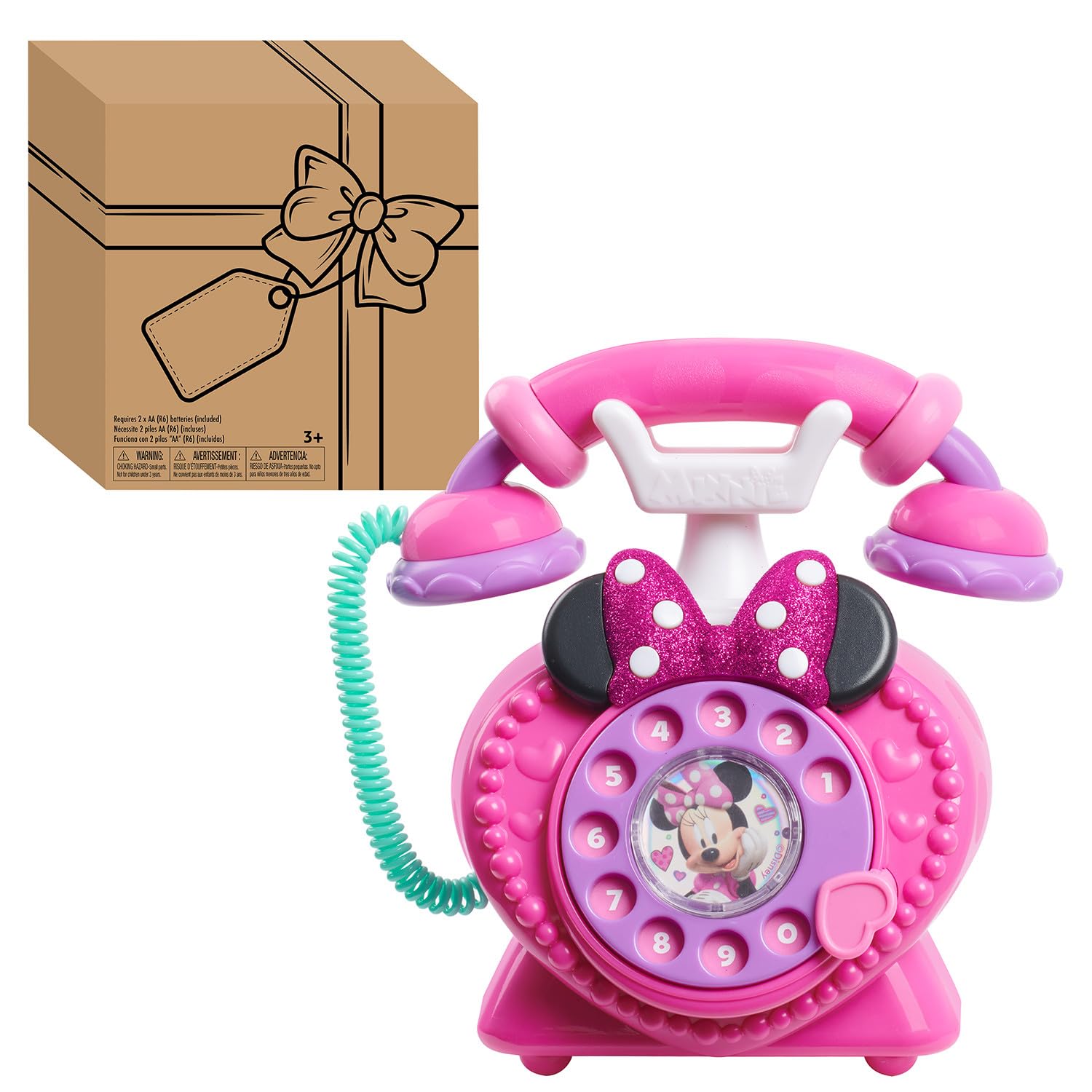
Minnie Mouse Ring Me Phone

Minnie Mouse Ring Me Phone

Rotary Disney play

Doodle Score 9.4/10
Check Price

Worth Noting

  • Packaging reveals the gift
  • Focused on pretend calls, not lessons
Dial
Rotary
Sounds
Minnie phrases and phone sounds
Dimensions
7.5 x 5.75 x 7.75 inches
Recommended Age
3-8 years
Read the full review

The rotary dial is the whole reason to pick the Minnie Mouse Ring Me phone. A child turns the dial, hears the clicks, and then holds the handset to an ear—an old-fashioned phone motion that most kids today have never tried. The Minnie phrases, lights, and realistic telephone sounds fill in the rest, and the 7.5-inch body feels substantial without being too heavy for a preschooler.

We were charmed by how completely it commits to the bit. The dial is not a decorative ring around a button; it is the main control, and that makes the phone feel different from the screen-style toys here. The 3-to-8 age range gives it room to grow, and the Disney styling is cute without turning the whole toy into a collectible. For a child who likes to imitate a landline call, this is the most satisfying design in the group.

Two practical notes. The packaging reveals what is inside, so it is not a good choice if the phone is meant to be a surprise. And the play is narrower than the learning phones: there are Minnie phrases and telephone sounds, but the focus is pretend conversation rather than counting games. That is fine if you want a dedicated pretend phone; if you want more educational content, the LeapFrog is the stronger buy.

Bottom line: The rotary phone to buy for a Disney fan: tactile dialing, Minnie phrases, and a design that makes pretend calls feel physical.

#7

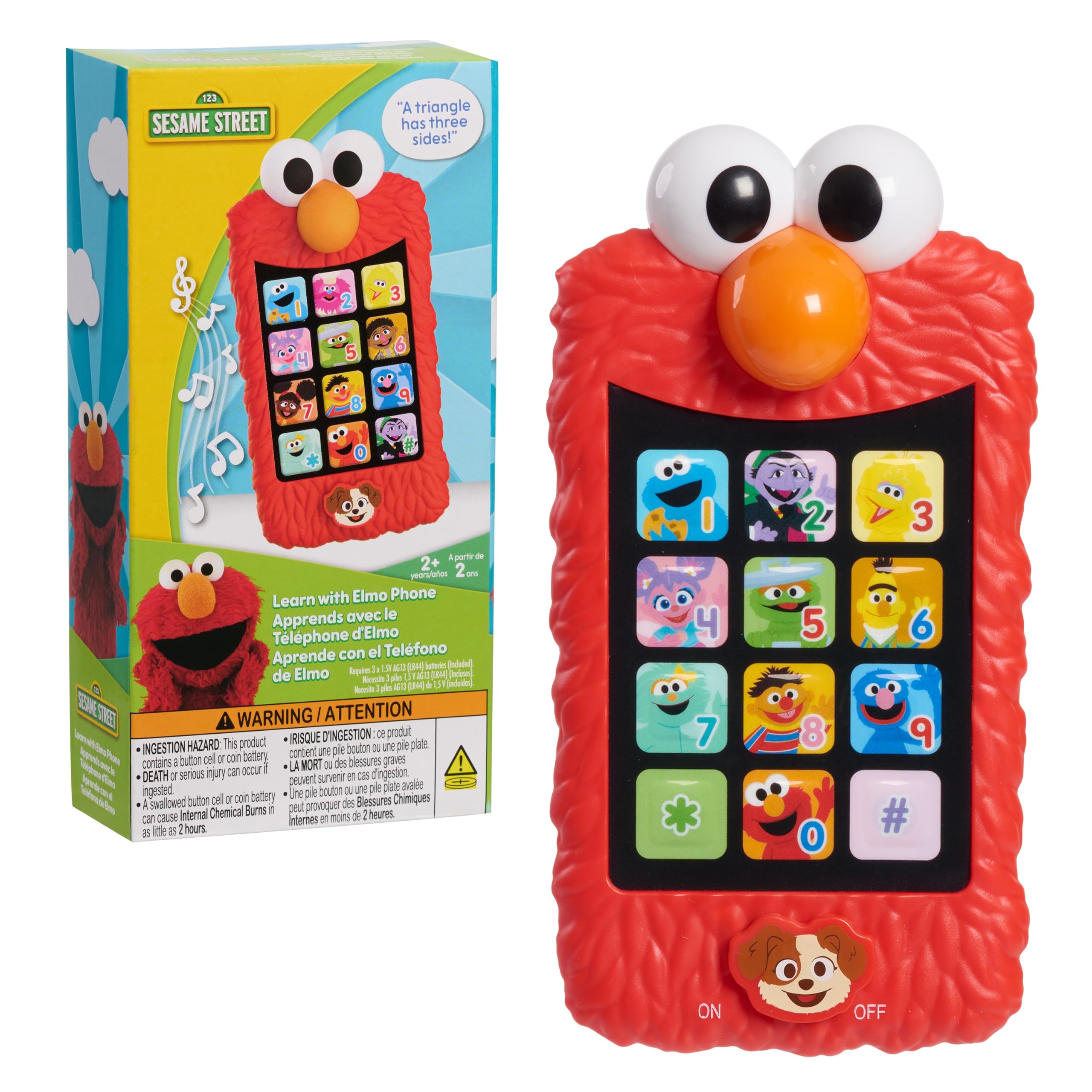
Sesame Street Elmo Phone

Sesame Street Elmo Phone

Budget Elmo fans

Doodle Score 9.2/10
Check Price

Worth Noting

  • Low, muffled speaker
Phrases
50+
Batteries
3 LR44 (included)
Learning Themes
12
Recommended Age
2-6 years
Read the full review

The Elmo phone gives you a lot of Elmo for the money: more than 50 phrases, 12 character buttons, and a rendition of 'Wheels on the Bus' in a 6-inch package. For a toddler who already lights up at Elmo, that is the main event. Press a button and Elmo talks; the learning themes run through counting, colors, shapes, and other preschool basics without asking the child to follow a menu.

The size is right for little hands, and the chunky red body feels like a toy that can be carried around in one fist. We like that the buttons are large and the phrases are short, because that suits a 2-year-old's attention span better than a long game sequence. It is the kind of phone a child can use without an adult setting it up first.

The speaker is the weak point. The volume is low and can sound muffled, so the phrases are easier to follow in a quiet room than in a car. For the price, the Elmo phone is still an easy add for a fan, but it is not the pick for a noisy household or a long drive. If volume matters more than the character, the eKids Frozen phone is the better travel choice.

Bottom line: An affordable Elmo phone with plenty of phrases for a young fan; the muffled speaker keeps it from being the best all-around choice.

#8

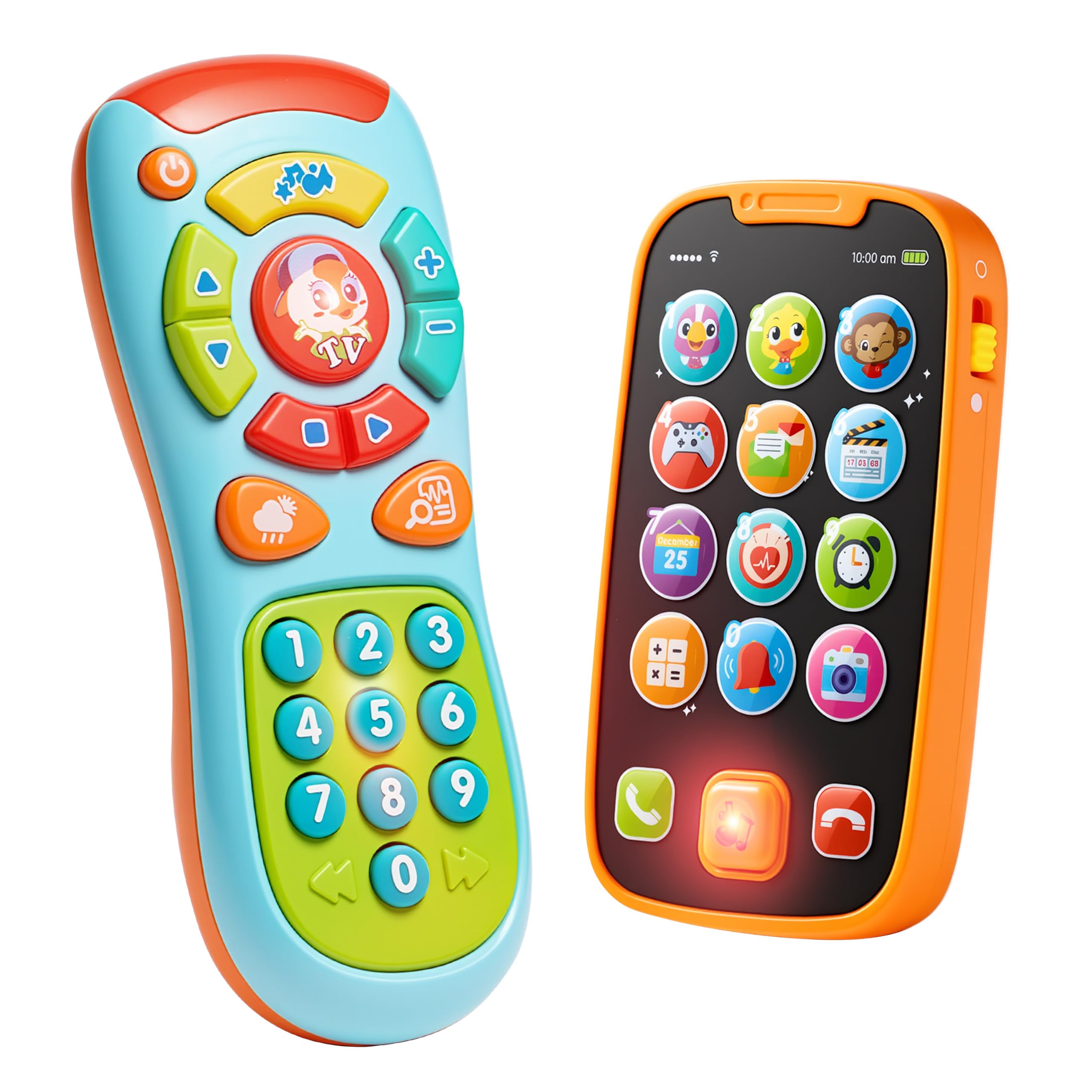
JOYIN Phone & Remote Set

JOYIN Phone & Remote Set

Phone and remote

Doodle Score 9.2/10
Check Price

Worth Noting

  • Phone audio is quiet
Includes
Phone and remote
Material
ABS plastic
Dimensions
6 x 5 x 1.7 inches
Recommended Age
6 months and up
Read the full review

The JOYIN set is really two toys, and the remote is the better half. It has channel keys and a mix of animal, calculator, music, and camera sounds that make it feel like a busy TV remote. The phone is the piece a child will copy you with, but the remote is the one that kept our attention because the sound is easier to hear and the buttons are more varied.

The phone itself is simple: a large screen shape, number buttons, and a handful of sounds. It is 6 inches wide and light enough for a baby to wave around, and the ABS plastic feels made for the age range. For a 6-month-old who is already grabbing at your phone and the TV remote, the pair makes sense as a decoy set.

The phone's volume is low, and some buttons can feel repetitive after a while. That is less of a problem in a set this inexpensive, because the remote carries more of the play. We also like that the remote has the more interesting sound effects, since that is the piece an adult is more likely to hear across the room.

This is not the phone to buy if you want a single, focused pretend phone with rich learning content. It is the pick for the family who wants to redirect a baby from the real remote and doesn't mind that the phone is the quieter half. If the phone needs to be the star, the LeapFrog or Little Smartphone is the better choice.

Bottom line: A smart two-piece decoy set for babies who grab at phones and remotes; the remote is the stronger toy and the phone is the quieter one.

How We Tested (and Listened to) 14 Pretend Phones

We started with a sweep of the toy aisle and the toddler sections of the major retailers, then cut anything that needed an adult with a screwdriver to silence it, anything with small parts that looked ready to snap off, and anything priced well past what a decent birthday gift should cost. That left 14 pretend phones from brands I recognized and a few I didn't, which we lived with for three months.

Sound got the closest listen. I held each phone at arm's length the way a kid does, then listened again from across the room, noting whether the voice was clear or fuzzy and whether the top volume was genuinely louder than a real ringtone. Every model was checked for a volume control or a silent switch; the ones that only go quiet when you pull the batteries got marked down immediately, because a toy that sings at full blast in a quiet waiting room does not stay in the bag.

Then I handed them over. Kids roughly 1 to 4 got each phone with no instructions while I watched which buttons they found first, whether the lights or screen changed enough to hold attention past ten minutes, and whether the sounds were distinct enough for a toddler to tell them apart. On the landline-style models I measured the cord, gave it a yank, and checked whether it wrapped around a wrist, and I wiped every phone down after snack time to see if the buttons stuck.

Durability and value had the last word. Each one was dropped on tile, tossed into a car seat, and left on the playroom floor for three months; the phones that survived and were still being picked up in week ten are the ones that made the list. Cuteness counted too — the models that looked like the phone a parent actually carries got grabbed first, every single time.

How to Choose Pretend Phones

Start With the Child’s Stage, Not the Feature List

A 9-month-old and a 4-year-old want different things from a phone. For babies, look for a light body, large buttons, and immediate cause-and-effect sounds; the VTech Little Smartphone makes more sense than a game-heavy model. Around 18 months, pretend calls and simple counting become the main draw, which is where the LeapFrog phone fits. By 3 or 4, character voices, games, and a phone that feels like a grown-up device matter more. Match the age rating first, then decide whether you want a first phone or a preschool toy with more content.

Listen for Volume Before You Buy

Volume is the most common disappointment in this category. A phone that sounds clear in a quiet kitchen can disappear in a car, and not every toy phone gives you a volume control. If the phone will travel, prioritize a model with built-in volume adjustment and automatic shut-off, like the eKids Frozen phone. If it will stay at home, a quieter phone can still work; just know that a child may lose interest when the speaker is competing with a sibling or a TV. Test the volume in the room where it will actually be used.

Decide How Much Phone You Want

There are three useful shapes here. A classic dial or rotary phone, like the Fisher-Price Chatter Telephone or Minnie Mouse phone, makes pretend calls physical and tactile, but it usually does less learning. A character phone such as the Bluey or Elmo model trades breadth for familiar voices and phrases. A preschool learning phone like the LeapFrog mixes calls with numbers, games, and songs. None is better in the abstract; the question is whether your child wants open-ended imitation, a favorite character, or guided learning. If you want the phone to stay a simple toy, stay with buttons and sounds; screen-style phones add apps, charging, and more to break.

Check the Build, Not Just the Gimmick

Toy phones get dropped, sat on, and dragged by the cord. Simple button phones have fewer failure points than screen-based models, and chunky plastic with recessed buttons is easier to live with than a thin shell. Check the battery door and the buttons before you hand it over; if either feels loose, return it before the toy becomes a favorite. A short cord is also a build decision: it can limit pull-along play and make it harder to hold the receiver to an ear. The toy should fit the way your child actually plays, not just the way it looks in the box.

Frequently Asked Questions

Final Verdict

The LeapFrog Chat and Count Emoji Phone is the default we recommend because it balances pretend calls, counting play, and a shape that survives daily carrying; it suits the widest age range here. If the phone will live in the car, the eKids Frozen phone’s volume control and auto shut-off make it the better travel buy. For a Bluey household, the Bluey phone’s voice chat is the reason to switch. Start with the child’s age and where the phone will be used, and the choice is straightforward.