Pretend Play

Best Toy Cash Register of 2026

The best toy cash registers disappear into the game. Your kid is behind a cardboard-box shop, quoting prices at a stuffed rabbit, and the register keeps up — drawer sliding out, coins dropping in, a beep at the right moment. The trouble starts when the drawer jams halfway, a coin wedges under the tray, and suddenly you're the one crouched on the rug with a pencil, playing repairman instead of customer. A register that actually works keeps the shop open all afternoon; a flimsy one ends it in tears.

I've grabbed a few of these on a whim and watched them get abandoned inside a week, so I was curious which ones survive. Over four months, my team and I tested 14 registers, from plain wooden sets to battery-powered ones with working scanners. Something first-time buyers don't realize: the coins matter as much as the register — if they don't drop cleanly through the slot, kids hand them straight to you to fix. The picks below are the ones that kept the shop open.

#1

Learning Resources Calculator Register

Learning Resources Calculator Register

Everyday pretend play

Doodle Score 9.4/10
Check Price

Worth Noting

  • Durability is uneven; some units crack early
Calculator
Solar-powered
Dimensions
11.4 x 9.8 x 6.3 inches
Set Contents
73 pieces
Recommended Age
3 years and up
Read the full review

Thirty actual-size bills and 40 plastic coins are the reason this one wins. Plenty of toy registers hand a kid a thin stack of oversized notes that don't correspond to anything real; this set gives them money close enough to the genuine article that a seven-year-old can sort it, stack it and make change from it. Add a calculator that runs off a solar cell instead of a battery hatch, and the case is basically made.

The keypad is a real calculator, not a prop: punch in the price of two items and it hands back the total, which is the difference between arithmetic practice and a toy that just makes noise. The drawer ka-chings as it opens, the card slot takes the included credit card, and the receipt pad gives a kid something to write on after the sale. In our play the receipts and the card were fought over first; the calculator came into its own once someone thought to put prices on things.

The drawer is the one thing to know before you hand it over. It's spring-loaded and pops with real force — hard enough to send coins skidding and to startle a child sitting square in front of it. Angle it away from faces, or park the register at the end of a low table, and it becomes part of the ritual rather than a surprise.

What keeps it in rotation is how open-ended it stays. Nothing talks, so the shop can be a bakery, a pet store or a ticket booth, and the same money works for all three. It's the register we hand over when we want a kid occupied and doing something with numbers without a screen doing the talking.

Bottom line: Our default pick for ages three to eight: real-size money, a working solar calculator and a drawer that ka-chings. Buy it if you want math practice hidden inside shop play.

#2

Fisher-Price Classics Retro Cash Register

Fisher-Price Classics Retro Cash Register

Toddlers from age two

Doodle Score 9.4/10
Check Price

Worth Noting

  • Only six coins, all identical in size
  • Drawer spring can break under force
Power
None — mechanical
Dimensions
7.7 x 10.25 x 7.75 inches
Coins Included
6 plastic coins
Recommended Age
24 months and up
Read the full review

Drop a coin in the slot on top and it rolls down a ramp into the drawer; turn the crank on the side and a bell rings as the drawer pops open. There are no buttons, no voice and no off switch, which is exactly why this one survives being handed to a two-year-old.

What we keep coming back to is how much of the transaction a toddler can run alone. A four-year-old at the Learning Resources register needs someone to explain the calculator; a two-year-old here needs nothing explained, because the crank is the whole interface. The trade-off is the money — six plastic coins, all the same size and shape, so it can't teach a child what a quarter is or why a dime is worth more.

Past that, there isn't much to it, and that's the appeal: no firmware, no volume setting to lose, no battery door for a toddler to pry open. It's the register we hand over when we don't want to supervise, and the one that comes back out when the next kid in the family turns two.

Bottom line: The right first register for a two- or three-year-old: crank it, ring the bell, watch the coins land, and nothing ever needs charging.

#3

LeapFrog Count Along Cash Register

LeapFrog Count Along Cash Register

Counting practice

Doodle Score 9.4/10
Check Price

Worth Noting

  • Outgrown by about age four
Power
3 AAA batteries
Set Contents
20 pieces
Recommended Age
24 months to 4 years
Phrases And Songs
50+
Read the full review

Two to four years is a narrow window for a toy, and LeapFrog aims straight at the middle of it. Drop a coin in the slot and a voice counts it; press the total button and it tells you how many coins to feed in; the whole checkout narrates itself in more than 50 phrases and songs.

The set backs that up with 20 pieces — eight food items, 10 coins and a shopping card — so the shop opens the day it comes out of the box. Bright colors and buttons sized for a small thumb point at the same buyer: a child learning to count who doesn't yet care about making change.

The coins are the weak spot. They can slip behind the drawer door, and once one is in there the drawer has to come out and be shaken. It's an occasional annoyance rather than a design failure, and it doesn't touch what we like most: a register that teaches counting to a child who thinks they're just ringing up groceries. If your kid is already five, skip it — the sing-song voice wears thin fast.

Bottom line: For a two- or three-year-old learning to count, this register does the teaching while they run the shop, and it's hard to outgrow before four.

#4

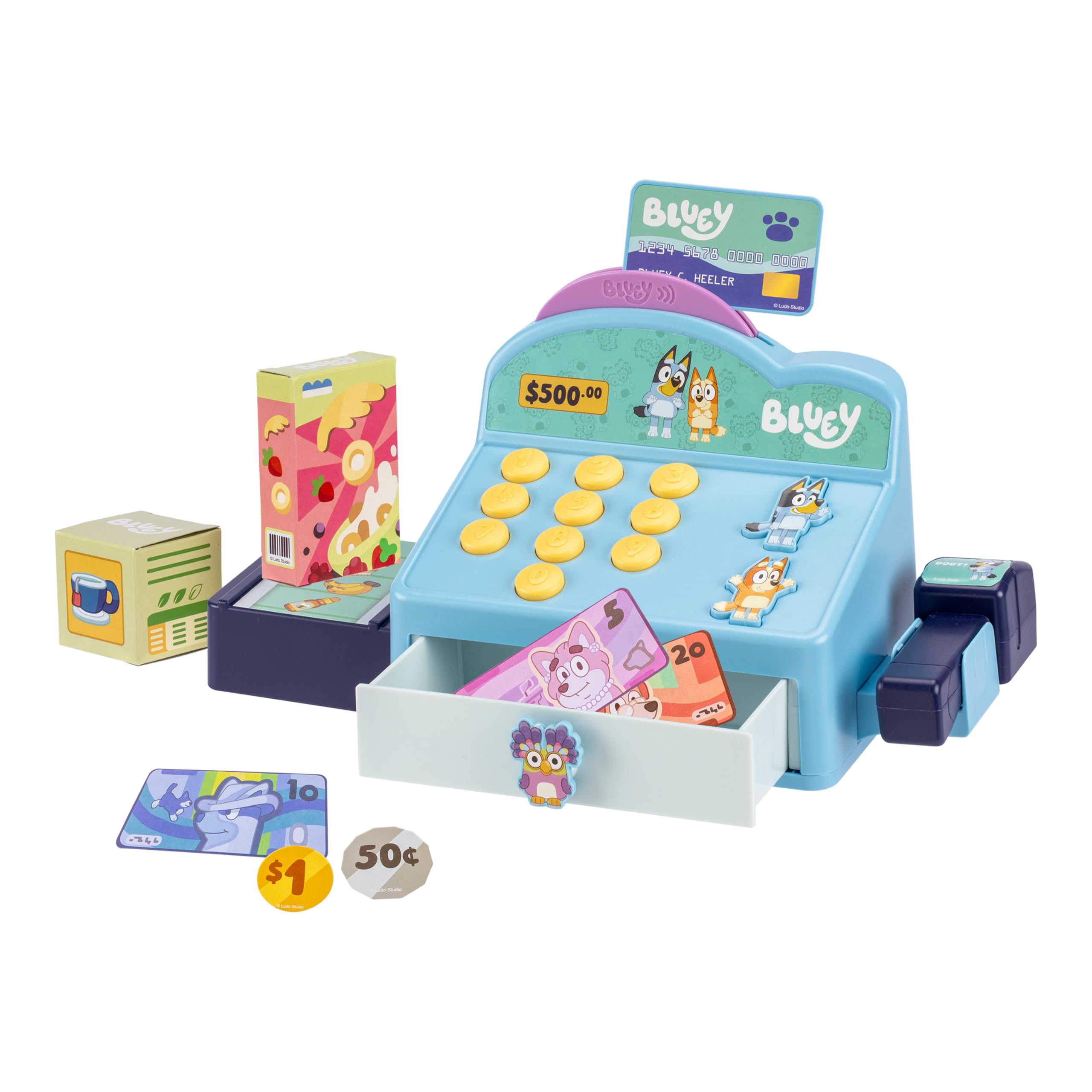
Bluey Cash Register Playset

Bluey Cash Register Playset

Bluey fans

Doodle Score 9.4/10
Check Price

Worth Noting

  • Scanner may not beep at all
Sounds
Bluey and Bingo phrases and music
Dimensions
5.16 x 11.73 x 5.91 inches
Set Contents
Register, scanner, credit card, Dollar Bucks
Recommended Age
3 years and up
Read the full review

Press the Bluey or Bingo button and you get phrases and music from the show; the rest is a compact, light checkout with a detachable scanner, a credit card and a drawer of Dollar Bucks. If a four-year-old already narrates their day in Bluey episodes, this is the register they'll reach for.

We appreciate the restraint. It doesn't try to teach arithmetic or count coins — it's a prop for reenacting the shop episode — and at 11.7 inches wide and under six deep it fits on a shelf or in a tote. The sounds are character lines rather than a running commentary, which makes them far easier to live with than a register that talks continuously.

The scanner is the weak point: on some units it's a shell that doesn't beep, which is a letdown for a kid who has watched a real checkout. Everything else holds up — the drawer, the card, the phrases — and the batteries are in the box, so it plays straight out of the package.

Bottom line: If Bluey is the whole reason your kid wants a register, buy this one: it sounds like the show, packs away small and doesn't narrate every second.

#5

Disney Junior Minnie Mouse Cash Register

Disney Junior Minnie Mouse Cash Register

Budget gift buying

Doodle Score 9.4/10
Check Price

Worth Noting

  • Scanner may not make any sound
  • Only four bills and three coins
Sounds
Realistic effects and Minnie phrases
Dimensions
11.5 x 6 x 6.5 inches
Set Contents
Register, scanner, 4 bills, 3 coins, credit card
Recommended Age
3 to 8 years
Read the full review

This is the least expensive way into a licensed register, and it covers the basics: a drawer, a scanner, four bills, three coins, a credit card and Minnie phrases that aren't turned up to an unbearable volume. For a Minnie-obsessed three-year-old on a tight budget, that's most of what you need.

The scanner is the catch: on some units it's a plastic shell that doesn't beep or light up, and that's the first thing a kid checks. Set expectations before the wrapping comes off, and the rest of it does its job — phrases, a drawer with money in it, and a sound level that won't follow you through the house.

Bottom line: The budget pick when Minnie is non-negotiable: phrases, a drawer and play money for the least here, with a scanner that's mostly for show.

#6

Learning Resources Teaching Cash Register

Learning Resources Teaching Cash Register

Math and money skills

Doodle Score 9.2/10
Check Price

Worth Noting

  • Runs on three C batteries
Power
3 C batteries required
Dimensions
14.4 x 10.1 x 8.1 inches
Interactive Features
Coin counter, scanner, built-in games
Read the full review

This is the classroom register. It counts the coins you drop in, announces them, keeps a running total and runs built-in games on top of the pretend checkout, with a scanner and a working calculator alongside. A five-year-old can check their own arithmetic on it without an adult leaning over their shoulder, which is not true of anything else here.

That's what the extra outlay buys: the Learning Resources calculator register gets a child comfortable with coins and change, and this one pushes on into addition and subtraction. The games matter more than they sound — they give the toy a life after the shop phase ends, which is the phase most toy registers die in.

It's a big toy at 14.4 by 10.1 by 8.1 inches, so it wants a table rather than a shelf, and it feels like equipment instead of a trinket. Give it a permanent spot at the end of a low table and it earns the space.

Electronics are the risk. Some units arrive dead or go quiet within a few weeks, and the failures tend to show up early enough to exchange. Buy it somewhere with easy returns, and it's the most capable register here for a five- or six-year-old who is already asking what things cost.

Bottom line: If you want a register that actually teaches arithmetic, this is the one: it names coins, totals them and has games to grow into, for kids around five and up.

#7

Battat Cash Register with Scanner

Battat Cash Register with Scanner

Rough, big-hand play

Doodle Score 9.2/10
Check Price

Worth Noting

  • Loud beeps with no volume control
  • Coins are oversized for teaching currency
Weight
4 lb
Scanner
Handheld, beeps on contact
Dimensions
11.5 x 10.25 x 7.5 inches
Read the full review

Eleven and a half inches wide and four pounds is a lot of register, and that's the point: it sits on the floor without tipping, the buttons are big enough for a whole hand, and the money is chunky enough to find after it has been dropped.

The scanner beeps when you press it against an item, the credit card swipes with a beep, and the buttons answer with a tone. Nothing here is clever — no voice, no games, no counting — but a three-year-old can operate all of it without help, and there's room in the drawer for a full wallet of bills.

The beeping is loud, and there's no volume control and no off switch, so a long afternoon of checkout wears down the adults in the room. If that's a deal-breaker, the wooden set is silent. If it isn't, this is the register that survives being sat on.

Bottom line: For a rough-and-tumble three-year-old and a house that can tolerate beeping, this is the sturdiest register here, with a roomy drawer that keeps money usable.

#8

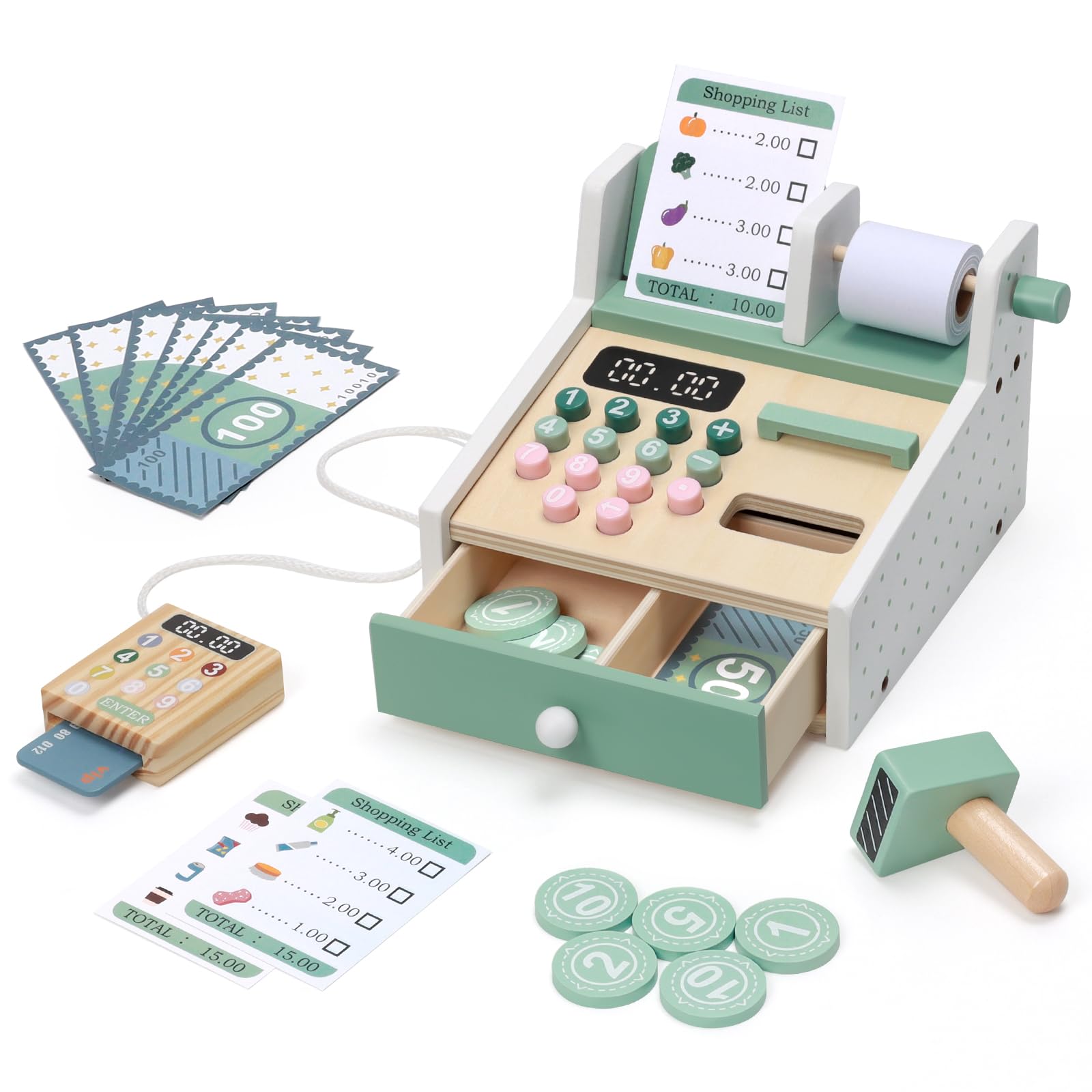
OSLINE Wooden Cash Register

OSLINE Wooden Cash Register

Quiet, screen-free play

Doodle Score 9.2/10
Check Price

Worth Noting

  • Receipt paper runs out quickly
Material
Wood
Dimensions
6.97 x 5.12 x 7.87 inches
Set Contents
Register, card reader, three shopping lists, play money, receipts
Recommended Age
3 years and up
Read the full review

There is no beep. That is the first thing we noticed, and it's probably why you're reading about a wooden register at all: a checkout you can set up in the living room without a soundtrack.

The set is small but complete — a register with a card reader, play money, coins, a credit card, three shopping lists and a receipt pad. The lists are the smart part: hand one to the customer and the game becomes reading, finding and tallying instead of pressing buttons for a sound.

Wood brings trade-offs. The receipt paper is a consumable and a busy afternoon can empty it, so buy it knowing that. And the play buttons don't press on every unit — this is a mechanical register, not a calculator — so check the drawer and the buttons the day it arrives and send it back if either is stiff.

For a Montessori shelf, a shared living room, or a child who plays shop quietly for twenty minutes at a stretch, this is the pick. It's the quietest thing here by a long way, and the only one that looks like furniture rather than a toy.

Bottom line: The pick for a quiet house: solid wood, no batteries, and shopping lists that turn checkout into a reading game.

How We Tested 14 Toy Cash Registers in a Real Playroom

The shortlist began as a spreadsheet of about 40 registers, then got cut by price, recommended age range, and what actually comes in the box — some sets ship without coins, a few need batteries the packaging barely mentions, and one or two include a calculator that does real math. We bought 14 and moved them through a playroom shop staffed by kids ages 3 to 7 over four months, including several loud playdates.

Drawer operation got its own routine: each child opened and closed the drawer 20 times in a row while I counted the pulls before it stuck, jumped the track, or popped off entirely. Then we fed every coin the set came with through the slot, twenty drops each, and shook the register upside down to see what fell out. A coin stuck under the tray was the most common failure, and anything that needed an adult fingernail to free got marked down.

For sound quality, we listened up close and noted whether the beep was a chirp or a smoke alarm, and whether there was a mute switch for the ride home. Functionality meant scanning every sticker twice, pressing every button, and checking the calculator math. Appearance we judged the way a kid does — set beside the other toys, did it look like the register at the grocery store or just a lump of plastic?

Durability came from a drop off the play table onto hardwood, three times, plus a damp-cloth wipe of juice fingerprints. Educational value was less about the label than what I saw: whether kids started counting coins and making change without a prompt. Playability was the simplest measure — which registers got picked up again the next morning unprompted. And value came down to what actually worked in the box against what it cost.

How to Choose the Right Toy Cash Register

The money decides whether it teaches

Bills and coins are the difference between a math toy and a noise box. Actual-size notes and a real pile of change — the Learning Resources calculator register packs 30 bills and 40 coins — let a child sort, stack and make change. Six chunky identical coins do not, though they are the right call for a two-year-old who mostly wants to post something through a slot.

If coin recognition is the goal, check the piece count and whether the coins are sized like currency. If the child is still mouthing things, buy the chunky version now and the realistic one at four.

A working calculator or a pretend keypad

A keypad that answers arithmetic is a genuinely different toy from one that only beeps. On the Learning Resources registers, a child can enter prices, add them and check the total, so the sum has a consequence. That is worth paying for once a kid is five and asking what things cost.

Expect a real calculator to need power — a solar cell in one case, three C batteries in the other — and expect to explain it once. For a two- or three-year-old, a pretend keypad is plenty; they are pressing for the sound, not the sum.

Drawer action is where these toys live or die

Almost every register here snaps its drawer open with a spring, and that spring is the most common complaint in the category: some fire hard enough to scatter coins, others stick and need prying. Open the drawer a dozen times before you wrap it, and keep the drawer side pointed away from the face of a child sitting right in front.

A drawer that jams is worth returning. A drawer that is merely enthusiastic is something kids learn to work around in an afternoon.

Sound, volume and the missing off switch

Toy registers talk, beep and sing, and few of them let you turn that down. The Battat register has no volume control at all, and the talking registers narrate continuously while a child plays. Character sets tend to stick to a handful of phrases, which is easier on everyone.

If the register will live in a shared living room or travel in a car, weight this heavily. The wooden OSLINE set makes no sound beyond the clack of pieces, and that is the whole reason to choose it.

Match the register to the age, not the birthday

Two-to-four-year-olds need cause and effect: a crank, a bell, a coin that vanishes and reappears. Five-to-eight-year-olds want arithmetic and change, and will lose interest in a register that only sings. That is why one register rarely covers both ends.

If you want to buy once, buy up: a five-year-old can still play shop with a simple mechanical register, but a two-year-old cannot use a coin counter. If you have two children three years apart, the toddler register tends to get handed down anyway.

Frequently Asked Questions

Final Verdict

Most families should buy the Learning Resources calculator register. The money is realistic enough to teach with, the calculator works without a battery habit, and the drawer sound is what keeps a shop running for a second hour. It is the one we point to when someone asks for a toy that earns its shelf space.

If your cashier is still two, start with the Fisher-Price retro instead — the crank and bell ask nothing of them. And if your household cannot absorb another beep, the wooden OSLINE set does the same job in silence.