Pretend Play

Best Hand Puppets of 2026

A good hand puppet turns a bored Tuesday into a full-scale theatrical event for an audience of one. The trick is finding one that fits your hand, opens its mouth wide enough for real dialogue, and survives being yanked off for an encore. I've learned that the cutest puppet on the shelf can be the least fun once it's on your hand: if the fabric feels scratchy or the mouth barely moves, the show ends fast. Over the past four months, my team and I have tried 14 hand puppets during living-room shows, playroom rehearsals, and a few very opinionated bedtime stories.

The keepers were soft enough for a child to cuddle during the quiet parts, sturdy enough to survive a tug-of-war between siblings, and generously sized so both my adult hand and a preschooler's hand could work them. They also felt worth the money—not because they were fancy, but because they got used every single day. The picks below are the ones that held up to the most encores.

#1

Pete the Cat Hand Puppet

Pete the Cat Hand Puppet

Read-aloud story time

Doodle Score 9.6/10
Check Price

Worth Noting

  • Single puppet, so two-character scenes need another
Height
14.5 inches
Hand Fit
Kids and adults
Material
Polyester plush
Recommended Age
24 months to 15 years
Read the full review

Fourteen and a half inches is the number that settles this one. That is tall enough for an adult hand to sit inside without cramping and small enough that a child can still wear it, which is why it is the puppet we hand to whoever is doing the voices. Of the picks here, only the Chef comes close on size; the Bluey pair is roughly half this height. If you have ever tried to make a nine-inch puppet talk while your fingers went numb, you know why this matters.

The character earns its keep too. Pete the Cat and His Four Groovy Buttons is a book plenty of preschoolers can already recite, so a puppet that matches the cover turns a read-aloud into a show with no rehearsal. You get the coat, the button song and a face the audience recognizes before you say a word, which is more preparation than most parents have time for on a Tuesday night.

Soft polyester, nothing scratchy at the cuff, comfortable against the skin for a long session — it is as much a cuddle toy as a puppet, and that matters for the preschool crowd. It is equally at home in a classroom, a library or a therapy room, and it does not look out of place in any of them.

What you give up is flexibility. This is one puppet, one hand, no rod and no change of costume, so a two-character scene means buying a second one. For a parent, teacher or librarian who wants a single expressive face to carry a story, that is a fair trade — and it is the one we reach for first.

Bottom line: This is the hand puppet we recommend to most families: big enough for an adult to wear, soft enough for a toddler to cuddle, and tied to a book that already gets read ten times a week.
#2

Bluey Unicorse & Bob Bilby Puppets

Bluey Unicorse & Bob Bilby Puppets

Toddler hands

Doodle Score 9.6/10
Check Price

Worth Noting

  • Small for most adult hands
  • Unicorse and Bob Bilby, not Bluey and Bingo
Height
8-9 inches (23-24 cm)
Pieces
2 puppets
Outer Material
Cotton plush
Recommended Age
36 months to 15 years
Read the full review

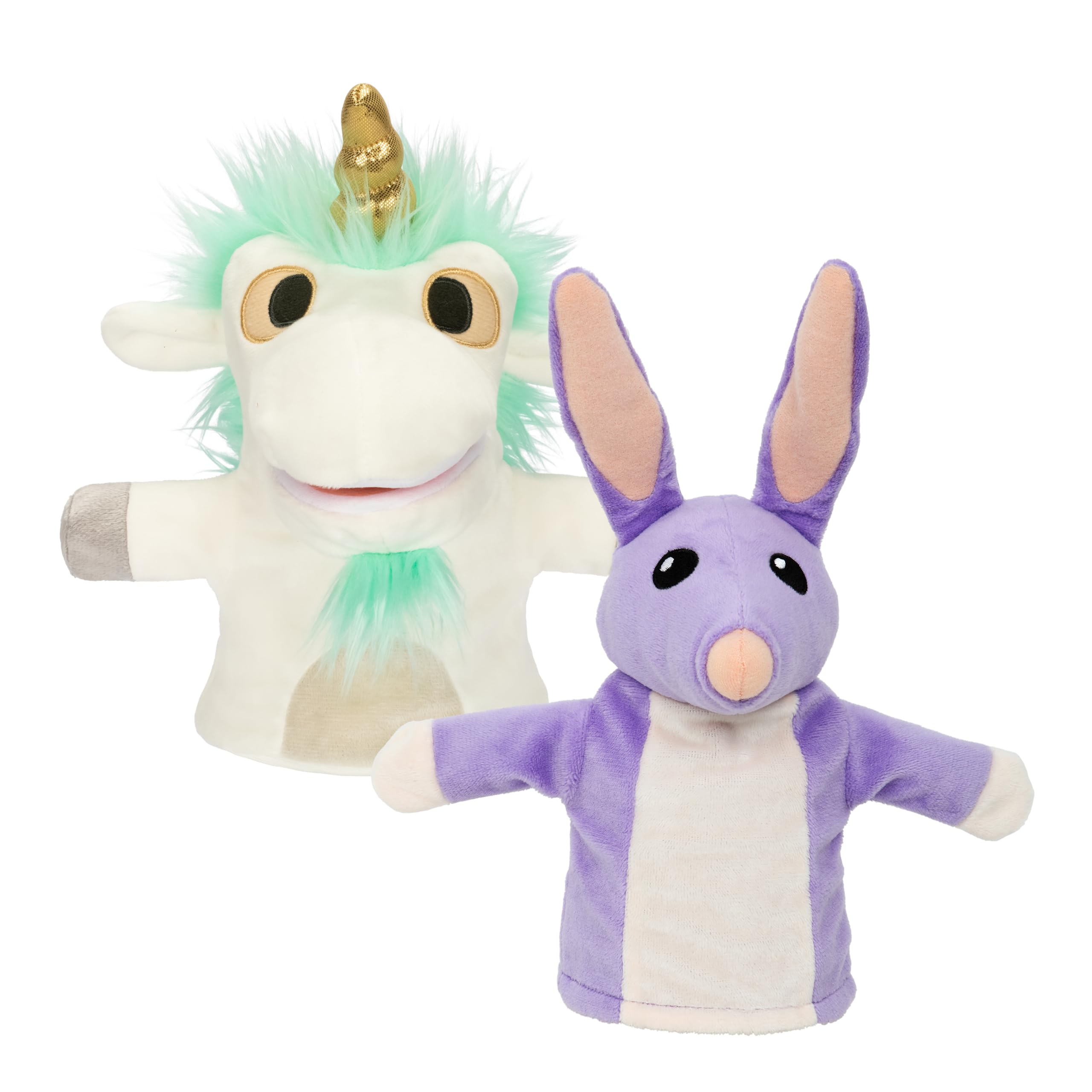
Two puppets, and small ones — which is exactly the point. At eight to nine inches tall, Unicorse and Bob Bilby are sized so a two-year-old can wear one on each hand, and that is the age that gets the most out of them. An adult can wedge a hand in, but it is a squeeze, and that is the honest limit of the pack.

We like what you get for the price: two characters rather than one, in a soft cotton plush with embroidered rather than printed faces, so there is nothing to peel or rub off. They are plush toys that happen to be wearable — the personality comes from your voice, not from a moving jaw — and for a toddler that is the right amount of puppet. Both are soft enough to be dragged around by one arm, which is how most two-year-olds operate.

Check the characters before you order. The pack is Unicorse and Bob Bilby, supporting players rather than Bluey and Bingo themselves. A child who specifically wants the blue dog will be disappointed; a child who has watched every episode will know exactly who these two are and will not care. If the title pair is non-negotiable, this is not the pack.

Bottom line: The pack we hand to Bluey-obsessed toddlers: two soft characters small enough to wear one on each hand.

#3

hand2mind Feelings Family Puppets

hand2mind Feelings Family Puppets

Big feelings

Doodle Score 9.6/10
Check Price

Worth Noting

  • Each puppet is locked to one emotion
Focus
Social-emotional learning
Theme
Emotions
Recommended Settings
Counselors, classrooms, calm-down corners
Read the full review

Some puppets are for shows; this set is for the conversations that are harder than a show. Each puppet carries one feeling, and the design does half the work — the hands can be brought up to the face, where they read as wiping away a tear or covering a mouth, so the emotion lands before anyone speaks. That is the trick that makes the set useful with a child who will not answer a direct question about how they feel.

It is a specialist tool and it is honest about that. The set is built for counselors, classrooms and calm-down corners, and that is where it makes sense: a shy child will often tell a purple puppet about a bad afternoon long before they will tell an adult. The faces are simple and bright, readable to a three-year-old rather than frightening, and the range covers the feelings that come up most often. Because each puppet is locked to one emotion, though, the set does not double as a story-time cast — there is no narrator and no villain, just a small range of feelings. For bedtime stories, buy a Pete or a Chef; for helping a child name what is going on inside, this is the set we point to.

Bottom line: We point counselors and preschool teachers to this set: fixed expressions, readable faces, and a way into feelings that does not need a direct question.

#4

Melissa & Doug Chef Puppet

Melissa & Doug Chef Puppet

Puppet shows

Doodle Score 9.4/10
Check Price

Worth Noting

  • Needs both hands during play
  • Labeled for ages 3 and up
Height
15 inches
Arm Rod
Detachable, fits either hand
Costume
Removable coat, scarf, hat
Puppet Style
Hand-and-rod
Read the full review

The rod is the whole idea. One hand works the chef's mouth and face while the other holds a detachable wooden rod clipped to his arm, so he can point at the pot, wave, or throw both hands up in despair. A few minutes of handling makes the difference obvious: this is a character doing something, not a plush animal you happen to be wearing.

We think it is the most capable performer in this roundup, and the details back that up. The rod moves between hands on a velcro tab, so a left-handed puppeteer is not stuck, and the chef's coat, scarf and floppy hat all come off — half the fun for a kid, and much easier to freshen up between shows. At 15 inches, with a mouth you actually open and close, he reads from the back of a room.

The cost is hands. One on the mouth and one on the rod leaves none for a book, so this suits someone who already knows the story or is improvising with a partner rather than reading aloud cold. It is also the priciest single puppet here, and the label starts at three years. Both are easy to accept if you are staging something; as a toddler's first puppet, it is more machinery than you need.

Bottom line: If you want a puppet that performs rather than cuddles, this is the one we pick: a jointed arm, a moving mouth, and a costume that comes off.

#5

Melissa & Doug Barn Buddies

Melissa & Doug Barn Buddies

Group play

Doodle Score 9.4/10
Check Price

Worth Noting

  • Snug on large adult hands
  • Plush heads don't articulate
Fabric
Washable
Pieces
6 puppets
Characters
Cow, sheep, horse, duck, chicken, pig
Recommended Age
24 months to 6 years
Read the full review

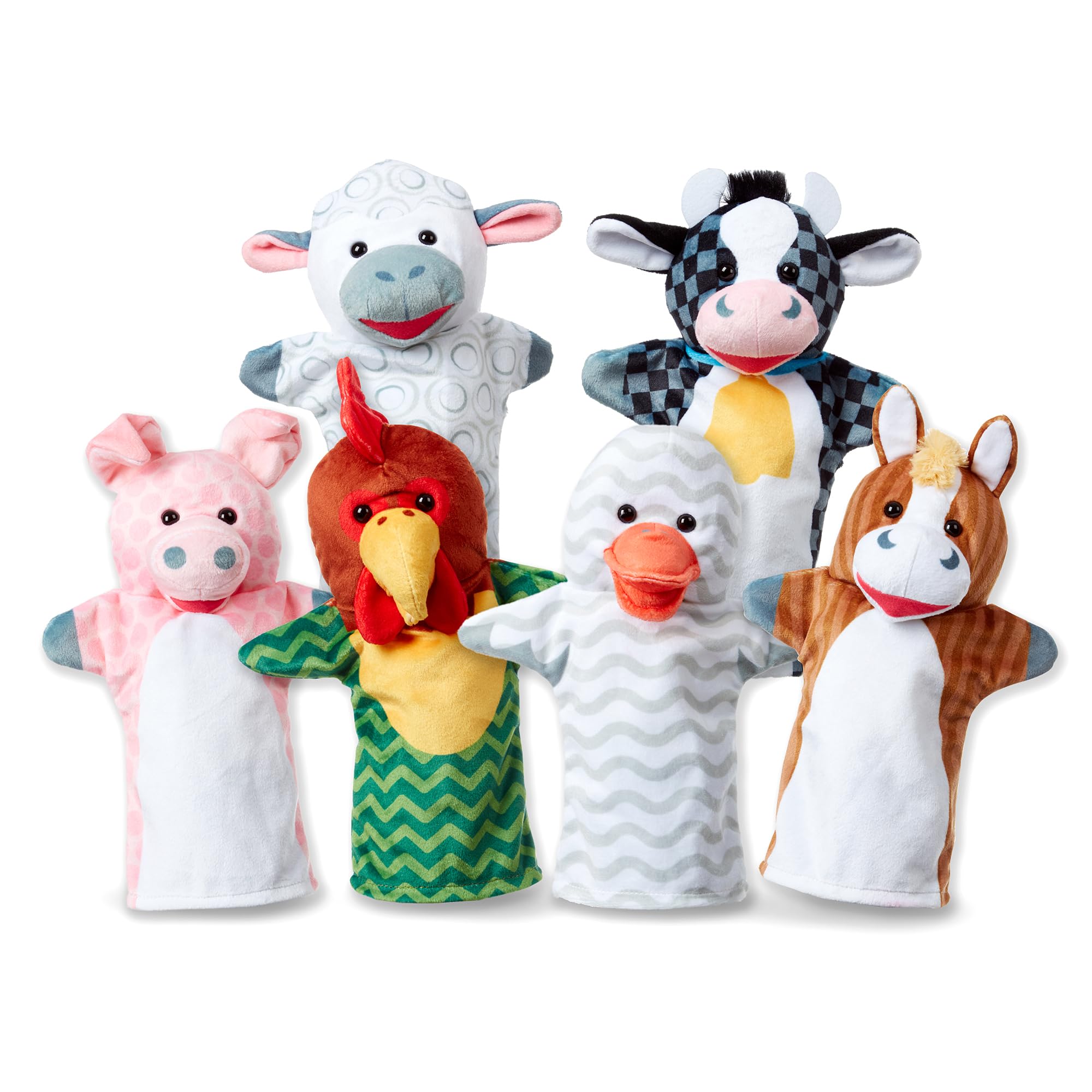
Six animals in one bag — cow, sheep, horse, duck, chicken and pig — and the count is the reason to buy. Two siblings and a parent can each take a character, and a rainy afternoon turns into a scene instead of a solo. The fabric is brightly patterned and washable, and there is enough stuffing in the heads that the animals double as cuddle toys once the show is over.

Farm animals also beat a licensed cast for a child who is still building words. There is no script attached, so a two-year-old can moo, quack and hand you the horse when the horse is supposed to talk. The set is labeled from 24 months to six years, and that span matches what we found: simple enough for a toddler, varied enough that a five-year-old still reaches for it.

The variety is what earns the set its place. Six faces beat one nicer face when the audience is three kids who all want a turn, and swapping characters mid-scene is half the game. That is the case for a set over a single showpiece, and it is why this one stays in the roundup.

Bottom line: Six washable animals, one for every hand — the set to buy when more than one kid wants a turn.

#6

Schylling Shark Hand Puppet

Schylling Shark Hand Puppet

Budget silliness

Doodle Score 9.2/10
Check Price

Worth Noting

  • Too small for adult hands
  • Thin rubber tears with rough play
Weight
1.76 oz
Material
Plastic
Dimensions
4.33 x 5.91 x 2.36 inches
Read the full review

The cheapest puppet here, and the one that gets the biggest laugh. The head is soft rubbery plastic that takes the shape of a hand rather than sitting on it like a shell, and it reads as a shark from across the room. Kids grab this one to chase a sibling around the furniture; it is the puppet equivalent of a whoopee cushion.

Buy it for a child, though. The opening takes small fingers, and an adult hand can get in but not far enough to work it, so this is a puppet for the kid doing the chasing rather than the parent doing the voices. Water and sweat lift the finish too — keep it out of the bath and wipe it dry after a hot afternoon, because a faded shark is a sad shark.

We keep this one for the reaction it gets: a low-risk add-on gift, the extra character in a birthday bag, the thing that makes a video funny. Nobody builds a story around it, and that is fine. For silly, high-reaction play in this set, it is the obvious pick.

Bottom line: We like it as the silly one: a soft shark sized for small hands, for when the goal is a laugh rather than a performance.

How We Chose and Tested Our Hand Puppets

To build the shortlist, I read through product descriptions and customer feedback, then pulled candidates from craft shops, toy stores, and online retailers. I ruled out puppets with loose trim, tiny detachable parts, or a pattern of complaints about split seams. Price stayed in the conversation, but only as a fairness check: a puppet had to feel like a fair trade for what it cost.

We ended up testing 14 puppets over four months. They lived in a basket by the couch and came out for morning play, after-nap stories, and the pre-dinner stretch when attention is hard to hold. I put each one on my own hand first, noting whether my fingers hit the back seam, how much of the puppet flopped forward, and whether the mouth opened wide enough for talking, yawning, or a dramatic gasp. Then I passed them to kids of different ages and watched which ones they picked up without being asked.

Durability got its own workout: we tugged at arms and legs, opened and closed each mouth dozens of times, and checked seams, felt, and stuffing after a few weeks of play. Softness we judged by hand feel and by whether a child wanted to keep holding the puppet after the show. Cuteness is subjective, so we watched for the faces that got named and requested again rather than the ones that only looked good on a shelf. We also kept a running note of repeat performances, and compared that use against cost to decide which ones felt genuinely worth it.

How to Choose Hand Puppets

Start with the hand, not the character

Puppet height is a rough proxy for hand size, and it is the specification worth checking first. In this set, the eight- to nine-inch puppets are toddler-sized, and the fourteen- to fifteen-inch puppets are the ones an adult can wear comfortably for a whole story. A listing that says it fits kids and adults is not lying — a grown-up can usually get a hand in — but getting in and working the puppet for twenty minutes are different things.

If you will be the one doing the voices, buy for your hand: look for 14 inches or more. If the puppet is for a two-year-old, anything adult-sized will slide off mid-sentence, and you are better off with a small plush pair they can wear one on each hand.

Moving mouths and wooden rods

A plush puppet has a stuffed head and no jaw, so the character comes from your voice, your wrist and the tilt of the head. A hand-and-rod puppet adds a working mouth and a second control for the arm, which is what makes pointing, waving and shrugging possible — and it costs you a hand.

With one hand on the mouth and one on the rod, there is nothing left to hold a book. Rod puppets suit rehearsed shows and improvisation with a partner rather than read-alouds, so decide which of those you are actually doing before you pay for the extra articulation.

One good puppet or a set of six

Sets solve a social problem rather than a performance one. Six animals mean six people can play, siblings stop negotiating over a single character, and the set gets pulled out again long after one puppet would have been abandoned. They also tend to be the plainer puppets — plush heads, no rods — which is right for toddlers and wrong for a kid who wants to stage a proper show.

Count the hands in your house before choosing. One performer needs one good puppet with a face worth watching; three kids in a rainy-day living room need a cast, even if each individual puppet is simpler.

Licensed characters and what is actually in the box

A licensed puppet gets played with on day one because the child already knows the voice and the jokes. The catch is specificity: a Bluey puppet wants to be Bluey, while a set of generic farm animals does not mind being anything a child needs it to be.

There is a practical trap here too. Read the character list rather than the picture on the pack, because character packs are often built around supporting players — the Bluey set here is Unicorse and Bob Bilby, not Bluey and Bingo, and a child who wanted the blue dog will notice within seconds of opening it.

Frequently Asked Questions

Final Verdict

Pete the Cat is the puppet we point most families to, and the reason is practical rather than exciting: at 14.5 inches it fits an adult hand and a child's, so the person doing the voices is not fighting the puppet. Pair it with the book and story time runs itself.

If you are staging shows rather than reading, the Chef's rod arm and working jaw are worth the step up and the second hand. If the puppet is for a two-year-old's hands, buy the Bluey pair — anything adult-sized will simply fall off.