Outdoor Play

Best Ride-On Toys for Toddlers of 2026

A ride-on toy is the first vehicle a kid actually steers — the first time they pick a direction and get there themselves. That's the appeal: the grin when they work out the handlebars, the driveway loop that becomes twenty loops. The trouble usually arrives before the fun does: a box of loose hardware, a wheel that wobbles by day three, a motor loud enough to clear a room.

These aren't cheap, so a dud stings. The good ones are sturdy enough to survive a sidewalk, simple enough to assemble in half an hour, and fun enough that your kid picks them over a screen. Over the past eight months, my team and I handed 12 of them to toddlers aged one to four, and the gap between the great and the frustrating showed up fast. One thing worth knowing going in: match the toy to what your child can already do — a foot-to-floor model a 1-year-old can straddle gets ridden daily, while a pedal version she can't reach sits in the garage. The ones that earned their floor space are below.

#1

Little Tikes Rocking Horse

Little Tikes Rocking Horse

First birthdays

Doodle Score 9.6/10
Check Price

Worth Noting

  • Rocks in place; there are no wheels
Assembly
None required
Age Range
12 months – 3 years
Weight Limit
50 lb
Assembled Size
33"L x 10"W x 17.5"H
Read the full review

Nothing else in this guide comes out of the box ready to ride. The rocking horse does — no bolts, no decals, no evening with an Allen key — and that single fact is why it is our pick as the first ride-on for a one-year-old. Take it out, set it on the floor, and a toddler is rocking before the wrapping paper is off the carpet.

The shape does the safety work. The rockers run the full length of the base, so enthusiastic rocking does not tip it, and the seat sits low enough that a child can get a foot down and climb off without help. At 7.5 pounds you can carry it to the yard in one hand, and the 50-pound limit means an older brother gets a turn without the frame complaining.

What it will not do is take a child anywhere. There are no wheels under it, so this is a toy for the living room, the patio and the kitchen floor — if your toddler wants to travel, one of the push cars or the balance bike is the right buy instead.

Nothing on it can rust, snap off or go missing, which is more than we can say for the battery toys here, and the plastic wipes down after a snack in seconds. At the end of the toddler years this is the toy that goes to a cousin rather than the bin.

Bottom line: For a one-year-old's first ride-on, this is our recommendation: it arrives assembled, sits low enough to climb on alone, and it is the cheapest toy in this guide.

#2

SEREED Baby Balance Bike

SEREED Baby Balance Bike

Learning to balance

Doodle Score 9.6/10
Check Price

Worth Noting

  • No brake
Age Range
12 – 24 months
Item Weight
3.5 lb
Weight Limit
55 lb
Frame Material
Aluminum alloy
Read the full review

Three and a half pounds is the number that matters. The SEREED is light enough to carry under one arm while you are holding a toddler's hand, and light enough that a child still finding her feet can push it along without it running away from her. An aluminum frame and four 6.7-inch EVA wheels are how it manages that.

We recommend it for the 12-to-24-month stretch, before pedals or a parent handle make any sense. Four wheels and a 135-degree steering limit keep it upright when a one-year-old over-corrects, and the seat is low enough for both feet flat on the floor — which is the point, since balance here comes from the child's feet rather than from the toy. Watching a toddler work out that pushing off moves her forward is the best thing about it.

Sizing is the thing to check before you order. The seat is narrow and the wheelbase short, which suits a small rider, and the stated range stops at 24 months — a tall two-and-a-half-year-old will look like a bear on a tricycle. The listing asks for a minimum user height of 18 inches, so sit your child against the seat and see whether both feet reach the ground before a first birthday.

Bottom line: Our pick for the months between first steps and a real bike: 3.5 pounds, four wheels, and a seat low enough for a one-year-old to push along on her own feet.

#3

Radio Flyer Busy Buggy

Radio Flyer Busy Buggy

New walkers

Doodle Score 9.6/10
Check Price

Worth Noting

  • Steering wheel does not move the front wheels
Assembly
No tools required
Age Range
12 months – 3 years
Item Weight
4.9 lb
Weight Limit
42 lb
Read the full review

Most ride-ons ask a toddler to sit before she can sit well. The Busy Buggy works the other way round: at 12 months a child grips the handle and pushes it across the floor, with an anti-tip base stopping it running out from under her, and only later climbs aboard and scoots. At 4.9 pounds it goes wherever the child goes.

For a first birthday we rate it the best buy in this guide. Seventeen activities are why it keeps earning its place — gears to spin, a clicking spare tire, mirrors that fold, a horn, sliding beads, a dashboard — and the seat flips open so a favourite toy rides along. Setup is a couple of snaps with no tools, which is the difference between using it on the day and using it next weekend.

The catch is that it is child-powered or nothing. There is no handle for an adult to push, so this is a kitchen-floor and driveway toy rather than a walking companion, and the 42-pound limit is the lowest in this guide. Expect to pass it on at about three, when the legs outgrow the seat before the plastic does.

Bottom line: The best first-birthday buy here: it starts as a walker, becomes a ride-on, and goes together without a single tool.

#4

VTech Prance and Rock Unicorn

VTech Prance and Rock Unicorn

Musical rocking

Doodle Score 9.6/10
Check Price

Worth Noting

  • Needs two AAA batteries for its songs
Modes
Rocker and ride-on
Age Range
12 – 36 months
Batteries
2 AAA (demo set included)
Item Weight
5.6 lb
Read the full review

The music starts when the child moves. A motion sensor in the base picks up rocking or rolling and sets off songs and phrases, so a one-year-old works out within a minute that her own movement makes the unicorn sing — no button-hunting, no adult required, which is the difference between a toy that plays and a toy that performs.

It is two toys in one frame. The base flips from a curved rocker to wheels, so the unicorn that rocks in the nursery at 12 months is scooting across the kitchen at two, and there is a handle behind the head for a small rider to hold. Learning and Adventure modes add colors and phrases on top, and at 5.6 pounds it moves from room to room without a second trip.

We recommend it when you want rocking and a first ride-on out of one purchase and you do not mind a toy that talks back. The rocking arc is shallower than the Little Tikes horse's, so the appeal here is the conversion and the songs rather than the rock itself — and the wheels are for a child who is already steady on her feet.

Bottom line: Worth it if you want rocking and first scooting from one toy, with songs a toddler sets off herself; not the pick for a quiet nursery.

#5

Skip Hop 3-in-1 Unicorn

Skip Hop 3-in-1 Unicorn

Growing toddlers

Doodle Score 9.6/10
Check Price

Worth Noting

  • ⚠️ Can tip forward in walker mode
  • Needs three AAA batteries, not included
Handle
Adjustable height
Age Range
12 months – 5 years
Batteries
3 AAA (not included)
Ride Modes
3
Read the full review

Three configurations is the pitch. In stage one it is a wagon a new walker pushes and pulls, with a storage tub that holds the toys; pull the seat out for stage two and it becomes a ride-on; raise the adjustable handle and it is a scooter for a taller toddler. In a small flat, that is three toys' worth of floor space saved.

It looks the part — unicorn head, bright plastic, a button at the front that plays sounds and lights up — and assembly is genuinely quick. The handle adjusts to standing height, so a three-year-old is not hunched over the bars, and the wheels roll smoothly across a kitchen floor.

Where it earns its keep is the scooter stage. As a ride-on for a one-year-old it is fine; as something a two-and-a-half-year-old can push herself around the block on, it is the pick here, because the deck is wide enough for both feet and the handle comes up high enough to matter.

Our recommendation is as a second-birthday buy for a child already walking confidently, at a price that reflects the three configurations rather than the materials. For a shaky first walker, the Radio Flyer Busy Buggy and its anti-tip base are the better shape to learn on.

Bottom line: A good second-birthday buy for a confident walker, when the scooter and ride-on stages come into their own.

#6

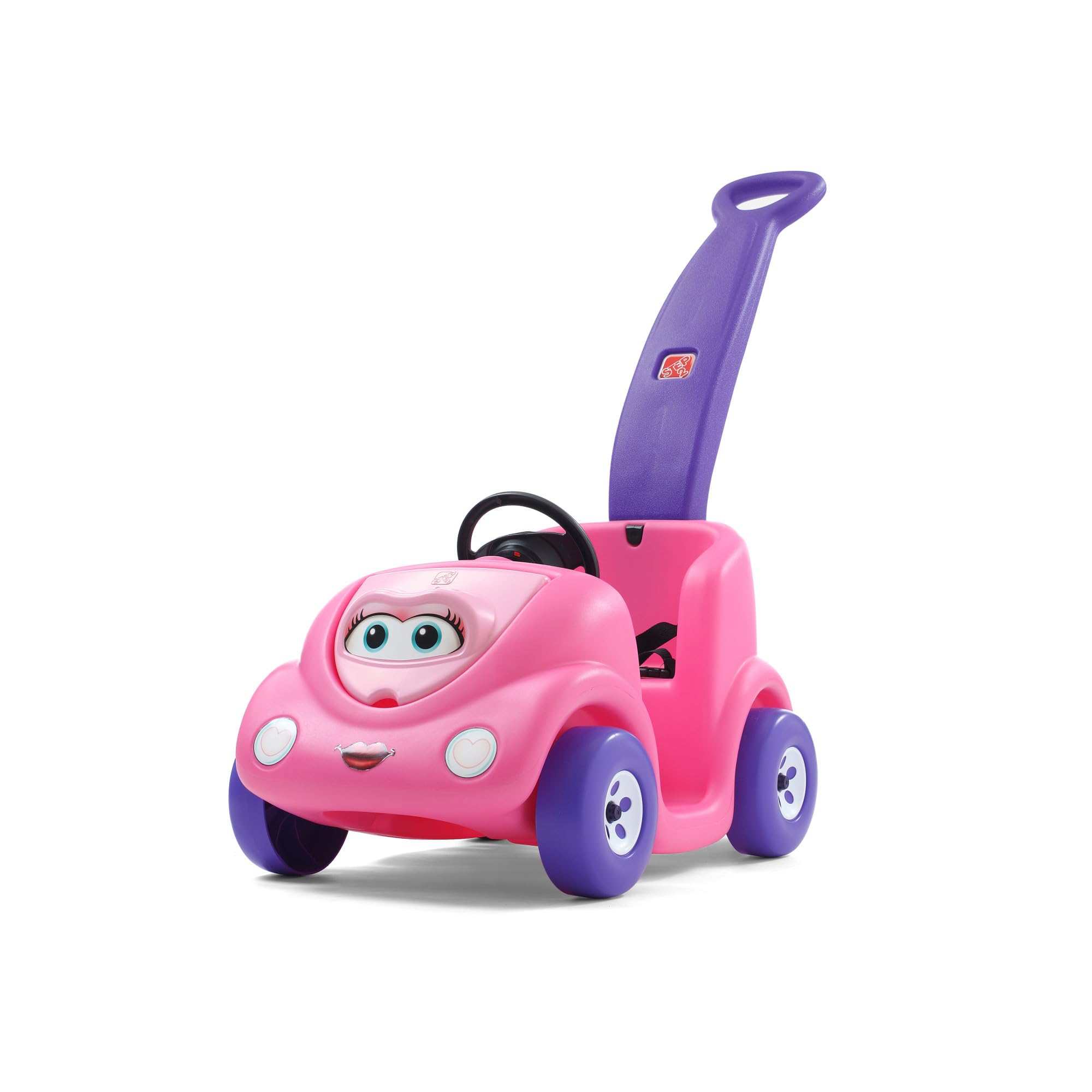
Step2 Push Around Buggy

Step2 Push Around Buggy

Short trips

Doodle Score 9.4/10
Check Price

Worth Noting

  • Hard plastic wheels are loud on pavement
Age Range
18 months – 3 years
Item Weight
14.2 lb
Weight Limit
50 lb
Parent Handle
Folds down
Read the full review

If the Whisper Ride II looks like a lot of money for molded plastic, start here. The Push Around Buggy is the same idea — a wide handle at the back, a lap belt, a horn, storage under the hood — in a shell a couple of inches shorter and noticeably cheaper.

It weighs 14.2 pounds, is rated from 18 months to three years and to 50 pounds, and it pushes easily in a straight line and around a corner. The double-walled plastic wipes clean after a snack, the handle folds for the trunk, and the deep seat with raised sides holds a small passenger in place alongside the belt.

Where it gives up ground to the Whisper Ride II is refinement: less storage, a simpler seat, and a stated range that ends at three instead of four. For ten minutes around the block, we think the saving buys more than the polish does — and the pink shell is the same plastic as the rest of the range, so it cleans up after a muddy afternoon either way.

Bottom line: A sensible choice if you want the push-car experience without the premium price, as long as your walks are short and your ears forgiving.

#7

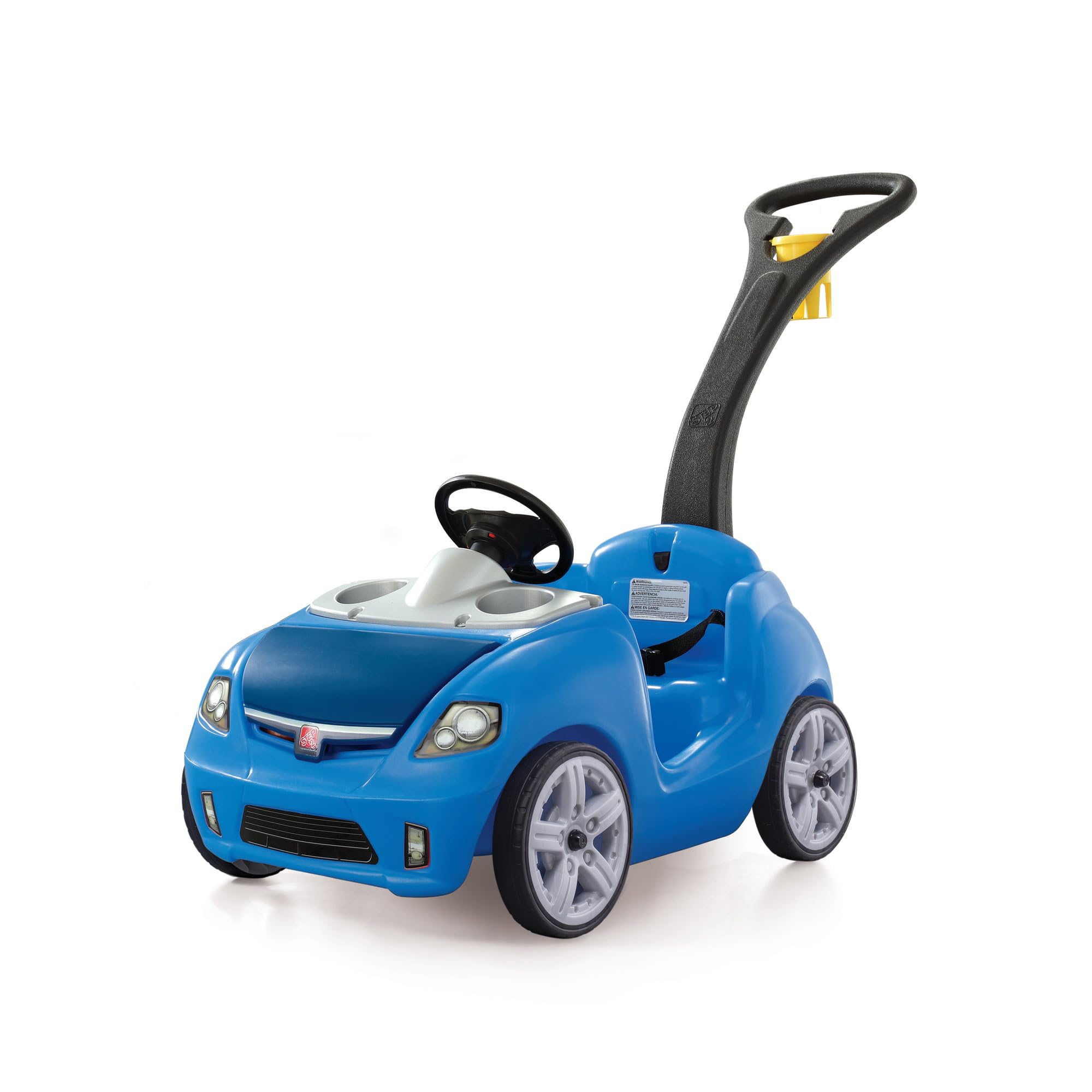
Step2 Whisper Ride II

Step2 Whisper Ride II

Daily walks

Doodle Score 9.2/10
Check Price

Worth Noting

  • Fiddly assembly for a molded plastic car
  • Screws and small parts can arrive missing
Age Range
18 months – 4 years
Weight Limit
50 lb
Assembled Size
45.5"L x 19"W x 34"H
Folding Handle
Yes
Read the full review

The walk is the product. On smooth pavement the Whisper Ride II rolls quietly enough that you can hear your toddler talking, which is not true of the hard-wheeled push cars here, and the rear handle is wide enough to steer with one hand while the other holds a coffee. That combination is why it is our pick for daily neighborhood walks.

The details are aimed at the adult doing the pushing. A belt that latches one-handed, a horn and a steering wheel for the passenger, cup holders, and a compartment under the hood that swallows snacks and a spare set of clothes. The handle folds for the trunk, and the double-walled shell wipes down after a spilled cracker.

Steering comes from the handle rather than from the wheel in front of your toddler, so a two-year-old who wants to drive will be disappointed — that wheel is mostly for show. The upside of the length is room: at 45.5 inches there is more legroom than in the shorter buggies, and a three-year-old still fits comfortably under the 50-pound limit.

Bottom line: Buy it to replace the stroller on flat pavement: the wide handle and quiet wheels make an hour-long walk pleasant for both of you.

#8

Little Tikes Cozy Coupe

Little Tikes Cozy Coupe

Long-term play

Doodle Score 9.2/10
Check Price

Worth Noting

  • Heavy and awkward to move once built
Age Range
18 months – 5 years
Item Weight
17.8 lb
Assembled Size
29.5"L x 16.5"W x 33.5"H
Removable Floor
Yes
Read the full review

The Cozy Coupe arrives as a stack of 17.8 pounds of plastic panels and a bag of screws. Putting it together is the price of admission — plan on two adults, a rubber mallet and an evening, because the panels need rocking into place and the instructions are the weakest thing in the box.

What you get for that evening is the most complete toy here. The floor panel lifts out so a toddler can push it along Flintstone-style; drop the floor in and an adult pushes from the handle at the back. There is a high seat back, storage behind the seat, and a shape children recognize before they can say the name.

It is rated from 18 months to five years, which makes it the longest-lived pick in this guide, and there is nothing to charge or replace. A two-year-old scoots it with his feet; a four-year-old uses it as a clubhouse with a steering wheel.

Our verdict is that it is worth the build if you want one toy that spans the whole toddler years and lives outside. What keeps it off the top spot is the finish — the plastic is thinner in places than 17.8 pounds suggests, and the trim is the part that ages first.

Bottom line: The one here that is still useful at five, and the closest thing to a real car a toddler can own — if you can face the build.

How We Tested Ride-On Toys With Real Toddlers

We started with a list of about 40 ride-on toys sold by major retailers and cut it to 12 based on age range, weight limits, whether replacement wheels and parts could actually be ordered, and price — we wanted a spread from basic foot-to-floor pushers up to battery-powered cars. Assembly came first. I built each one alone with a stopwatch running and only the included tools, counting every bolt and panel against the parts list before I started so we'd know immediately if something was missing, and noting whether the instructions could be followed without swearing.

Then the toys went home with families who have kids between 1 and 4. They got ridden on living room rugs, sidewalks, driveways, a grassy park path, and one very patient grandmother's carpet. We watched how the wheels responded in tight turns, whether a child could reverse out of a corner without help, how each one handled on grass versus pavement, whether it tipped when a toddler leaned into a turn, and how much noise it made indoors — the hard plastic wheels on hardwood were the loudest offenders by a wide margin. We also measured footprint and seat height, because a ride-on that won't clear the hall closet gets left in the garage.

Durability and value were judged over the full eight months, not on day one. Each toy spent a week outside in the weather, got loaded into a trunk, and was ridden by a second, rougher kid. We checked monthly for cracked plastic, loosened bolts, faded decals, and wheels that stopped rolling straight. Value came down to how often kids came back to a toy on their own — the ones still getting ridden in month seven were worth their price, and a couple of the pricier ones weren't.

How to Choose Ride-On Toys for Toddlers

Start with how it moves

Rockers and rocker-to-rider toys suit 12 months and up, because the child sits and the toy does the rest. Four-wheel balance bikes fill the gap between first steps and a real bike, with the child's feet doing the propelling. Parent-push cars come next, from about 18 months, when a toddler will sit still for a walk but cannot steer yet. Pedals come last, and they are where buyers get caught: a trike rated from age two often has a pedal reach that only suits a three-year-old, so check your child's inseam against the seat-to-pedal distance before you spend anything.

The push handle is what you will actually use

On a push car, the handle decides whether the toy gets used. A wide grip at adult hip height lets you steer with one hand and hold a toddler's hand with the other, and a folding handle is the difference between a car that lives in the trunk and one that lives in the garage. Look for a belt you can latch one-handed. Then think about the wheels: hard plastic rumbles loudly on pavement, while the quieter wheels on the Step2 Whisper Ride II account for most of what it costs over the Push Around Buggy.

Budget for the build, not just the toy

Assembly is where toddler ride-ons surprise people. The Little Tikes rocker needs none at all, the Radio Flyer Busy Buggy snaps together without tools, and the Cozy Coupe wants two adults, a rubber mallet and an evening of rocking panels into place. None of that tells you how good the toy is — a hard build is not a bad product, it is a Saturday you have spent. If it is a birthday gift, build it the night before and keep the packaging until it is standing.

Measure the floor before you fall for it

Ride-ons are bigger than the photos suggest: a push car runs about 45 inches long, a rocking horse 33, and the biggest of them need dedicated floor space. Walk the route the toy will take — hallway, kitchen, patio — before you order. Weight matters too, because you are the one lifting it into the trunk: the Busy Buggy is under five pounds and the Cozy Coupe is nearly eighteen, and that difference shows up every time you take it somewhere.

Frequently Asked Questions

Final Verdict

For most families with a one-year-old, the Little Tikes rocking horse is the ride-on to buy first: nothing to assemble, nothing to charge, and a seat low enough that a toddler climbs on alone. It is the least complicated thing in this guide, and the least likely to be outgrown before the batteries die.

When the goal shifts from rocking to going somewhere, the SEREED balance bike covers the 12-to-24-month stretch on wheels, and the Step2 Whisper Ride II is the one for daily walks once your child is 18 months and content to be pushed.