Outdoor Play

Best Outdoor Toys for Toddlers of 2026

A toddler in a backyard has about twenty minutes of good mood in them, and the right toy stretches that into an hour. The wrong one ends the afternoon early: a wagon that tips when they lean, a slide that wobbles on uneven grass, a set that arrives with three missing bolts and instructions that might as well be in code. What a good outdoor toy actually fixes is that restless stretch between lunch and nap, when everyone needs to be outside and nobody wants to be told what to do.

Over eight months my family and I cycled 12 different toys through our yard, the driveway, the park, and one very patient neighbor's patio, with testers ranging from a wobbly new walker to a fearless three-year-old. Assembly mattered more than any product photo suggests — I lost a whole evening to predrilled holes that didn't line up — and a toy only counts as a value if it survives a winter shoved into the garage. The picks below are the ones that earned their footprint.

#1

Little Tikes Rocking Horse

Little Tikes Rocking Horse

One-year-olds

Doodle Score 9.6/10
Check Price

Worth Noting

  • One piece, so it will not fold or store
  • Outgrown by around age three
Size
33 x 10 x 17.5 in
Assembly
None required
Weight Limit
50 lb
Recommended Age
12 months to 3 years
Read the full review

It arrives in one piece: no screws, no manual, nothing to wait for. That's why it's the toy we give a one-year-old first. The molded body has a high back and a wide stance, with a ridge underneath that keeps hard rocking from pitching it forward, and the seat sits low enough that a toddler can climb on unaided. It's rated to 50 pounds, which is far more than the child using it will weigh for the two years it fits.

What you trade away is shelf life and floor space. The 33-inch body doesn't fold or collapse, so it lives exactly where you put it, and the 12-month-to-three-year window is the shortest of anything here — by three, most children have moved on to wheels. For the year when they're just finding their balance, though, this is the piece that gets used every single day, and there is nothing to assemble at seven in the morning on a birthday.

Bottom line: We hand this to a one-year-old first — it comes out of the box ready to ride and it's near impossible to tip.

#2

SEREED Baby Balance Bike

SEREED Baby Balance Bike

New walkers

Doodle Score 9.6/10
Check Price

Worth Noting

  • Outgrown by around age two
Wheels
Four, 6.7 in
Bike Weight
3.5 lb
Weight Limit
55 lb
Recommended Age
12 to 24 months
Read the full review

Three and a half pounds is the number that matters. The aluminum frame and small EVA wheels keep this light enough for a 12-month-old to shove across the yard, and light enough that you can carry it home in one hand while carrying the child in the other. That second part is not a small thing when the park is four blocks away and the child has decided they're done walking.

It's the best introduction to wheels in this set for exactly that reason. No pedals means a child sits and walks it forward — the same motion as learning to walk — and the four wheels plus a 135-degree steering limit keep it from jackknifing or tipping when they crank the bars too far. The wheels are fully enclosed, so there is nothing to catch fingers, and the seat takes a 55-pound load, which is generous for the age it serves.

The catch is the calendar. It's designed for 12 to 24 months, and by two and a half most children are too tall for the seat and already eyeing a scooter. That's a two-season toy, so buy it for the child you have now rather than the one you'll have next summer — and if you want something that lasts to four, spend the money on the push car instead.

Bottom line: The best first set of wheels here for a child not yet two, light enough to carry and simple enough to master in a week.

#3

TOMY John Deere Sandbox Vehicle Set

TOMY John Deere Sandbox Vehicle Set

Sandbox play

Doodle Score 9.6/10
Check Price

Worth Noting

  • Decals wear with sand and water play
Set Weight
13.8 oz
Recommended Age
18 months to 4 years
Vehicles Included
2
Read the full review

Two trucks instead of one is the whole idea, and it works. A dump truck and a tractor, each around six inches long and light enough that a toddler carries both at once — one in each hand, which is exactly how a two-year-old moves toys from the sandpit to the grass and back again.

The moving parts are the ones that matter in sand. The dump bed tips, the front loader on the tractor scoops, and the wheels roll freely enough that the pair works on a sidewalk or a deck as well as in a sandbox. Officially licensed John Deere, which matters if there's a grandparent doing the buying.

At the bottom of the price range, this is what we suggest to anyone who wants an outdoor toy without giving up yard space — it lives in a bucket by the door and comes out for twenty minutes at a time. The decals are the weak spot: sand and water take their toll, so expect the markings to wear long before the plastic does.

Bottom line: Two working trucks for the price of one, small enough for a toddler's hands and tough enough for the sandbox.

#4

Moncoland Pop-Up Play Tunnel

Moncoland Pop-Up Play Tunnel

Small yards

Doodle Score 9.6/10
Check Price

Worth Noting

  • Labeled 3+, though it suits crawlers
Length
69 in
Weight
1.4 lb
Diameter
18.1 in
Packs Into
Storage bag
Read the full review

Sixty-nine inches of crawl space that collapses to roughly the size of a folded camp chair is a good trade in a small yard. The tunnel pops open, clips into shape, and packs into its own zip bag, so it goes to the park, the beach, or just back into the closet when the grass is wet.

A mesh panel runs along one side, which matters more than it sounds: you can see a small person halfway through, and light gets in so it doesn't feel like a cave. Set it up before you bring a toddler out — the frame springs open with real force — and treat it as a crawl-through rather than something to climb on. The fabric takes knees, not shoes.

It's the cheapest way to give a flat yard a destination, and the only thing here that stores on a shelf. The label says three and up, which reads as cautious for an 18-inch tube with no small parts, but it is still a toy to set out and put away rather than leave out for the season.

Bottom line: We like it for the yards too small for anything else: 69 inches of crawl space that bags up and stores on a shelf.

#5

Step2 Rain Showers Splash Pond Water Table

Step2 Rain Showers Splash Pond Water Table

Multiple toddlers

Doodle Score 9.4/10
Check Price

Worth Noting

  • No pre-drilled holes; assembly needs a driver
Assembled Size
39 x 24 x 32 in
Recommended Age
18 months and up
Accessory Pieces
13
Players At The Basin
1 to 4
Read the full review

The reason this table sits at the top of our list is a loop of water a toddler controls entirely. Scoop from the pond with the big bucket, pour into the top tray, and it comes back down through a run of spinners, ramps and cups — then you do it again. Nothing needs a tap, a battery, or an adult hand on a hose.

What we watched for during testing was whether that loop stayed interesting past the first ten minutes. It did, because the three maze pieces lift out and clip back in different positions, so the water takes a new route every time you rearrange them. The hand-held spinning wheel makes a fine rain a two-year-old can work alone, and the side flipper flicks figures back into the pond — a small thing that turns out to be the move kids repeat most. The kit is generous rather than gimmicky: a duck, two squirters, a strainer, cups.

At 39 by 24 inches it takes roughly the floor space of a small sandpit, and the basin has room for one to four children, which is more than most toys in this category can honestly claim. Ours sat outside all season; the plastic wipes down with household cleaner and drains without being tipped.

Assembly is the one real cost. There are no pre-drilled holes, so every screw has to find its own way through, and a couple of the steps genuinely want a second pair of hands and a cordless driver. Do that the night before rather than on the morning of a birthday, and it's still the toy we put first: the most play per square foot in the whole set across the widest spread of toddler ages.

Bottom line: We recommend it first: a self-running water loop that holds two or three toddlers at once and takes a summer of outdoor use.

#6

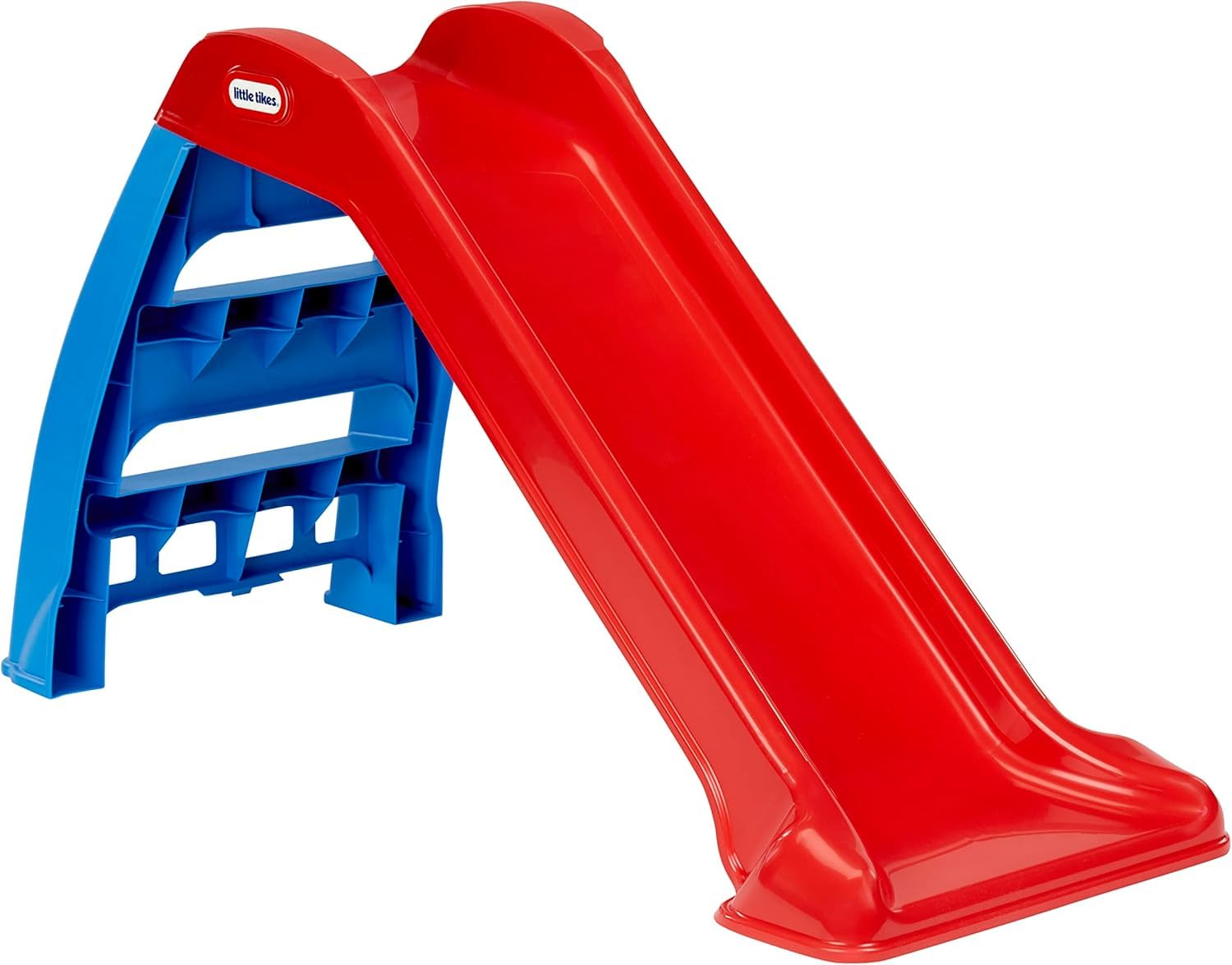
Little Tikes First Slide

Little Tikes First Slide

First slide

Doodle Score 9.4/10
Check Price

Worth Noting

  • Top rail pieces work loose during play
Item Weight
9.5 lb
Weight Limit
60 lb
Assembled Size
39 x 18 x 23 in
Recommended Age
18 months to 6 years
Read the full review

Folded, this is a flat plastic slab that stands behind a door or slides under a bed. Opened out, it's a 39-inch slide with a 23-inch platform a two-year-old can climb and launch from without help, and it breaks down again with no tools at all — which is the whole reason it survives in a house with a small yard.

A 23-inch platform is low enough that a cautious 20-month-old tries it without being lifted, and the 60-pound limit means it keeps working well past three. It's the one piece here a toddler can use alone within minutes of coming out of the box, and that immediacy is worth more than any feature on this page.

Before you buy, look at the height rather than the styling: the short chute makes for a steeper drop than the studio photos suggest, so this wants grass or a mat rather than a patio, with a hand at the bottom for the first few goes. Setup is four pieces and a couple of firm pushes — five minutes, no tools, and just as quick to take down at the end of the day.

Bottom line: Our pick for a first slide: low enough for a cautious 20-month-old, modest enough to justify, and it folds flat when the weather turns.

#7

Step2 Whisper Ride II Push Car

Step2 Whisper Ride II Push Car

Neighborhood walks

Doodle Score 9.2/10
Check Price

Worth Noting

  • Body does not collapse for transport
  • Assembly is a longer job than it looks
Storage
Under-hood compartment
Weight Limit
50 lb
Assembled Size
45.5 x 19 x 34 in
Recommended Age
18 to 48 months
Read the full review

Every parent of a two-year-old knows the standoff: the stroller is a prison, the walk takes forty minutes, and everyone arrives Cross. This car ends it. You steer from a wide rear handle, the passenger gets a working horn, a steering wheel and cup holders, and there's storage under the hood for snacks, a water bottle and whatever rocks get collected along the way.

We found the quiet wheels live up to the name on pavement, which keeps a walk pleasant for the person pushing. The easy-latch seat belt is workable one-handed, which matters when the other hand is holding a bag, and the 45.5-inch body has real legroom — the reason a three-year-old still fits in it. Double-walled plastic and colors that are sold as chip- and fade-resistant mean it can live on a porch.

Where it gives ground is logistics. The handle folds, but the body doesn't, so it takes most of a small trunk and needs a garage corner when it's idle. Assembly is also more of a job than the pictures imply: set aside an evening and a second pair of hands, and check the hardware bag before you start rather than halfway through.

Bottom line: If your toddler has declared war on the stroller, this push car is the fix we suggest — the walk becomes the outing.

How We Tested 12 Outdoor Toys With Real Toddlers

We started with a list of roughly 60 toys sold for kids aged one to three, then cut it down using age labeling, footprint, and price — nothing over $300, and nothing so big it would swallow a small yard. We favored makers that publish replacement-parts pages, since a toy nobody can fix is a toy that ends up at the curb. Twelve made the cut.

Each one was assembled by a single adult using only the hardware in the box and whatever tool the manufacturer included. I timed every build from opening the carton to the last tighten, kept a running count of missing pieces, and checked whether the predrilled holes lined up with the brackets they were meant for — three of the twelve sent me back to the drill. Then the toys went outside: grass, driveway, a splash pad, a park, and a garage corner for storage.

Over those eight months I watched how kids actually came back to each toy, noting whether a water table got a second look in week six or was stepped over by week two. I checked whether a 20-month-old could grip the handles and pull up without the whole thing sliding out from under them, measured each footprint against a standard 36-inch gate, and left everything outdoors through rain and a light frost to see what faded, cracked, or rusted. Value got scored last, against the number of seasons each toy looked likely to survive.

How to Choose Outdoor Toys for Toddlers

Buy for the stage, not the birthday

The gap between 18 months and three years is wider than almost any other stretch of childhood. At 18 months a child is often still pulling up on furniture; at three they're climbing, throwing and running. Buy for the child in front of you. A pull-to-stand toddler does best with something low they can mount alone — the rocking horse, the four-wheel bike, the 23-inch slide platform — while a three-year-old wants speed and a challenge and will ignore anything that doesn't deliver it.

A good mix is one item that's slightly ambitious and two that are easy wins, so there's always something that works on a tired afternoon.

Measure the footprint, then the door it has to fit through

Everything here is bigger in the yard than it looks in the photo. The water table's 39 by 24 inches is a permanent summer resident; the slide folds down to a flat slab you can stand behind a door; the tunnel packs into a bag. Decide before you buy which pieces live outside year-round and which come in, because anything that comes in needs a clear route through a doorway and somewhere to go.

Treat the word compact with suspicion. In a listing it usually means it fits in a car trunk, which is not the same as fitting on your patio.

Treat assembly as part of the price

Some of these snap together in five minutes with no tools. Others want a screwdriver, and at least one has no pre-drilled holes at all, so every screw has to find its own way through plastic. That's the difference between a toy that's ready when the box opens and a toy that eats an evening.

Where the screws are self-starting, a cordless driver and a second pair of hands turn a frustrating hour into a short one — and check the hardware bag before you begin rather than halfway through. Build anything with a birthday attached the night before.

Plan where the mess lands

Water and sand are the two things toddlers never tire of, and both leave a mess you'll be living with. A water table is a basin of water in your yard, not a babysitter: site it where you can see it from the kitchen, where a spill doesn't matter, and plan on a towel by the back door. Sand toys are the easy half — they live in a bucket and travel to the beach.

If siblings or cousins are close in age, count the players. The water table seats one to four at the basin; the slide and the rocking horse are single-rider and a queue will form.

Check the weight limit and what's meant to be climbed

Every ride-on and slide here states a limit — 50 to 60 pounds on the ones we chose — and it's about more than your child's size. It's the load the thing is built to take when a friend piles on or an adult leans while lifting someone out. Buy for the heavier end of what you expect, not today's weight.

Then be honest about what each piece is. A slide platform is built to be climbed; a water table is a container; a fabric tunnel is neither. That distinction decides where you put it and how closely you watch.

Frequently Asked Questions

Final Verdict

The water table is the one we point people to first: a pour-and-rain loop a toddler runs without help, room for two or three at the basin, and enough sturdiness to take a whole summer of use. If your yard is small or the budget is tight, the First Slide does more per square foot than anything else here and folds away when the weather turns.

And if the child is still one, start with the rocking horse. No assembly, no learning curve, no waiting.