Outdoor Play

Best Pull-Along Wagons of 2026

The meltdown usually hits somewhere between the otter exhibit and the parking lot. One kid wants to be carried, the other insists on walking, and you're already holding a cooler bag, two jackets, and half a pretzel. A decent pull-along wagon fixes that particular evening: it swallows the gear, gives tired legs somewhere to land, and turns the trudge back to the car into part of the outing. What it also has to do is survive being climbed on, yanked off curbs, and forgotten in the garage for a month.

I've dragged wagons through muddy parks, crowded farmers markets, and one beach trip I'd rather forget. Over eight months, my team and I tested 11 pull-along wagons, hauling them over grass and gravel and handing the rope to kids who'd much rather pull than ride. The thing that surprised me: the best-looking wagon isn't always the one you reach for. Rope length and wheel response decide whether a walk stays pleasant or turns into a tug-of-war. The picks below are the ones that earned a permanent spot by the door.

#1

Kidpop PULA 2-in-1 Wagon
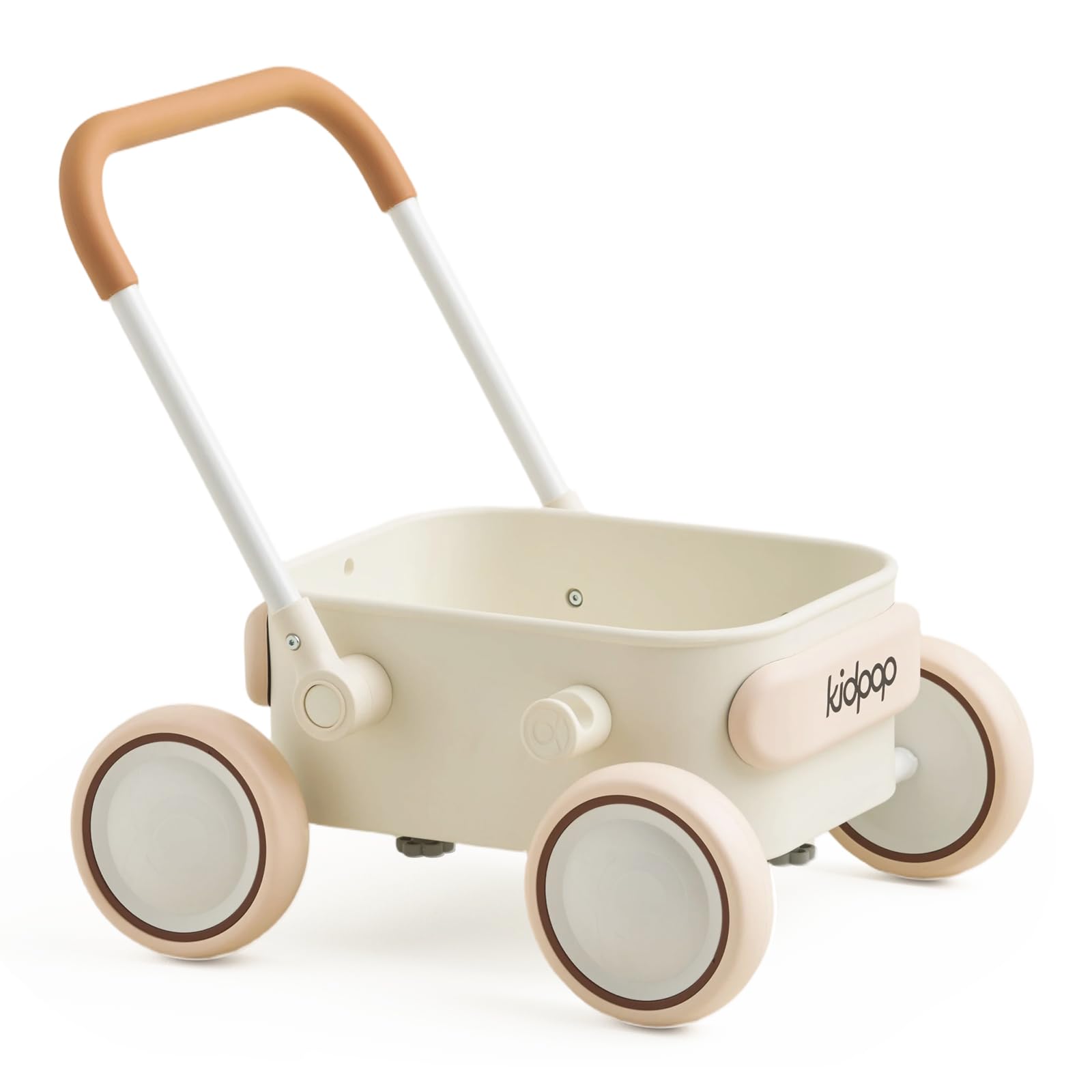
Kidpop PULA 2-in-1 Wagon

First walkers

Doodle Score 9.6/10
Check Price

Worth Noting

  • Compact hopper holds toys, not a passenger
Wheels
EVA, fully enclosed
Folding
One-click frame fold
Age Range
7 months to 4 years
Assembled Size
19.7" L x 16.1" W x 18.9" H
Read the full review

The frame folds with one click and the wheels are fully enclosed, so there's nothing on this wagon to catch a sock or gouge a baseboard. At 19.7 by 16.1 by 18.9 inches it steers down a hallway, and the EVA wheels are the quietest of anything in this group — we ran it back and forth over a wood floor without the plastic clatter the others make.

What it does better than anything else here is cover two stages with one object. From about 7 months it's a push walker: the hopper sits low, the wheels stay put under a lean, and the non-slip bar gives a wobbly child something to grip. Later the same handle lets a toddler tow it with a load of toys inside. One purchase serving both the standing-up months and the year after is genuinely good value, and it's the pick we suggest first to anyone in a small apartment.

The build is the part to prepare for. Some of these go together in three minutes; others need the red wheel cap driven home with a hammer, and that's the step where assembly goes wrong. A rubber mallet and a scrap of wood will protect the plastic, and if a cap won't seat, stop and contact the seller rather than forcing it — a wheel sitting proud won't roll straight and won't survive a running toddler.

Bottom line: The best wagon here for the stretch between cruising and walking, and it folds flat enough to live in a closet.
#2

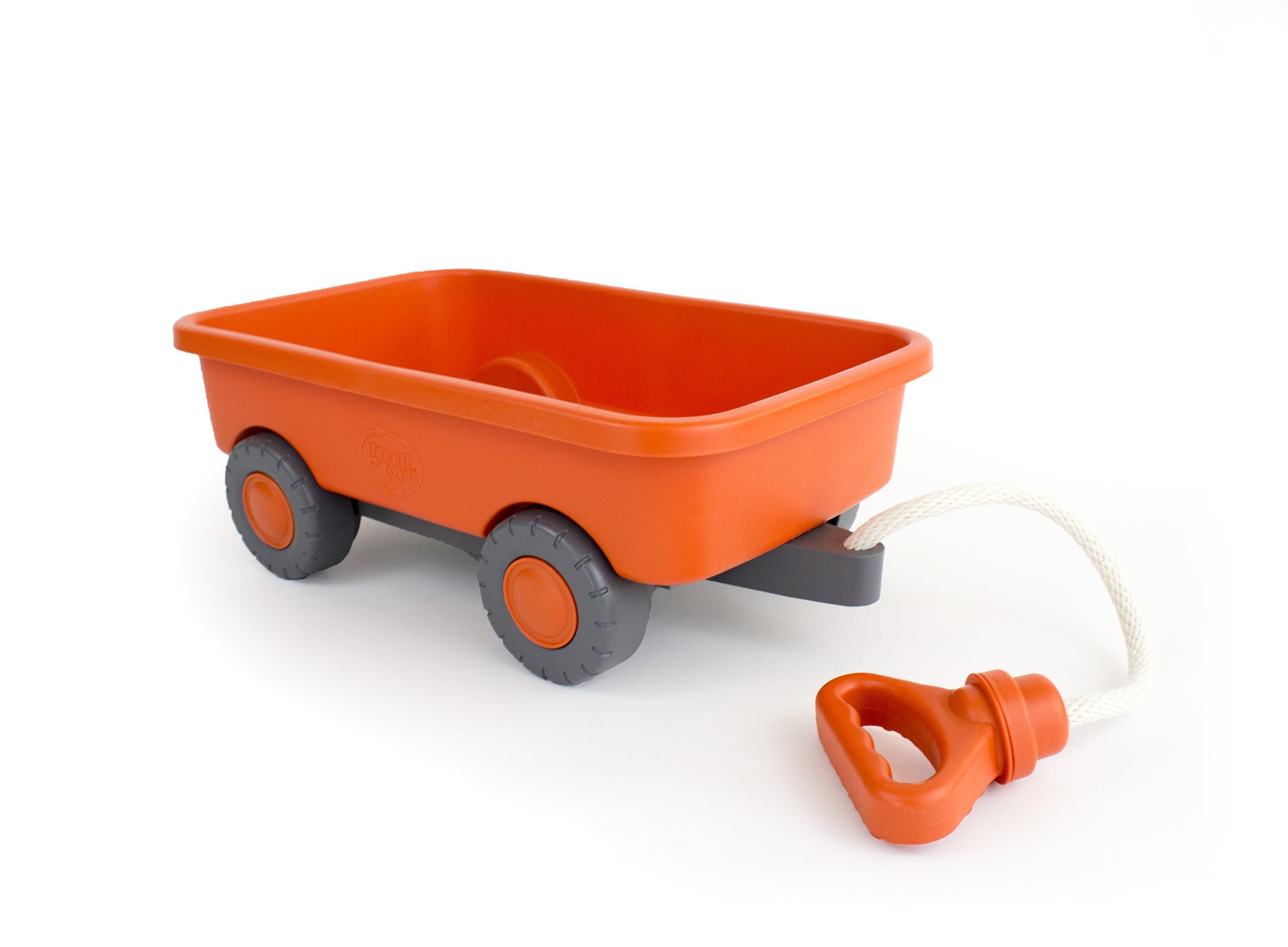
Green Toys Toy Wagon

Green Toys Toy Wagon

Small spaces

Doodle Score 9.6/10
Check Price

Worth Noting

  • Short rope makes taller toddlers stoop to pull
Size
16 x 9.5 x 5.5 inches
Weight
16 oz
Material
100% recycled plastic
Age Range
12 to 48 months
Read the full review

Sixteen inches long and 16 ounces, this is the smallest wagon in the group, and the size is the feature. It disappears onto a shelf, it fits in a stroller basket, and it's light enough that a 1-year-old can drag it one-handed across a rug. Ours has carried blocks, a plastic dinosaur, a very important rock and one cup of water, which it held.

What we appreciate most is what it's made of. The body is a single piece of recycled plastic with no metal axles or external coating to rust, chip or snag, so a wipe-down brings it back and a shower doesn't shorten its life. That's why it's the wagon we're happiest to see in a living room: nothing on it can mark a floor, and it looks like a design object rather than a toy that lights up.

The trade is scale. It's a wagon for a hallway, a deck or a short walk up the sidewalk, and the tub holds a handful rather than a haul. Between this and the Little Tikes, the Little Tikes carries more, sits higher off the ground and suits a taller child; the Green Toys is the one that earns its shelf space in a small home and gets pulled out every single day.

Bottom line: For an apartment or a playroom, this small recycled-plastic wagon is our pick — light enough for a 1-year-old to tow and small enough to put on a shelf.

#3

Radio Flyer Classic Walker Wagon

Radio Flyer Classic Walker Wagon

Learning to walk

Doodle Score 9.6/10
Check Price

Worth Noting

  • Wheels don't swivel, so turns take a wide arc
Weight
10.4 lb
Material
Wood, steel, rubber
Age Range
12 months to 4 years
Assembled Size
22.44" L x 14.57" W x 17.13" H
Read the full review

At 10.4 pounds it's the heaviest thing on this list, and the weight is the point: a toddler leaning on the handle doesn't send the wagon skating out from under them. The resistance clickers add a steady drag on hardwood and tile, the rounded bumper takes the hit when steering goes wrong, and the wooden body looks like furniture rather than something that came in a plastic blister pack.

It's a push wagon, though, and that's the lens to buy it through. A child walks behind it and shoves; the clickers and the bumper are designed around a walker's pace, and if what you pictured was a wagon trailing along behind a child, one of the pull-first picks here will serve you better. Where it earns its keep after walking is mastered is as a toy bin on wheels — the tub takes a surprising load of blocks, and it stays out in the room rather than being banished to a bedroom.

What surprised us is how long it stayed in use. Most walkers are finished within a few months; this one became the place toys got dumped at the end of every day, and the classic red-and-wood look is the reason it was allowed to. The side panels lift out by design, which is what makes it a bin — press them home before a wobbly toddler sets off, since a lean can free them.

Bottom line: If you're buying a wagon to keep a new walker steady rather than to tow a load, this heavy wooden one does that job better than anything else here.

#4

Step2 Wagon for Two Plus

Step2 Wagon for Two Plus

Two toddlers

Doodle Score 9.4/10
Check Price

Worth Noting

  • Adult assembly required before first use
  • Wide 42.5-inch footprint needs real storage space
Seats
2, with seat belts
Warranty
3 year limited
Max Weight
75 lb
Assembled Size
42.5" W x 20.25" D x 39.5" H
Read the full review

Two children, one handle, and a walk to the park that doesn't end with someone on your shoulders — that's the job this wagon does, and it's why it sits at the top of our list. The molded bench seats two small riders side by side, the easy-latch belts hold them in, and the wide rear grip sits at adult hip height, so you aren't hunched over the whole way there. The second seat is what changed things for us: a friend can come along, or one child rides while the diaper bag takes the other side.

Thought has gone into the small stuff. A latch door on the side lets a 3-year-old climb in without being lifted, cup holders sit within reach of both seats, and the compartment under the seat swallows snacks, sunscreen and a spare outfit. The 75-pound maximum covers two toddlers with room to spare, and the double-walled plastic is built for a wagon that lives on a patio, with a finish specified not to chip, fade or peel.

Ride quality is where it earns the money. On grass, on gravel paths and over the tree roots that lift a sidewalk, it rolls with a steady pull and turns without fighting you — the comparison that matters if your walks are park paths rather than a driveway. Two toddlers and a cooler is a realistic load, and it never felt close to tipping on a camber.

Bottom line: If you're pulling two toddlers to the park, this is the wagon we point you to: belted seats, real storage, and a handle at adult height.

#5

Little Tikes Lil' Wagon

Little Tikes Lil' Wagon

Budget starter

Doodle Score 9.4/10
Check Price

Worth Noting

  • Shallow 20-inch tub holds toys only
Size
20.38" D x 11.63" W x 9" H
Handle
Folds flat
Weight
4 lb
Max Weight
50 lb
Read the full review

It's the cheapest wagon here, and for a lot of families that settles it. A first pull toy is a gamble — toddlers change their minds by the week — and this is the low-risk version of that bet: 4 pounds, no assembly, and a tub shallow enough that a 2-year-old can reach in and out without tipping it. The folding handle keeps itself upright when a small hand lets go, which we think is the difference between a wagon that gets dragged around the yard and one that ends up face-down in the grass.

The tub is roughly 20 inches long and 9 inches deep, which is right for a doll, a fistful of chalk and a pocketful of rocks, and wrong for anything bulkier. From about 18 months a child can start it, stop it and turn it without help. It's a wagon for a toddler to fill rather than one to pull a toddler in — if rides are the point, the Step2 is the wagon you want, and this becomes the toy that follows it around.

The wheels are solid plastic, which is where the money was saved rather than spent. On tile and hardwood they glide and leave nothing behind; on grass and pavement they're perfectly fine; on gravel they clunk and drag and a determined 2-year-old will notice. That's the honest trade for a wagon this light, and it's why ours lives by the back door rather than going to the park.

Bottom line: The least expensive wagon here is also the easiest to hand over: light enough for a toddler to tow alone, and there's nothing to assemble.

#6

Radio Flyer Push & Pull Walker Wagon

Radio Flyer Push & Pull Walker Wagon

Outdoor play

Doodle Score 9.4/10
Check Price

Worth Noting

  • Rated for cargo, not for carrying a rider
Modes
Push walker to pull wagon
Included
Garden tool set
Max Weight
35 lb
Assembled Size
18.3" D x 13.9" W x 17.7" H
Read the full review

The garden tools are the sort of extra that usually ends up in a drawer, and here they're the reason the wagon stays outside. A small tool set and a wagon to carry it turns a patch of dirt into a job with a beginning and an end, and ours spent more time outdoors than any other wagon here because there was something to do once it arrived. The 35-pound limit tells you what it's for: dirt, tools and stuffed animals, not a passenger.

It starts as a push walker with the handle locked upright, which gives a wobbly 1-year-old a bar at chest height to hold, then unlocks into a pull wagon as they get steadier. At 4.9 pounds it lifts over a step one-handed, and the 13.9-inch width slips through a garden gate. The maker rates it from 12 months to 4 years, and the push phase realistically covers the first of those.

We like that both modes are real rather than theoretical. Plenty of two-in-one toys do one job well and the other badly; this one pushes straight and tows straight, and the conversion is a handle lock rather than a rebuild. The wheels are the thing to check on arrival — press each one until it clicks, because a hub only partway home will drag and then work loose. We seat every wheel against a hard floor before handing the wagon over.

Bottom line: For a first birthday and a backyard, this is the most useful inexpensive wagon here, as long as all four wheels are clicked firmly into place first.

How We Tested 11 Pull-Along Wagons Over Eight Months

We started with research, not shopping. We pulled specs for every wagon we could find, compared stated weight limits against folded footprints, read through the one- and two-star reviews looking for patterns, and crossed off anything with paper-thin fabric, a rope that clipped on instead of looping through the frame, or no brake. That left 11 wagons, which we then put through eight months of ordinary family use.

Each one got the same treatment. We loaded it with a 40-pound bag of play sand plus a week of groceries and walked a two-mile neighborhood loop, then repeated the route over grass, gravel, and a curb lip. We measured every rope from handle to wagon and noted how far behind our heels the wagon trailed on turns — short ropes meant bruised ankles, long ones meant the wagon drifting toward the street. We folded each one one-handed and slid it into a trunk to see how much cargo space it actually ate. On tight turns we watched whether the front wheels followed or skidded, and whether the whole thing tracked straight when pulled at a jog.

Then we simply lived with them. Kids climbed in and out, snacks spilled, and we hosed the fabric down; at the end of the eight months we checked seams, axle wobble, and how much color the sun had taken out. Enjoyment came down to whether our test kids asked for a specific wagon by name. Value was simpler arithmetic: the price divided by how much still worked in month eight.

How to Choose Pull-Along Wagons

Ride-in or toy hauler

Ride-in wagons are built around seats and a maximum weight — the Step2 here is rated to 75 pounds, which covers two toddlers and a bag of snacks. Toy haulers run the other way: a shallow tub a child tows themselves, like the Little Tikes, rated to 50 pounds of cargo with no belts at all. The trap is reading a weight rating as a seat. A 50-pound limit on a 20-inch plastic tub tells you what won't crack it, not that a child should ride inside. Settle which job you're buying for before you compare anything else, because the rest of the spec sheet follows from it.

Handles, ropes and pulling height

The handle is where most of the regret lives. An adult-pulled wagon wants a wide grip at hip height so you aren't stooping for a mile; a child-pulled wagon wants a handle short enough to reach and long enough to tow without bending double. Ropes are cheap, pack flat, and are the part most often cut too short — fine for a 2-year-old, hopeless for a 4-year-old. A rigid folding handle, as on the Little Tikes, holds itself upright when a small hand lets go, and we found that catches the wagon before it becomes a toy nobody picks back up.

Where it will live

Measure the corner before you fall for a two-seater. The Step2 assembles to 42.5 inches wide and about 20 inches deep, so it wants a garage or a hallway, and the folding handle takes away height rather than width. Small toy wagons run the other way — the Green Toys is 16 inches long and 16 ounces, which is why it disappears onto a shelf. If the wagon will travel in a car, check trunk depth with the handle folded, and check your own doorways: a 42-inch wagon doesn't fit through every garden gate.

Wheels for the ground you actually have

Solid plastic wheels are quiet and gentle on a kitchen floor and noisy on gravel; EVA wheels like the Kidpop's are quieter indoors and absorb more on pavement. None of these wagons runs pneumatic tires, so treat grass and park paths as the sensible range and gravel as a chore. If most of your walking is pavement, any of the ride-in models will serve you. If it's a dirt yard and a vegetable patch, buy for the outdoor job and accept that the wagon gets hosed down far more often than it gets wiped.

What arrives in the box

Toy wagons often arrive ready to use; ride-in wagons arrive as panels, wheels and a bag of hardware. The Little Tikes comes out of the box assembled, while the Step2 needs adult assembly with the included hardware. Budget an evening and a second pair of hands, and don't skip the wheel check on anything with push-on hubs — a wheel pushed only partway home will drag, then work loose. That goes double for walkers, where a wobbly wheel under a leaning toddler is the last thing you want.

Frequently Asked Questions

Final Verdict

For most families the Step2 Wagon for Two Plus is the wagon to buy: two belted seats, storage that swallows the snacks, and a pull that stays steady on grass and pavement. It's also the largest thing here, and it arrives needing an evening of assembly.

If your child is still finding their feet, buy the Kidpop instead. It does the pushing job first, folds flat against a wall, and converts to a tow-along wagon once they're steady enough to want one.