Outdoor Play

Best Electric Ride-On Cars for Kids of 2026

The first lap down the driveway is pure magic. Then the battery sags two houses later, the parental remote lags a half-second behind the wheel, or you're two hours into assembly with a hex key and no coffee. The right ride-on car fixes all three: it runs long enough for a real outing, it steers when you tell it to, and it goes together in an afternoon instead of a weekend.

I've watched a kid ignore a fancy remote-control truck for a ride-on that tops out at 2 mph, which tells you where the appeal actually lives — the seat, the wheel, the feeling of being in charge. We've spent the past six months with nine cars, and the differences that mattered weren't printed on the box. Voltage gets all the attention, but gearing, seat depth, and how smoothly the remote feeds in throttle separate the one your kid rides every evening from the one that ends up under a tarp. The picks below are the ones that survived all of it.

#1

ELEMARA Mercedes-AMG G63
ELEMARA Mercedes-AMG G63

Most families

Doodle Score 9.2/10
Check Price

Worth Noting

  • No published amp-hour rating for the pack
  • 66-pound limit rules out older kids
Motors
Dual 35W
Listed Run Time
2 hours
Recommended Age
3 to 6 years
Weight Capacity
66 lb
Read the full review

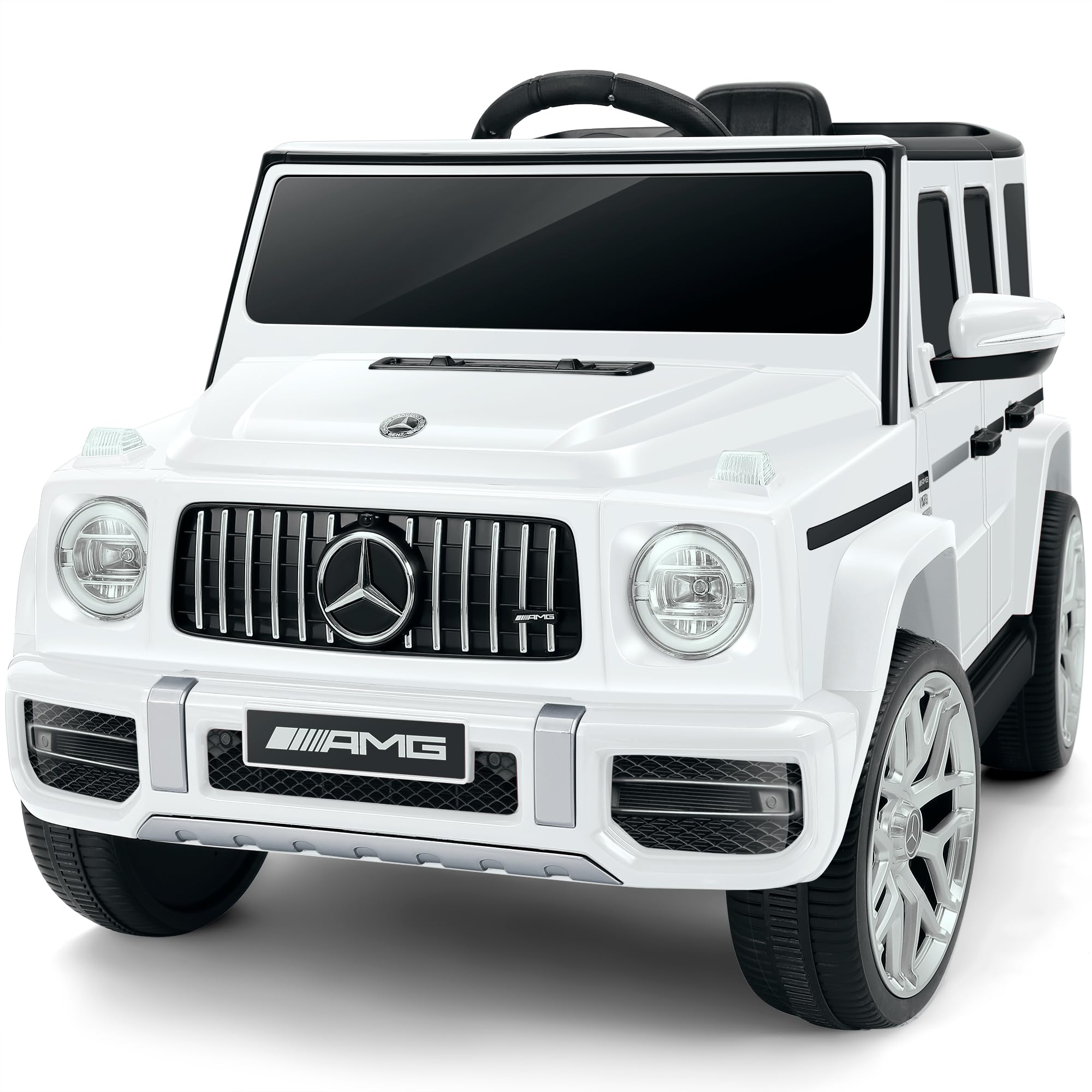
Two licensed G-wagons arrived within a week of each other, and the badge turned out to be the least interesting thing about either. The ELEMARA is the one we kept reaching for. Its soft start rolls the truck forward instead of lurching, and the remote trims low and high speed in steps rather than an on-off shove — the difference between a three-year-old enjoying the ride and a three-year-old being startled by it.

The bodywork earns its keep. It's a 1:1 take on the AMG G63, grille and flared arches included, with a roofline at 20.5 inches. That last number matters more than it sounds: it sits well below the ANPABO G63 here, so a small child climbs over the sill without being lifted, and the whole thing tucks under a workbench. Four treaded wheels and shock-absorbing springs make the driveway and short grass fair game.

ELEMARA lists an average run time of two hours, and the battery is the one topic that comes back entirely positive for this car. Bluetooth, flashing LEDs and a low-battery prompt round it out. What you don't get is an amp-hour rating for the pack, so two hours is your only runtime guide, and it's optimistic with a heavier child on grass.

The real ceiling is the 66-pound limit and the 3-to-6 age band. That's three or four good summers for most families, and it's the trade for a car this size. If a seven-year-old already lives in the house, the 24V Bronco further down is the better use of the money.

Bottom line: We recommend it to most families: calmest steering here, a body small kids can climb into, and the only spotless battery record.

#2

ANPABO Mercedes G63

ANPABO Mercedes G63

Long run times

Doodle Score 9.2/10
Check Price

Worth Noting

  • 36.2 pounds is heavy to lift and store
  • Longest 12V body here at 44 inches
Motors
Dual 35W
Battery
12V 7Ah
Product Weight
36.2 lb
Weight Capacity
66 lb
Read the full review

Most 12V cars here run a 4.5Ah pack. The ANPABO runs a 7Ah one — 55% more capacity by the brand's own arithmetic — and that single figure is why it made the list at all.

We like what it buys: the car that gets used in ten-minute bursts all Saturday, charges overnight, and still has something left after dinner. Two 35W motors and a three-speed remote give it enough pull for a lawn, and the soft start and low-battery prompt are the sort of features you stop noticing because they work. Assembly is quick and the parts line up, which is rarer in this category than it should be.

The rest is a well-finished G63: 44 inches long, LED headlights, a music player and horn, a 66-pound limit and a 3-to-5 age band. Two reservations. At 36.2 pounds it's the heaviest 12V single-seater here, and you feel that every time it goes into a trunk. And long-term durability is the least settled part of the picture for this car, so buy it somewhere with a straightforward return window.

Bottom line: We take this one when the day is long: the biggest 12V pack here, with the heft as the price.

#3

Miniature Motors 12V Truck

Miniature Motors 12V Truck

Budget first car

Doodle Score 9.2/10
Check Price

Worth Noting

  • Manual mode has one fixed speed
  • 50-minute listed run time
Top Speed
3.5 mph
Product Weight
26.4 lb
Listed Run Time
50 minutes
Weight Capacity
66 lb
Read the full review

Thirty-nine inches long, 26.4 pounds, and certified to ASTM and CPSIA: the Miniature Motors truck is what the bottom of the price range looks like when it's done properly.

It's also the quickest 12V car here at 3.5 mph, with three remote speeds between 2 and 3.5. Manual mode is single-speed — you can't dial it back for a nervous first driver — so most of the early months happen on the remote. The listed run time is 50 minutes, which is an afternoon at the park rather than a whole day.

Steering is the compromise. It turns wide, and on a slope the front end can go light and the truck can rock back onto its rear wheels, so flat ground isn't a suggestion with this one — it's the condition of use. On a level lawn or a driveway it tracks straight, and the suspension soaks up the step from pavement to grass.

Bluetooth, working lights and a body that looks better than the money suggests round it out, and assembly is quick. If your yard is flat, this is the budget truck we point to. If it isn't, spend the difference on the G63.

Bottom line: Our budget pick for a flat yard: the fastest 12V drivetrain here, certified, and honest about its limits.

#4

Winado Chevrolet Colorado

Winado Chevrolet Colorado

Narrow storage

Doodle Score 9.2/10
Check Price

Worth Noting

  • Two 25W motors, least power in this group
Motors
Dual 25W
Battery
12V
Body Width
21.65 inches
Weight Capacity
66 lb
Read the full review

Lockable doors, a soft start, rear shock absorbers and a 21.65-inch-wide body: the Colorado is the slim, tidy one. It slips past the trash cans and through a garden gate that the 26-inch-wide cars here won't take.

Two 25W motors are the least power on offer in this group, and that's the honest limit of the truck. Pavement, paths and short grass are its territory; a steep, damp lawn is not. We're content with the trade, because everything about the way it drives is calm — the soft start is smooth, the remote holds a line rather than hunting, and the doors latch without a fight, so a child can climb in unaided.

Assembly and appearance draw no complaints, the remote and battery read strongly, and the reliability topic is too thin to call either way. Sixty-six pounds of capacity against a 40-pound child gives it a few seasons yet. If your yard is flat and your storage is narrow, this is the truck that fits.

Bottom line: We like it for narrow gates and flat ground: the slimmest truck here, and the calmest to live with.

#5

BTMWAY Lamborghini 12V

BTMWAY Lamborghini 12V

Fit-first buyers

Doodle Score 9.2/10
Check Price

Worth Noting

  • 8 to 12 hours charging for 1 to 2 hours
  • 55-pound limit is on the low side
Battery
12V 7A
Max Speed
2.5 mph
Weight Capacity
55 lb
Max Rider Height
33 inches
Read the full review

Of everything here, the BTMWAY is the one that tells you whether your child fits before you buy. The listing caps the rider at 55 pounds and 33 inches of height and publishes the seat at 14.2 inches wide by 7.9 deep — three numbers that answer in ten seconds what most listings leave to guesswork.

The rest is a licensed Lamborghini with lockable doors, spring suspension, LED lights and a music player, at 2.5 mph and 42 inches long. Charging takes 8 to 12 hours for 1 to 2 hours of running, the least convenient ratio here, so plugging it in overnight becomes the routine rather than an afterthought.

We think the size honesty is worth more than it sounds. A published height ceiling is rare in this category, and it's the difference between a car a child grows into and one they perch on with their knees up. The rest reads well — speed draws no complaints, enjoyment is strong, the remote is well rated — with the usual split on battery and mixed feelings about size, which is what a car with a stated ceiling should expect.

Bottom line: Our fit-first pick: the published height and seat depth answer the only question that really matters.

#6

ELEMARA Bumper Car

ELEMARA Bumper Car

Indoor play

Doodle Score 9.2/10
Check Price

Worth Noting

  • 1.9 mph only works on smooth indoor surfaces
Footprint
25 x 25 x 19 inches
Max Speed
1.9 mph
Recommended Age
3 to 8 years
Weight Capacity
66 lb
Read the full review

This is not a car for the sidewalk. At 1.9 mph with a 25-inch footprint, the ELEMARA bumper car is an indoor spinner — a finished basement, a screened porch, a smooth patio — and judging it as a ride-on truck misses the point.

What it does, it does well. The 360-degree spin turns a hallway into a fairground ride, the two speeds give a cautious parent a slow setting, the joystick and the remote work at the same time, and the lights have five modes plus a sheet of stickers a child can apply themselves. At 6.1 kilograms it's the only thing here one adult carries indoors one-handed.

On the measures that matter for indoor play it's as well liked as anything on this page: enjoyment and fun read strongly positive, assembly is close to unanimous, and the remote and value both come in for praise. Battery life and functionality are the split topics, which is the same story as every other car here and no worse.

Buy it for a family with an indoor space and a child who isn't ready for a truck. It stores on a shelf, it survives a basement, and it doesn't need a lawn. If the plan is the driveway, skip it — 1.9 mph runs out of road in about four seconds.

Bottom line: We keep this one indoors: a 360-degree spinner for basements and patios, and no use at all on a sidewalk.

#7

First Ride On Bronco Raptor

First Ride On Bronco Raptor

Two riders

Doodle Score 9.0/10
Check Price

Worth Noting

  • Rear gearbox and plastic wheels show wear
  • Battery life starts at 50 minutes
Seats
Dual, 21 inches
Speeds
2.0, 2.7, and 4.3 mph
Battery
24V dual drive
Weight Capacity
132 lb
Read the full review

If two children will be in it at once, nearly everything else on this page is out. The Bronco Raptor is the only true two-seater here: a 21-inch dual seat, two separate three-point belts, and a 132-pound limit that covers a five-year-old and a three-year-old together.

The 24V drivetrain is the other half of the argument. Three speeds of 2.0, 2.7 and 4.3 mph make it the quickest thing here by a clear margin, and the extra voltage is what lets it haul two children up a gentle slope without bogging down. It's 44 inches long and 31.7 inches wide, though, so walk the route from garage to yard with a tape before promising a driveway debut.

What we didn't expect was how much the sibling detail matters. The anti-slip seats, the two belts and the wide bench mean nobody is perched on an axle housing, and the radio and Bluetooth buy a good ten minutes of quiet at the start of every ride. For a family with two small children close in age, this is the purchase that ends the argument.

It isn't the toughest thing here. The rear motor gearbox and the hard plastic wheels are where wear shows, steering has been the weak point for some, and the listed battery life starts at 50 minutes — enough for a yard, thin for a park. At the top of the price range you're paying for size and seats, not longevity.

Bottom line: We buy this one for siblings: the only real two-seater in the group, with the torque to carry both.

#8

ARBELI 12V Toddler Car

ARBELI 12V Toddler Car

Small riders

Doodle Score 9.0/10
Check Price

Worth Noting

  • Outgrown sooner than anything else here
Motors
Dual 35W
Battery
12V
Recommended Age
36 to 72 months
Weight Capacity
50 lb
Read the full review

Fifty pounds is the lowest weight limit of any car here, and it's the first thing to check rather than the last. A 30-pound two-year-old has years in this; a 45-pound five-year-old has a summer. What you get in exchange is a genuinely small car — 39 by 25 by 25 inches, 30 pounds — with a soft start that rolls away from a stop instead of jerking, dual 35W motors, a three-speed remote, and ASTM F963 and CPSIA certification.

As a first car it's well judged. The remote steers smoothly enough for a toddler's pace, assembly is one of the strong points, and value is the standout at this end of the range. The MP3 player and Bluetooth give it a second life as a patio radio. Two notes: battery life is the split topic for this car, and the seatbelt is cut generously, so check that it cinches down on a small child before the first ride.

Bottom line: We hand this to a first driver: small, soft-starting, certified, and outgrown before it wears out.

How We Tested Nine Ride-On Cars Over Six Months

We started with every ride-on car we could find in stock, then filtered by age and weight ratings, replacement-part availability (a battery you can't reorder is a dead car in a year), and a real spread of prices. That left nine, which we bought ourselves and ran for six months across weekly driveway sessions, sidewalk laps, backyard grass, and one long park path.

Assembly came first, and it told us plenty. We timed each build solo with only the included tools, noting where the instructions stopped matching the hardware and whether holes lined up without persuasion. We charged every battery to full, logged the time, then watched how plastic, decals, and tires held up after a month parked outside.

For battery life, we ran each car from full until it visibly slowed, logged the minutes, and repeated every few weeks to see whether capacity faded. Stability got checked on curb transitions, a sloped driveway, and thick grass, with a 40-pound sandbag in the seat when our younger testers weren't up for it. Remote control meant handing the transmitter to a parent following a walking child around a corner — we noted lag, throttle smoothness, and whether the car stopped cleanly when the stick was released.

We measured footprint and weight for garage storage, and tracked reliability for the full six months: steering that drifted, wheels that loosened, remote pairing that dropped, and how fast support answered when a charger died. Enjoyment is unscientific, but we logged which cars the kids went back to without being asked. Value came down to cost per season and whether parts were reorderable, not sticker price alone.

How to Choose Electric Ride-On Cars for Kids

Fit Comes Before Anything Else

Every car here is sold with a weight capacity, and that number, not the recommended age, tells you how long you own it. The range runs from 50 pounds to 132, which is the difference between a car a five-year-old has already outgrown and one that carries two children. Weigh your child, add a season of growth, and match it. An age band on the box is a manufacturer's guide, and heights vary enormously between a small three-year-old and a tall one.

Seat size matters as much as capacity. A published seat measurement, like the 14.2 by 7.9 inches on the BTMWAY, tells you whether a child sits properly in the seat or perches on the front edge with their knees up. When a listing gives no seat dimensions, capacity and body length are the best proxies you have.

Voltage, Amp-Hours and What Run Time Really Means

Twelve volts is the standard here; the 24V Bronco is the outlier. Voltage buys torque and top speed rather than duration — the Bronco is the quickest car in this group and has the shortest starting run time. Duration comes from amp-hours, and the ANPABO's 7Ah pack is the largest on the page against a typical 4.5Ah.

Plan around a charge, not a day. Eight to twelve hours on the charger for one to two hours of driving is normal at this size, so an overnight routine beats hoping. Charge after every use rather than running it flat, and keep the car out of a freezing garage over winter.

The Remote Is Half the Purchase

Every car here ships with a parent remote, and they are not equal. What you want is stepped speed — low, medium, high — steering that moves the wheels proportionally instead of in jumps, and a clear override so the remote wins whenever a child grabs the wheel. A remote that steers in steps drives like a shopping cart.

Check two practical things before the child sees the car: that the remote takes its own batteries, and that it pairs cleanly from the far end of the yard. On the cars here that pair well, the remote becomes the brake as much as the steering.

Match the Wheels to the Ground

Hard plastic wheels are fine on pavement and wear on concrete over months; treaded wheels and spring suspension are what make grass and gravel bearable. Motor power is the other half of that decision: the 25W motors on the Colorado are pavement-first, while the 35W units in most of the 12V cars here will pull a lawn.

Be honest about the surface. If the intended ground is a basement floor or a screened porch, buy the 1.9 mph spinner and stop shopping for a truck. If it's a sloped yard, buy capacity and torque, because a light 12V car on a grade is where owners get their surprises.

Frequently Asked Questions

Final Verdict

For a child between three and six, we point to the ELEMARA Mercedes-AMG G63 first. It steers more gently than anything else here, a small child climbs in and out unaided, and its battery record is the only clean one on the page.

Two requirements change that. If two children will ride together, the 24V Bronco Raptor is the only real answer at 132 pounds and a 21-inch bench. If the car will run all afternoon, the ANPABO's 7Ah pack is worth the extra weight.