Outdoor Play

Best Pedal Cars for Kids of 2026

The best pedal car earns its keep in that golden half-hour before dinner, when a kid can tear up and down the driveway instead of circling the kitchen. But the category has a way of separating shoppers into two camps: the ones whose car went together in twenty minutes and the ones still hunting for a missing washer while a preschooler asks if it is ready yet. A good one should feel solid under a wobbly driver, steer without a wrestling match, and stay fun after the novelty wears off. That mix of sturdy construction, predictable steering, and easy assembly is what turns a pedal car from a yard ornament into a daily favorite.

Over the past eight months, my team and I have put 12 pedal cars through driveways, sidewalks, park paths, and the occasional patch of grass. We watched kids climb in and out, parents assemble and carry them, and siblings argue over whose turn was next. Size and maneuverability mattered as much as ride quality: could a 4-year-old reach the pedals, could an adult move it one-handed, and did the price still feel reasonable after a month of hard use? The picks below are the ones that kept getting chosen for another lap.

#1

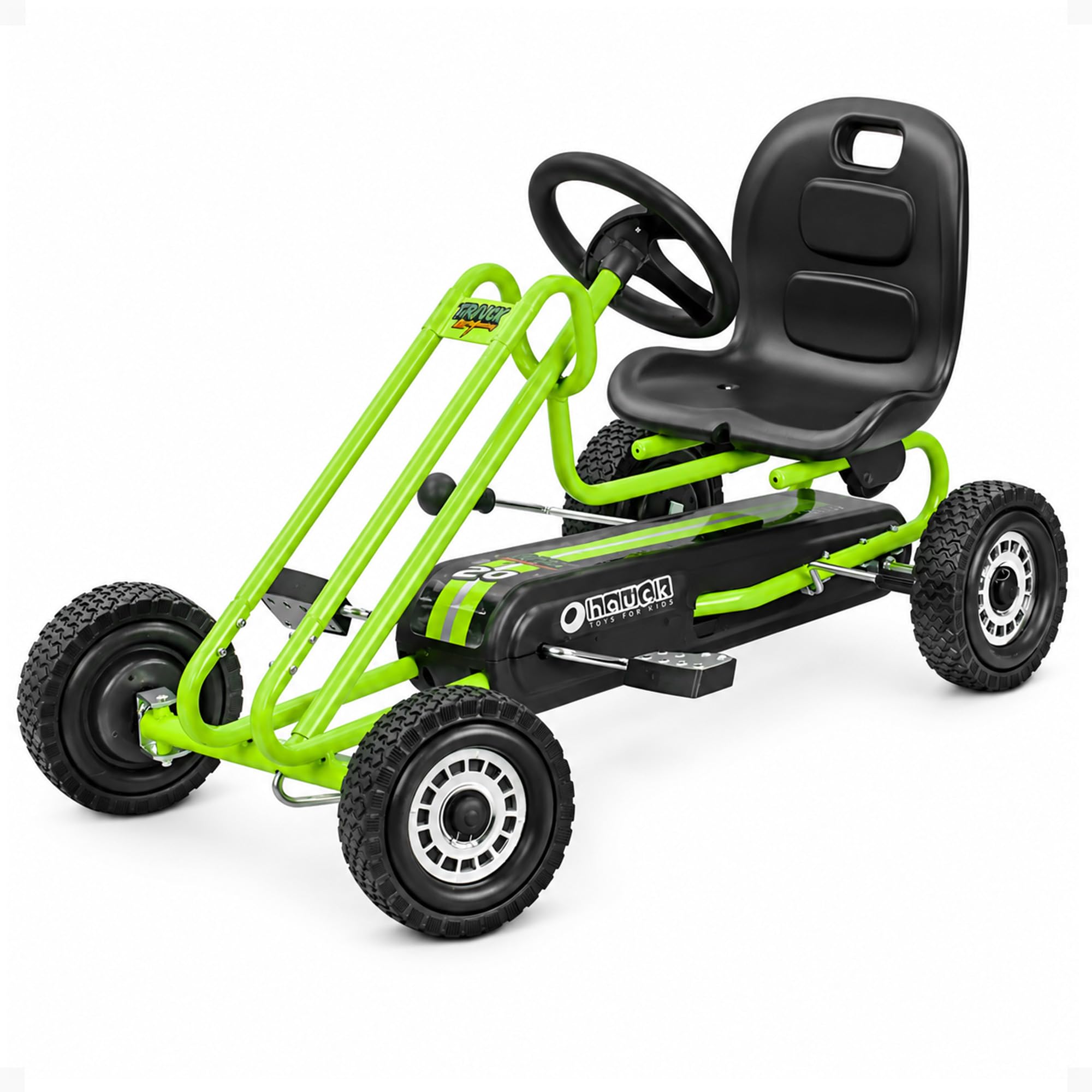
Hauck Lightning

Hauck Lightning

Everyday family kart

Doodle Score 9.4/10
Check Price

Worth Noting

  • Plastic wheels with a rubber tread strip
Brake
Handbrake, both rear wheels
Rider Age
4–8 years
Max Rider Weight
110 lb
Seat-to-pedal Positions
44 cm and 51 cm
Read the full review

Two seat positions, 44 and 51 centimeters from the pedals, and a 110-pound rider limit — that pairing is the argument for the Lightning. Set the seat forward and a small four-year-old turns the pedals through a full stroke; slide it back a summer later and the same kart still fits. The frame is steel and the whole thing weighs a little over 21 pounds, light enough for an adult to shift one-handed. Of everything here, it's the one we point a family to when they want a single purchase that lasts more than a season.

The details that impressed us are the unglamorous ones. The handbrake bites on both rear wheels rather than one, which is what you want on any driveway that isn't dead flat, and putting it together is a screwdriver job with hardware that matches the instructions. We paid close attention to the pedals, because they're fixed to the rear axle: they carry on turning while the kart coasts, so a child who stops pedaling at speed still has spinning pedals by their shins. On flat pavement that's a non-issue; on a slope it's exactly why the brake matters.

Steering is the compromise. A wheel works the front wheels and turns in a wider arc than the kart's size suggests, and younger riders take a few laps to judge it. On a driveway or a paved path that stops mattering within an afternoon; on a narrow patio it doesn't, so walk the turn on foot before you commit.

What settles it against the Batmobile is capacity — 110 pounds against 77 — at a lower price. The one-year parts warranty covers the pieces that actually wear, brake cables and cranks and wheel fittings, which is a quiet argument in a category where spares are hard to track down.

Bottom line: We recommend the Lightning to most families because it fits a small child now and still carries a big one later, with brakes on both rear wheels.

#2

Hauck Batmobile

Hauck Batmobile

Batman fans

Doodle Score 9.2/10
Check Price

Worth Noting

  • Longest footprint here at 44 inches
  • 77-pound rider limit, the lower of our two Haucks
Seat
Adjustable bucket seat
Length
44 inches
Rider Age
4–8 years
Max Rider Weight
77 lb
Read the full review

A pedal kart with a steel frame and rubber wheels is a sensible purchase. A pedal kart a four-year-old pretends is the Batmobile is the one they climb into without being asked, and that's the honest case for this one. Under the bodywork it's the same formula as the Lightning: steel chassis, rubber tires, race-styled pedals, and an adjustable bucket seat with a backrest.

We think the theme earns its keep with the right kid and does nothing at all for the wrong one. If your rider has never asked for a cape, buy the Lightning and put the difference toward a helmet. The bodywork has one quirk worth knowing before the box is opened: the front panel is clipped on rather than bolted, and it pops loose when a child puts a foot on the hood to climb aboard. It presses back on, and it's cosmetic rather than structural.

Rough ground is the other boundary. With the pedals fixed to the axle, an incline or a patch of grass takes real leg work, and feet can slip off when the kart stalls. On pavement those rubber tires roll quietly and it steers like a small car; Hauck lists it for indoor use as well, which makes it a wet-afternoon toy as well as a driveway one.

Bottom line: Buy the Batmobile for the child who asks for it by name — it's a solid steel-framed kart underneath the bodywork, and the costume is what gets it ridden.

#3

Little Tikes Jett Car

Little Tikes Jett Car

First-time riders

Doodle Score 8.6/10
Check Price

Worth Noting

  • No manufacturer warranty listed
  • Assembly takes patience and some force
Frame
Plastic
Steering
Rear-wheel, dual handles
Rider Age
3–10 years
Max Rider Weight
69 lb
Read the full review

The Jett Car doesn't have a steering wheel, and that's the point of it. Two levers work the rear axle — the front wheels simply roll — so a small rider steers with both hands held at hip height instead of reaching up and turning a wheel hand over hand. For a three- or four-year-old still working out which way is left, that's a much shorter learning curve.

It's plastic, and it feels it: 26 pounds, tires that are molded rather than rubber, and a body that flexes when a bigger kid flops into the seat. The low stance does more for a first rider than any of that — the whole kart stands under 14 inches tall, so getting on is a step rather than a climb, and a nervous beginner isn't perched up high.

Where it earns its place is the first-kart job. The seat back adjusts, the stated range runs from 3 to 10, and the whole thing is small enough to live on a back porch or beside the bins. We're comfortable recommending it as a starter for a small child on smooth pavement, with the expectation that a proper go-kart comes later.

The part that takes the abuse is the rear axle and its bushings, so put a hand on those bolts after the first week of riding and again each spring. The rest of the kart is simple enough that there's little else to fuss over.

Bottom line: We point families with a three- or four-year-old at the Jett Car, whose twin levers are easier to work than a steering wheel, as long as the riding happens on smooth pavement.

#4

Costzon Go Kart

Costzon Go Kart

Tight budgets

Doodle Score 8.0/10
Check Price

Worth Noting

  • Tight cockpit for taller preschoolers
  • Wheels and steering feel light-duty
Rider Age
3–8 years
Kart Weight
13 lb
Seat Positions
Two positions
Max Rider Weight
66 lb
Read the full review

At 13 pounds and 36 inches long, the Costzon is the one you can hang on a garage hook or drop in a trunk without thinking about it. Two seat positions, a handbrake beside the seat, and pedals that work forward and backward — the basics are all here, and they work.

What struck us is how little there is to go wrong mechanically and how much of the hardware still feels built to a price. It pedals, it steers, the handbrake bites, and it goes together faster than anything else in this group. It's also the least expensive kart here, and the money question hangs around it longest: the iron frame and polypropylene panels are honest, the finish and fittings less so.

Treat it as a starter. Expect a child to outgrow it before it wears out, which is the better of the two outcomes, and plan the upgrade rather than the repair. Its real trick is the weight: you can move it one-handed while a child holds your other hand.

Bottom line: The Costzon is the low-cost way into a pedal kart for a small child on smooth pavement, provided you expect to upgrade rather than hand it down.

How We Tested the Best Pedal Cars

We started by pulling together a shortlist of pedal cars from established brands and smaller specialty makers, then narrowed it by size range, assembly requirements, and whether replacement parts were available. Price mattered, but we did not treat the most expensive car as the default winner; we looked for a clear reason each one cost what it did. That left us with 12 cars, which we tested over eight months.

Assembly happened first, usually on a garage floor with the manual open and a kid hovering nearby. We timed each build, noted how clearly the hardware was labeled, and checked whether the finished car felt tight or flexed at the joints. Once it was rolling, kids drove on smooth driveways, cracked sidewalks, short grass, and park paths while we watched how easily they steered around cones, turned in tight spots, and backed out of a corner. We also loaded and unloaded each car from a trunk and moved it around the garage to judge size and maneuverability in real storage spaces.

Ride quality and construction got the rougher test. We sent each car over driveway seams and a strip of gravel to see whether the body rattled, the wheels tracked straight, and the pedals stayed within reach for smaller riders. We ran a hand along edges and checked paint, wheel mounts, and undercarriage hardware for sharp spots or looseness. Parents and kids rated fun and enjoyment after repeat sessions, not just the first excited lap but the fifth or sixth time it came out. At the end of the eight months, we looked at wear against price, because a pedal car only feels like a value if it survives a season of hard use.

How to Choose Pedal Cars for Kids

Fit is about reach, not the age on the box

The age ranges on these karts overlap so heavily that they're close to useless. One is sold as 4 to 8, another 3 to 10, another 4 to 10, and in the driveway they're much the same size. What decides whether a kart gets ridden is whether the child's feet reach the pedals with the seat in its closest position.

Buy against a published height or seat-to-pedal figure where the maker gives one — Hauck lists the Lightning for roughly 90 to 110 centimeters of rider height, which is a more honest guide than the number on the box. Sit your child in it with the seat forward: there should be a slight bend in the knee at the far point of the stroke. If they can only reach with their toes, wait a season rather than buying big.

A steering wheel or two levers

Both work, and they ask different things of a small rider. On the Hauck karts a wheel turns the front wheels, which feels like driving, gives a child something to hold onto, and takes an afternoon of practice. On the Little Tikes Jett Car the front wheels stay fixed and two levers pivot the rear axle, so a three-year-old steers with both hands at hip height instead of reaching up and turning a wheel hand over hand.

The trap is turning circle. These karts are long, the steering is direct, and a kart that can't complete a U-turn on your patio gets lifted rather than ridden. Walk your flattest paved area and picture the turn before you buy; a driveway or a paved path is where nearly all of them belong.

Brakes, and what happens when they stop pedaling

None of the karts here freewheel. The pedals are fixed to the rear axle, so when a child stops pedaling the pedals keep turning with the wheels. That's not a fault, it's how a simple chainless drive works, but it means feet can slip off at speed and a kart can run on down a slope.

Which makes the brake the feature to check. You want a handbrake acting on both rear wheels rather than one, positioned where the child can actually reach and squeeze it from the seat. A kart with no brake at all is a flat-driveway toy, and only that.

Wheels and the surface you actually have

Rubber tires roll quietly on pavement and keep grip when it's damp. Plastic wheels with a rubber tread strip, as on the Lightning, are fine on smooth concrete and skittish on gravel. Molded plastic tires are the least forgiving of the three.

Grass is hard work for every kart in this group: the wheels sink, the pedals slip, and the ride ends early. If you're buying for a driveway or a paved path, almost any of these will do the job. If the plan is the lawn, that's the wrong plan.

Assembly, storage, and the parent's share

These arrive in pieces. Some go together with a screwdriver and hardware that matches the instructions; others need two adults, a rubber mallet and patience while the holes line up. Build it the night before a birthday, not while a child is watching.

Weight and footprint matter more than shoppers expect. A 13-pound kart can be carried one-handed and hung on a hook; a 30-pound one is a two-trip job up steps. Before you choose, check the gate, the steps to the yard, and whether it goes in the trunk.

Frequently Asked Questions

Final Verdict

For most families the Hauck Lightning is the answer: it fits a small four-year-old at the near seat setting, still carries a 110-pound rider at the far one, and stops on both rear wheels. The steering runs wide, so walk your pavement before you commit.

If Batman is non-negotiable, the Batmobile is the same idea in costume, with a lower weight limit and a longer footprint. If you're buying for a three-year-old who can't yet coordinate a wheel, the Jett Car's twin levers are the easier way in.