Outdoor Play

Best Balance Bikes for Toddlers of 2026

The first time my nephew lifted both feet and coasted down the driveway, he looked back at me like he'd discovered fire. A balance bike does that—it lets a toddler feel the glide before worrying about pedals, which is why so many kids skip training wheels altogether. What looks like a simple frame with two wheels is really a lesson in steering, leaning, and stopping with their feet.

But not every balance bike is ready for a toddler's enthusiasm. Some tip too easily on uneven pavement, some seats won't drop low enough for a 19-month-old, and assembly can turn into a puzzle with missing tools. Over the past six months, I've tested 12 balance bikes with kids ranging from 18 months to 4 years on driveways, park paths, and the occasional grassy hill. The ones that stood out were sturdy enough to survive a few drops, adjusted as the kids grew, felt worth the price, and—most importantly—made them ask to ride again the next day.

#1

Strider 12 Sport

Strider 12 Sport

Ages 1 to 4

Doodle Score 9.6/10
Check Price

Worth Noting

  • Heavy for a one-year-old to right
  • Premium price against this group
Weight
6.7 lb
Age Range
1-4 years
Seat Height
11-17 in
Rider Weight Limit
60 lb
Read the full review

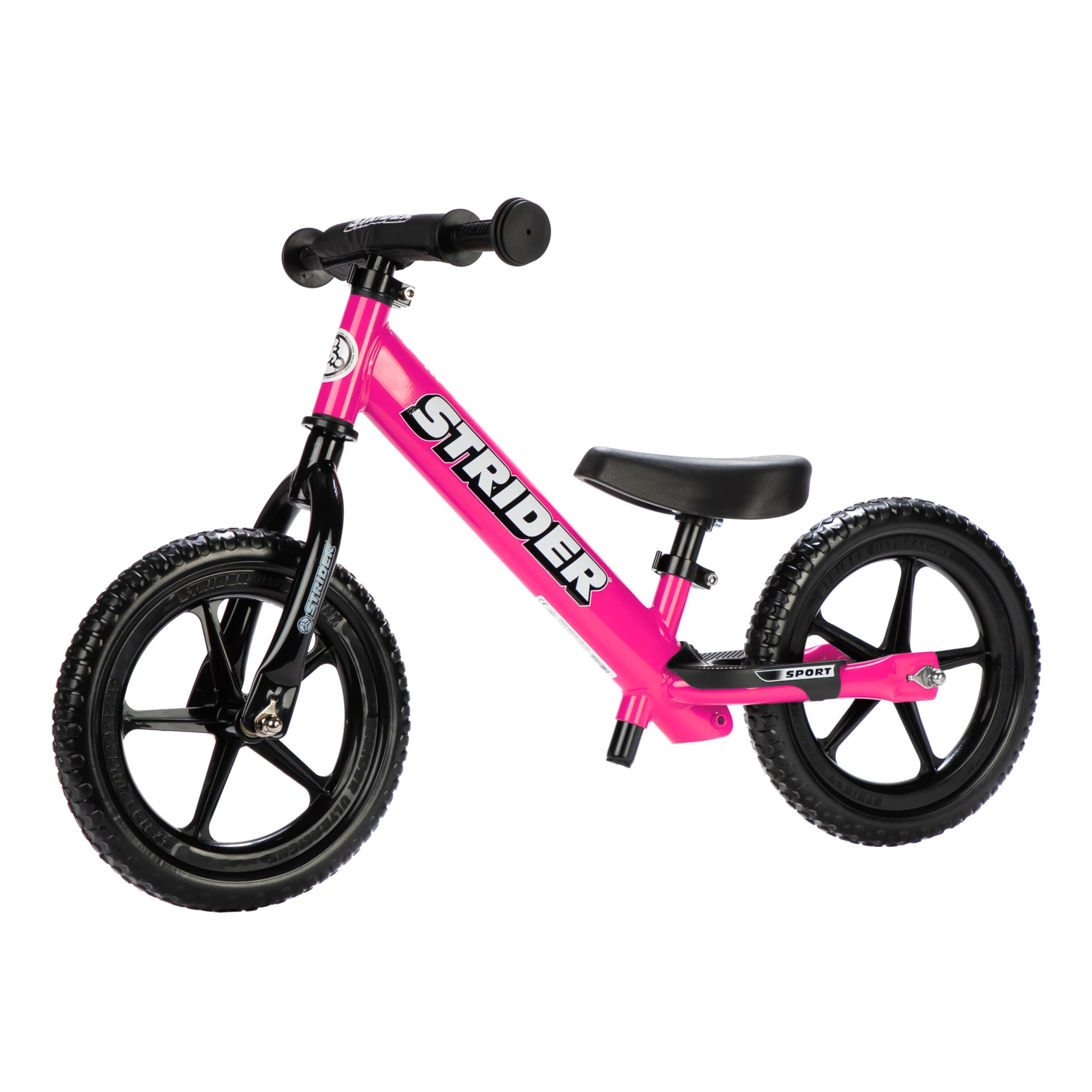
Seat height is the number that decides whether a balance bike gets ridden or parked, and the Strider 12 Sport covers more of it than anything else here: 11 to 17 inches, matched to a 12-to-18-inch inseam and a 1-to-4-year age range. The frame is alloy steel at 6.7 pounds, the 12-inch tires are foam rubber that never need air, and the bike is rated to 60 pounds.

That span is why it is the one we point friends toward. Most balance bikes serve a single slice of toddlerhood, and the four-wheelers are essentially finished by two and a half, while the Sport is still the right size the summer your child turns four and starts lifting both feet for a proper glide. It also behaves like a bicycle rather than a toy: two wheels, a real saddle, geometry that rewards leaning into a turn. The spare, longer seat post in the box is the detail we did not expect to care about, and it is what lets the saddle keep climbing after the standard post runs out.

The case against it is weight and money. At 6.7 pounds it is roughly double the four-wheel first bikes, so a small one-year-old will need help righting it after a tip. There is no brake, and none of these have one, which makes stopping a feet-down skill you will be teaching for the first couple of weeks. It is also the priciest bike on this page by a wide margin.

For a child who is already running, none of that slows things down. They can handle the weight, the fit range means you buy once instead of twice, and the bike will still be worth handing to a younger sibling. If your rider is still wobbling on two feet, start with the SEREED further down and come back to this one next year.

Bottom line: The one we recommend for the whole toddler window: a seat that runs 11 to 17 inches, a spare post in the box, and a ride that behaves like a real bicycle.

#2

SEREED UD30

SEREED UD30

First birthdays

Doodle Score 9.6/10
Check Price

Worth Noting

  • Outgrown by about age two
Weight
3.5 lb
Wheels
4, 6.7 in
Age Range
12-24 months
Rider Weight Limit
55 lb
Read the full review

This is the one we hand over at a first birthday. The SEREED UD30 is a four-wheeler with 6.7-inch wheels, a 3.5-pound aluminum frame, a 55-pound rider limit, and a seat low enough that a wobbly toddler plants both feet without stretching. Nothing about it asks a child to balance; it asks them to sit, push, and steer, which is the skill set that comes just before balance and the reason it earns a place here.

Two details do the real work. The steering stops at 135 degrees, so a hard yank on the bars cannot spin the front end out from under a beginner, and the wheels are fully closed, which means no gap to catch a toe, a finger, or a pant leg. At 3.5 pounds it is light enough for a one-year-old to drag around by the handle, and light enough that you will not mind carrying it home from the park with a child on your other hip.

Measure before you order, though. The seat sits low and the wheelbase is narrow, so a long-legged one-year-old looks folded up on it; if your child is already tall for their age, go straight to a 12-inch bike. Treat it as a first bike rather than a last one and it is hard to beat, because it asks almost nothing of a child who is still finding their feet.

Bottom line: We buy this one for first birthdays rather than for the long haul: a 3.5-pound four-wheeler that gets a wobbly one-year-old moving and costs about what a present should.

#3

Strider 12 Classic

Strider 12 Classic

Ages 1 to 3

Doodle Score 9.6/10
Check Price

Worth Noting

  • Seat range stops at 16 inches
Weight
6.5 lb
Age Range
1-3 years
Seat Height
11-16 in
Rider Weight Limit
60 lb
Read the full review

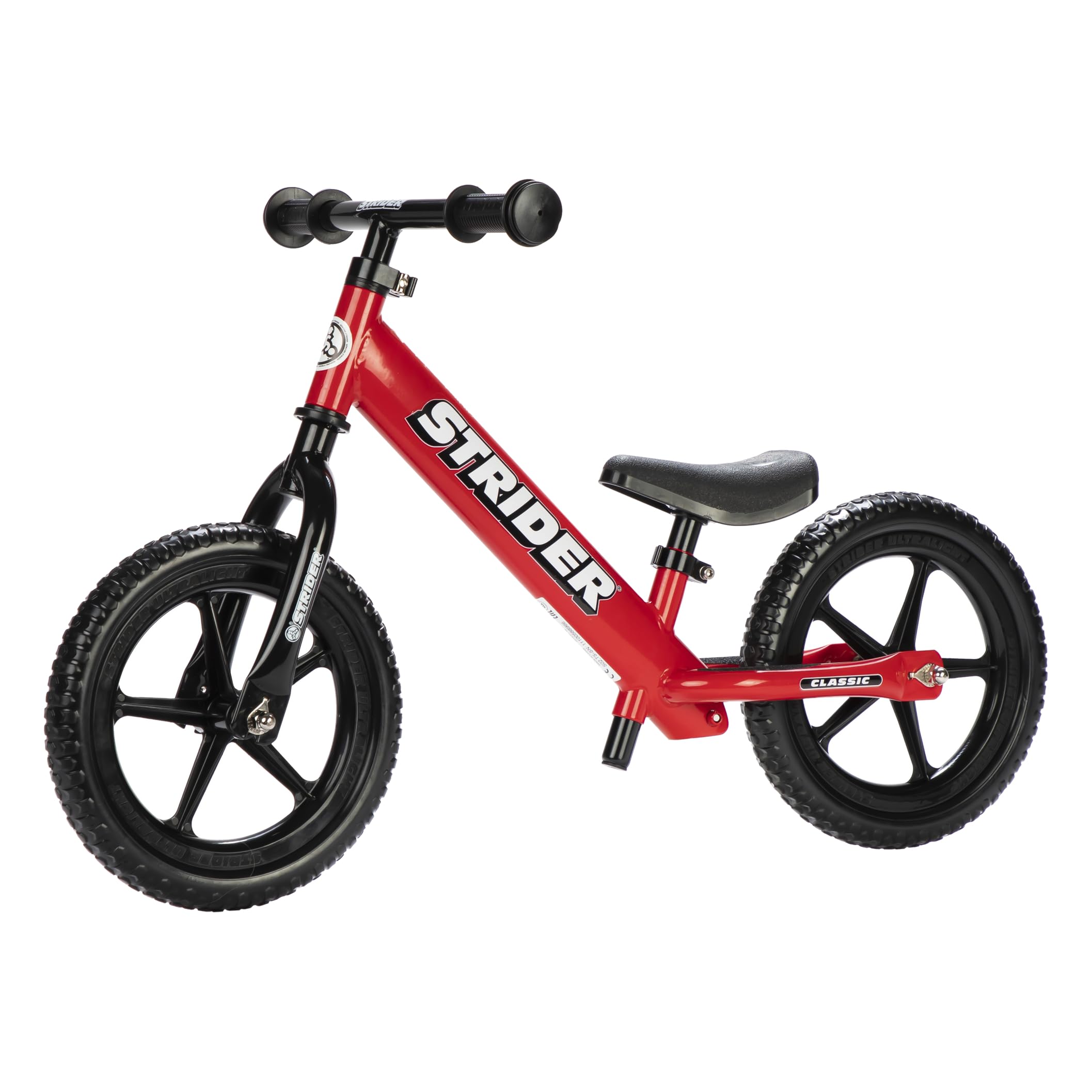
The 12 Classic is the Sport with the top of its range taken off: a seat that runs 11 to 16 inches instead of 11 to 17, a 1-to-3-year rating instead of 1 to 4, and the same alloy-steel frame at 6.5 pounds with the same 60-pound rider limit. It also carries a built-in footrest, which matters more than it sounds, because once a child starts gliding, having somewhere to put their feet is the last step before pedals.

For a one-, two-, or three-year-old, this is the smarter of the two Striders. You are not paying for a fourth year the bike will not see, and you are still getting the geometry and the build that make the Sport worth recommending in the first place. If a second child is coming along, the 60-pound limit means it gets handed down rather than replaced.

The catch is the ceiling. A tall three-year-old will be at the top of the seat range with nowhere to go. Buy this one if your rider is on the younger side of the range and the saving matters, and buy the Sport if you want that last year before a pedal bike.

Bottom line: The Strider we point one- and two-year-old families to: the same frame and geometry as the Sport, minus the seat travel a fourth year would use.

#4

Yvolution Y Velo Junior

Yvolution Y Velo Junior

Confidence building

Doodle Score 9.6/10
Check Price

Worth Noting

  • 44-pound rider limit caps it around age three
Weight
7.7 lb
Wheels
9 in, dual rear
Age Range
18 months-3 years
Rider Weight Limit
44 lb
Read the full review

The Y Velo Junior's trick is at the back. Two rear wheels sit side by side for a wide, tricycle-stable platform, then narrow into a single wheel as your toddler gains confidence. It is the only bike here that changes shape with the rider, and for a child who is nervous about tipping, that is worth more than any number on the box.

The rest of the design pulls the same way. There is a steering lock so the bars cannot spin all the way around, the 9-inch front wheel rolls over pavement seams that the small four-wheel hoops catch on, and the dual rear means the bike stands up on its own between rides instead of lying across the driveway, a small thing you notice every time you walk past it.

It is also the heaviest bike in this group at 7.7 pounds, and that is the price of the conversion hardware and the steel frame: a one-year-old will not be lifting it, and a two-year-old will want a hand now and then. What you get back is the smoothest on-ramp here. Start wide, narrow the rear once they begin lifting their feet, and the balance a two-wheeler wants is already there. For a cautious rider, this is the one we recommend.

Bottom line: For a cautious toddler this is the one we hand over: a rear end that starts wide and narrows as their confidence builds.

#5

PerKidern Balance Bike

PerKidern Balance Bike

Gift centerpiece

Doodle Score 9.6/10
Check Price

Worth Noting

  • Outgrown by about age two
Weight
4.6 lb
Wheels
4 EVA
Age Range
12-24 months
Rider Weight Limit
66 lb
Read the full review

The PerKidern is shaped like a pony: a saddle with a raised front, a horse's head between the grips, and a finish that reads as nursery furniture rather than sports equipment. If you are the relative who wants to give the present everyone remembers, that is the entire pitch, and it is a good one.

The saddle is not only decorative. It is shaped to hold a small rider in place instead of letting them slide forward when they push off, and it is padded PU rather than the hard plastic on some of these, a detail a one-year-old notices within about four seconds. At 4.6 pounds with a 66-pound rider limit, the frame is sturdier than the shape suggests.

Assembly is five steps with the tools in the box, and the four EVA wheels roll quietly enough for a living room floor. Nothing here needs a mechanic.

Buy it for a first birthday and it does what a first bike should: a child who can barely walk will sit, push, and steer themselves around under their own steam, and the shape gives them a reason to try. It is the rare first bike that works as a present and as a toy, and the saddle is why.

Bottom line: We recommend it for one job, and it does that job well: a first-birthday bike a child wants to sit on before they can walk.

#6

Umatoll B402

Umatoll B402

Tiny riders

Doodle Score 9.4/10
Check Price

Worth Noting

  • Small 6-inch wheels limit it to smooth ground
Seat
3-position adjustable
Weight
3.3 lb
Age Range
12-24 months
Wheel Size
6 in
Read the full review

At 3.3 pounds the Umatoll B402 is the lightest bike here, and that is most of its case: a 12-month-old can pick it up, drag it across the kitchen, and right it without help, and you can carry it under one arm along with everything else a toddler outing requires. The aluminum frame is rated to 55 pounds, and the seat clicks through three height positions, which is more adjustment than most four-wheelers offer.

The rear wheels light up as they roll with no batteries to replace, and the effect is magnetic for this age group, since a hesitant child climbs on to make the colors happen. There is a removable basket on the front for whatever comes home from the park, and the whole thing goes together in a few minutes.

Then there is the handling. The bike is short and it feels front-heavy for its size, so a child who pushes hard into a turn can feel the back go light. Start on flat ground and stay within arm's reach for the first week. Past that it is a well-mannered little thing, and the adjustable seat is what separates it from the rest of the four-wheel crowd.

Bottom line: We like it as a first bike for the smallest riders: the lightest thing here, with a seat that clicks through three heights and wheels that light the way.

#7

YGJT Balance Bike

YGJT Balance Bike

Playful first bike

Doodle Score 9.4/10
Check Price

Worth Noting

  • Seat runs low for long-legged toddlers
Weight
4.19 lb
Wheels
4 enclosed EVA
Age Range
10-36 months
Rider Weight Limit
50 lb
Read the full review

The eyes on the front of the YGJT move with the handlebars. A linkage turns them as the bar turns, so the dog looks where the bike is going, and it gives a hesitant toddler a reason to climb on that no amount of encouragement from a parent quite matches.

Underneath it is a sensible four-wheeler: carbon steel, a 10-to-36-month recommendation, a 50-pound rider limit, fully enclosed EVA wheels, and a seat low enough for a child who is only just walking. At 1.9 kg, about four pounds, it is light enough for a small rider to manage and light enough that you will not think twice about carrying it in from the yard.

Assembly is a couple of minutes with the screwdriver that comes in the box, and the closed wheels mean there is nothing to fish out of the spokes after a trip to the park.

Where it earns its place is the combination of price and personality. You are paying first-bike money for something a child actively wants to ride, with a range that runs longer than most of the four-wheelers here, and it takes being dropped on a driveway without complaint. When the present needs to land with a laugh, this is the one.

Bottom line: Our pick when the present has to land with a laugh: a four-wheeler whose eyes follow the handlebars, with a longer fit window than most of its kind.

#8

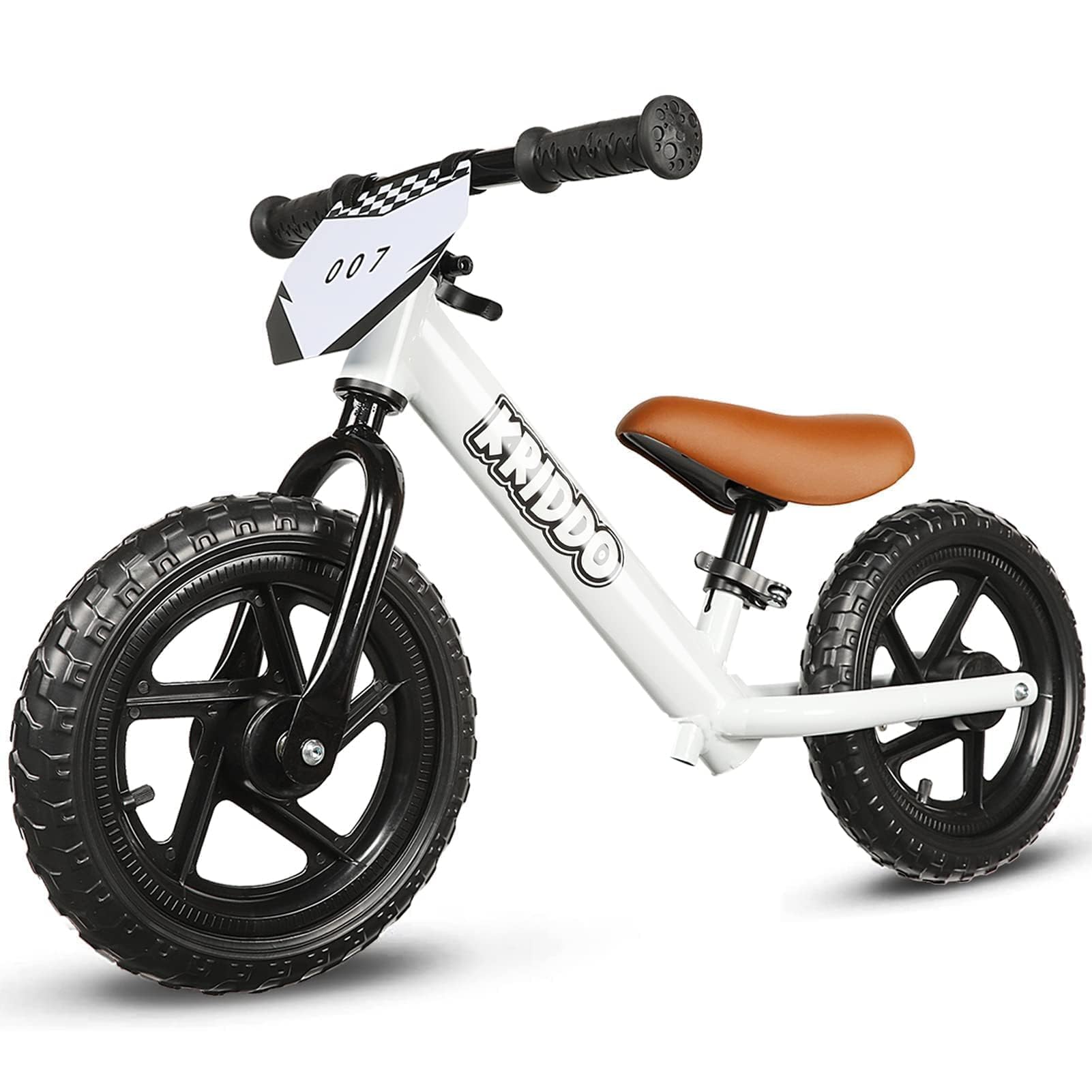
KRIDDO Balance Bike

KRIDDO Balance Bike

Ages 2 to 5

Doodle Score 9.2/10
Check Price

Worth Noting

  • Thin assembly instructions
  • Less settled at speed than the Striders
Weight
6.6 lb
Age Range
18 months-5 years
Wheel Size
12 in
Rider Weight Limit
110 lb
Read the full review

If the Strider's seat range is the reason to buy it, the KRIDDO is the reason to ask whether your child will use all of it. This is a 12-inch two-wheeler on a carbon-steel frame rated to 110 pounds, with quick-release levers on both the seat post and the handlebar stem, so you can raise the whole bike for a growth spurt in about ten seconds without hunting for an Allen key.

The age window runs from 18 months to five years, the longest in this group, and the weight is 6.6 pounds, within a couple of ounces of the Strider. The tires are puncture-resistant rather than air-filled, so a thorn does not end the afternoon. A removable name plate and three sets of stickers come in the box, which sounds like a gimmick until you meet a three-year-old who wants their own name on the front of something.

For a rider who is already two, this is the pick we make. The frame is stout, the levers work, the tires shrug off gravel, and the whole thing adjusts far enough to cover the years when a child grows two inches a summer. You give up some polish, and nothing that decides whether the bike gets ridden.

The seat post is the weak point: it can creep down under a bouncy rider, which quietly changes the fit mid-ride, so tighten the clamp properly and check it after the first week. That is a five-minute fix, and after it the bike settles into being exactly what it looks like, a sturdy adjustable two-wheeler a two-year-old can grow with for three years.

Bottom line: Our value pick for a rider who is already two: a 12-inch two-wheeler with a five-year window and quick-release levers at a fraction of the Strider's price.

How We Chose and Tested the Best Balance Bikes

We started by pulling together the balance bikes that show up again and again in parent forums and retailer reviews, then narrowed the list to models with a seat that could drop low enough for a 19-month-old and rise high enough for a 4-year-old. We also filtered out bikes with no tool-free adjustability, sketchy assembly instructions, or tires that looked like they'd wear through on pavement. That left us with 12 bikes, which we tested over six months.

Assembly came first. I timed each build solo, noted whether the box included the right tools, and checked if the instructions made sense without a video. Then we handed the bikes to kids between 18 months and 4 years and watched them ride on driveways, neighborhood sidewalks, park paths, and a grassy hill. We measured seat height against each child's inseam, adjusted the handlebars, and noted whether they could plant both feet flat at a stop.

Stability showed up in the small moments: a toddler leaning into a turn, a slow wobble on a sloped sidewalk, a bike that tipped when they stood still. We watched how quickly kids lifted their feet and coasted, and whether they asked for another turn. To check sturdiness, we dropped each bike on pavement, rolled it over a curb, and re-checked the bolts and frame afterward. We also inspected welds, tires, and grips, then weighed what each bike offered against its price. Enjoyment was easy to spot—the bikes kids didn't want to get off were the ones we kept coming back to.

How to Choose Balance Bikes for Toddlers

Fit Is an Inseam Question, Not an Age Question

Inseam, not age, decides whether a balance bike gets ridden. Measure from the floor to the crotch with shoes on, then look for a seat whose lowest setting is at or just below that number, which is what lets a child sit with both feet flat and knees slightly bent. The Strider 12 Sport's 11-to-17-inch seat is sized for a 12-to-18-inch inseam, the widest spread here; the four-wheelers sit lower and suit shorter legs.

The trap is buying for the birthday rather than the body. An inch too tall turns a bike into something to push around instead of ride, and one that barely fits is gone by August.

Two Wheels or Four

Four wheels teach sitting, steering, and scooting. Two teach the lean-and-glide that transfers straight onto a pedal bike. If your child is 12 to 24 months and still unsteady on their feet, start with four: the SEREED, Umatoll, YGJT, and PerKidern here are all that shape. Once they are running, a 12-inch two-wheeler does more, and the Strider and KRIDDO are built for the 18-month-and-up crowd. The Y Velo Junior splits the difference with a rear end that narrows from two wheels to one.

Do not expect a four-wheeler to teach balance. It is a walker with a seat, and it is a fine thing to be for one season.

Weight, and Who Ends Up Carrying It

The bikes here run from 3.3 to 7.7 pounds, and the difference shows up twice: whether a child can right the bike after a tip, and whether you resent carrying it home. Lighter is not automatically better, since the 7.7-pound Y Velo is also the most stable thing in the group, but for a one-year-old, under four pounds is the target. By three, six or seven pounds is normal and a child that age manages it. Pick a bike up one-armed and imagine the walk back from the park.

Wheels, Steering, and the Details That Bite

Two features do real safety work on the smallest bikes: a steering limiter, which caps how far the bars turn (the SEREED stops at 135 degrees), and fully enclosed wheels, which keep toes and fingers out of the spokes. Foam and EVA tires never go flat and never need air, which is right for a bike that lives in a driveway; 12-inch wheels roll over cracks that 6-inch ones catch on.

None of these has a brake. Stopping is a feet-down skill, so start on flat, smooth ground and keep shoes on.

Buy for the Rider You Will Have in Two Years

Seat range and rider-weight limit tell you how long a bike stays useful. A 12-to-24-month four-wheeler is a one-season purchase and should be priced like one. A 12-inch bike rated to 60 or 110 pounds, with an adjustable seat, will see a child from two to five and then a younger sibling.

When you are choosing between a bike that fits perfectly today and one with an inch of growth above it, take the growth, as long as the child can still reach the ground at the lowest setting.

Frequently Asked Questions

Final Verdict

Buy the Strider 12 Sport if you want to shop once. Its seat runs from 11 to 17 inches, which covers a first birthday through the summer your child turns four, and it rides like a bicycle rather than a toy.

If the birthday in question is a first one, the SEREED is the better purchase: a 3.5-pound four-wheeler is the right tool for a child still finding their feet, and it is priced like a present. And if your rider is already two with years of growth ahead, the KRIDDO does the same job for a fraction of the Strider's price.