Outdoor Play

Best Backyard Toys of 2026

A backyard in July is a great thing until about four in the afternoon, when the sprinkler loses its magic and someone announces they're bored in that specific tone. What keeps kids out there is a toy with real playability — the water table that gets dragged out every single day, the climber that becomes a spaceship by Thursday, the bug viewer where the ant actually looks like an ant. The problem is that the category is full of things that look incredible on the box and are wobbling by August.

We've spent six months with 12 backyard toys, and the ones that lasted all shared the same unglamorous qualities: thick plastic at the stress points, handles a small kid can actually grip, and holes that came predrilled so assembly didn't eat a Saturday. Here's a piece of category wisdom worth having before you buy — build time matters more than you'd think, because the toy that takes four hours to put together gets used a lot less than the one that's ready before lunch. Value, in the end, came down to whether kids went back to it in week ten. The picks below are the ones they did.

#1

Little Tikes Rocking Horse

Little Tikes Rocking Horse

First birthdays

Doodle Score 9.6/10
Check Price

Worth Noting

  • Outgrown around age three
Assembly
None required
Item Weight
7.5 lb
Weight Limit
50 lb
Recommended Age
12 months - 3 years
Read the full review

It arrives in one piece. No screws, no tools, no evening lost to a diagram - the rocking horse comes out of the box assembled, and for a toy aimed at one-year-olds that is the most useful thing about it. We think that is worth more than it sounds: the gifts that actually get used are the ones a child can climb on five minutes after the paper comes off.

The ride itself is the classic shape done well. The seat sits low, so a toddler can get on and off without a hand, and the base is wide enough that hard rocking does not tip it. At 7.5 pounds it moves from patio to living room in one hand, and the 50-pound limit covers the 12-month-to-3-year span it is sold for with room to spare.

The one practical annoyance is storage: it is 33 inches long, it does not fold, and the shape does not stack, so it lives against a wall or under a bed. That is a small price for a toy with nothing to break, nothing to tighten and no batteries to feed. Ours has been ridden hard, dragged across a patio and left in the grass, and it still looks like a rocking horse.

Bottom line: We recommend it for a first birthday: it arrives assembled, sits low enough for a one-year-old to climb on alone, and takes the rocking a toddler gives it.

#2

FUN LITTLE TOYS Pop Up Play Tent

FUN LITTLE TOYS Pop Up Play Tent

Pretend camping

Doodle Score 9.6/10
Check Price

Worth Noting

  • Small accessories break or go missing first
  • Stove and lamp need batteries
Setup
Pop-up, folds flat
Accessories
17 camping pieces
Assembled Size
30.7 x 30.7 x 35.5 inches
Recommended Age
3 years and up
Read the full review

The tent is the least interesting thing in the box. The camping set is what sells it: a pretend gas stove that glows, an oil lamp that lights up, and a pile of small gear - tools, food, a lantern - that two children can divide between them and still find something to negotiate over. Seventeen pieces, and most of the play is in handing them out.

Setup is a pop. The tent is fabric over a spring frame, it opens in one movement and folds flat the same way, which is what makes it viable in a yard that has to be tidy by dinner. It is small - about 31 inches square and under three feet tall - so it is a one-toddler-and-a-cousin tent, not a family camp. The stove and lamp take batteries, the only running cost in the box.

What we did not expect is how much of the play happens outside the tent. The gear gets carried around the yard, set out as a picnic, loaded into a wagon; the tent is base camp rather than the destination. That is also where the weak points show: the fabric and frame hold up, and the small accessories - thin plastic food, the lantern handle - are what get chewed, dropped and lost first.

So we rate it for what it is: a pretend-play kit with a tent attached, sized for a birthday present. If your kids are past pretending it is a two-afternoon toy; at three and four it turns a corner of the yard into a campsite and then disappears into a closet, which is exactly what a backyard toy should do.

Bottom line: We recommend it for 3- and 4-year-olds who like to set up camp: a pop-up tent plus 17 pieces of gear, packed away in seconds.

#3

Nerf Vortex Aero Howler Foam Football

Nerf Vortex Aero Howler Foam Football

Backyard throwing

Doodle Score 9.6/10
Check Price

Worth Noting

  • Tail is the first part to wear
Use
Indoor and outdoor
Tail
3-finned
Weight
5.64 oz
Material
Foam
Read the full review

The whistle is the point. Air holes in the foam body make a loud rising noise in flight, so you can hear where the ball is even when it is behind you, above the fence line or lost against a bright sky. In a yard with more than one kid throwing, that is a locating device as much as a toy.

We like it because a six-year-old and a forty-year-old can play on equal terms with it. The molded grip fits a small hand, the three-finned tail keeps the throw straight enough to catch, and the foam means a dropped catch is a laugh rather than a bruise. At 0.16 kg it does not punish a weak arm either - it flies on the throw, not on the muscle.

The tail is the part that goes first: it is the thinnest section, and a dog or a hedge will find it before you do. The fin bends back into shape rather than snapping, though, and the body of the ball takes a scuffing without losing its spiral. There is not much more to say about a foam football, which is the recommendation - it works, it is easy to keep by the door, and everyone in the family can throw it.

Bottom line: This is the ball we keep by the back door: foam-soft, easy to grip, and loud enough in flight that nobody loses it in the hedge.

#4

Step2 Rain Showers Splash Pond Water Table

Step2 Rain Showers Splash Pond Water Table

Toddler water play

Doodle Score 9.4/10
Check Price

Worth Noting

  • Needs a hose and warm weather
  • Play value peaks in the preschool years
Players
1 to 4
Accessories
13-piece kit
Assembled Size
39 x 24 x 32 inches
Recommended Age
18 months - 10 years
Read the full review

Pour a bucket of water into the top tray and the table answers: it runs down through the maze pieces, spins the wheels and ramps on the way, and lands back in the pond where the bucket is waiting. That loop is the entire design, and it is why a child who has poured once goes back for a second bucket without being asked.

It is our top pick because the play does not need an adult to keep it alive. The table rates for one to four players, and its shape - a low pond, a raised tray, a side flipper - lets two children work opposite ends without waiting for a turn. The thirteen accessories are mostly garnish; the big bucket, the maze pieces and the squirters are the ones still in play after the first week.

Assembly is the honest cost. The plastic is not predrilled, so the screws need real pressure to bite and the frame wants a second pair of hands to hold it square - set aside an evening and a screwdriver instead of expecting a five-minute snap-together. Once it is up, it is easy to live with: rinse, wipe with household cleaner, pull the drain, done. It also carries a three-year limited warranty, which is worth knowing for something that lives outside.

Two things to accept before you buy. It needs a hose within reach and a warm afternoon, so it is a spring-and-summer fixture rather than a year-round one. And the top of the age range is optimistic; our attention in it peaked with the preschool set and faded once kids could run a proper water fight. For the years it covers, nothing else here holds a small crowd so easily.

Bottom line: It is the backyard toy we point to first for toddler years: a pour-and-watch loop kids run themselves, room for four, and a hose-and-wipe cleanup.

#5

PACEARTH 40-Inch Saucer Tree Swing

PACEARTH 40-Inch Saucer Tree Swing

Mixed-age families

Doodle Score 9.4/10
Check Price

Worth Noting

  • Needs a solid branch or beam
  • Fabric and netting wear over seasons
Weight Limit
600 lb
Seat Diameter
40 inches
Seat Material
600D Oxford fabric
Included Hardware
2 straps, 2 carabiners
Read the full review

A saucer swing is only as good as the thing you hang it from, so start there: you need a solid horizontal limb or a beam on an existing playset, and the straps have to wrap something that will not flex under load. Sort that out and the 40-inch seat becomes the piece everyone gravitates to. The 600-pound limit covers three small kids at once, or a parent and a toddler, which is the setup we ended up using most - and the reason it is our pick for families with a spread of ages.

The padded frame matters more than it looks. Foam tubes run around the metal ring, so a toddler leaning forward meets a soft edge rather than a bar, and the whole thing is light enough at 8.6 pounds to unclip and move. Straps and locking carabiners come in the box, so there is no separate trip for hardware, and hanging it is a short job with a stepladder.

Fabric is where saucer swings age: the Oxford seat and the netting around the border are the parts we watch, and the sensible habit is to unclip it and bring it in for the off-season rather than leave it hanging through a winter. If your yard has no suitable branch and no playset, skip it - that is the one requirement this toy cannot work around.

Bottom line: Give it a stout branch or a playset beam and this is the seat everyone rides: three kids at once, or a parent and a toddler, hung in minutes.

#6

Little Tikes First Slide

Little Tikes First Slide

First slide

Doodle Score 9.4/10
Check Price

Worth Noting

  • Handles can pull out of their slots
  • Narrow chute suits toddlers only
Folds
Yes, no tools
Weight Limit
60 lb
Assembled Size
39 x 18 x 23 inches
Recommended Age
18 months - 6 years
Read the full review

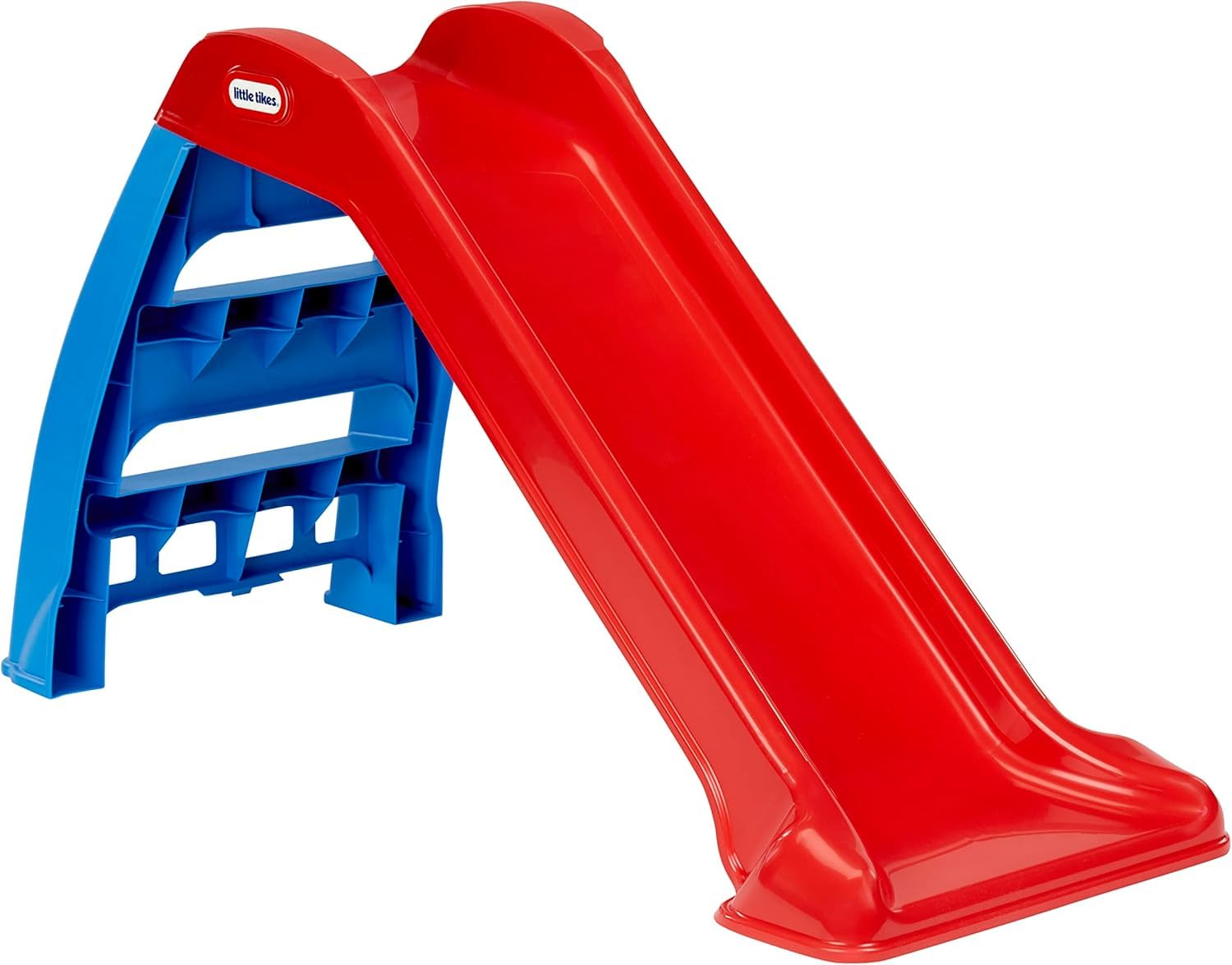
The handles push into the top of the slide rather than being molded into it, and they can work loose when a child hauls up on one. Seat them fully before anyone climbs, and check them again after a few afternoons - it is a two-second habit that keeps the only handhold where it belongs.

What you get otherwise is a properly good first slide. Thirty-nine inches long and 23 inches high is a beginner's height, low enough that a cautious 18-month-old will try it alone, and the 60-pound limit covers most children to about six. At 9.5 pounds it is light enough to carry out with one hand, and it folds flat without tools, which is why it survives in houses with no garage.

For a first slide, we think the trade is worth it: it gets used because it is easy to put out and easy to put away, and a toddler who can climb on without help will do it twenty times in a row. Where it stops making sense is kindergarten - a five-year-old who has mastered the playground slide will turn this one into a ramp for something else inside a week.

Bottom line: For a first slide we recommend the low, light one: a cautious 18-month-old can try it alone, and it folds away between afternoons.

#7

Stomp Rocket Jr. Rocket Launcher

Stomp Rocket Jr. Rocket Launcher

Group energy burn

Doodle Score 9.2/10
Check Price

Worth Noting

  • Launch stand comes apart in play
Power
Kid-powered, no batteries
Launch Height
Up to 100 feet
Recommended Age
3 years and up
Rockets Included
8
Read the full review

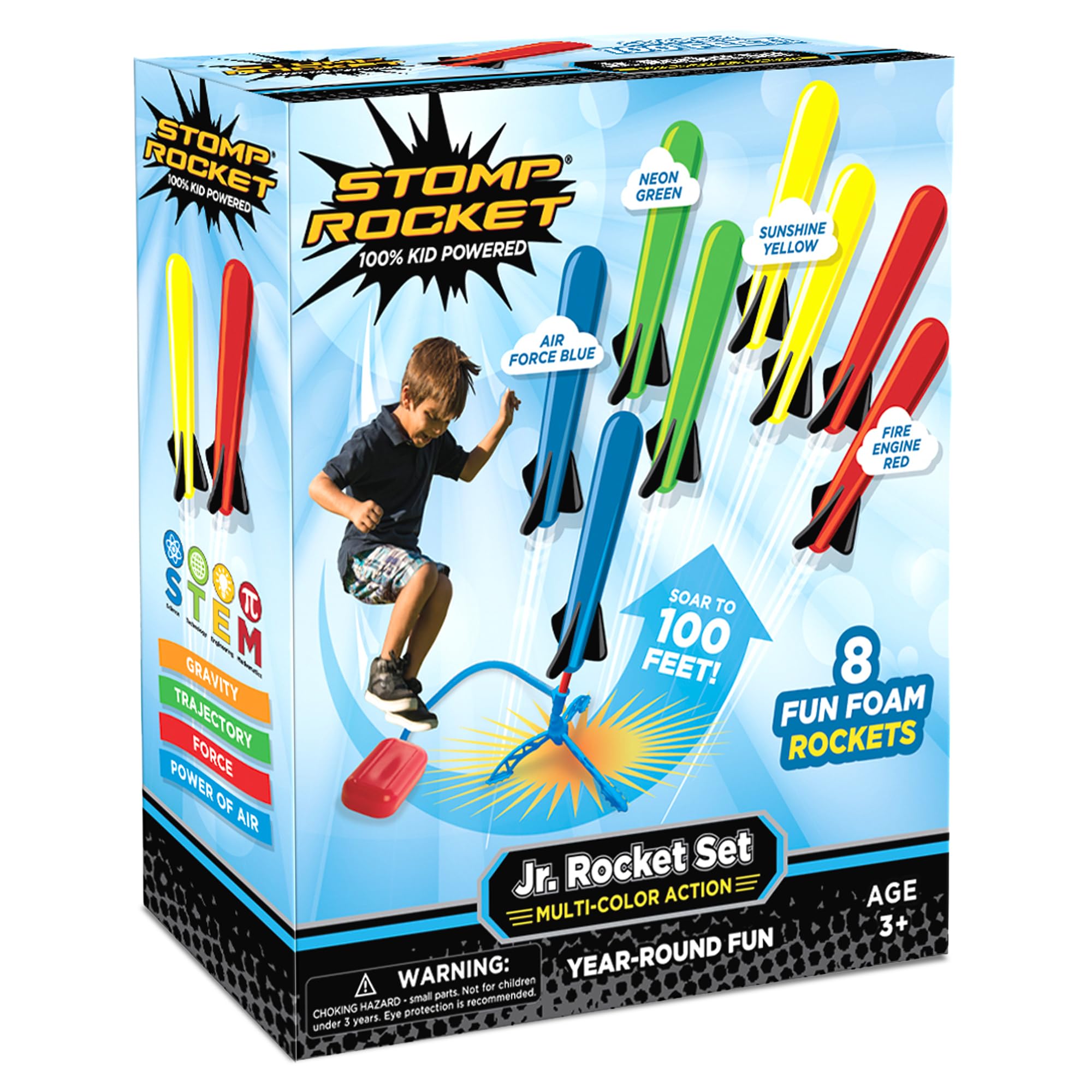
A three-year-old can run this alone. The launcher is a flat pad on a hose, and a stomp sends a foam rocket up - no batteries, no pumping, no adult needed to work a trigger. That independence is why it comes out at every gathering: the queue forms itself, and the smallest kid in the yard gets a turn without being lifted.

The rockets are foam and paper, soft enough that a landing on a sibling is a shrug rather than an incident. The listing claims up to 100 feet; an adult's hard stomp gets the good ones most of the way there, while a small child's stomp is more modest - which is fine, because the fun is in the launch, not the altitude. Eight rockets in the box matters more than it sounds once two or three kids are launching at once.

The stand is the weak point. It clips together to hold the launch tube upright, and it comes apart in play - sometimes in a child's hands, sometimes in the car. We stopped fighting it, because the tube can be held, propped or angled and the game carries on. For a toy a preschooler can operate start to finish, a flimsy stand is a fair trade.

Bottom line: We keep coming back to it for any yard with a 3- to 10-year-old: kid-powered, foam-soft, and simple enough that a preschooler runs the whole game.

#8

GeoSafari Jr. Kidnoculars

GeoSafari Jr. Kidnoculars

Nature spotting

Doodle Score 9.2/10
Check Price

Worth Noting

  • 2x shows very little detail
  • Plastic lenses look blurry to older kids
Focus
Fixed
Weight
7.05 oz
Magnification
2x
Recommended Age
3 years and up
Read the full review

Two-power magnification is barely magnification - a bird at the far fence looks like a bird slightly nearer the fence. That is deliberate, and it is the thing to understand before you buy: these are a first pair of binoculars for a three-year-old, not an optical instrument, and the habit they teach is looking rather than magnifying.

The design is built around that job. The eyepieces are big and rubber-ringed, so a child can press them to their face without hunting for the exact spot; focus is fixed, so there is no wheel to fiddle with; and the neck strap breaks away instead of pulling. We handed them to a four-year-old and got the thing every parent wants from an outdoor toy: a stretch of quiet at the edge of the yard.

Where they disappoint is at the far end. The lenses are plastic, the field of view is narrow, and a child used to a screen will notice the blur before you do. The specification to check against your own expectations is the magnification: 2x gets a child interested in a bird feeder, and it will not show them feathers.

For the three-to-five set, the trade works. They are light enough to wear all afternoon, tough enough to survive being dropped and left in the grass, and inexpensive enough that losing them under the deck is not a disaster. Add a feeder and they become a daily habit rather than a novelty - which is more than most toys in this roundup manage.

Bottom line: For 3- to 5-year-olds these are the first binoculars we hand over: big eyepieces, fixed focus, and just enough magnification to make looking out a habit.

How We Chose and Tested the Best Backyard Toys

We started with the toys that keep surfacing in parents' group chats and the annual "what should we get for the yard" threads, then filtered by age range, footprint, and whether replacement parts were actually available. Anything that needed a power tool, a second adult, or a call to customer service just to identify a missing bolt got pushed down the list. What survived was mostly gear with predrilled holes, labeled hardware, and instructions that didn't assume an engineering degree.

Twelve toys made it to the lawn, and we lived with them for six months, from the first warm weekend in spring through the end of summer. The yards were ordinary ones — a fenced suburban lawn, a small city patio, a deck with a slope that ruins everything — and the testers were kids between 2 and 10 who did not care about our spreadsheet. We timed assembly solo with a stopwatch, counted how many holes arrived predrilled versus how many we had to drill ourselves, and checked whether the grab handles sat low enough for a 4-year-old to reach without help.

Then we let the kids at them. We noted which toys got dragged out unprompted on a random Tuesday, how long a single session ran, and whether two kids could play at once without a referee — our rough read on playability, enjoyment, and whether the price felt fair. Durability got checked the hard way: sprinklers, sun, a few thunderstorms we didn't beat to the punch, and a close look at joints, handles, and stress points for cracks, flex, and wobble. For the bug viewers and binoculars, we looked at the same leaf and the same ant through every lens, comparing magnification and clarity, and noted whether the lenses fogged or scratched after a week in a kid's pocket.

How to Choose Backyard Toys

Buy for the youngest regular player

Box age ranges are optimistic at the top. A two-year-old needs something to climb on that sits low, needs no instructions and can be started alone; a six-year-old needs a skill curve or the toy is a two-day novelty. When a household spans both, buy for the youngest and add a group toy that the older child can run - a stack of rockets, a swing seat, a camping kit.

That is why the slide and the rocking horse sit alongside the stomp rocket on this list rather than replacing it. One is for the child who is still learning to climb on; the other is for the child who needs to run.

Count the setup you are signing up for

Assembly is a one-time cost, but it lands on the worst possible morning, usually a birthday. Some pieces genuinely take two adults and a screwdriver - the water table's screws go into undrilled plastic, so line up a second pair of hands and an evening. Others arrive assembled or open in one movement.

Check three things before you commit: tools required, batteries required, and whether the toy has to be hung from something you already own. A toy that needs a tree, a beam or a hose is a different purchase from one that needs a flat patch of grass.

Decide whether you are buying for one child or a crowd

A toy that occupies one child is a different purchase from one that occupies four. The water table rates for up to four players, the saucer swing carries 600 pounds, the rocket set ships with eight rockets for a reason, and the camping set is built around handing every child a piece.

If playdates are regular, one crowd toy earns more of an afternoon than three solo ones. If your child mostly plays alone, capacity is dead weight - put the money into something with a longer skill curve instead.

Plan for sun, water and storage

Anything left out through a summer takes ultraviolet light, rain and a hose. Thin plastic parts go first - handles, stands, small accessories - and fabric, rope and foam are next. Our rule is to buy what folds or unclips if the yard has no shed, and to accept that anything with a thin frame is a bring-it-in toy.

That is also the argument for a folding slide or a pop-up tent over a bigger, heavier version of the same thing: a toy that takes ten seconds to put away gets put away, and one that does not gets left in the rain.

Set the limits before the first afternoon

Weight limits are the number to check against the biggest child who will climb on, not the one the toy is for. A slide rated to 60 pounds covers most six-year-olds; a rocking horse rated to 50 is a three-year-old's toy. Water needs an adult within sight and should be drained afterwards, and a swing needs clear space in every direction plus a branch or beam that will hold.

None of that is complicated. It just has to be decided before the first afternoon rather than during it.

Frequently Asked Questions

Final Verdict

If you are buying one thing this month, make it the Step2 water table. It is the pick that needs nothing from your yard except a hose and a flat spot, and the one that keeps a small crowd busy without a referee - which is what most families are actually shopping for.

The saucer swing is the better answer when the yard already has a stout branch or a playset beam and the ages are spread out, because it grows with the group. And if you want the most play for the least commitment, the stomp rocket and the foam football between them cover a whole afternoon with no assembly at all.