Outdoor Play

Best Backyard Playsets of 2026

A backyard playset is the rare purchase that promises years of outdoor play but arrives as a small mountain of lumber and a bag of hardware the size of a pillow. The appeal is obvious: a swing, a slide, a climbing wall, all in your own yard, no screens. What's less obvious is whether it will wobble when two kids race up the ladder, whether the wood will splinter by August, and whether you'll still be assembling it at midnight. A good set turns a patch of grass into the default hangout spot, but only if it's sturdy enough to trust and simple enough to finish building.

My team and I built and lived with six playsets over the past nine months, and the differences showed up fast—especially on assembly day. The dirty secret here is that instructions and hardware matter as much as the lumber; a set with clear diagrams and pre-drilled holes feels rock-solid, while a confusing kit leaves you with a wobble you can't diagnose. Below are the ones that held up to daily play.

#1

Step2 Woodland Climber II
Step2 Woodland Climber II

Toddlers and preschoolers

Doodle Score 9.4/10
Check Price

Worth Noting

  • Outgrown once kids pass age six
  • No swings or hanging play
Warranty
3-year limited
Play Features
2 climbing walls, platform deck, slide, ladder, 2 steering wheels, lower hideout
Recommended Ages
24 months to 6 years
Assembled Dimensions
75 x 47 x 53.75 in
Read the full review

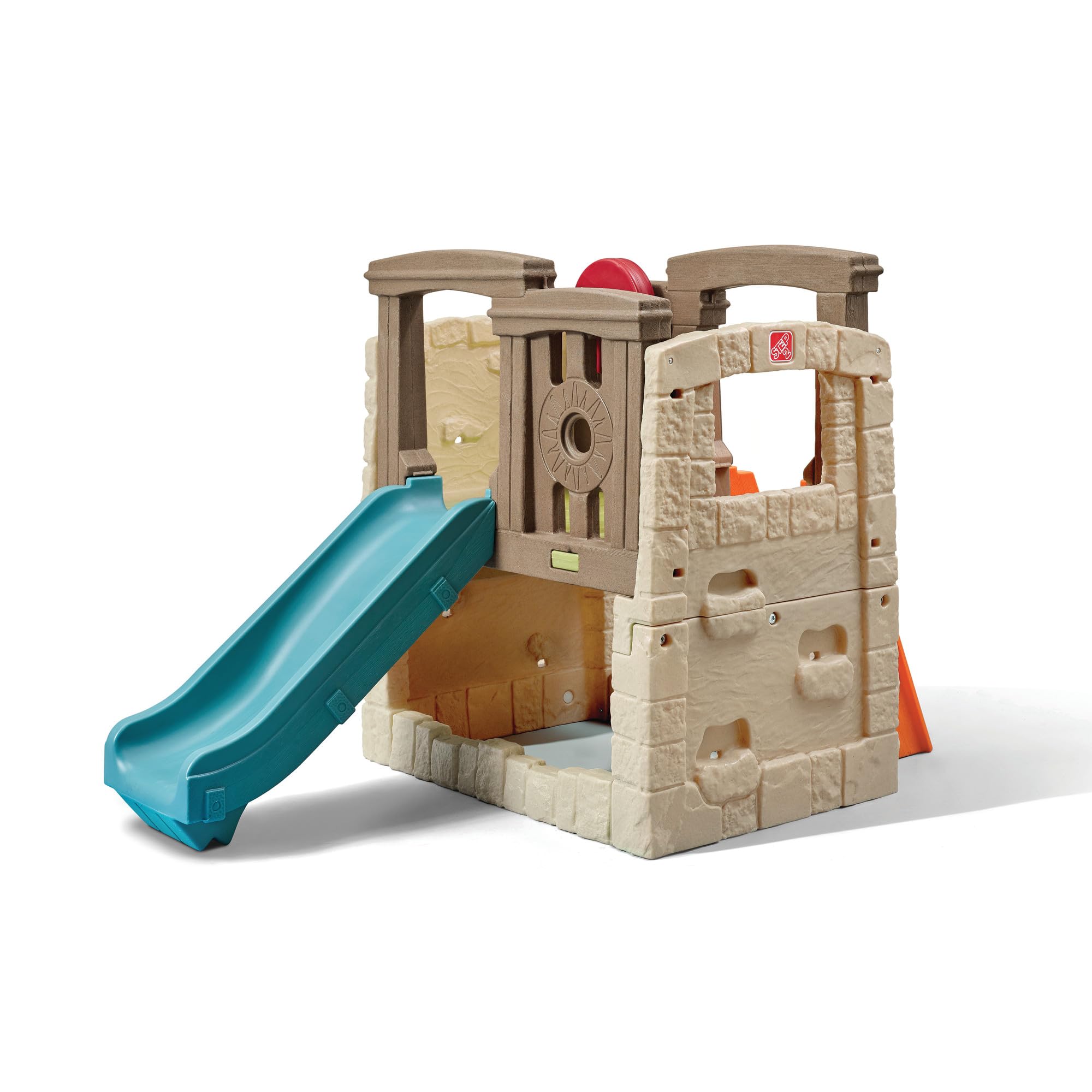
Two climbing walls, a ladder, a slide and a hideout, in a footprint you could park a small car beside and still walk around. The Woodland Climber II measures 75 by 47 inches on the ground, which is compact for a backyard playset, and it still gives a toddler a complete circuit: up one of the two climbing walls, across the deck, down the slide, then underneath to start again. The two steering wheels at the top are the difference between a climber and a game — a two-year-old gets up there and drives.

That circuit is why it's our top pick. Most playsets ask for either a weekend of assembly or an annual maintenance habit; this one asks for an afternoon and a patch of level lawn. The double-walled plastic won't chip, fade or peel, there's nothing to sand, stain or seal, and a hose plus a disinfecting wipe is the entire upkeep calendar. For the two-to-six years it packs climbing, sliding, steering and a fort into less ground than a dining table and chairs.

The build lives up to the reputation these plastic sets have. The panels arrive with pre-drilled holes, the platform goes down first and everything keys off it, and the one part that benefits from a second adult is holding the deck square while the base is bolted on. Getting that base level matters more than how hard you torque the bolts — on a slope the whole structure racks and the slide entry sits crooked. Underneath, the hideout swallows a ball bin and a watering can, which is the difference between a playset and a lawn covered in loose toys.

The ceiling is age, not build quality. Six is the top of the range, and a tall six-year-old will be finished with it a season before that; if your children are already there, the Mount McKinley or one of the swing frames will serve much longer. For the toddler and preschool years, nothing here does as much in as little space.

Bottom line: Our pick for most backyards: it climbs, slides and hides a fort underneath, and there's nothing to seal, stain or repaint. Buy it for a two- to six-year-old.
#2

Step2 All Around Playtime Patio

Step2 All Around Playtime Patio

Pretend play in shade

Doodle Score 9.4/10
Check Price

Worth Noting

  • No slide, swings or climbing
  • Only 60 inches tall, so adults stay outside
Included
16-piece accessory set and removable canopy
Material
Double-walled plastic
Recommended Ages
2 to 8 years
Assembled Dimensions
47.5 x 47.5 x 60 in
Read the full review

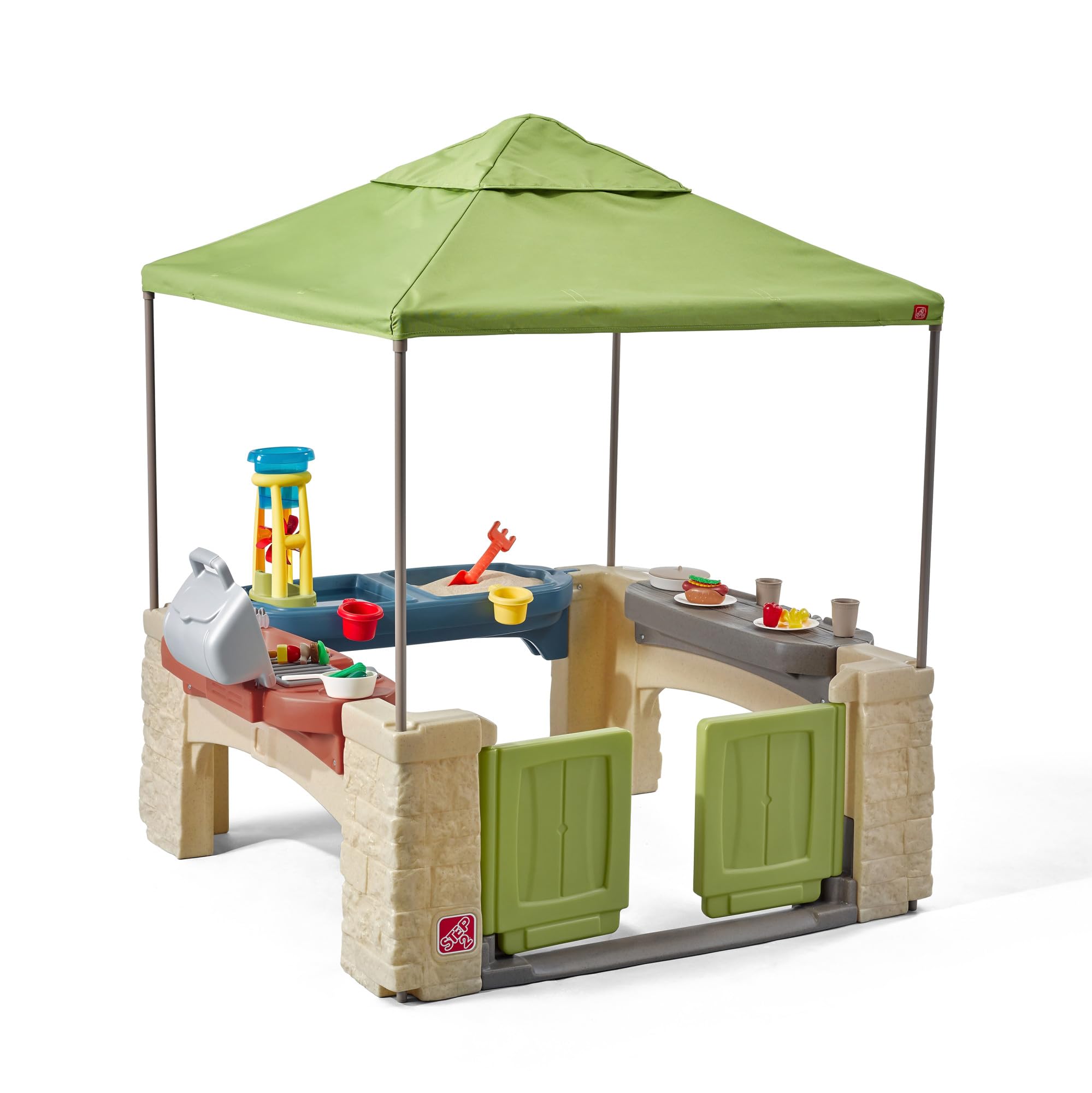
A canopy over a play kitchen sounds like a small thing until you've watched a three-year-old serve sand in full afternoon sun. The awning on the All Around Playtime Patio throws genuine shade over the counter and the water basin, and it lifts off when the set comes indoors for the winter — which is the second half of its usefulness.

This is our playhouse pick because it keeps two or three small children busy without a slide in sight. The 16-piece accessory set covers a pretend grill, pots, pans, plates, silverware and sand toys, and a water-and-sand basin sits sunk into the counter, so one child can be grilling while another pours. The front is completely open, so they work side by side instead of queuing, and it's the one set here that a child in a wheelchair can pull up to at counter height.

At 47.5 inches square and 60 inches tall it fits on a deck or a patio, and the double-walled plastic wipes down with household cleaner — sand, ketchup and whatever the birds leave behind. The honest limit is motion: no slide, no swing, nothing to climb, so a child who wants to be upside down will be bored by it. Pair it with a swing frame, or buy it for the years when pouring and pretending beat climbing.

Bottom line: The playhouse we recommend when shade and pretend play matter more than sliding: it wipes clean, seats two or three toddlers and keeps the sun off.

#3

Trekassy 440 lb Swing Set

Trekassy 440 lb Swing Set

Small yards, tight budgets

Doodle Score 9.0/10
Check Price

Worth Noting

  • Saucer fabric wears where it rubs
Frame
Powder-coated alloy steel
Swings
32-inch saucer plus belt swing
Weight Capacity
440 lb
Assembled Dimensions
63 x 86.6 x 66.9 in
Read the full review

It's the least expensive way here to own a real swing arc. The Trekassy two-seat set is a powder-coated steel A-frame carrying a 32-inch saucer and a conventional belt swing, and it covers 63 by 86.6 inches — a corner of a lawn rather than a commitment to a whole playset.

The two seats do genuinely different jobs, which is why the set works for siblings two or three years apart. The saucer takes a child lying down, leaning back, or two small ones sitting cross-legged; the belt swing is the one they'll still be pumping on at seven. The chains are zinc-plated and adjustable, so the belt comes down for a small child and goes back up as they grow, and the frame carries 440 pounds across both seats.

Where it gives ground is composure. With a heavier child swinging hard, the top beam flexes and the whole frame starts to walk, and no amount of tightening fixes that if the legs aren't pinned. Stake it, re-check the stakes after a wet week, and it's a fine set for two children under about eight. It's also the one we suggest when there's no room for a tower — the footprint is small enough to live beside a shed and still leave the lawn usable.

Bottom line: We reach for this when the yard is small and the money is tight: two real swings, a steel A-frame and an afternoon's work.

#4

Backyard Discovery Sweetwater

Backyard Discovery Sweetwater

Charming pretend play

Doodle Score 9.0/10
Check Price

Worth Noting

  • Cedar needs sealing before winter
Included
Play kitchen, snack bar, working doorbell, toy phone
Material
Cedar
Recommended Ages
2 to 6 years
Assembled Dimensions
46 x 42 x 55 in
Read the full review

The snack bar window is the detail that sells it. A hinged half door, a counter at the right height for a four-year-old and a little awning over it — the Sweetwater is built around the way children actually play house, handing out juice boxes through a window and ringing a doorbell that works.

Inside there's a play kitchen with a sink and a stove, cookware, utensils and a cordless phone, plus four windows and flowerpot holders. In cedar, at 46 by 42 inches on the ground and 55 inches tall, it reads as a garden building rather than a toy, which is why it's the one here that looks right at the end of a lawn instead of merely acceptable.

Assembly is the surprise: the manual uses 3D diagrams and there's an online video, and it's the clearest set of instructions of any wooden playset here. It's still a two-person job — one to hold, one to drive — and a few hours rather than one. Check the boards as you unpack; cedar is light, and some pieces arrive rough enough to want a pass with sandpaper before a toddler runs a hand along an edge.

We recommend it for the pretend-play years, roughly two to six, and for a family who wants something that looks permanent at the end of the garden. It won't climb, swing or slide, and it doesn't pretend to. If you want the same pretend play with no upkeep, the plastic Step2 patio is the alternative; if you want wood, this is the prettier one.

Bottom line: Buy it for the look and the pretend play, not for climbing; the cedar cottage is the most charming thing here, and it wants an annual seal.

#5

Backyard Discovery Mount McKinley

Backyard Discovery Mount McKinley

Big, growing families

Doodle Score 8.8/10
Check Price

Worth Noting

  • Footprint demands a big, level yard
  • Cedar needs sealing before winter
Slide
8-foot wave
Weight Capacity
1,080 lb
Recommended Ages
3 to 10 years
Assembled Dimensions
150 x 186 x 119 in
Read the full review

Twelve and a half feet deep, fifteen and a half wide, ten feet tall at the canopy. The Mount McKinley is the biggest thing in this guide, and it's the one we point at when a family wants to buy once: deck, 8-foot wave slide, double rock wall, rope ladder, web swing, two belt swings and a trapeze, rated for ages three to ten on a 1,080-pound frame.

What the space buys you is range. A three-year-old has the sandbox under the deck, the rock wall and the slide. A nine-year-old has the rope ladder, the web swing and a swing beam that doesn't complain. The canopy roof over the deck earns its keep in July, and the telescope and steering wheel give the top level a reason to stay up there once the climbing is done — the sort of detail that turns a climbing frame into a ship for an afternoon.

The build is the part to plan for. The cedar arrives labeled and bundled with a decent manual, and a second adult genuinely halves the time on the deck and the swing beam; an impact driver saves wrists and a rubber mallet saves tempers. Pilot-drill near the ends of any board — cedar splits along the grain, and a split at a bolt hole is a wobble you'll be chasing for years. One thing no manual can fix: the set is not going to be relocated once it's up, so pick the spot with the arc and the slide exit in mind.

Bottom line: If you want one purchase that carries a family from preschool to double digits, this is the set we point to — provided you have the yard and a free weekend.

#6

Hapfan 600 lb Swing Set

Hapfan 600 lb Swing Set

Wide age spread

Doodle Score 8.8/10
Check Price

Worth Noting

  • Top rail flexes with two heavy swingers
  • Seats sit close together
Frame
Powder-coated steel
Swings
45-inch platform swing plus 2 belt swings
Weight Capacity
600 lb frame
Assembled Dimensions
78 x 118 x 78 in
Read the full review

A 45-inch platform swing is the reason to look at this frame at all. It's wide enough to lie across, it takes two small children at once or one adult, and it's the piece the eight-to-twelve crowd still uses after the belt swings have lost their charm. It also holds a grown-up, which is rarer in this category than it should be.

The frame around it is 78 inches tall and 118 wide in powder-coated steel, with two belt swings flanking the platform. Three seats means a toddler, a seven-year-old and an adult can all be on it inside the same ten minutes, and the belt positions take a baby seat if you want to start earlier. The tubes are pre-drilled and the instructions are illustrated, so the build is more about having two pairs of hands than any particular skill.

What we noticed in use is that the frame tells you when it's working hard: with two heavy children swinging together the top rail flexes visibly, and the seats sit close enough that a wide swing can clack into its neighbor. Neither kills the recommendation — this is still the best set here for a household with a wide age spread — but set the legs on level ground and pin them down before anyone gets on.

Bottom line: Our pick for a household with a toddler and a tween: the platform swing takes a teenager, the belt swings take the little one, and the frame carries both.

#7

KidKraft Appleton

KidKraft Appleton

Wooden on a budget

Doodle Score 8.6/10
Check Price

Worth Noting

  • Thin pine boards can arrive warped or split
  • Sandbox sand is not included
Features
Rock wall, wavy slide, chalk wall, canopy, sandbox area
Weight Capacity
660 lb
Recommended Ages
3 to 7 years
Assembled Dimensions
108 x 123 x 95 in
Read the full review

Set aside the day. The Appleton arrives as a flat-pack of lumber, bolts and brackets, and two people with a drill should plan on most of a day rather than an afternoon — the kind of build where you sort the hardware into cups before you start and keep the manual open on a bench.

What you get for it is the most play per square foot of any wooden set here. A rock wall and a ladder give two routes up to the shaded deck, a wavy slide brings them down, and the chalk wall is the feature children come back to long after the slide has lost its novelty. Under the tower there's a space built to take sand, and the two belt swings hang off the same beam.

The wood is where the money was saved. It's pre-stained with UV and mold protection, which spares you a weekend with a brush, but the boards are thin pine and they don't all arrive straight; check the stack against the parts list before you bolt anything, because a warped board is easier to argue about before assembly than after. Pilot-drill every hole near an end.

For a handy family who wants a wooden set with a slide and can't stretch to the Mount McKinley, this is the one to buy — go in expecting to swap a board and lose a Saturday, and it delivers the sandbox, the chalk wall and the rock wall for years. If the build itself is the dealbreaker, the plastic Step2 climber has a toddler playing the same afternoon.

Bottom line: A wooden set with a slide, rock wall and sandbox on a mid-range budget — just set aside a full day and accept builder-grade pine.

#8

LulliSpace 6-in-1 Slide

LulliSpace 6-in-1 Slide

First slide, small space

Doodle Score 8.6/10
Check Price

Worth Noting

  • Much smaller than the photos suggest
Play Features
L-shaped slide, climbing step, basketball hoop, telescope, under-platform storage
Weight Capacity
120 lb
Recommended Ages
0 to 3 years
Read the full review

Small. That's the first thing to know about the LulliSpace six-in-one: the photos suggest a junior play structure, and what arrives is a toddler slide with a climbing step, a hoop and a telescope. For a one- or two-year-old on a patio it's exactly right; for a four-year-old who has already met a real slide it's a disappointment. Judged as a first slide it's good — a wide base, handrails on the steps, and plastic that gives a little without feeling flimsy.

The six features are real: an L-shaped slide, a climbing step, a basketball hoop, a telescope, and storage under the platform for balls and the hundred small things that otherwise live on the floor. At just over 20 pounds it moves from playroom to patio in one lift, which is the whole point for an apartment or a courtyard, and the joints fasten with plastic screws — so treat it as a one-child-at-a-time toy. If you have a lawn and a three-year-old, skip it and look at the Step2 climber instead.

Bottom line: A first slide for a one- or two-year-old on a patio or in a playroom — small, light and easy to build, but far smaller than the photos suggest.

How We Tested Backyard Playsets

We started by pulling together the most widely sold and well-reviewed playsets in a range of sizes and materials, then filtered out anything with vague weight limits, flimsy-looking hardware, or instructions that seemed to require a contractor. That left us with six sets, which we built in our own backyards and left up through sun, rain, and at least one windstorm over nine months.

Assembly day was its own test: we timed how long it took two adults to build each set, noted how many times we had to re-read the instructions, and checked whether the pre-drilled holes actually lined up. Once upright, we pushed, pulled, and leaned on every swing beam, ladder, and platform to feel for wobble, then had kids of different ages climb, swing, and slide while we watched for tipping or flex. We also measured the footprint of each set against a typical suburban yard and noted how much clearance the swings needed.

Over the months, we inspected the wood for splinters, cracks, and fading, checked the hardware for rust, and watched how the sets handled daily use—three kids at once, a friend's birthday party, the occasional parent sitting on the fort. We compared what each set cost against how it looked and felt after a season, and asked whether we'd buy it again. The sets that scored best were the ones that stayed tight and splinter-free without constant fiddling.

How to Choose Backyard Playsets

Match the set to the age range, not the birthday

The ranges in this group run from 24 months to 10 years, and they aren't decoration. A set built for two-to-six-year-olds has a lower deck, shorter climbs and smaller handholds, which is exactly what makes it right for a three-year-old and dull for a seven-year-old.

Our rule of thumb is to buy for your youngest child's age plus four years. One set rated to ten costs more and eats yard, but it's usually the cheaper route over a decade than buying twice. If your children are already six, skip the toddler climbers entirely.

Measure the footprint, then add the swing arc

Listed dimensions cover the frame, not the ground the set really occupies. The Mount McKinley is 186 inches wide before anyone is on it, and a belt swing carries a child well forward and back of the frame. The slide exit needs the same thinking — a wave slide throws a child out and down, so nothing hard belongs at the bottom of it.

Stake the outline with string, walk the route from the back door and look at what the set will block: a window, a washing line, the only flat patch for a paddling pool. It takes ten minutes and saves a season of regret.

Wood, plastic or steel: decide what upkeep you want

Cedar and pine feel like garden furniture and hold up to weather, but wood is a commitment. Cedar wants a sealer before its first winter and a fresh coat every year or two, and pine boards can arrive warped or split. Double-walled plastic never needs sealing, wipes clean and can't be refinished, which is why toddler climbers are built from it.

Powder-coated steel is the lowest-effort frame, but its moving parts — chains, fabric, fasteners — are what wear first. Pick the material you will genuinely maintain, not the one that photographs best.

Level ground and anchors aren't optional

A swing set on a slope rocks no matter how tight the bolts are, and an unpinned A-frame walks across the lawn one hard swing at a time. Every set here is designed to sit on level ground; if your yard isn't, a patio or a leveled gravel patch is worth the effort before assembly rather than after.

Ground anchors are cheap insurance. Check what comes in the box on delivery day, because a set that rocks gets used less and breaks sooner.

Budget the build, not just the set

Builds here run from an afternoon alone with a plastic climber to a full day with two adults for a wooden tower. Pre-drilled holes and an illustrated manual make most of the difference, and a cordless drill, an impact driver and a rubber mallet save more time than any tutorial.

Sort the hardware into cups before you start and count it against the parts list. A missing bag of bolts on a Saturday morning costs you a week.

Frequently Asked Questions

Final Verdict

The Step2 Woodland Climber II is the set we tell most families to buy. It packs climbing, sliding, a fort and two steering wheels into a patch of lawn, needs no sealing or repainting, and goes up in an afternoon — for the two-to-six years, that's most of what a backyard needs. Its ceiling is age six.

If your yard is big and your budget can carry it, the Backyard Discovery Mount McKinley is the one purchase that lasts from three to ten. If the yard is small and you just want swings, the Trekassy frame gets you there for the least money here.