Games & Puzzles

Best Tile Games of 2026

The fastest way to kill a game night isn't a bad snack — it's a tile game that takes 20 minutes to explain and two rounds to get bored of. Tile games should sit in a sweet spot: no dice luck to hide behind, just a shared pile everyone draws from. But plenty that look charming on the shelf fall apart by the third play — chipped corners, colors too close to tell apart across the table, a rulebook only the buyer can follow. The good ones fix all of it: dump the bag, learn in a round, still fun on the tenth night.

I've been the designated rule-explainer in my family for years, and the games that survive are the ones I don't have to teach twice. Over seven months my team played through 14 tile games at Tuesday dinners, on a rainy cabin weekend, and around a coffee table that fits four adults and a bag of tiles. The keepers share one trait: easy to learn, still making you think three moves ahead. What follows earned a permanent spot in the cupboard.

#1

Bananagrams

Bananagrams

Family word play

Doodle Score 9.8/10
Check Price

Worth Noting

  • Little interaction between players
Ages
7 years and up
Tiles
144 letter tiles
Play Time
15 minutes
Max Players
8
Read the full review

There's no board, no score pad and no turn order — 144 letter tiles and a banana-shaped pouch is the whole game, and that's why ours lives in a tote by the door instead of on a shelf. Everyone builds their own crossword at the same time, racing to use up their letters. It's the tile game we recommend when we don't know the table yet, because it asks for no space, no setup and no patience from anyone watching.

Fifteen minutes is the listed playing time, and the format is what makes that work: nobody sits out a turn, so nobody drifts off. The pouch does the storage job properly — the tiles are loose inside it, which means a lost letter can end a round, but there's no board to lose and nothing to set up. Ages seven and up is about right, and the spelling practice is real; younger players build and rebuild words constantly without noticing they're doing schoolwork.

What surprised us is who wins. Anagram speed rewards fast hands more than a big vocabulary, so a nine-year-old who plays often can beat the adult who taught them, and a mixed-age table evens out in a way most family games don't manage. It's also the one that folds down small enough to live in a coat pocket.

The catch is that it's parallel play. Nobody touches your grid, and there's none of the table talk that comes from blocking someone, so a group that likes to meddle should look at Rummikub or Blokus instead. It's the game we pull out when the evening is short and nobody wants to learn rules.

Bottom line: If you're buying one tile game without knowing the table yet, buy this: it teaches in a minute, packs in a bag and plays two to eight.

#2

Rummikub

Rummikub

Classic game nights

Doodle Score 9.6/10
Check Price

Worth Noting

  • Cardboard box, no travel case
  • Four racks cap the table at four
Ages
8 years and up
Storage
Cardboard box
Max Players
4
Box Footprint
10.5 x 10.5 inches
Read the full review

Four racks, a heap of numbered plastic tiles, and one layout in the middle of the table that everybody builds into. Tiles go down as runs or groups, and because the layout is shared, every tile you add changes what the next player can do. Empty your rack first and the round is yours.

This is the one we hand to people who announce they don't like board games. The rules take a round to absorb rather than an evening, the tiles are big and easy to pick up, and the pace suits a table that includes an eight-year-old and a grandparent. There's real thinking in it too — sequencing and pattern recognition, without a worksheet in sight — and the racks stand up, so you can see how close everyone is to going out.

Two practical things. The box is cardboard with no case, so the tiles rattle loose unless you bag them yourself, and four racks is the ceiling: a fifth player sits out. Against that, this game has stayed in print for decades for a reason, and it's the tile game most likely to still be out on your table in ten years.

Bottom line: The safest classic on this list: easy to teach, tense at the end, and the four-rack limit is its only real constraint.

#3

Azul

Azul

Adult strategy

Doodle Score 9.6/10
Check Price

Worth Noting

  • Premium price for a 45-minute game
Ages
8 years and up
Tiles
100 resin tiles
Play Time
45 minutes
Max Players
4
Read the full review

Azul's tiles are resin, not cardboard, and they land on the table with a click you can hear across the room. There's a linen bag to draw from, four player boards, and nine factory displays laid out in the middle. It's the best-looking thing in this guide by a distance, and that matters when you're trying to get four people to sit down.

The play is a draft. You take every tile of one color from a display, and the leftovers slide to the center, where they become the next player's chance. You're filling pattern rows on your own board, but the denying is where the game lives — the tile you leave behind often decides someone else's round. It runs about 45 minutes and holds up at two as well as at four.

We think it's the strongest strategy game of the eight for adults and older kids. It won the 2018 Spiel des Jahres, and a few rounds explain why: the rules are short, the decisions aren't, and the mosaic you've built at the end is worth photographing. This is the one that comes out after the younger children have gone to bed.

Read the rulebook once, then teach it by playing a practice round with the tiles face up, which is faster than any explanation. What you pay is the premium end of this list, and you're buying resin and artwork as much as rules. If your group wants loud and quick, spend it elsewhere.

Bottom line: The best pure strategy game here, and the prettiest — buy it when the table is adults and older kids who want a real contest.

#4

Carcassonne

Carcassonne

Building together

Doodle Score 9.6/10
Check Price

Worth Noting

  • Luck of the draw can leave a dead tile
Ages
7 years and up
Extras
Two mini-expansions
Play Time
35 minutes
Max Players
5
Read the full review

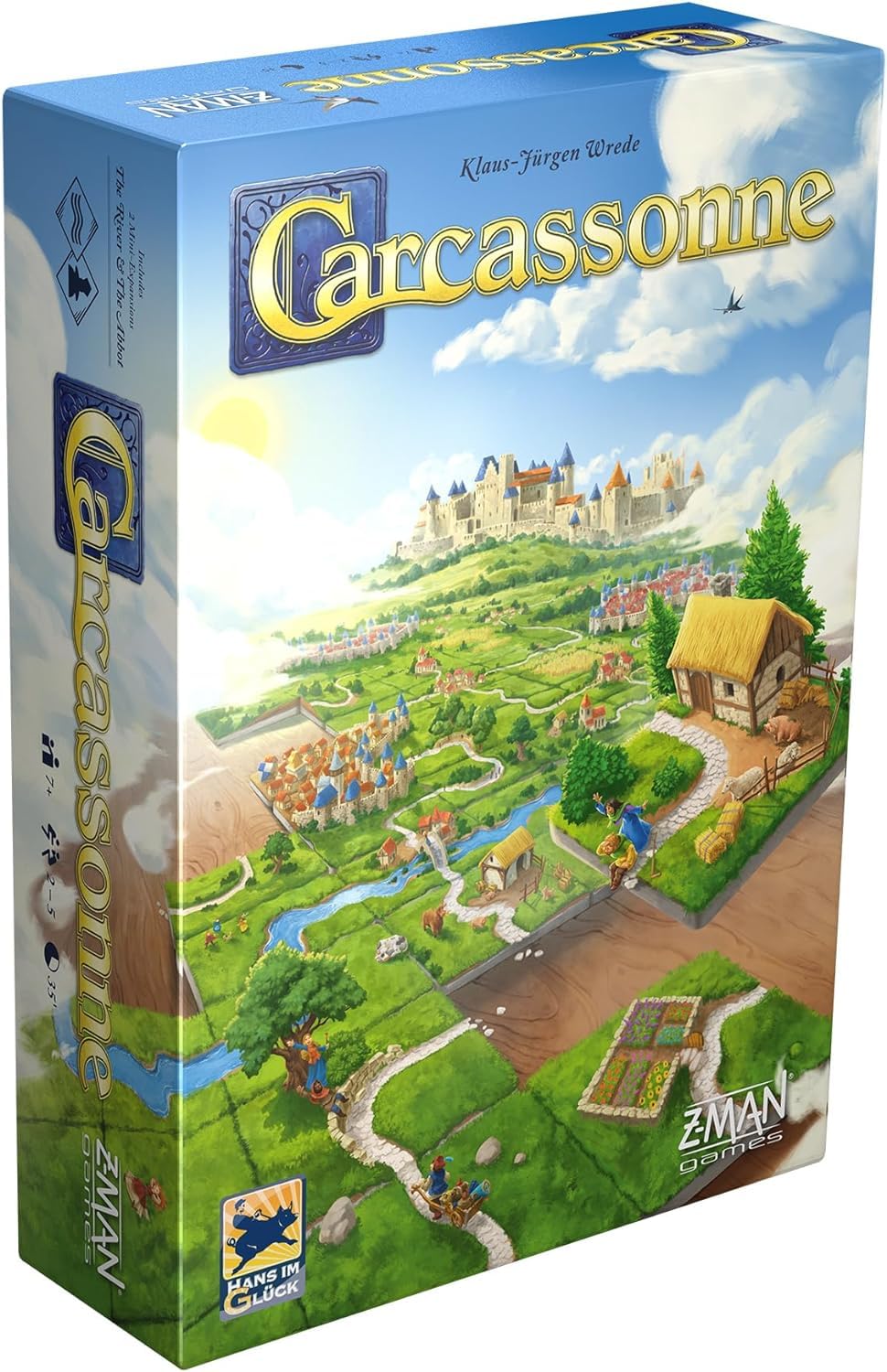
Carcassonne starts with a single tile on an empty table. Thirty-five minutes later there's a medieval landscape of roads, cities, monasteries and fields in front of you, and nobody planned it. Each turn you draw a tile, place it against what's already down, and decide whether to put a meeple on it and claim what it might become.

No two games look alike, which is the whole appeal — the map is a record of every decision the table made. There's no reading and nothing hidden, so teaching takes a couple of minutes and everyone is looking at the same problems. It also plays properly with two, which is more than most tile-layers manage.

The box includes two mini-expansions, The Abbot and The River, and The River alone is worth having: it builds a starting landscape instead of a lone tile, so the first ten minutes are interesting rather than polite. The tiles are thick card, the insert actually holds them, and the meeples are the only small pieces to keep track of.

The shared map is what keeps us coming back: nobody owns the board, nothing is private, and the table talks. The practical catch is space — by the end the layout is wide enough that a coffee table won't do, which is why ours gets played on the dining table. That's a fair trade for a game that leaves something worth looking at.

Bottom line: Buy this if you want a 35-minute game that looks different every time and is just as good with two players as with five.

#5

Qwirkle

Qwirkle

Mixed ages

Doodle Score 9.6/10
Check Price

Worth Noting

Ages
6 years and up
Pieces
Wooden tiles
Box Size
10.5 x 10.5 x 2.75 inches
Read the full review

Qwirkle asks nothing of you but color and shape. No reading, no board, no numbers to add — you lay wooden tiles so each line matches on color or on shape, and the lines grow from there. It's the one here we put in front of a six-year-old and a grandparent at the same table, with both of them playing the same rules at full strength.

The pieces are chunky wood, which is why the box has some weight to it, and six colors against six shapes gives more combinations than a rule that fits on a card suggests. Learning takes a round; the depth is in seeing which line is about to close and whether you can be the one to close it. There's no board at all, so it travels like a bag of blocks.

The colors are the one real caveat. Under warm indoor light the reds and oranges get friendly and the blues and purples need a second look, so we sort the tiles on a white cloth in daylight before the first game of the evening. Do that and it's the game that actually gets played, not the one that gets discussed.

Bottom line: The mixed-age pick: nothing to read, nothing to add, and enough tactics that the adults stop going easy.

#6

Blokus XL

Blokus XL

Easier handling

Doodle Score 9.6/10
Check Price

Worth Noting

  • Needs four players to be at its best
Ages
7 years and up
Board
12 x 12 inches
Pieces
21 per player
Max Players
4
Read the full review

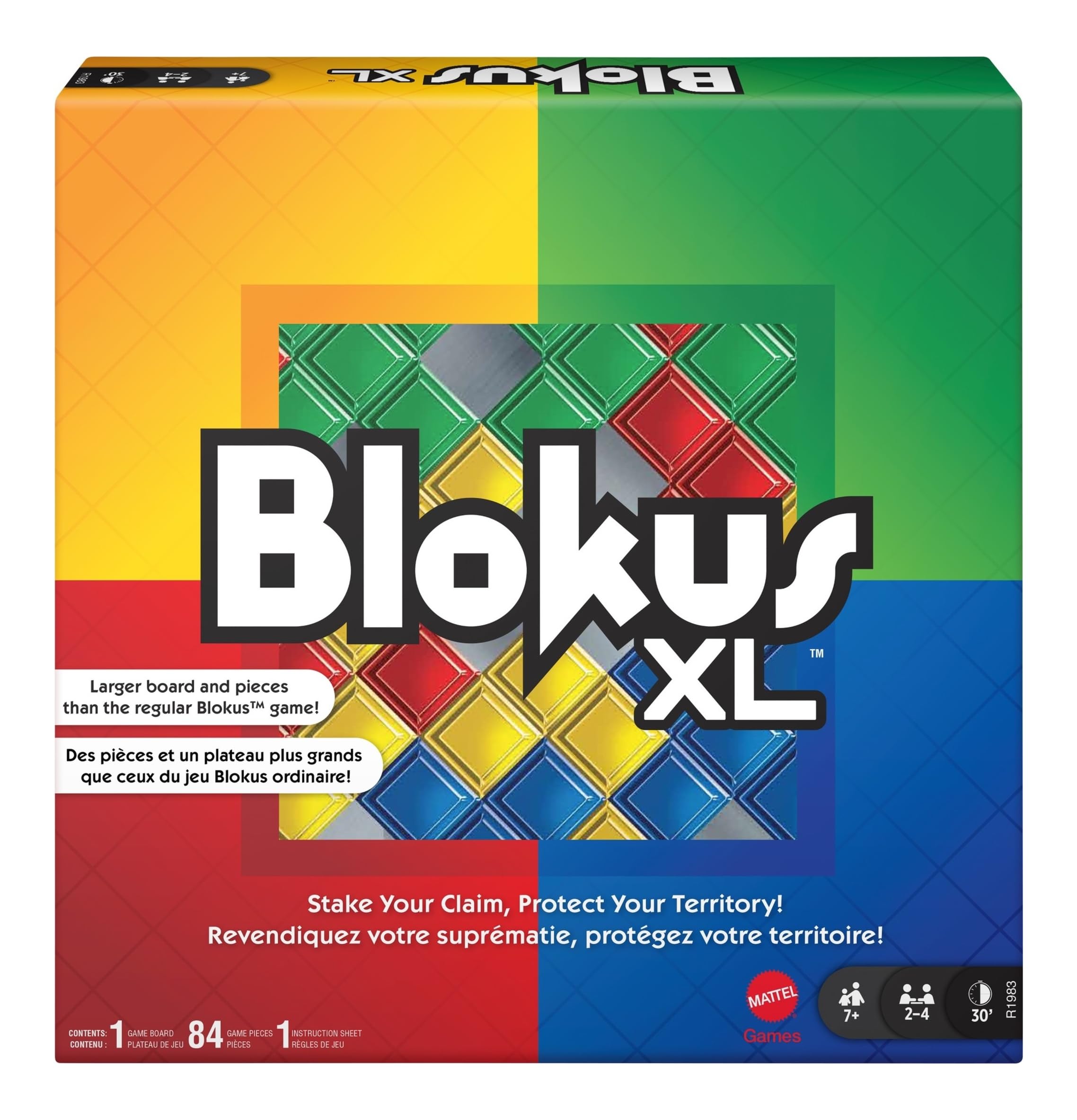
The XL version of Blokus is the same corner-blocking game on a 12-inch board, with pieces scaled to match — roughly two inches more board than the standard edition. That sounds like a marketing tweak until you watch a seven-year-old try to lift a standard piece off the table. The bigger board and pieces are easier to see and easier to grab, and the whole game reads better from across a room.

The rules are one line: every piece you place has to touch your own color at a corner, never along an edge, and you're out when you can't place. Twenty-one pieces each, and the lowest number left at the end wins. That's enough to make it genuinely sharp — people compare it to chess for a reason — while a child can be playing inside a minute.

Bottom line: Buy the XL if small pieces get fumbled at your table: same sharp little game, bigger board, easier hands.

#7

OK Play

OK Play

Travel

Doodle Score 9.6/10
Check Price

Worth Noting

  • Flimsy carabiner clip
Ages
6 years and up
Carry
Clip-on bag
Weight
2.88 oz
Max Players
4
Read the full review

OK Play arrives as a stack of tiles clipped together with a carabiner, and that's the entire pitch: under three ounces, waterproof, and it hangs off a backpack or a beach bag until somebody needs entertaining. It's the set that lives in the car rather than on the shelf.

The rules take about ten seconds. You lay tiles to sneak a line of five — across, down or diagonally — while everyone else does the same and blocks you. It plays two to four and a round is over in minutes, so it works at a restaurant table, in a waiting room, or while the real game is being set up.

For travel it's the pick of this guide, and it's the one we hand to kids who have stopped putting things in their mouths. What it isn't is a long-evening game: once everyone knows the blocking, rounds get quick and a little samey, and adults will want something with more underneath. For its size and its price bracket, though, it does exactly what it promises.

Bottom line: The travel pick: waterproof, under three ounces, and quick enough to play while you wait for the food to arrive.

#8

Rummy Cube 6-Player Set

Rummy Cube 6-Player Set

Big groups

Doodle Score 9.4/10
Check Price

Worth Noting

  • Costs more than a four-player set
Racks
6 wooden racks
Tiles
160 tiles
Storage
Zippered case
Max Players
6
Read the full review

If you have played Rummikub, you know this game: numbered tiles into runs and groups, empty your rack first and you win. What you get here is the six-player version — 160 tiles, six wooden racks instead of four, and a zippered case that holds the lot, racks included. For a household where five or six people actually sit down, that difference is the entire product.

The kit is better than it needs to be. The racks are solid wood with felt on the bottom, so they don't slide or scratch the table; the numbers are large and the colors tell apart easily, which matters more as the light gets worse; and there's a drawstring bag for the tiles plus a die and an instruction sheet. Everything packs back into the case in about a minute.

At the table it behaves the way rummy should: easy to teach anyone who has played cards, quick turns, and enough luck that a younger player can take a round off an adult. Six racks is also a lot of game to look at, so it wants a dining table rather than a side table.

We rate it as the set to buy for a big table rather than a better game than the classic box: if four is your usual number, the extra racks are just something else to store. For five or six, though, nothing else here lets everyone play at once.

Bottom line: The set for five or six: everyone gets a rack, everything zips into one case, and rummy night stops excluding a chair.

How We Tested the Best Tile Games

We started with a spreadsheet of roughly 60 tile games — pulled from shelf listings, hobby-shop recommendations, and the ones that keep resurfacing at family gatherings — then cut by player count, age range, price, and whether it's actually in stock. That left 14 games, which we played for seven months.

Every one got at least eight sessions. We taught each cold to a group of four without reading the rulebook aloud and counted how many turns passed before someone asked a question only the book could answer. Setup and teardown got timed, because a game that takes ten minutes to sort back into its bag doesn't come out on a weeknight. We also ran a kids' table, ages 7 to 12, to see whether their moves actually changed the adults' plans or just filled space.

Tiles take abuse, so we gave them some: 30 seconds of shaking in the bag, the full set dumped from waist height onto hardwood, and a wipe-down after a round played with sticky fingers. Then we checked corners for chips, faces for scratches, and whether color had rubbed off onto the bag lining. We also spread each set out under warm lamplight and window light to find two shades that were hard to tell apart at arm's length — the detail that turns a friendly game into an argument.

Gameplay got the longest look. We logged whether the fifth playthrough felt different from the first, whether one player could run away with it early, and whether most turns offered a real decision or merely a legal one. Some sets are luck with nice artwork; the ones that stuck around gave us something to argue about on the drive home.

How to Choose Tile Games

Start with the seat count, not the box

Almost every game here claims two to four players, and almost none of them are equally good at both ends. Blokus is a four-player game that tolerates two. Rummikub's four racks mean a fifth person simply cannot play, which is exactly the gap the six-rack rummy set fills. Think about your usual number, not your theoretical maximum.

If five or six people regularly gather, buy for six and accept the extra width on the table. If you are usually a pair, a game built for head-to-head play — Azul and Carcassonne both hold up at two — will get played far more often than a game that needs a crowd to come alive.

Word tiles or number tiles

The biggest divider is reading. Word games like Bananagrams have players building and rebuilding words against the clock, which is wonderful spelling practice and unforgiving for a six-year-old or for a grandparent reading in a second language. Number and color games — Qwirkle, Rummikub, Blokus — need recognition rather than vocabulary, so a mixed-age table competes on close to equal terms.

If your group spans more than one generation, buy the matching game. If everyone reads confidently and wants the fastest fifteen minutes in this guide, buy the letters.

Match the length to the evening

Play time is where tile games quietly sort themselves. Fifteen to twenty minutes is a filler: a couple of rounds before dinner, a restaurant table, a waiting room. Thirty-five to forty-five minutes is a main event that wants a cleared table and everyone's attention.

Neither is better than the other, but buying a 45-minute game for a family that plays in ten-minute bursts is how games end up on a shelf, and buying a filler for a group that wants to think is how they end up back in the box by nine.

Check that you can read the tiles

Tile games live or die on whether you can tell one piece from another across a table, and there are two traps. The first is color: reds and oranges, blues and purples, blur under warm indoor light. The second is size, because small pieces are hard for young hands and older ones alike.

Look for big numbers and strong contrast, and expect to sort tiles once under the light you actually play in. This is the honest argument for the oversized Blokus board and for rummy sets with enlarged numbers — not extra plastic, but the fact that everyone can see the table.

Decide where it lives when it is not out

A pouch that goes into a bag gets played; a box that lives on a shelf gets played at Christmas. Bananagrams and OK Play sit at the travel end of this guide, one as loose tiles in a banana, the other clipped to a backpack. Carcassonne, Azul and the rummy cube set are boxes with inserts and table requirements.

Loose tiles go missing, so a bag, tin or zip case is not a luxury. It is the difference between a game you own and a game you use.

Frequently Asked Questions

Final Verdict

Bananagrams is the tile game we tell people to buy first. It fits any table and any bag, teaches in a minute, plays two to eight, and sits at the budget end of this list, so a wrong guess costs very little.

If your group wants a proper 45-minute contest with something beautiful on the table, Azul earns its premium. If you need six seats, the six-rack rummy set is the only thing here that provides them.