Games & Puzzles

Best Stacking Games of 2026

A good stacking game works at a kid's birthday party, a backyard cookout, and a quiet Tuesday night with the same six people around the coffee table. Nobody sits through ten minutes of rules, any age can take a turn, and the tension builds on its own. What separates a set you'll keep for a decade from one that gets donated is almost always the blocks: how evenly they're cut, how smooth the faces are, and whether the wood is heavy enough to hold a real tower or so light the whole thing shivers when someone walks past.

My family's set lived in the trunk of a car for years. Over four months, my team and I played through 14 stacking games, tabletop and giant yard versions alike, at cookouts, on rainy afternoons, and on a picnic blanket. The surprise: thicker blocks don't make a steadier tower — even cutting and a slightly grippy finish matter more. The sets worth buying handle a mixed-age crowd and pack up without a fight, and a few of those are below.

#1

Jenga

Jenga

Family game night

Doodle Score 9.6/10
Check Price

Worth Noting

  • No cards, dice, or extra rules included
Ages
6 years and up
Blocks
54 wood blocks
Players
1 or more
Storage
Tube with handle
Read the full review

The stacking sleeve is the part nobody mentions and the part that matters. Jenga's 54 blocks only become a tower if you can get them square, and doing that by hand is exactly the friction that keeps a game in its box. The sleeve drops over the stack, you lift, and eighteen rows are aligned in about ten seconds. The tube package then swallows the whole set, handle included, so this lives on a shelf rather than at the bottom of a closet.

We keep coming back to it because the difficulty curve lives in the tower, not in a rulebook. The first ten turns are easy enough for a six-year-old; by the time the thing is leaning, adults are holding their breath and nobody has had to learn anything. The hardwood blocks have a light finish that gives them just enough grip to stack cleanly, and the edges hold their shape through ordinary play.

The 1-to-100 player count isn't a joke: a solo practice stack is a legitimate way to spend ten minutes, and the same set seats a table of eight without anyone sitting out. Six and up is honest, and the hardwood is why this one survives — the tube takes the knocks and the blocks stay square, which is what keeps it in the cupboard rotation.

Bottom line: Our default for a reason: 54 hardwood blocks, a stacking sleeve that makes setup painless, and rules nobody has to read. Buy it if you want one game that works with two people or twelve.

#2

Tinderblox

Tinderblox

Travel and camping

Doodle Score 9.6/10
Check Price

Worth Noting

  • Needs a flat, hard surface to play on
Ages
6 years and up
Players
2 to 6
Packaging
Mint tin
Play Time
15 minutes
Read the full review

Everyone at the table uses tweezers, and that single decision separates Tinderblox from every other tower here. You aren't sliding a block free with a finger; you're lowering a tiny log onto a growing campfire with a plastic pincer, following a card that dictates the piece, the color, and the orientation. It plays closer to surgery than to Jenga, and the table goes quiet in a way that is funny to watch.

The tin is the other half of the pitch. At roughly 4 by 2.75 inches and under three ounces, it goes in a jacket pocket, and we've played it on a picnic table and a café two-top. Setup is a shuffled deck and a base piece, the rules take about three minutes to teach, and a round can be over before the food arrives, which is why it's the one in this group that actually leaves the house.

What we like most is that the tweezers flatten the age gap. A six-year-old and a grandparent are playing the same game at the same difficulty, because the challenge is steadiness rather than reading or arithmetic. You trade the slow, crowd-gathering drama of a four-foot tower for a game that travels anywhere and finishes fast — and for a lot of tables, that's the better trade.

Bottom line: If the game has to fit in a coat pocket, this is the one we reach for: tweezers, a mint tin, and rounds that finish in minutes.

#3

SPORT BEATS Large Tower

SPORT BEATS Large Tower

Backyard parties

Doodle Score 9.4/10
Check Price

Worth Noting

  • Heavy at a listed 6.64 kg to move far
Blocks
54 pine blocks
Players
2 to 6
Block Size
6" x 2" x 1.3"
Max Height
4 feet
Read the full review

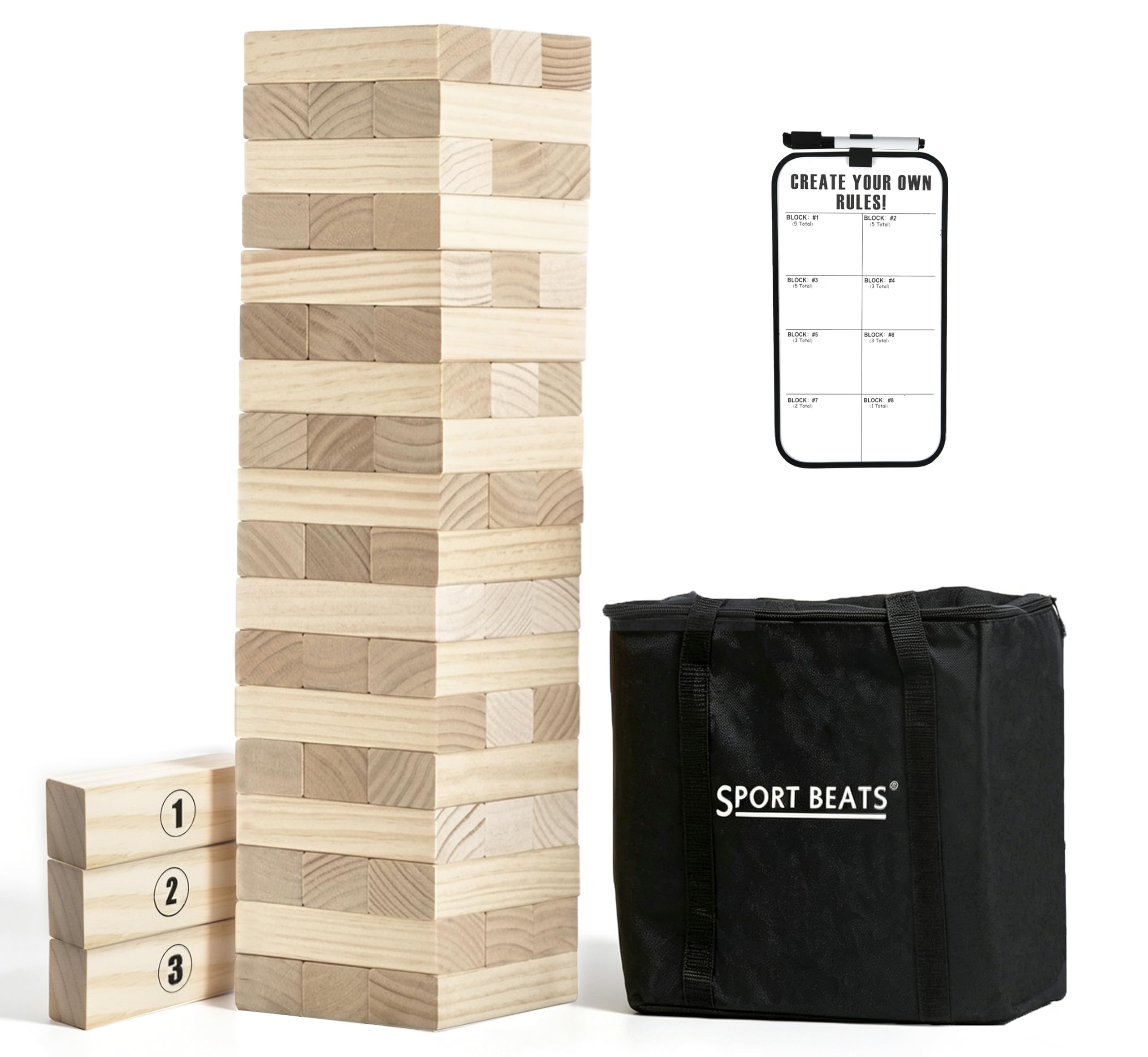
Six inches long, two wide, and heavy enough that the crash is the event — the SPORT BEATS set is the outdoor version of the game, and the size of the blocks is the reason to own it. Fifty-four sanded pine blocks build a tower that is genuinely four feet tall at its peak, and when it goes, it goes with a clatter that pulls people across a yard. We think that's the whole case for a giant set over a tabletop one: the noise and the gathering.

Two details earn it the outdoor slot ahead of the other oversized towers here. Twenty-seven blocks are printed 1 through 8 and come with a dry-erase board and marker, so you can write house rules, dares, or scoring instead of playing straight Jenga all afternoon; and everything drops into an included bag that fits in a trunk. Set expectations on height, though: the listing describes a tower that starts at 23 inches and reaches four feet only as blocks migrate upward. At a party, that's the last ten turns rather than a disappointment.

Bottom line: Six-inch pine blocks make the crash the whole point; this is the set for patios, tailgates, and parties that spill outside.

#4

Megwoz Giant Tumble Tower

Megwoz Giant Tumble Tower

Big groups

Doodle Score 9.4/10
Check Price

Worth Noting

  • No numbers printed on the blocks
Blocks
57 pine blocks
Extras
2 dice and scoreboard
Players
2 to 12
Max Height
Over 4.2 feet
Read the full review

Set this next to the SPORT BEATS tower and two numbers separate them: 57 blocks against 54, and a player range that runs to twelve instead of six. The Megwoz blocks are a little smaller, and the set is listed at three pounds, which is light for a bag of pine — worth checking before you plan to carry it far — but for a crowd it's the more generous set.

The extras are what push it past a plain block set. Two wooden dice and a scoreboard turn the tower into a game with turns and points rather than just a nervous ritual, and the zippered bag is the heavy-duty sort that holds all 57 blocks plus the accessories. Blocks are hand-selected pine, sanded at the edges, and the set handles the repeated collapses that come with a tall tower.

Height works the same way as every oversized set here: 4.2 feet is the tower at its most rearranged, not the thing you build on turn one. We still rate it near the top of the giant sets for group size — twelve players is a genuine party game, and the dice give a crowd something to do between turns. If printed numbers and a dry-erase board matter more to you, the SPORT BEATS set is the better buy.

Bottom line: The giant tower for a real crowd: 57 blocks, enough dice-and-scoreboard structure for a proper game, and room for up to twelve players.

#5

Rhino Hero Super Battle

Rhino Hero Super Battle

Young kids

Doodle Score 9.2/10
Check Price

Worth Noting

  • Better with three or four players than two
Ages
5 years and up
Made In
Germany
Players
2 to 4
Material
Cardboard
Read the full review

Rhino Hero Super Battle isn't a block tower. Players fold cards into walls, balance floors on top of them, and move superhero figures up the outside, so what grows on the table is a lopsided cardboard skyscraper with monkeys and rhinos perched on the upper floors. Mid-game it looks like a craft project that got out of hand, which is a large part of why younger children stay at the table.

We were struck by how much game sits inside the building. There's a die, there are movement rules, and there are battles when two heroes meet on the same floor, so a turn asks for a decision rather than just a steady hand. The five-and-up rating is accurate — pre-schoolers get the stacking quickly and need a hand with the battling the first time — and it plays noticeably better at three or four than at two.

The physical limits are worth knowing before you buy. Folded card walls don't snap, but they do soften along the creases after a lot of games, and the structure is deliberately precarious — a heavy breath at the wrong moment takes it down. That's the fun, and it also means this is a table game rather than a floor game. The box, meanwhile, is roughly twice the size the contents need, which matters if shelf space is tight.

Bottom line: Five-year-olds can genuinely play this one: folded-card walls, a swaying skyscraper, and superhero pieces that keep them invested in the next turn.

#6

Tower Stack

Tower Stack

Teens and adults

Doodle Score 9.2/10
Check Price

Worth Noting

  • Light plastic pieces topple at a nudge
  • 14+ rating rules out younger players
Ages
14 years and up
Cards
36 cards
Blocks
24 blocks
Players
1 or more
Read the full review

The 14-and-up rating is the first thing to notice, and it's accurate: Tower Stack is built for teenagers and adults, with small plastic pieces, a base and tower body that frame the build, and cards that tell you what to place next. Think Tetris with a wobble. Hand it to an eight-year-old and you'll spend the game retrieving blocks from the floor. For the right table, that narrowness is the appeal.

The frame is what separates it from a plain tower. You're stacking inside a shape rather than in open air, so the build stays contained and the tension comes from the cards rather than from how wide you dare to go. Setup is a minute, rounds are short, and this is the quickest game in this group — a warm-up before something longer, or the thing you play while dinner finishes.

Where it earns its place is the teen table. It packs small, it looks like a modern game rather than a nursery toy, and the head-to-head format gives two players something to needle each other about. For a game night with teenagers in it, this is the one we put on the table.

Bottom line: A teen-and-adult table game, not a family one — the tower frame and cards turn stacking into something closer to real-life Tetris.

#7

ALKISTA Tetra Tower

ALKISTA Tetra Tower

Budget family play

Doodle Score 9.0/10
Check Price

Worth Noting

  • Light ABS blocks feel cheap next to wood
Base
2.7 x 6.7 inches
Cards
22 draw cards
Blocks
48 ABS blocks
Players
2 or more
Read the full review

Forty-eight colored ABS blocks, a base, and 22 draw cards make this the cheapest way into a stacking game here — and the only one built on tetrahedra. The blocks meet at angles rather than flat faces, so you're fighting geometry instead of friction. It plays like a phone puzzle come to life, which is exactly why kids who'd yawn at a wooden tower lean in.

The base is small: 2.7 by 6.7 inches. That's where most of the difficulty comes from — there's little room to spread out, so the stack turns precarious fast and a build that looks settled will go over when you add the next piece. For a patient eight-year-old that's the challenge; for a five-year-old it's the point where interest collapses.

The cards are what give it legs. Ignore them and it's free-form balancing; deal them and you get a turn-based game with real constraints and room for house rules, which is more structure than most sets at this price bother with. Setup is tipping the blocks out of the box, and we wish it came with a bag rather than a plain box, because loose pieces are the reason small games get left behind.

For a family table on a tight budget, this is the one we point to. It's quick, it's genuinely difficult for adults, and 48 pieces plus a deck is a lot of game in a small box. Buy it for a table with players eight and up; buy a wooden tower if you need something a four-year-old can join.

Bottom line: The budget pick worth taking seriously: tetrahedral blocks and draw cards make a difficult, quick, genuinely replayable little game.

#8

ApudArmis Tumble Tower

ApudArmis Tumble Tower

Mid-size towers

Doodle Score 9.0/10
Check Price

Worth Noting

  • Smaller blocks than the other oversized sets here
Blocks
60 pine blocks
Players
2
Block Size
4.75 x 1.6 x 1 inches
Max Height
3.2 feet
Read the full review

3.2 feet is the number on the box, and like every oversized set here it's the height at the end of a game rather than the start. The 60 blocks measure 4.75 by 1.6 by 1 inches, so you build well short of three feet on the first turn — a decent floor game, just not the knee-high spectacle the height figure suggests.

Sixty blocks is the largest count of any wooden set here, and more blocks means a longer, more forgiving game: there's more material to draw from before the tower turns hostile, and the build grows more gradually. The pine is smooth with rounded edges, the dice and white scoreboard give the game some structure, and the zippered bag holds the lot.

The 16-and-up age rating is the odd part. Nothing about stacking 4.75-inch pine blocks requires a teenager, and the set is sold for family parties — treat the number as a small-parts caution rather than a difficulty guide, and judge it by your table instead. Kids who can stack carefully will play this fine.

If you want a big wooden tower and don't need four feet of it, this is the value buy of the oversized sets: 60 blocks, a scoreboard, and a bag. If height is the point, the SPORT BEATS set gets you six-inch blocks; if you want the tallest build and the biggest crowd, Megwoz is the one to get.

Bottom line: Sixty smooth pine blocks with a scoreboard and bag make this the value buy among the oversized towers — just don't expect waist-high.

How We Played Our Way Through 14 Stacking Games

We started by pulling together every stacking game sold as a complete set rather than a pile of loose blocks — tabletop sizes, oversized yard versions, wood and composite — then filtered by block count, stated dimensions, whether a carry bag or case came with it, and how the price lined up with what's actually in the box. That left 14 sets, which we played with over four months.

Testing happened where these games actually live: a dining table after dinner, a backyard cookout with kids between six and eleven cycling through, a rainy Sunday when the porch was the only option, and a park picnic where everything had to be carried in and back out. Each set got stacked to its full starting height, and we measured the tower and watched how it behaved on a slightly uneven patio table — settling cleanly or wobbling from the first turn. We ran rounds with adults only and with mixed ages, counting how often a tower came down because of a bad pull versus blocks that were cut unevenly or slick with finish. Thumbs ran along every face, checking for splinters, rough corners, and residue that sent blocks sliding out faster than they should. We also noted which sets had people asking for one more round.

For portability, we packed each set back into whatever it came with and timed it, then carried it a few blocks to see whether the bag held. Ease of use meant handing the instructions to someone who'd never played and seeing how long it took before their first turn. At the end of four months we re-checked every block: chipped corners, edges swollen after a humid weekend, paint or printed markings wearing away. The sets that held up looked and stacked the same as the day we opened them.

How to Choose Stacking Games

Where the Game Gets Played

Tabletop sets and oversized sets are different purchases, and the table is the dividing line. A small set needs a hard, flat surface roughly the size of a dinner plate and travels to a café, a hotel room, or the kitchen floor; a four-foot pine tower needs clear floor space, a level surface, and enough room around it that a collapse doesn't take a lamp with it.

Measure before you fall for a giant set. A soft rug, a sloping patio, or a lawn makes any balancing game noticeably harder, and the last thing you want is a set that only works in one corner of one room.

What a Height Claim Actually Measures

Every oversized set here quotes its tallest moment, and that moment arrives at the end of a game, after blocks have been pulled from the base and piled on top. The starting tower is shorter — often by half — which is why the height figure on the box tells you less than the block dimensions do.

Block size is the number worth reading. A six-inch block gives you a heavier, noisier crash and easier handling for adult hands; a 4.75-inch block is more manageable indoors and less of a spectacle. Decide which of those two afternoons you want.

Age Ratings and Fine Motor Skill

Age labels across these sets run from 5 to 16, and most of them reflect small parts rather than difficulty. The real question is grip: a game played with tweezers asks for a pincer grip a five-year-old may not have, while a plain block tower asks for a steady pull most six-year-olds manage.

Match the game to the youngest person who will actually take a turn, not to the oldest, and plan on helping with rules for the first round. A set that's too demanding for one kid at the table stops being a game for everybody.

Wood or Plastic

Wood is the better material for a tower, and the reason is friction. Pine blocks have weight and surface texture, so a stack settles and gives a little warning before it goes. ABS blocks are lighter and slicker, which means a build collapses from smaller nudges and a wobbly table shows up immediately.

Plastic wins on price and upkeep — no splinters, no finish, nothing to worry about after a party. It's the sensible choice for a first game or for a table where pieces will end up on the floor.

Storage Decides Whether It Travels

Sixty pine blocks with no bag is a set that stays in the garage. A tube with a handle, a mint tin, or a zip bag is the difference between a game that goes to the park and one that gets left behind, so check the container before you buy rather than after.

For the oversized sets, a bag with a real zip matters more than the box it shipped in. For the small ones, look for something that fits in a coat pocket — that's the whole point of a compact set.

Frequently Asked Questions

Final Verdict

Jenga is what we tell most people to buy. The blocks are hardwood, the stacking sleeve gets the tower square in seconds, the tube puts it back on a shelf instead of in a pile at the bottom of a cupboard, and it's the cheapest of the wooden towers here. That combination keeps it in rotation long after a novelty set has been retired.

If your game nights happen outside, buy the SPORT BEATS tower instead — six-inch blocks and a four-foot crash are the reason to own a big set, and the dry-erase board makes it play as more than Jenga. For a bag you can take anywhere, Tinderblox is the one.